
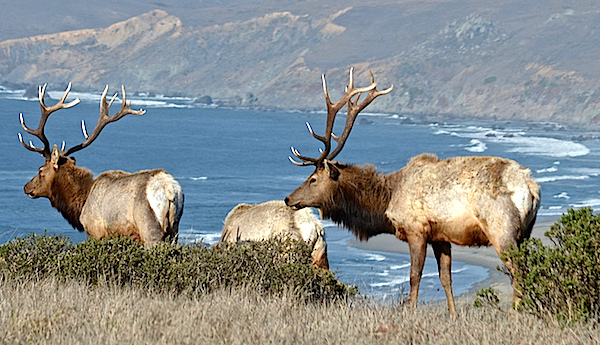
The population of one herd of Tule elk at Point Reyes National Seashore has declined precipitously, drawing charges of mismanagement/David McSpadden via flickr
Charges of wildlife mismanagement by the staff at Point Reyes National Seashore are being leveled in the wake of the deaths of more than 200 Tule elk caused, apparently, by a lack of water inside their fenced preserve.
While park biologists point to California's long-running drought as a primary cause for the deaths of more than 250 elk between 2012 and 2014, staff at the Center for Biological Diversity note that elk at the seashore that are not penned in have been enjoying a population boom of sorts.
"Tule elk need room to roam, and native wildlife in our national park should not be fenced in or prevented from finding water and food," said Jeff Miller with the Center. "The loss of nearly half the Pierce Point elk herd highlights how important it is that the Park Service not cave to commercial ranchers who want free-roaming Point Reyes elk fenced in."
Point Reyes is just the latest National Park System unit enmeshed in wildlife issues spurred by a lack of space. At Yellowstone National Park the plight of bison, which are killed by the hundreds each year when they roam out of the park and into Montana, has been well-documented. At Cape Hatteras National Seashore in North Carolina the Park Service has been castigated for fencing off large areas of beach to allow for nesting piping plovers, a threatened species. Culling operations for elk and deer have been used at Rocky Mountain National Park in Colorado, Wind Cave National Park in South Dakota, Cuyahoga Valley National Park in Ohio, and Valley Forge National Historical Park in Pennsylvania, just to cite a few examples.
Dave Press, a wildlife ecologist at Point Reyes, said Friday afternoon that the ongoing drought that has gripped California for four years now contributed greatly to the die-off of the herd that lives within a 2,600-acre fenced-in preserve on Tomales Point.
"Considering we are in one of the worst droughts in Californial history, it doesn't surprise us that there were impacts to the Tule elk up at Tomales Point," he said. "I think the presence of the fence contributed to the severity of those impacts. The free-range elk, just by the nature of where they occur, they are associated with areas that have year-round water supplies. Creeks that flow year-round, ponds.'
The preserve was created in 1978 when an elk recovery program brought 10 animals to Tomales Point, explained the wildlife ecologist.
"We didn't want to put 10 elk out there and then just have those elk go their separate ways, not breed, not establish and create a robust herd," said Mr. Press.
Concerns that Tule elk might overlap with cattle on the point spurred the decision to keep the herd fenced in, he added.
Now, however, the die-off likely will fan controversy as the Park Service develops a ranch management plan for the national seashore. There are, Mr. Press said, about 22 ranching operations on the national seashore and neighboring Golden Gate National Recreation Area. While the ranches are on Park Service land, they existed before the national seashore was created.
"Part of the main reason the park is here was because of that partnership that was reached between the conservationists and ranching interests," the ecologist explained.
When former-Interior Secretary Ken Salazar visited Point Reyes in 2012 to look into the propriety of an oyster farm operating in the seashore on land tagged to become wilderness, he issued a memorandum authorizing the Park Service to pursue long-term lease/permits for dairy and beef ranching operations that operate on roughly 28,000 acres of the national seashore.
Now the Center for Biological Diversity, against the backdrop of the elk die-off, is criticizing the planning effort.
Cattle ranchers who enjoy heavily subsidized cattle grazing leases on public lands within the national seashore are lobbying the Park Service to remove or fence out the free-roaming elk from ranching areas, because elk are eating grass they believe should be reserved solely for their cattle. The Park Service is considering evicting the free-roaming elk under a planning process initiated for 28,000 acres of leased dairy and beef cattle ranches within the park and Golden Gate National Recreation Area lands in Marin County administered by the national seashore. The Park Service is also proposing extending ranching leases for up to 20 years, and may allow ranchers to expand their operations to animals other than cattle, which would create more conflicts between livestock and native wildlife.
At the national seashore, Mr. Press said a number of alternatives are being discussed. While some call for more fencing of elk, or fencing-out of cattle pastures, others identify culling as one action. A draft plan for public review is expected late this year, he said.
Tule elk are native and endemic to California. There were once 500,000 tule elk in the state but by the late 1800s impacts from cattle ranching and hunting had reduced them to only 28 elk, according to a release from the Center for Biological Diversity. From one surviving herd, Tule elk were reintroduced throughout the state and there are now 4,300 elk in 25 herds. Tule elk were returned to Pierce Point at Point Reyes in 1978, and a free-ranging herd was established in the park in 1998. Point Reyes Seashore is the only national park with tule elk.
According to the Center, the Pierce Point herd declined from 540 elk in fall of 2012 to 286 elk by 2014, a drop of 47 percent. There are no natural year-round fresh water sources on Pierce Point and the elk in the preserve are prevented from migrating by a large, elk-proof fence, the organization adds. During the same drought period, the free-roaming Point Reyes elk herds 'which had access to water ' increased by 32 percent. The Limantour herd grew from 94 to 120 elk and the Drakes Beach herd increased from 66 to 92 elk.
"The reintroduction of elk to the Point Reyes peninsula is a success story for conservation of native species, but the elk are in jeopardy of eviction to benefit a few lease holders," said Mr. Miller. "The Park Service already prioritizes commercial cattle grazing in Point Reyes. Now these subsidized ranchers want to dictate park policies that could eliminate native elk and harm predators and other wildlife."
According to the Center, "(T)here are 13 cows for every elk in the national seashore, with nearly 6,500 dairy and beef cattle and only 498 elk. One-quarter of the national seashore is devoted to commercial cattle operations, with grazing on nearly 18,000 acres under 39 leases. Ten ranching families were paid $19.6 million by the public from 1963 to 1978 for the purchase of ranch lands added to Point Reyes National Seashore. Many of those same families still enjoy heavily subsidized grazing lease rates within the park, paying one-half to one-third the cost they would pay for non-federal grazing land in Marin."
Stories about:
Story Categories:
A copy of National Parks Traveler's financial statements may be obtained by sending a stamped, self-addressed envelope to: National Parks Traveler, P.O. Box 980452, Park City, Utah 84098. National Parks Traveler was formed in the state of Utah for the purpose of informing and educating about national parks and protected areas.
Residents of the following states may obtain a copy of our financial and additional information as stated below:
- Florida: A COPY OF THE OFFICIAL REGISTRATION AND FINANCIAL INFORMATION FOR NATIONAL PARKS TRAVELER, (REGISTRATION NO. CH 51659), MAY BE OBTAINED FROM THE DIVISION OF CONSUMER SERVICES BY CALLING 800-435-7352 OR VISITING THEIR WEBSITE. REGISTRATION DOES NOT IMPLY ENDORSEMENT, APPROVAL, OR RECOMMENDATION BY THE STATE.
- Georgia: A full and fair description of the programs and financial statement summary of National Parks Traveler is available upon request at the office and phone number indicated above.
- Maryland: Documents and information submitted under the Maryland Solicitations Act are also available, for the cost of postage and copies, from the Secretary of State, State House, Annapolis, MD 21401 (410-974-5534).
- North Carolina: Financial information about this organization and a copy of its license are available from the State Solicitation Licensing Branch at 888-830-4989 or 919-807-2214. The license is not an endorsement by the State.
- Pennsylvania: The official registration and financial information of National Parks Traveler may be obtained from the Pennsylvania Department of State by calling 800-732-0999. Registration does not imply endorsement.
- Virginia: Financial statements are available from the Virginia Department of Agriculture and Consumer Services, 102 Governor Street, Richmond, Virginia 23219.
- Washington: National Parks Traveler is registered with Washington State’s Charities Program as required by law and additional information is available by calling 800-332-4483 or visiting www.sos.wa.gov/charities, or on file at Charities Division, Office of the Secretary of State, State of Washington, Olympia, WA 98504.
INN Member

The easiest way to explore RV-friendly National Park campgrounds.

Here’s the definitive guide to National Park System campgrounds where RVers can park their rigs.
Our app is packed with RVing- specific details on more than 250 campgrounds in more than 70 national parks.
You’ll also find stories about RVing in the parks, tips helpful if you’ve just recently become an RVer, and useful planning suggestions.


Comments
Ah, the foul scent of politics and money waft through the fresh air of yet another National Park.
No, there is a National Park on ranch land through an arrangement made before the Park existed.
http://www.ptreyes.org/activities/ranching-seashore
But in the end the ranches are located on national park lands, not private in-holdings. Taken along with the oyster farm, there's an interesting relationship between private businesses and NPS management at Point Reyes. Why are the ranches allowed to remain, but the oyster farm was shut down? It too was in business before the seashore was designated.
Why are the ranches allowed to remain, but the oyster farm was shut down? It too was in business before the seashore was designated.
Well I would agree the oyster farm shouldn't have been shut down either but I think the ranches operation aren't depending on their prexistence but it would appear on a formal agreement associated with the sale of the land. The land was owned by the ranchers. I'm guesing as a condition of the sale to the Feds, the ranchers were promised grazing rights. Would be interesting to see documentation of the orginal deal.
[edit] From an NPS site:
'The compromise hammered out by Congress and signed by President Kennedy in 1962 explicitly provided for the retention of the ranches in a designated pastoral zone, with ranchers signing 25-30 year reservations of use and occupancy leases, and special use permits for cattle grazing'
http://www.nps.gov/pore/learn/historyculture/people_ranching.htm
[edit edit] Here is the actual bill, it doesn't seem to say what the above edit said. It merely says the ranchers can't be forced to sell. Nothing about 25-30 reservations.
https://www.govtrack.us/congress/bills/87/s476/text
There must have been some later action.
For the record, EC, not taking a position on whether oyster farm should have been shut down.
Shutting down the oyster farm is another example of environmental ideological stupidity.
Glad the oyster farm was shut down. Now the estuary can become a wilder and more biologically diverse place, not just a farm harboring mostly a monoculture of non-native species.
There is no reason to believe Drakes Estero will become any more wild or biologically diverse in any meaningful sense of the word. I doubt you could find evidence that would even suggest that.
http://www.newsweek.com/2015/01/30/oyster-shell-game-300225.html
yep, just more environmental ideological stupidity and dishonesty by the NPS.
From what I read the oyster farm was closed because the lease (think it was a 40 year lease) that was assigned to the original owners when the park was established had expired. 7 years before the lease was due to expire the original owners sold the lease, the new owners tried to get the lease extended and failed. The Drakes Estero was designated as potential wilderness area when the park was established, which would become a wilderness area when the lease was up, the tenants had vacated and all the machinery etc. was removed. Looks like the original intention is going to be fulfilled.
Drakes Estero "could" become a wilderness. As I recall, there was no requirement.
That is correct.
Elk should take precedence over cows in a National Park. Not even a question, in my opinion. Cows are all over the western and eastern USA. They are everywhere, even in places where there is little water, and resources are scarce- but there they are and in numbers that far exceed the carrying capacity of the land. An endangered species can not be associated with domesticated cattle. That status can be used to describe Tule Elk.
Agree Gary.
I don't know if it was "could" or "would". But I would wonder why Drakes was identified as potential wilderness and why a sunset date was established for the commercial enterprise if there wasn't some intent as to what Drakes was intended to become, namely a Wilderness Area.
There was no sunset date. The oyster farm's agreement was renewable, just like the agreements the ranches have. It happened to have a longer term than the ranches because the former owner negotiated that when he made the original deal. When the oyster farm's Reservation of Use and Occupancy expired, it was expected to be renewed by way of issuance of a Special Use Permit. The ranches have already gone through this transition from RUO to SUP and then the SUPs are renewed. (By the way, none of those ranch permits required an EIS for the transition; the fabric of lies that is the DBOC EIS was never necessary, it was simply a weapon.)
The drafters of the legislation have publicly stated that was not their intent.
Elk instead of cattle, why not. Elk meat is much better for you.
So Ron, you think the agreement made with the ranchers should now just be ignored?
Ecbuck
Their actions established their intent for me, which were designating the area as potential wilderness and setting a date for removing the main impediment from establishing it as a wilderness area.
And I don't think the agreement should be ignored but I also think the elk should be allowed to go where they want to go. This will be one for the lawyers.
http://parkadvocate.org/commercial-beef-cattle-in-americas-national-park...
I'll go with what they said they intended over your interpretation of their actions:
http://www.marinij.com/general-news/20110813/former-legislators-back-poi...
In regards to the oyster farm, do you think its okay for the NPS to misrepresent the available scientific information? Does these ends justify the means?
I can think of at least one other park where this was done, right Buxton?
Of course that isn't right. Blowing up people and pouring millions of gallon of crude in the gulf isn't right either, the world is full of wrongs.
Nothing should have been a surprise to the former tenants at Drakes Bay.
http://www.nps.gov/pore/learn/management/upload/planning_dboc_sup_background_sup_080422.pdfs)
The former tenants signed a lease that spelled out clearly when the lease was over.
The RUO expired, but it was explicitly renewable via issuance of an SUP.
If everyone knew this was going to happen then why did the expend so much effort to smear and deceive everyone? Why would they risk thier credibility?
I wonder if any thode deceitful NPS biologists were reprimanded in any way and are they involved in this fiasco?
Yes, the lease was over but there was no reason it couldn't be renewed. As explicitly stated by the bills sponsors, it was not their intent to kick the Oyster business out - ever.
BTW - I don't consider posts and string a fence, it doesn't constrain these birds to an area.
As of right now, these posts and string are being unnecessarily used to close off human access to the highly popular Cape Point beach for not endangered, not threatened, birds that have possibly shown breeding behavior.
It is a symbolic fence intended to keep people from disturbing unique to CHNS nesting birds, as specficed in that Park's EL.
"and no development of the project or plan for the convenience of visitors shall be undertaken which would be incompatible with the preservation of the unique flora and fauna"
I don't think it really matters much that AMOYs are not a listed species. I thought Kurt's intention was just relating similar instances not implying that wild birds were being fenced in a national park.
Ecbuck,
It is to bad those sponsors didnt make their intentions clear when they sponsored the bill. Because the bill's language is much more clear that the area was suppose to become Wilderness area with no oyster farm. And then there is the lease that was signed. What would you do with a tenant that signed a lease to leave and you had different plans for your property that you intended to pursue.
It is why these things are written and not done with a handshake and a promise.
Show me the language that said the oyster farm had to leave so that the area could become Wilderness.
Tenants don't sign leases "to leave". I have several lease tenants and it is my hope and expectation and theirs that when the lease expires we will negotiate another one to keep them in place.
Unique? These birds are found all over VA and NC coastal regions.
Beachdumb,
They are unque to the specialized habitat and phisiographic properties of the Seashore. The word unique has meaning in the EL or it would not be there. By your definition nothing would be unique. In addition NC has these birds listed as species of concern. It is not up to the state of NC to dictate how federal mangers manage resources in a National Park (Seashore) which are consistently held to a higher standard than other federal land. It is enough that NC has identified AMOYs has having issues, maybe the state should take a lesson from how the Feds are managing these birds and if succesful they could be removed from the state's list.
Or maybe the Feds should take a lesson from the State since they manage and have more experience with these populations then the Feds do. So you agree that the AMOYS are not unique to the Seashore.
AMOYs are most definItely part of CHNS unque fauna.
I ask again Buxton - can you share that language with us?
http://www.doi.gov/news/pressreleases/loader.cfm?csModule=security/getfi...
ec, why not share the language you claim supports your interpretation of all this?
I already did.
http://www.marinij.com/general-news/20110813/former-legislators-back-poi...
?????? Oysters = Elk ???????????
I reckon we can take that as another admission that you can't back up another of your fabrications with facts.
Really, what this all goes back to is the old buggaboo that plagues so many parks with conflicting portions of their management mandates. When Congress tries to keep everyone happy, there ain't nobody happy.
In the meantime, some poor soul who was brave (or foolish) enough to become a park superintendent gets all the blame from all seventy six sides of the argument.
Buxton, that DOI report was done in 2011, but no one would expect the DOI to report honestly. The NAS report was done later, proving otherwise.
Its interesting to me that the USGS dishonestly altered thier reports, like they did with their faking of peer review for the "Survey protocols for managing threatened and endangered species at the Cape Hatteras National Seashore".
All the language regarding Point Reyes wilderness areas can be found at this page:
http://www.nps.gov/pore/learn/management/lawsandpolicies.htm
No "woulds" or "coulds," but rather "shalls" and "potential"
And nothing that says or implies that the oyster farm was to be removed. Buxton, you need to stop relying on hearsay.
Further, the courts weren't ruling based on intent related to the oyster farm. They were ruling on whether the NPS had the power to shut it down. They probably did. Doesn't make it the right thing to have done.
EC, over the years the Traveler has written dozens of stories on the Drakes Estero situation, and the documents contained within or cited clearly show that the oyster farm was to be removed if the wilderness designation was to be made official.
An overview of much of the back and forth can be found in this story from September 2011:
/2011/09/politicians-past-and-present-want-interior-secretary-permit-oyster-farm-point-reyes-national-seashor8758
For other stories, anyone can peruse our Point Reyes "folder":
/park/point-reyes-national-seashore
When the sponsors of the legislation say that was not the intent and the legislation itself includes no such language, I have to believe the sponsors and the orginal documents not other comments and documents drawn up after the fact.
ec,
Yes but the courts did not agree. Not saying it wasn't their intent but seems unequivocally clear they didnt make their exact desires known in the bill 40 years down the road.
Once again Buxton - the courts didn't rule on their intent. The court ruled on the legality of the action. The fact they found it legal doesn't reflect in any way on the intent nor does it necessarily make it the right thing to do.
I'm not saying the courts ruled on the sponsors intent. I am saying their intentions were not clear in the legislation. Wouldn't you wonder why that area was classified as a potential wilderness area in the legislation? It would be a red flag for me if it was my intent that the oyster farm remain a renewable lease forever and the land was specifically classified as potential wilderness in the EL. Someone had to go ask them (the sponsors) what their intentions were after the fact.
I don't think we are going to see eye to eye on this.
Not at all. It was potential wilderness until the non-conforming use discontinued. If the oyster farm decided to close on its own, the land would then become Wilderness. The sponsors never intended for the oyster farm to be forced to close and there is no language in the founding documents that suggest it should be.
Looks like some of the comments I submitted as replies didn't get formatted that way. Sorry for any confusion. Kurt, feel free to delete whatever you want.
Pages