
Sussex County, Virginia—On a cornflower-blue morning, Chance Hines balances on a ladder chained to a tree, high overhead. The tree is a longleaf pine, one of thousands in the Piney Grove Preserve, a picturesque pine savanna in southeastern Virginia owned and managed by The Nature Conservancy (TNC). Staff and volunteers gather around the tree’s base, waiting for him to finish his delicate task. At this particular tree, it’s taking a bit longer than usual.
Wearing a cloth pouch around his neck, Hines has climbed up to fetch baby red-cockaded woodpeckers from their cavity within the tree and bring them to the ground. There, he and his partner, Laura Duval, both research biologists with the Center for Conservation Biology at The College of William and Mary, will quickly weigh and band them as part of ongoing monitoring and data collection for these rare and imperiled birds. This cavity is one of five the group will visit on this day, with more planned over the coming week. The window in which they can easily fetch and band the chicks, before they grow larger and feistier, is short.
Widely referred to simply as RCWs, red-cockaded woodpeckers are robin-sized birds that are named for the tiny red streak, or cockade, behind the eyes of the species’ adult males. The non-migratory species lives exclusively in fire-dependent pine forests, in which the regular incidence of fire maintains the mature canopy and open understory that the species requires for food and shelter. Piney Grove is a prime example of this ideal habitat, with tall pines visible in every direction and relatively open undergrowth, the result of TNC's regular controlled burns.
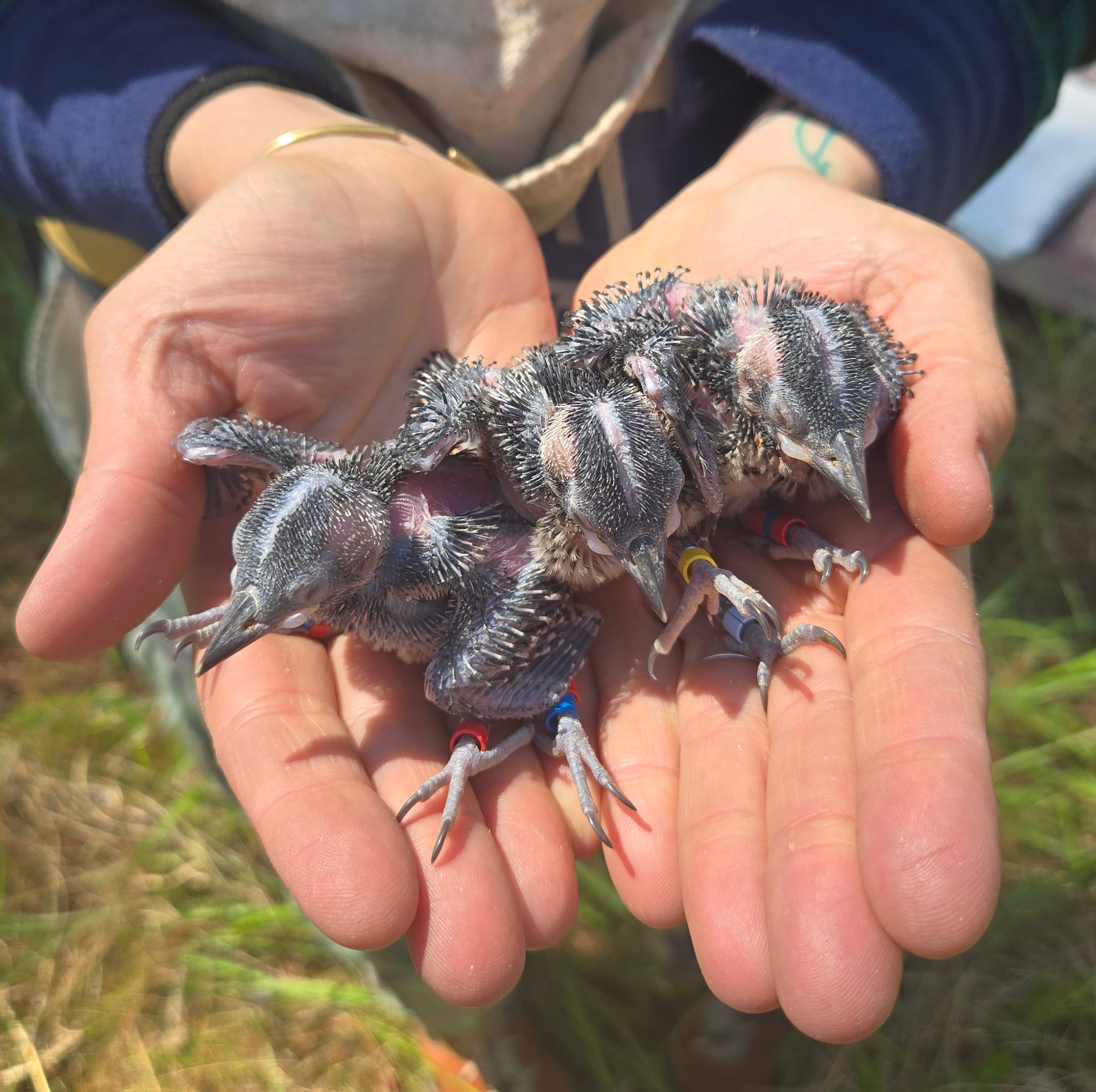
Research biologist Laura Duval holds a trio of newly banded red-cockaded woodpecker chicks on The Nature Conservancy's Piney Grove Preserve. Each chick weighs only about 25-30 grams. / Kim O'Connell
Once spread widely across the southeastern United States, RCWs suffered from a precipitous decline primarily due to habitat fragmentation and loss and suppression of naturally occurring fire. In 1970, the federal government listed the species as endangered under a law that was a precursor to the Endangered Species Act, enacted three years later. By the late 1970s, the species was edging dangerously close to extinction, having disappeared from several states altogether and with fewer than 1,500 clusters (family groups of about two to five birds) remaining, according to the U.S. Fish and Wildlife Service (USFWS).
A half-century later, however, RCWs are experiencing something of a rebound, one promising enough that, in 2024, USFWS downlisted the species from endangered to threatened. In doing so, the agency recognized that decades of collaborative conservation efforts and pineland management by federal, state, and local governments and private partners have made a positive impact, allowing growing numbers of these fragile birds to establish breeding clusters and have the ecological support they need. As of 2024, USFWS estimated that about 7,800 RCW clusters exist across 11 states from southern Virginia to eastern Texas.
Today, in addition to privately managed places like Piney Grove and other lands that are protected under conservation easements or so-called safe harbor agreements, RCWs can be found at Big Cypress National Preserve and Big Thicket National Preserve in the National Park System (and have been spotted in Everglades National Park and other national parks); other federal lands including forests, national wildlife refuges, and military bases; and state lands such as the Big Woods Wildlife Management Area in Virginia.
What are some characteristics of red-cockaded woodpeckers?
Red-cockaded woodpeckers get their name from the thin red streak, or cockade, visible behind the eyes of adult males, in contrast to their otherwise black-and-white plumage. Usually only seven to nine inches in length, the birds are also known for their sharp, straight bills that are used for drilling into pine bark.
What is the red-cockaded woodpecker's preferred habitat?
These birds are found almost exclusively in open longleaf pine ecosystems, where they excavate nesting cavities in living trees, usually older specimens between 60 and 100 years old. Unlike most woodpecker species that prefer drilling into deadwood because it's softer, RCWs prefer to excavate in live pines because the sap they produce is a natural deterrent to predators.
What is the RCW's current protected status?
Originally listed as an endangered species in 1970, the red-cockaded woodpecker was downlisted to "threatened" under the federal Endangered Species Act in 2024. It is still listed as endangered under Virginia statute, and as "near threatened" globally, according to the International Union for Conservation of Nature (IUCN).
It is worth noting, however, that some groups, including the Southern Environmental Law Center and Defenders of Wildlife, decried the downlisting, saying it was premature in light of climate-change impacts and habitat destruction. The bird remains on the state endangered list in states including Virginia, North Carolina, and South Carolina. It is currently listed as “near threatened” on the International Union for Conservation of Nature’s Red List. Land managers and biologists say that vigilance and commitment to the species’ continued recovery is necessary.
“When we purchased this land [in 1998], and this was the northernmost extent of their habitat, they were still federally endangered,” says Andi Clinton, a Virginia pinelands restoration specialist for TNC. “What we're really finding is lack of management means lack of birds. And lack of management comes from lack of committed resources. Because you can't one-off it.”
Over the last two decades, the organization has steadily expanded its controlled burn program, which has allowed specific, ecologically niche plants to grow that support RCW populations. With just a handful of RCWs on the property when it was purchased, the preserve now boasts about 23 breeding clusters, or about 100 adults.
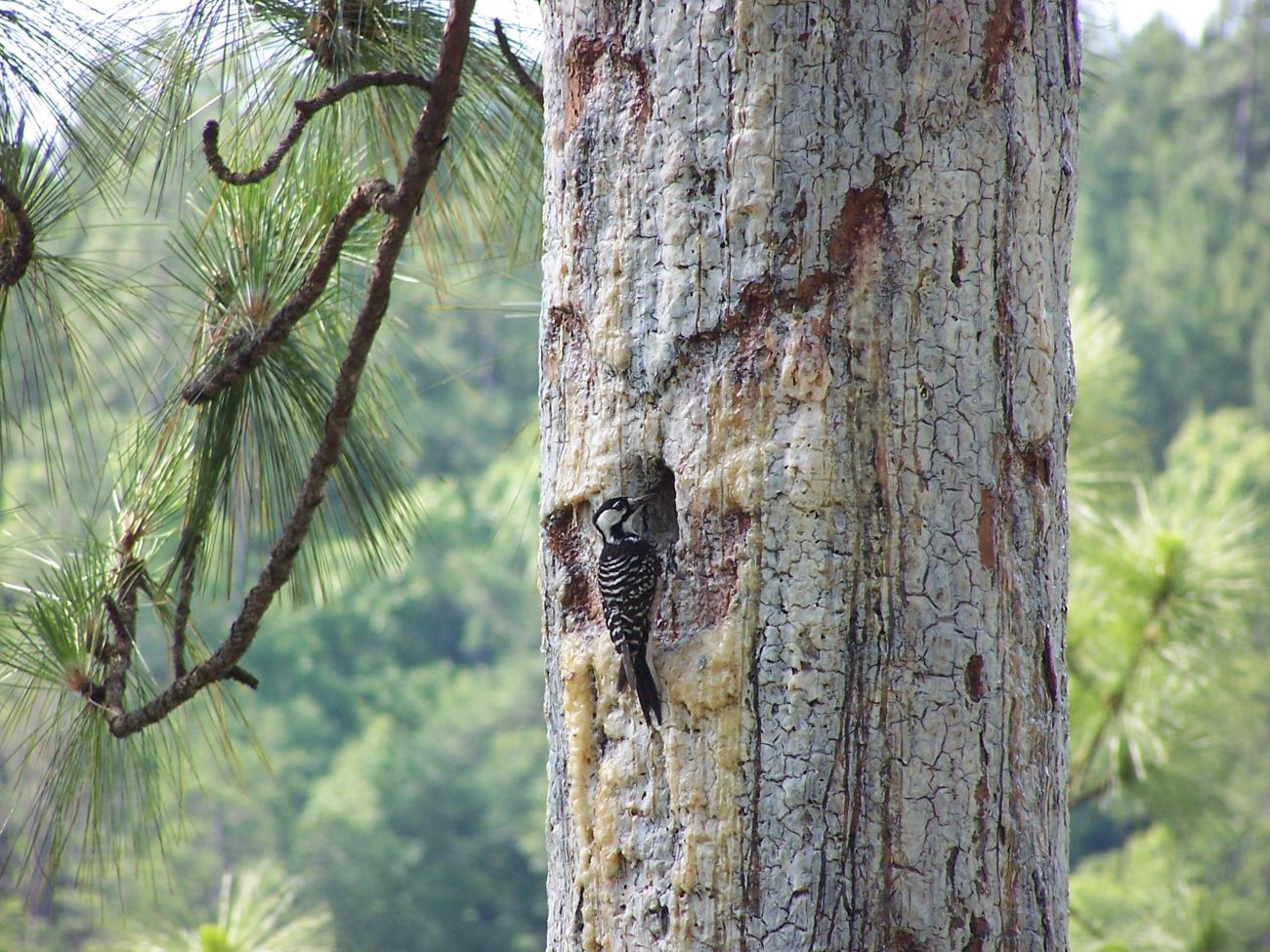
Another individual RCW boosting current populations. / USFWS
South Florida is witnessing positive signs of recovery as well. Jessica Spickler is a biologist with the Florida Fish and Wildlife Conservation Commission, a frequent collaborator with the National Park Service when it comes to RCW management in South Florida. Spickler notes that active clusters in the state have steadily grown to just under 2,500 over the past few years. “I think that's really encouraging to hear, and it's the main story in areas where they're occurring across the country,” she says.
At Big Cypress, the primary pine species is slash pine, which is a somewhat lower-nutrient landscape for the birds, ecologically, than the longleaf pine forest found farther north, Spickler says. So RCWs require larger territory sizes on which to form clusters and forage. Here, too, prescribed burns are essential to promoting biological diversity and a healthy ecosystem; in 2026, NPS has planned controlled burns in four strategic areas of Big Cypress covering more than 81,000 acres.
“All of the areas that these birds currently exist on, with a few exceptions, are pretty much public land,” Spickler notes. “So it's state and federally held lands that are being managed for the health of those pine ecosystems. It's very much an ‘if you build it, they will come’ scenario, where if you're taking this overgrown pine habitat and turning it into that, like, open park-like structure, the birds will just naturally want to live there.”
Spickler points to interagency cooperation and dedicated land managers as the root of the recovery efforts. The commission is part of the Southern Range Translocation Cooperative, a network of agencies, military installations, and private landowners that work to introduce RCWs from thriving populations into other areas to encourage new breeding and bolster struggling flocks.
“In the 1970s, it was researchers, biologists, and land managers that had to get together to figure out, ‘Okay, how are we going to turn this around?’” Spickler notes. “They wrote the rulebook for us, where if we do this amount of burning, or this amount of habitat treatment to reduce mid-story height of these woody species, and if we increase the herbaceous ground cover…if we do all of these things, if we create artificial cavities for them to nest and roost in [where needed]…these are all things that basically were developed in the '70s, '80s, and '90s and are what we have used since then to continue growing these populations.”
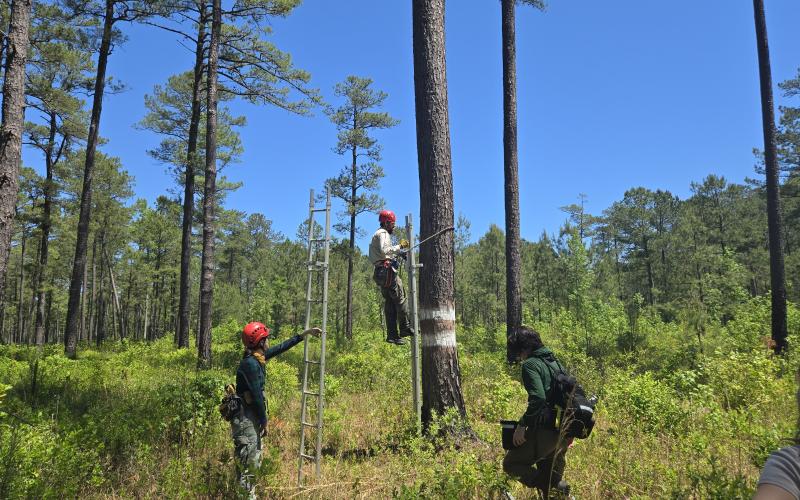
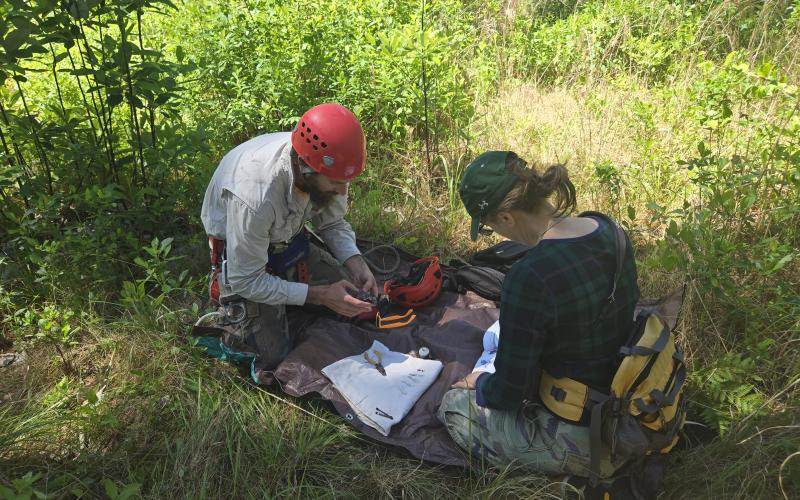


Chance Hines and Laura Duval of the Center for Conservation Biology at The College of William and Mary, along with staff and volunteers from The Nature Conservancy, work to collect and band red-cockaded woodpecker chicks at the Piney Grove Preserve in southeastern Virginia. / Kim O'Connell
Back at Piney Grove, Hines is continuing to work to extract chicks from their longleaf pine cavity. To do this, he uses a soft noose that can swiftly encircle one of the chicks’ tiny limbs for extraction from the cavity, the exterior of which is thick with shiny sap, a natural deterrent to snakes and other potential predators.
“He’s gotten two chicks out; there's one left in there,” Duval explains as Hines works. “The first time that he puts the noose in is his best shot at getting the birds, because they immediately stick their head up because they think an adult's coming to feed. But now, the chicks have had that thing come in so many times it’s like, ‘All right; something's up. It's not mom and dad.’ So it’s making it harder for him to catch a little wing or leg or something.”
After about 30 minutes, Hines is finally able to capture the last of the cavity’s three birds—two to four chicks per cavity is typical—and bring them to the forest floor for examination. There, Duval has laid out the tools with which they will band one leg on each bird that carries an identification number, and a series of colored bands for the opposite leg, which identifies which cluster they came from. The data they collect is then shared with the state.
“The red-cockaded woodpecker is a fascinating species because of how it is matched to a specific landscape—a fire-maintained pine savanna."
— Brian van Eerden, The Nature Conservancy
Studies have shown that, where RCWs thrive, so do countless other species. “I’ve personally seen old cavity trees that are kind of a little bit large for the RCWs, and I've seen an American kestrel nest there,” Spickler says. “I’ve seen Eastern screech owl nests in them. There have been southern flying squirrels, rat snakes, wasp nests, honeybee hives….There are so many animals that can use those cavities after the RCWs are done with them.”
The endangered Florida bonneted bat has even been spotted in abandoned RCW cavities in Big Cypress. “RCWs are important on the landscape for a variety of reasons," Spickler adds, "and managing for their habitat benefits the whole ecosystem."
Academic research is ongoing as well. A 2025 study published in the Proceedings of the National Academy of Sciences, for example, examined the benefits of translocation for RCWs at the Avon Park Air Force Base in Florida.
"We presented evidence that carefully implemented translocations into the red-cockaded woodpecker population at Avon Park offered a swift demographic boost and provided extended genetic and demographic benefits via the translocated individuals’ descendants," the authors concluded. "Importantly, the population improvements documented here reflect the combined effects of multiple management actions, including consistent efforts to enhance and expand habitat for red-cockaded woodpeckers."
This is exactly what's happening in Virginia, Florida, and beyond. “The red-cockaded woodpecker is a fascinating species because of how it is matched to a specific landscape—a fire-maintained pine savanna,” says Brian van Eerden, TNC's Virginia Pinelands Program director. Without the federal endangered listing, he adds, it’s hard to know whether efforts to protect and restore the pine ecosystems on which RCWs depend would have been as fruitful. “If that species had not been on the brink of extinction, there might not have been that same urgency.”
At Piney Grove, with the banding concluded, Hines shimmies up the ladder to return the RCW chicks to their cavity, where they are safe and sound, at least for the moment. In less than a month, these nestlings will be ready to fly. Till then, the group moves on, hiking through the sparse, fire-managed underbrush to the next longleaf pine.
Kim O'Connell is a longtime contributing writer for National Parks Traveler based in Arlington, Virginia, whose bylines have appeared in a range of national and regional publications. This article was made possible in part by the Park Foundation.
Story Categories:
A copy of National Parks Traveler's financial statements may be obtained by sending a stamped, self-addressed envelope to: National Parks Traveler, P.O. Box 980452, Park City, Utah 84098. National Parks Traveler was formed in the state of Utah for the purpose of informing and educating about national parks and protected areas.
Residents of the following states may obtain a copy of our financial and additional information as stated below:
- Florida: A COPY OF THE OFFICIAL REGISTRATION AND FINANCIAL INFORMATION FOR NATIONAL PARKS TRAVELER, (REGISTRATION NO. CH 51659), MAY BE OBTAINED FROM THE DIVISION OF CONSUMER SERVICES BY CALLING 800-435-7352 OR VISITING THEIR WEBSITE. REGISTRATION DOES NOT IMPLY ENDORSEMENT, APPROVAL, OR RECOMMENDATION BY THE STATE.
- Georgia: A full and fair description of the programs and financial statement summary of National Parks Traveler is available upon request at the office and phone number indicated above.
- Maryland: Documents and information submitted under the Maryland Solicitations Act are also available, for the cost of postage and copies, from the Secretary of State, State House, Annapolis, MD 21401 (410-974-5534).
- North Carolina: Financial information about this organization and a copy of its license are available from the State Solicitation Licensing Branch at 888-830-4989 or 919-807-2214. The license is not an endorsement by the State.
- Pennsylvania: The official registration and financial information of National Parks Traveler may be obtained from the Pennsylvania Department of State by calling 800-732-0999. Registration does not imply endorsement.
- Virginia: Financial statements are available from the Virginia Department of Agriculture and Consumer Services, 102 Governor Street, Richmond, Virginia 23219.
- Washington: National Parks Traveler is registered with Washington State’s Charities Program as required by law and additional information is available by calling 800-332-4483 or visiting www.sos.wa.gov/charities, or on file at Charities Division, Office of the Secretary of State, State of Washington, Olympia, WA 98504.
