


DAISY PASS, Custer-Gallatin National Forest, Montana—Ninety-five-hundred-feet high in the Rocky Mountains, Diana Tomback plants her boots in the snow and pans her binoculars across broken forest and steep, icy crags, hopeful the ancient trees around her are not veering towards extinction.
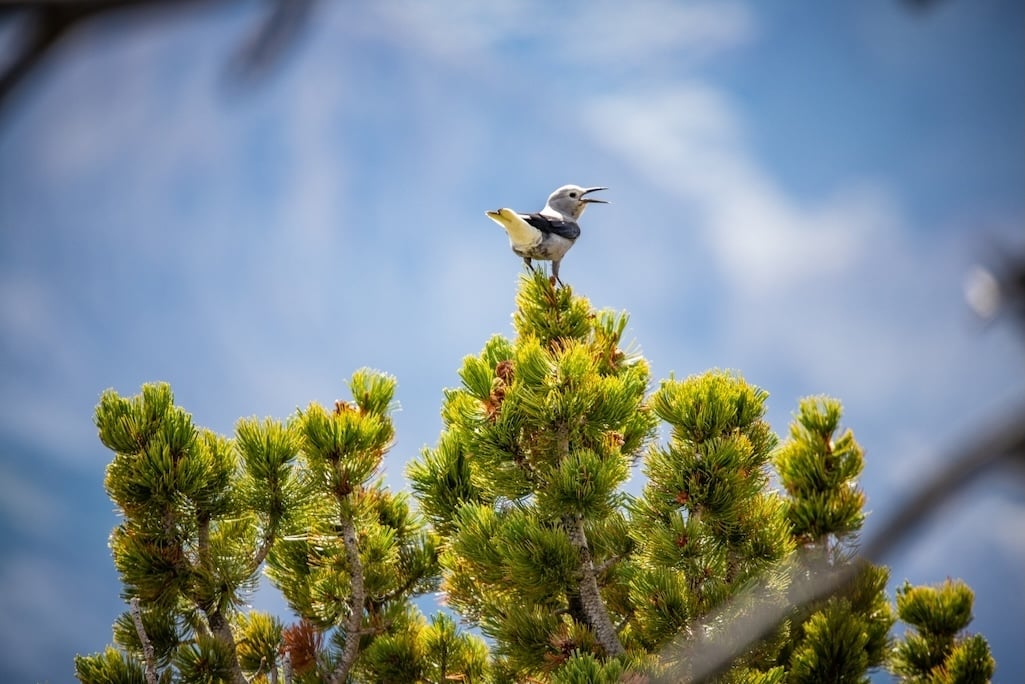
She’s looking for Clark’s nutcrackers, raucous gray and white birds that have a mutually dependent relationship with those very trees, the whitebark pines. These contorted giants, which have clung to the highest and harshest reaches across much of the West since the last ice age, now are losing their grip.
Afflicted by climate change and other threats, the trees are experiencing dramatic decline throughout their range. That includes several national parks that have stands of dead and dying whitebarks, a devastation that may well affect tourist economies in and around those parks, the U.S. Forest Service observes. The trees' decline spells an environmental-ripple calamity that's already underway for plant and animal species as well as humans.
“It's been predicted that whitebark will lose 80 percent of its current range by mid-century,” says Tomback, who has studied the trees since graduate school in the 1970s.
A loss of that magnitude is a little hard to envision from where Tomback is gazing at the ample snow-blown mountainside with clusters of whitebark pines. Beyond this vista, in fact, the trees range across 80 million acres in two Canadian provinces and seven U.S. states. But warming temperatures, reduced precipitation, and an aggressive nonnative tree fungus have been taking a toll. Due to its high elevation, whitebark is "ranked up there as one of the most vulnerable to climate change,” Tomback says.
A range of groups, from nonprofits like the Whitebark Pine Ecosystem Foundation and American Forests to federal agencies, tribes, and university researchers, is working to preserve the species. And there are encouraging signals, such as pockets of healthy whitebark pines in the Sierras, particularly within Sequoia, Kings Canyon, and Yosemite national parks, that provide a measure of optimism that the species can be saved.
Elizabeth Pansing, who studies the trees for the nonprofit American Forests, ventured into Yosemite last summer and found healthy whitebark stands that reflected what those in the Rocky Mountains "could have looked like 10, 20, 30 years ago."
For now, though, the species is in jeopardy. Its plight prompted the U.S. Fish and Wildlife Service (FWS) in January 2023 to list whitebark pines as threatened with extinction under the Endangered Species Act (ESA).

And it’s not just the trees that are at risk.
The National Park Service has designated the whitebark pine a "vital sign" species for subalpine ecosystems because of its crucial role in supporting plants and animals and influencing ecological processes such as snowfall accumulation around the tree trunks that sends cold water downhill during the spring and summer melt.
That means the trees help control water that fills communities' reservoirs.
Grizzly bears gorge themselves on whitebark pine nuts in fall, tearing through squirrel middens for a feast. Like Clark’s nutcrackers, numerous other species depend on the nuts for highly nutritious meals more calorie-dense than butter or chocolate.
The whitebark pines also hold cultural significance for tribal nations.
With these ecosystem anchors now listed for ESA protection, restoration projects are underway in the national forests, national parks, and tribal lands of the West. But success won’t be easy or quick.
“The successful restoration of whitebark pine ecosystems will take from decades to centuries,” warned a 2018 U.S. Forest Service report outlining strategies for saving the trees. “Not all whitebark pine forests need to be restored immediately, but a plan must be in place to prioritize those areas in the greatest need for restoration, and to also proactively prepare additional healthy ecosystems to be more resilient to the on-going threats.”
Despite the daunting road ahead, a range of tree-planting efforts — by the Forest Service and National Park Service, nonprofits, Native tribal groups, and even the passive activity of the little Clark's nutcracker — seek to reverse the whitebark's decline and restore the forests.
Ancient Origins
Whitebark pines are known as “five-needle pines” for the five needles held in each stem cluster. Others in the family are the twisted and wizened bristlecone pines (also known as Methuselah trees for their extreme age), white pines, limber pines, and foxtail pines.
Arising on the landscape after the last ice age some 15,000 years ago, whitebark pines, bent by the winds and often marking the tree line, reproduce slowly. They do not bear cones with nuts until they are 20 or 30 years old and, even then, reach the age of 60 or more before producing substantial numbers of nuts. As a result, today’s whitebark champions will never fully see their successes.
Roughly 70 percent of whitebark range lies within the United States. National parks where they are found are Crater Lake, Glacier, Grand Teton, Lassen Volcanic, Mount Rainier, North Cascades, Sequoia and Kings Canyon, Yellowstone, and Yosemite.
In Canada the trees rise above Waterton Lakes, Banff, Kootenay, Yoho, Mount Revelstoke, Glacier, and Jasper national parks.

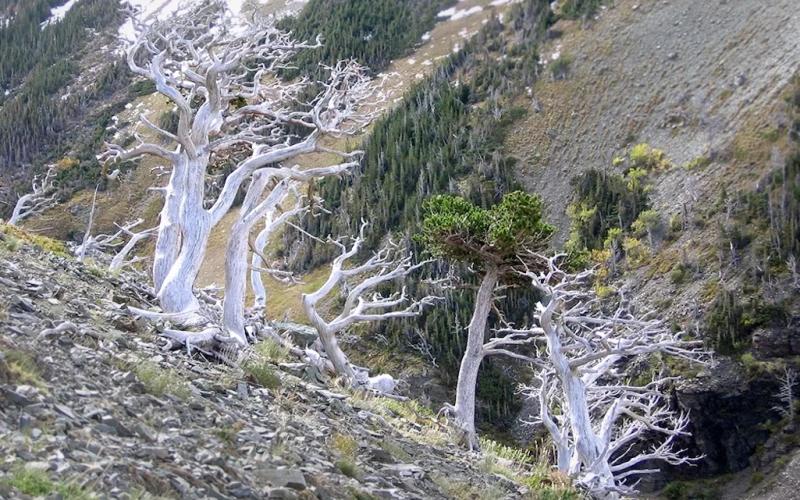
At Glacier in northern Montana, mortality in places has surpassed 90 percent, according to a 2018 survey cited by American Forests.
“Glacier is one of my favorite places and one of the saddest,” said Pansing, a doctoral student under Tomback who now is the whitebark pine expert for the nonprofit American Forests. “We will find two- to three-inch seedlings that are showing active signs of white pine blister. They have the blisters on their little trunks. It's really just heart wrenching. The mortality rate is above 90 percent in some locations across the park. It's a really sad place to be.”
What are whitebark pines?
Whitebark pines are a member of the "five-needle" pine family, named for the clusters of five pine needles in a bunch on stems. They arose after the last ice age and grow in the highest elevations of the West in two Canadian provinces and seven U.S. states.
Why should we care if they vanish?
This species provides many ecosystem benefits. The trees produce an extremely nutritious pine nut that grizzly bears, Clark's nutcrackers, and squirrels rely upon. They also anchor drifts of snow that slowly melt in the spring and summer, providing valuable water downstream to reservoirs human populations greatly depend on.
What risks do they face?
Whitebark pines are impacted by mountain pine beetles, which bore into the trees' phloem layer and disrupt the flow of nutrients in the trees. They also are being impacted by changing climate patterns that are altering rain and snow patterns, and by a potential fatal tree fungus — white pine blister rust — that arose in Eurasia and was transported to the United States upon white pine seedlings imported from Germany and France in the early 1900s.
Whitebark Threats
Climatic conditions since 1980 have been changing, and not in favor of whitebark pines. The number of growing days per year has increased and precipitation has waned, stressing the trees and leaving them more vulnerable to pests and disease.
Mountain pine beetle populations used to be kept in check by extreme winter cold, but now they can have more than one reproductive cycle a year thanks to the warmer temperatures, unleashing more beetles into forests. They kill whitebarks and other pines by boring through bark into the phloem and disrupting the flow of nutrients. While pheromones have been used to slow the beetles attacks, they haven't been a panacea.
It was a failure by 19th century foresters to appreciate the value of stewardship that led to the arrival of white pine blister rust (WPBR), a fatal Eurasian fungal disease. Extensive logging towards the end of that century prompted reforestation projects using white pine seedlings that were imported from Germany and France, and some brought the fungus with them.
Ironically, the pines sent to the United States were the progeny of white pines that the United States had earlier sent to Europe.
Since the pine stock returned to the United States with blister rust, air currents have carried the fungus slowly but steadily through much of whitebark range, killing vast numbers of trees.
Initial signs of infection from the fungus are yellow spots on pine needles. It can affect all pine species and spreads into a tree’s limbs and trunk, forming swollen lesions known as cankers; they block the flow of nutrients and water and ooze a resin. Rodents, which gnaw on the sweet resin, add another insult to the trees.
Its devastation makes the fungus one of the most infamous forest diseases in the world, forest pathologists say.
Cascading Impacts
Losing the trees from the Western landscape has widespread implications, including for reservoirs in the Snake, Columbia, and Missouri river basins. They rely on spring runoff from snowbanks that form around whitebark pines.
Loss of the pines also means the steeply pitched slopes they anchor would become treeless expanses with weakened stability, unable to hold snow.
Loss of their nutritious seeds not only would see Clark’s nutcrackers vanish from Rocky Mountain forests, according to Tomback, but could lead to more human-grizzly bear confrontations as the bears head to lower elevation in search of meals before hibernating for winter.
“I just don't like the idea of humans being the cause of extinctions. The extinction rate, right now overall, it's like 1,000 times higher than the background extinction rate because of human activities. And that’s unfortunate. Because whitebark pine is threatened because of human activities, climate change, and white pine blister rust, I feel like there's moral imperative to do something about it.” — Sean Parks
Birds To The Rescue?
Clark's nutcrackers have a historic role in propagating whitebark pine trees. But despite their reputation as gardeners, the birds are inefficient when it comes to whitebark pine nuts.They can tuck about 75 seeds into their mouths and carry them to cache spots where they stash up to several thousand seeds. They retrieve the seeds to eat when they return the following spring.
But they fly as much as 20 miles to cache a mouthful of the seeds and deposit only about 15 percent of them into soils conducive to germination. Still, even if only 15 percent germinate, thousands of pine nuts might sprout into seedlings if conditions are just right and the nutcrackers don’t return to eat the nuts first.
The relationship of the birds with whitebark pines is what led Tomback and her colleagues up a steep, rocky and rutted Forest Service road to Daisy Pass last October. They wanted to spot Clark's nutcrackers among living and dead pines. The birds' presence can indicate a decent crop of pine nuts, which in turn could signal trees that have a natural resistance or immunity to the blister rust that afflicts them. That would be a genetic miracle and a key to saving the species.
Consistent pine nut crops would ensure the nutcrackers would remain in the Yellowstone area.
“In the Greater Yellowstone, there are fewer backup resources the nutcrackers have, like in the Sierra Nevada in California, where there's a number of different trees that produce larger seeds, such as sugar pine, Western white pine,” Tomback said. “We don't have even pinion pine (in the GYE), and nutcrackers will readily use those.
“So, we hypothesize that there's more of a one-on-one relationship here in the Greater Yellowstone, and we see this in some other parts of whitebark range,” she added. “Nutcrackers may well move on if there isn't consistently a good cone crop.”
If the nutcrackers leave the ecosystem, whitebark pines will vanish, too, said Tomback: “It cannot be regenerated in the absence of Clark's nutcracker.”
However, a 2025 research paper said the birds can’t save the trees alone.
“Recovery of whitebark pine is not likely to occur without management intervention,” it stated. “Since the recovery of whitebark pine is not likely to occur without intervention, given the prevalence and lethal impacts of (whitebark pine blister rust), restoration in protected areas will almost certainly be required if society intends to recover.”
That management, however, is difficult on the ground, as more than three-quarters of acreage seen as suitable for whitebark pine restoration lies within official Wilderness or national parks, two areas where access is limited and which are to be protected with minimal, if any, human intervention.
“I don't see whitebark pine covering as much range as it historically did,” said Sean A. Parks, the paper’s lead author. “And then without some sort of planting or intervention. It's definitely a species in peril.”
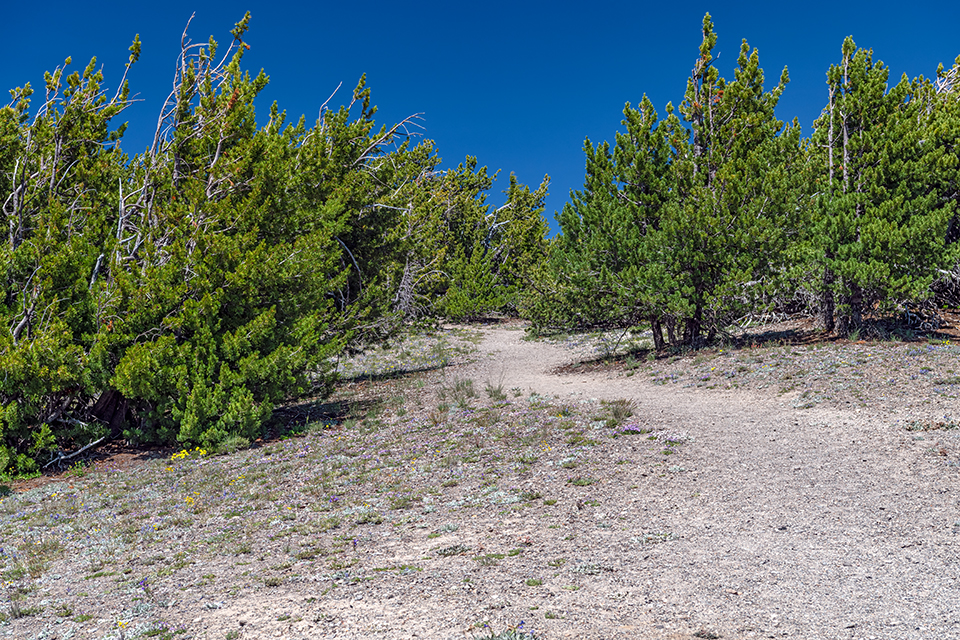
While research forecasts that 80 percent of whitebark pine habitat will become unsuitable for the species by mid-century, there are places outside of the trees' historic habitat that could be suitable for growing the trees. Should researchers become involved in assisted migration? Read what they think.
Restoration Efforts
Among those fighting to help the pines and the birds is the nonprofit American Forests. Pansing, the organization's senior director of forest and restoration science, said the group in 2023 signed a five-year plan with the National Park Service aimed at reforesting areas of Grand Teton and Yellowstone national parks with whitebark pine seedlings.
“The state of whitebark pine is dire, but hopeful,” she said during a Zoom call. “We have a really serious situation out there where a majority of the trees across its Rocky Mountain, Sierra Nevada, and Coastal Cascades range are declining and has resulted in really substantial mortality across that range. … By about 2018 we had about 325 million trees across the landscape that were dead, and that's more than 50 percent of the population across the range.
“From a personal perspective, it's really heartbreaking,” Pansing continued. “It's really hard to go out into these landscapes and see dead tree after dead tree, or tree that's infected with white pine blister rust after tree that's infected with white pine blister rust, from these little, tiny seedlings all the way up to the really big trees on the landscape.”
It’s not easy work.
“If you can think about trying to carry seedling pallets into a place in Grand Teton National Park [to a spot] that is 4,000 feet in elevation higher than where you start, and seven miles back into the backcountry, it gets a little bit logistically challenging to do a lot of the seedling planting,” said Pansing. “And so we're looking at whether or not you can actually plant seeds in lieu of seedlings and still get some of the benefits of restoration.”
In December 2024 federal agencies — the Park Service, Forest Service, Bureau of Land Management, and U.S. Fish and Wildlife Service — signed an agreement that runs into 2028 to sow blister rust-resistant whitebark pines on federal lands in the Greater Yellowstone area.
Work also is underway to zero in on a genetic cue that could identify whitebark pine trees that have the natural immunity to the fungus. In 2023 researchers at the University of California-Davis mapped the species' genome, and now work is focused on identifying the genes that provide the immunity. That could save thousands of dollars and years in finding rust-resistant seed sources in the wild. Currently, it's estimated to cost about $1,500 per seed sample and five to ten years to grow the seeds into pines that could be inoculated with the disease to see if they have natural immunity.
In the future, it possibly could require sending pine needs to a lab for a $100-or-so test.


Tree nurseries, such as this one at the U.S. Forest Service's Coeur d'Alene Nursery in Idaho, grow whitebark pine seedlings to reforest areas where blister pine rust, mountain pine beetles, and climate change are killing off the iconic trees/U.S. Forest Service and National Park Service photos.
Rebuilding Forests
Tribal nations in the western United States and Canada have been working for years on whitebark pine restoration. Generations of tribal people have valued the pine nuts for their high calorie count and medicinal qualities when used to brew teas. Clark’s nutcrackers also are revered as seed planters who could move the trees across mountain ranges.
ShiNaasha Pete, a Navajo who works for American Forests as director of tribal and Indigenous partnerships, began working with the trees in 2014 on the Flathead Indian Reservation in Montana, home to the Confederated Salish and Kootenai Tribes and an estimated 110,000 acres of whitebark forest.
Part of the tribes’ efforts involve nurturing whitebark pine “plantations” of up to 10 acres each for raising blister-rust-resistant pines to transplant into the wild. The plantations are in the high country on sites where whitebarks would be found naturally, she said.
“We hold the seedlings for two years before we plant them because of the harsh [growing] conditions, we want to make sure that those seedlings establish a strong root system,” Pete said.
A botanist by training, Pete is considering growing seedlings at lower elevations in greenhouses and then moving them to higher elevations to acclimate to the conditions before being planted.
The Forest Service’s Coeur d'Alene Nursery produces 100,000-250,000 seedlings a year for planting in national forests and national parks. The seedlings are cultivated for their ability to ward off blister rust.
On the Flathead Forest, which sidles along the western and southern flanks of Glacier National Park, nearly 12,000 seedlings were planted last year, said Michael Reichenberg, the forest silviculturist. Over a three-year period, about 85 percent of the young trees survived, he added.
“We treat whitebark a little differently than other tree species, given its special status,” Reichenberg said. “We focus on a lot of micro-siting. Instead of focusing on a grid pattern, like in normal planting, we focus more on being opportunistic, with using, say, downed logs or other materials available on the site to provide shade from the afternoon sun, which is a driver of mortality. Just kind of looking for the right places and being opportunistic, more so than sticking to a set spacing.”
“I had my first chance to go out into Yosemite this past summer and actually get into some of the whitebark pine stands out there, and it felt like I was walking back in time. It was just the most magical experience, to have spent my entire research career in the Northern Rockies and then really get to walk and see what those healthy ecosystems could have looked like 10, 20, 30 years ago, where you still have the cacophony of all of the animals and just these healthy canopies." — Dr. Elizabeth Pansing, American Forests
Nature's Way
Sometimes nature knows best. Twenty-six years after the 1988 wildfires that swept roughly of Yellowstone National Park, a whitebark pine that had naturally germinated after the fires stood tall on Mount Washburn and held one pine cone in its branches.
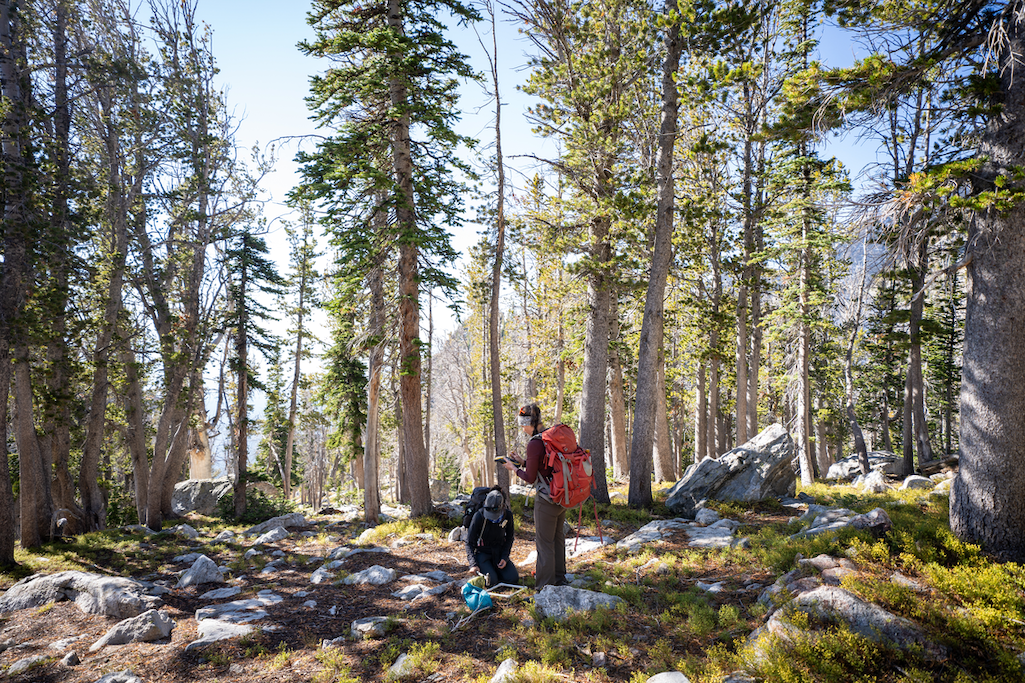
In Grand Teton along Wyoming’s sawtoothed border with Idaho, the pines spread across roughly 28,500 acres, with about 9,000 acres where the species is dominant, said Laura Jones, the park’s vegetation management chief.
However, whitebark pines have “been on the decline, with 51 percent overstory mortality range-wide due to non-native white pine blister rust, mountain pine beetle, fire, and all of these exacerbated by climate change,” Jones said in an email.
In a battle against the stressors, the park planted 2,600 whitebark pine seedlings last fall in Paintbrush Canyon and has plans to plant 1,800 seedlings during the current fiscal year and 3,000 during fiscal 2027 in Paintbrush Canyon, around Surprise/Amphitheater lakes, and in Static Basin, she noted.
The National Park Service says Yosemite National Park is home “to one of the healthiest whitebark pine populations [and] could become a potential refuge to a declining tree species affected elsewhere by the white pine blister rust pathogen, mountain pine beetle, and climate change.”
The park would not, however, allow its scientists to discuss those forests with the Traveler.
Pansing, though, has visited Yosemite, where she described the whitebark pine forests as “magical.”
“I don't think that we have a great scientific rationale as to why it has not experienced as high of rates of decline due to white pine blister rust as a lot of the other regions in the range,” she said.
“I had my first chance to go out into Yosemite this past summer and actually get into some of the whitebark pine stands out there, and it felt like I was walking back in time,” said Pansing. “It was just the most magical experience, to have spent my entire research career in the Northern Rockies and then really get to walk and see what those healthy ecosystems could have looked like 10, 20, 30 years ago, where you still have the cacophony of all of the animals and just these healthy canopies. It was just such an emotional experience for me to actually get out and be able to really experience that.
“I hope that we can figure out what it actually is that is going on out there and work hard to preserve it.”
Joan Dudney, an assistant professor of forest ecology at the University of California, Santa Barbara, speculates that the somewhat drier climate in the Sierra plays a role in the whitebarks' health.
"I would say it's because of the unique climatic dynamics of the Sierra Nevada, which is that they typically are pretty hot and dry in the summertime and very, very cold in the fall," conditions that make it hard for blister rust to spread, she said. "In the Rockies and northern parts of the whitebark pine range there's typically more summer precipitation, and some of these [trees] are a little bit lower elevation, so it's a little bit warmer, and you get a higher number of infection windows in each season than you do in the Sierra Nevada."
Dudney pointed out that as climate change brings warmer temperatures and more precipitation to the Sierra, blister rust infections are likely to increase. For now, though, she agreed with Pansing that there are very healthy whitebark pine forests in the national parks in the Sierra.
"They don't look like they have been battling disease for over almost 100 years, and they look like they're just still the pristine ecosystem that John Muir discovered," she said. "It's a beautiful landscape, a vibrant, healthy ecosystem compared to pretty much anywhere else I've ever been where there's whitebark pine."
Why Save Whitebarks?
“Extinction is forever,” reminds Parks, who collaborated with Tomback and 11 others on research (attached) that predicted the vast loss of whitebark range in little more than two decades, when asked about the effort going into saving whitebark pines.
“More biodiversity means that we have more ecological redundancy and resilient in our forests. We don’t want monocultures of lodgepole pine everywhere, right? It’s nice to have a suite of species in our forests,” he says.
The ecological impacts created by the loss of whitebark pines would be enormous, maintains Jones at Grand Teton.
“Loss of whitebark pine from the landscape is not just losing a tree—it would fundamentally alter high-elevation ecosystems. Whitebark pine is a keystone and foundation species at high elevations—often the first tree to establish in harsh, snowy, wind-exposed sites, improving conditions so other plants can follow,” she pointed out.
There’s also a philosophical rationale for saving the species, said Parks.
“I just don't like the idea of humans being the cause of extinctions. The extinction rate, right now overall, it's like 1,000 times higher than the background extinction rate because of human activities,” he said. “And that’s unfortunate. Because whitebark pine is threatened because of human activities, climate change, and white pine blister rust, I feel like there's moral imperative to do something about it.”
Kurt Repanshek founded National Parks Traveler in August 2005. Since then, as its editor-in-chief, he has grown the site’s audience to more than 4.5 million a year, as well as its reputation and relevance. A veteran journalist whose 40+-year career started with The Associated Press, Repanshek has interviewed presidential candidates, members of Congress, and reported on such natural disasters as the 1988 wildfires that swept across Yellowstone National Park.
This project was made possible in part by the Park Foundation.

Stories about:
Story Categories:
A copy of National Parks Traveler's financial statements may be obtained by sending a stamped, self-addressed envelope to: National Parks Traveler, P.O. Box 980452, Park City, Utah 84098. National Parks Traveler was formed in the state of Utah for the purpose of informing and educating about national parks and protected areas.
Residents of the following states may obtain a copy of our financial and additional information as stated below:
- Florida: A COPY OF THE OFFICIAL REGISTRATION AND FINANCIAL INFORMATION FOR NATIONAL PARKS TRAVELER, (REGISTRATION NO. CH 51659), MAY BE OBTAINED FROM THE DIVISION OF CONSUMER SERVICES BY CALLING 800-435-7352 OR VISITING THEIR WEBSITE. REGISTRATION DOES NOT IMPLY ENDORSEMENT, APPROVAL, OR RECOMMENDATION BY THE STATE.
- Georgia: A full and fair description of the programs and financial statement summary of National Parks Traveler is available upon request at the office and phone number indicated above.
- Maryland: Documents and information submitted under the Maryland Solicitations Act are also available, for the cost of postage and copies, from the Secretary of State, State House, Annapolis, MD 21401 (410-974-5534).
- North Carolina: Financial information about this organization and a copy of its license are available from the State Solicitation Licensing Branch at 888-830-4989 or 919-807-2214. The license is not an endorsement by the State.
- Pennsylvania: The official registration and financial information of National Parks Traveler may be obtained from the Pennsylvania Department of State by calling 800-732-0999. Registration does not imply endorsement.
- Virginia: Financial statements are available from the Virginia Department of Agriculture and Consumer Services, 102 Governor Street, Richmond, Virginia 23219.
- Washington: National Parks Traveler is registered with Washington State’s Charities Program as required by law and additional information is available by calling 800-332-4483 or visiting www.sos.wa.gov/charities, or on file at Charities Division, Office of the Secretary of State, State of Washington, Olympia, WA 98504.
