


Captain Slate’s Scuba Adventures offers tourists a familiar suite of snorkeling, diving, and scuba certification opportunities in the colorful underwater world off the Florida Keys. On special occasions like weddings the captain, Spencer Slate, goes the extra watery mile. For “two grand or less” people can tie the knot amidst the natural beauty of Florida’s coral reef.
“They say their vows, take their regulators out, and kiss. We do the ring exchange, and we film it,” said Slate.
Then the newlyweds celebrate — and so does Slate. Like the more than 4,000 businesses making money in these stunning waters off Monroe County in southeast Florida, Slate’s dive shop depends on tourism to pay the bills.
It’s not surprising that the Florida Reef, with its 6,000 marine species, including rainbow-colored fish, green sea turtles, shark, and barracuda, along with shipwrecks to swim through, is a moneymaker — not just for the businesses involved but also for state and local governments, including coastal communities that would flood without the reef’s protective barrier during storms.
Spanning about 350 miles from St. Lucie Inlet north of Miami to 70 miles west of the Florida Keys, Florida’s reef, a vibrant collection of plant and animal life, attracts 6 million residents and more than 38 million tourists annually, reports the Treasure Coast Regional Planning Council, a forum comprised of elected officials and gubernatorial appointees who address regional issues.
The tourism value of the Florida Reef in a typical year is more than $6 billion, according to the Florida Department of Environmental Protection (DEP). On any given day, an estimated 41,000 people visit the reef for beach fun, boating, diving, and snorkeling, among other water sports activities, the DEP said.
So, it’s also not surprising that Slate and his colleagues and peers have their eyes on the decline of the reef. What hurts the reef can hurt them as well.
How Big Is The Florida Reef
The Florida Reef stretches about 350 miles, from about 150 miles north of Biscayne National Park south to Dry Tortugas National Park. Though viewed as a single reef, it's comprised of thousands of smaller reefs.
Why is the Florida Reef Important?
The Florida Reef provides an array of benefits, from helping the state of Florida realize billions of dollars in tourism business each year to protecting coastal communities from the full fury of storms.
What Threats Does The Florida Reef Face?
The Florida Reef is being impacted by coastal pollution, rising water temperatures tied to climate change, coral diseases, and "mechanical" impacts from anchor drops and dredging to deepen ports.
Over the past 47 years Slate has watched the corals fall victim to pollution, disease, and warming seas, among other stressors. “The big, brown, beautiful corals used to be everywhere. You had to be careful anywhere you went,” and keep boat anchors from crushing the corals, he said.
Pollution, disease, and agricultural runoff are wiping the reefs away and threatening the state’s economy. A record heat wave in 2023, when water temperatures soared to 101 degrees Fahrenheit, killed almost all the elkhorn and staghorn coral colonies in the Florida Keys and at Dry Tortugas National Park. Now, they are functionally extinct.
Slate raised environmental concerns about the reef when he ran unsuccessfully for the Florida Legislature in 2006. Now a vocal advocate for cleaning up and protecting the reef, he tells politicians “if someone in our government doesn’t get serious about the pollution of our water, we, the Keys, and the state Florida are doomed.”
Money To Be Made
The third largest fringing coral barrier reef in the world, the Florida Reef is a jigsaw puzzle of thousands of smaller reefs. The only state in the lower 48 with extensive shallow coral reef formations near its coast, Florida boasts that the reef is home to Biscayne and Dry Tortugas national parks, the Florida Keys National Marine Sanctuary (FKNMS), several national wildlife refuges, and the John Pennekamp Coral Reef State Park. About two-thirds of the reef is within Biscayne National Park and the marine sanctuary.
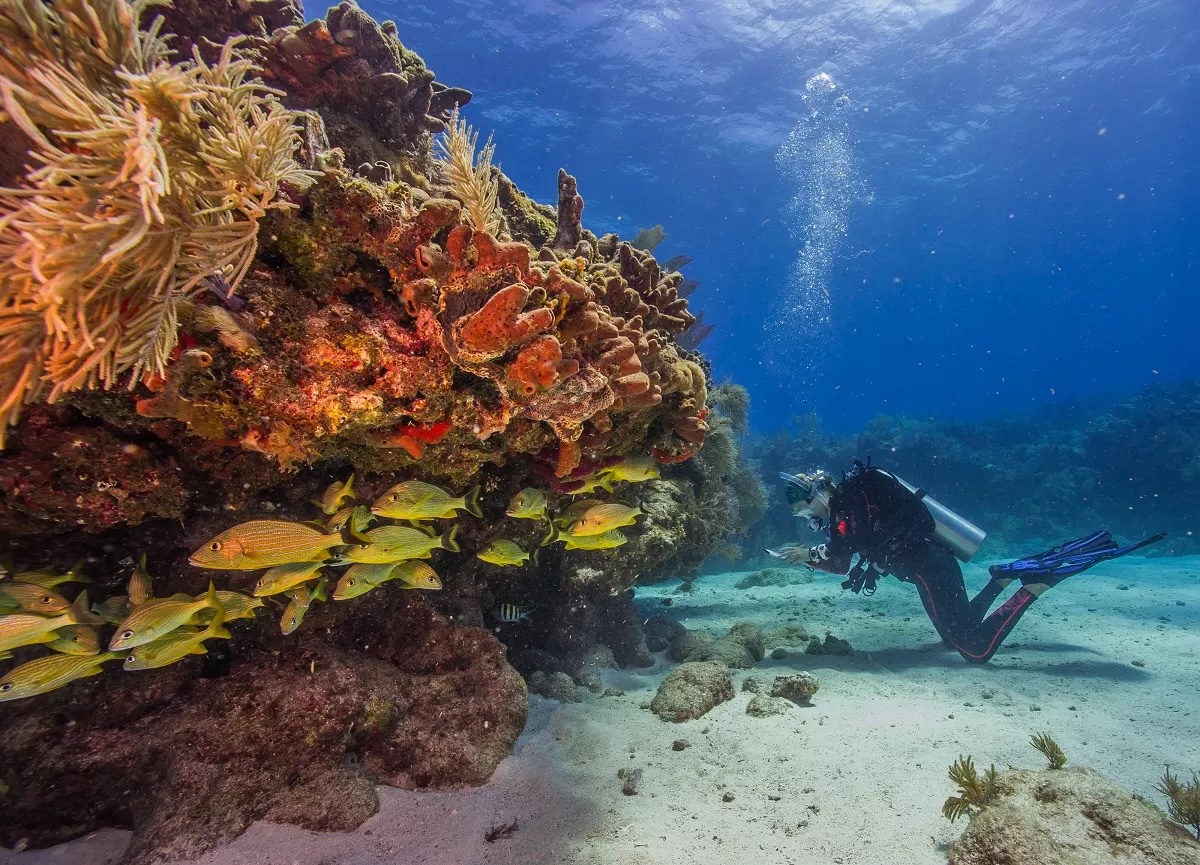
The Florida Reef generates billions of dollars from tourism and recreation/NPS file, Shaun Wolfe
In 2021, the National Oceanic and Atmospheric Administration estimated that reef-related snorkeling and diving activities in south Florida generated $902 million and supported 8,688 jobs, ranging from diving instructors to boat captains in south Florida.
Fishing generates another $6 billion annually, according to a 2022 study in Fisheries Research by Jerald Ault, University of Miami emeritus professor. Commercial and recreational anglers harvest grouper, snapper, blue crab, flounder, and spiny lobster, among other fish that rely on the coral reef for food, shelter, and breeding grounds.
Coastal Protection
The reef also plays an important economic role in serving as a breakwater when storms pummel coastal properties and communities. It is “a first line of defense that protects shorelines against 97 percent of the energy from waves, storms and floods,” according to NOAA’s Coral Reef Watch.
Research published in January in Earth’s Future states that if nothing is done to prevent continued degradation of the seafloor by the end of this century, about 17 percent of the state’s coastline could erode and impact more than 7,300 south Florida residents, at an annual cost of almost $1 billion to properties, roads, and buildings.
“If we don’t do anything, if the degradation trajectory stays the same, I hate to say this is how bad it could get,” said Curt D. Storlazzi, geologist with the U.S. Geological Survey, and lead author on the paper.
The Traveler asked Florida’s DEP for comment on Storlazzi’s study, but telephone calls and emails were not returned.
Populated, developed areas, including Miami, are expected to suffer the most from coastal flooding. Miami drew a record 28 million visitors in 2024. They spent $22 billion and generated $2.2 billion in local and state tax revenues, according to the Greater Miami Convention and Visitors Bureau.
Slate notes that reef decline is exacerbated by polluted water, including nutrients from septic tanks and farm runoff with fertilizers and phosphates flowing into the ocean. The nutrients fuel algal blooms that have harmed the corals and sea grasses.
“We don’t have clean water like we used to have because in big part to agriculture and the sugar industry have been polluting the bay for 50 years." — Spencer Slate
Restoring the Reefs
Researchers are trying to restore the reefs with re-plantings and development of hybrid reefs using dead corals and metal or concrete. In addition to supporting marine life, these efforts are also used as hazard mitigation strategy to reduce coastal flooding, said Storlazzi in another study published last year.
Storlazzi showed it is less expensive to restore Florida’s coral reef then it is to wait until future flooding damages the buildings and economic activity along Florida’s coast, valued at $675 million.
It’s unclear how successful restoration efforts will be. To be self-sustaining, corals need to grow to the size of a basketball or larger, said Allyson DeMerlis, a postdoctoral research associate with the University of Miami Rosenstiel School of Marine, Atmospheric, and Earth Science.
The University of Miami and Biscayne National Park are growing different coral species in nurseries in the Atlantic Ocean to create the diverse habitats that existed before corals started dying off. Divers then use cement or epoxy to glue coral pieces onto dead reefs in the water.
The researchers will monitor their growth for two years to see where the corals might flourish the best. “Then we can do more targeted research looking at different coral genotypes to see which ones are more resilient to different stressors,” said DeMerlis.
Not So Natural
Florida also has a robust artificial reef program — there are 4,476 artificial reefs, often made from steel, rock, concrete, or limestone deployed off its coast, according to the Florida Fish and Wildlife Commission. Like natural reefs, artificial reefs provide shelter and structure that fish need. University of Miami researchers are exploring the potential success of reefs that combine natural and artificial elements, said DeMerlis.
The tourism economic value from artificial reefs is not clear, since the public may prefer to visit natural reefs, NOAA researchers Kristy Wallmo and Mary E. Allen found in 2024.
“High values for natural coral reefs suggest that management approaches to restoring coral populations, such as the use of coral nurseries and out-planting corals, are strategies to consider,” said their study published in Environments.
Other NOAA studies looked at whether divers prefer to explore sunken ships acting as reefs or natural reefs. Two former Navy ships, the Spiegel Grove at Key Largo in 2002 and USNS General Hoyt S. Vandenberg at Key West in 2009, were repurposed as reefs.
At Key Largo, where the local chamber of commerce organized the sinking, divers opted to visit the massive 510-foot ship instead of the natural reef, which saw a 14 percent decrease in use.
Key West saw a mixed preference: A 189 percent increase in the number of divers and charter boats visiting both the natural reef and the sunken ship negated the research hypothesis that an artificial reef would reduce usage of natural reefs, NOAA said.
Medical Advances
What's unclear is the role the reef might play in human health. It's believed to hold an unknown potential to cure diseases, but that has yet to be quantified and will never be realized if the reef is destroyed.
Andy Bruckner, research coordinator with FKNMS, told the Traveler in an email that Mote Marine Laboratory is looking into shark and stingray immune cell peptides for cancer therapy, and the University of Florida is studying coral bacteria implications for chemotherapy.
“The corals themselves have a very complex immune system and there are ways we can harness understanding their system and apply this to the medical field,” such as in targeting bacteria, said DeMerlis.
In the 1950s, scientists discovered two molecules in the sponge Techtitethya crypta in Florida that led to developments in treatments for HIV/AIDS, leukemia, and herpes, according to the Kristin Jacobs Coral Aquatic Preserve Management Plan.
BCC Research estimates that marine-derived pharmaceuticals globally will see a market estimated at $9 trillion by 2033.
Unless the Florida Reef and its waters are protected, its full value for human and animal health, and recreation and business benefits will almost certainly diminish.
A contributing writer from Ithaca, New York, Lori Sonken spent more than two decades drafting legislation, organizing Congressional hearings, and analyzing policies affecting national parks, endangered species, and water as a staff member on the House Natural Resources Committee and at the Department of the Interior in Washington, D.C.
This article was made possible in part thanks to the Curtis & Edith Munson Foundation.
Story Categories:
A copy of National Parks Traveler's financial statements may be obtained by sending a stamped, self-addressed envelope to: National Parks Traveler, P.O. Box 980452, Park City, Utah 84098. National Parks Traveler was formed in the state of Utah for the purpose of informing and educating about national parks and protected areas.
Residents of the following states may obtain a copy of our financial and additional information as stated below:
- Florida: A COPY OF THE OFFICIAL REGISTRATION AND FINANCIAL INFORMATION FOR NATIONAL PARKS TRAVELER, (REGISTRATION NO. CH 51659), MAY BE OBTAINED FROM THE DIVISION OF CONSUMER SERVICES BY CALLING 800-435-7352 OR VISITING THEIR WEBSITE. REGISTRATION DOES NOT IMPLY ENDORSEMENT, APPROVAL, OR RECOMMENDATION BY THE STATE.
- Georgia: A full and fair description of the programs and financial statement summary of National Parks Traveler is available upon request at the office and phone number indicated above.
- Maryland: Documents and information submitted under the Maryland Solicitations Act are also available, for the cost of postage and copies, from the Secretary of State, State House, Annapolis, MD 21401 (410-974-5534).
- North Carolina: Financial information about this organization and a copy of its license are available from the State Solicitation Licensing Branch at 888-830-4989 or 919-807-2214. The license is not an endorsement by the State.
- Pennsylvania: The official registration and financial information of National Parks Traveler may be obtained from the Pennsylvania Department of State by calling 800-732-0999. Registration does not imply endorsement.
- Virginia: Financial statements are available from the Virginia Department of Agriculture and Consumer Services, 102 Governor Street, Richmond, Virginia 23219.
- Washington: National Parks Traveler is registered with Washington State’s Charities Program as required by law and additional information is available by calling 800-332-4483 or visiting www.sos.wa.gov/charities, or on file at Charities Division, Office of the Secretary of State, State of Washington, Olympia, WA 98504.
