


Extinction has claimed staghorn and elkhorn corals, whose distinctive antler-like arms once peppered the sea floor off Florida but now are all but impossible to find thanks to warming waters and disease throughout their coastal habitat.
But extinction has more than one face these days. The corals are not completely gone from the world. Rather, they are “functionally extinct,” meaning they lack numbers and health to survive threats facing them in the wild. It doesn’t mean they are entirely gone.
Scientists are keeping the two species alive in coral nurseries, both onshore and offshore. Many facilities are working to preserve them and raise their offspring as just one aspect of efforts to save the Florida Reef, a 350-mile-long collection of reefs besieged by disease and marine heat waves since the 1970s that have robbed the reef of an estimated 98 percent of its live coral cover.
These two unique corals are among many species around the world that have dwindled to such few numbers and are facing such severe threats that for now there’s no hope of sustaining a wild population. Extinction for them is just a matter of time. That’s what leads scientists to the final resort: bringing some of the final few under human control to nurture them and safeguard their genetics, then breed them or grow new ones, with the ultimate intent and hope of creating new populations in the wild.

“There are so few remaining individuals on the reef that they will not be reproducing on their own,” said Erinn Muller, a senior scientist and coral health and disease program manager at the Mote Marine Laboratory and Aquarium in Sarasota, Florida. “They are too few and too far apart from each other to create more coral. At this point, there's only 37 elkhorn corals that remain on the reef. How many staghorn corals is relatively unknown, but there are very, very few of them.”
With climate-change impacts largely unchecked and growing across the world, many more species are reaching functional extinction, and scientists in the national parks and elsewhere are becoming more sophisticated in their captivity efforts. The ‘Alalā, a Hawaiian crow, was deemed functionally extinct after efforts to restore them in the wild failed, partly due to mosquito-borne avian malaria. But about 100 individual ‘Alala are alive in captivity and a handful were released back to the forest last year with scientists’ high hopes that they may establish a new wild population.
In the case of the staghorn and elkhorn corals, the scientific determination last year that they were functionally extinct came in the wake of that same designation for the pillar coral in 2020 due to stony coral tissue loss disease (SCTLD).
“The functional extinction of three coral species in Florida in less than 5 years is unprecedented,” wrote nearly four dozen marine scientists, including Muller, in a paper on the heat-driven decline of the two corals that was published last fall in the journal Science.
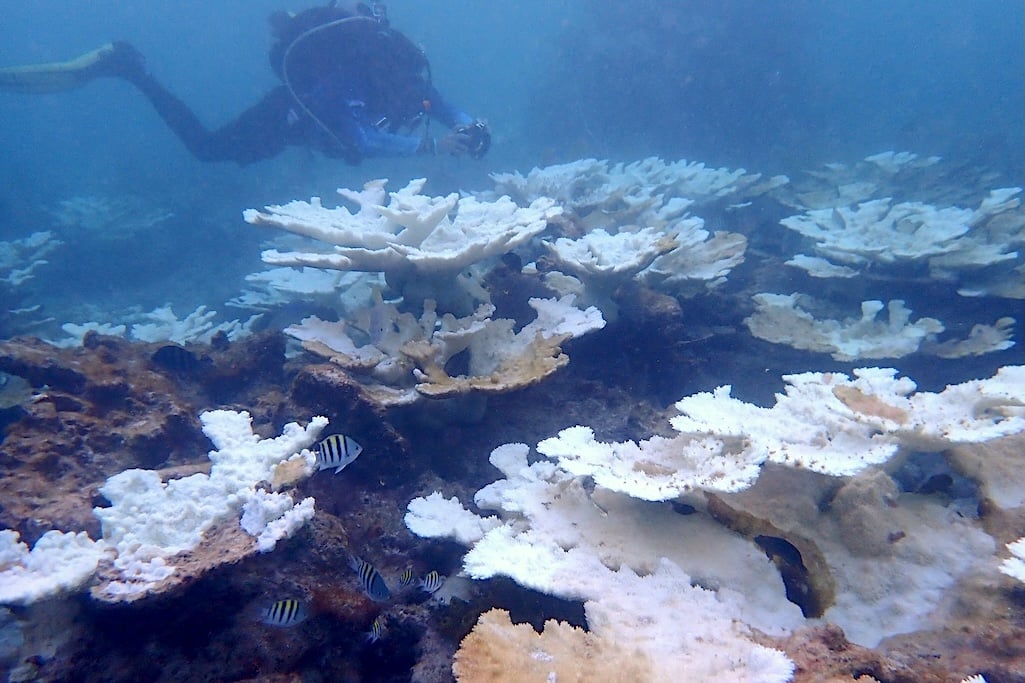
Corals like these elkhorn specimens can recover from bleaching if the marine heat wave is not too severe/NOAA
What is a marine heatwave?
Average South Florida sea temperatures are 69.8°F -86°F. In July 2023, water temperatures throughout the Gulf of Mexico and in the Caribbean Sea were approximately 2°F - 4.5°F warmer than average, which are typically 82.4°F -86°F for this time of year. Any time the ocean temperature is above the 90th percentile for a specific length of time — meaning that the temperatures are warmer than 90% of the previous observations for a given time of year — you’ve got a marine heat wave. — NOAA
How does warmer than normal ocean water affect corals?
73.4°F - 84.2°F is the optimal temperature range for reef-building corals. A 2°F (or 1°C) rise in temperature can cause a coral to bleach, meaning the coral expels its symbiotic algae, which provides the coral with its color and nutrients. It can take several weeks of stress before corals pale and/or turn white. — NOAA
What happens if most or all of the corals die?
Without live coral, there is subsequent erosion of coral reef habitat and ultimately the loss of fishing and food, storm protection, tourism, and biodiversity. — NOAA
Unable to Beat the Heat
In the woefully hot summer of 2023, anthropogenic climate change drove Atlantic Ocean surface temperatures to 90° Fahrenheit or higher along coastal Florida. That warmer water killed nearly all colonies of the two iconic corals that truly gave structure to the ocean bed as their tan-hued branches, or lobes, shaped somewhat like elk or stag antlers, rose like tree limbs as much as 6 feet above the ocean floor.
The temperatures spurred mass coral “bleaching,” which occurs when algae that provide the corals nutrition and give them their color are driven out by the heat, leaving the corals chalky white. Oftentimes such bleaching can lead to disease outbreaks.
That’s when marine biologists doubled down on efforts begun a few decades ago, bringing human efforts to bear to keep alive at least some representatives of the two species and use them to grow new ones.
“The historical importance of these two species cannot be overstated,” stressed the Science paper.
For an estimated 250,000-500,000 years elkhorn corals had “dominated the reef crest zone,” and were the primary builder of the Florida Reef roughly 12,000 years ago, the paper noted, while staghorn corals “dominated the mid-slope zone in the Caribbean.”
The two species grow faster than other Atlantic corals, and unlike other corals they fashion unique three-dimensional structures. Both species when healthy benefit hundreds of fish species, including darting schools of black-and-yellow sergeant majors, blue tang, grunts, and colorful parrot fish, by providing habitat; and they can mute somewhat the shore-pounding power of large waves, notes NOAA Fisheries.
Groups like the Mote Aquarium, Florida's Coral Reef Resilience Program, the National Centers for Coastal Ocean Science, the National Park Service, and many others are not standing idly by in the face of the marine heat waves and disease. Along with raising corals in captivity, and searching for cures to diseases like SCTLD, teams are working with relatively heat-tolerant Honduran corals to create a hybrid Florida coral that can endure future marine heat waves.
“We have teams that really specialize in different aspects of those research and conservation priorities,” Muller said of Mote’s operations. “We have a huge presence in the Keys and staff that are focused on kind of growing and rearing these corals (on land and offshore) for restoration purposes.”
Those “coral gardening” efforts are aimed at producing as much coral as possible, “and focus on the corals that seem to be more resilient to a lot of the major issues and get that biomass back out onto the reef to help increase functionality of that ecosystem,” she said.
Some of the research also seeks to understand why some coral offspring raised onshore and outplanted seem to be more heat tolerant than those naturally occurring along the reef.
“That gives us kind of a thread of hope to build some of our focus on in the future,” said Muller, referring to how the scientific community rebounded, mentally, from the loss of so many corals to the 2023 bleaching event.
"At this point, there're only 37 elkhorn corals that remain on the reef. How many staghorn corals is relatively unknown, but there are very, very few of them.” -- Erinn Muller, Mote Aquarium
A Hot History
The staghorn and elkhorn corals were listed as threatened with extinction in 2006 under the Endangered Species Act and listed as critically endangered in 2021 by the International Union for the Conservation of Nature.
The two species by then had managed to hold on through numerous modern heat events and disease, and continued to do so for a while.
Marine heat waves in 1987, 1990, 1997, 1998, 2005, 2014, 2015, and 2022 greatly diminished their numbers, and disease in the 1980s also had dire impacts on them, killing more than 98 percent of the species, said Muller.
The 2023 hot spell resulted in widespread losses of the corals, which had not been able to sufficiently recover from the previous heat waves. That summer saw not only naturally born individuals die but also “thousands” that had been grown in captivity and outplanted in the ocean prior to that catastrophic heat wave.
“During the summer of 2023 we had the warmest year on record in our oceans, and certainly within Florida,” Muller explained during a Zoom call. “The water temperatures were over 100 degrees in some places along the waterways of Florida and in the Florida Keys.”
“When those corals turn white and lose that algae, they basically are starving to death because they don't have the food that they need to survive, and they're also highly susceptible to things like disease,” the scientist said. “They're incredibly stressed out, their immune system is compromised, and they're more likely to suffer from some kind of infection, from a virus or a fungus or a bacterium. We saw almost all of the corals that had been outplanted to the reef, and the wild corals, die within a matter of months because of how warm the water temperatures were.
“It set us back significantly.”

Offshore coral nurseries are used by various groups and organizations to grow staghorn and elkhorn corals for planting along the reef.
Hope For The Future
The existing recovery plan crafted in 2015 by the National Marine Fisheries Service for elkhorn and staghorn corals focuses on boosting the species through nurseries, reducing pollution and damage from boaters and fishing, and mitigating climate-change impacts.
But authors of the plan (attached) acknowledge the challenges they face in succeeding, especially in regard to climate-change impacts such as marine heat waves and ocean acidification spurred by the ocean’s absorption of excess carbon from the atmosphere.
“Because many of the important threats to the recovery of elkhorn and staghorn corals are not directly manageable, the recovery strategy pursues simultaneous actions to address critical demographic factors, the range of threats, and knowledge gaps. The gaps in knowledge must be addressed through basic experimental and genetic research along with monitoring to determine the current condition of elkhorn and staghorn corals,” the recovery report states.
“Climate models and experimental research indicate that recovery of elkhorn and staghorn corals will be impeded by increasing ocean temperatures and acidification resulting from global atmospheric CO2 levels,” it continues. “Therefore, actions must be taken to address ocean warming and acidification impacts on these species.”
If there’s any silver lining when it comes to recovering the two species, it’s that they reproduce and grow quickly, and there are already thousands being nursed with an eye on outplanting them to the reef tract.
Muller said elkhorn and staghorn corals typically are ready to move from onshore nurseries into the ocean in about 18 months. Some boulder and brain corals, for comparison, could take a couple years before they’re ready to go into the Atlantic.
“There's thousands and thousands of corals that are getting created every year, not just by Mote, but other organizations like the Florida Aquarium, the Reef Institute, the University of Miami,” she said. “There are some really big players that are working on sexual propagation of corals and there are thousands and thousands of corals that are getting handed off for restoration every single year.
“It's becoming a really viable production line that we can pump into the restoration pipeline,” she added. “The question is, once they get out to the reef, will they survive? And that is our biggest challenge today.”
Traveler postscript: Interior Department officials would not make National Park Service nor Florida Keys National Marine Sanctuary officials and scientists available to the Traveler for this series.
Kurt Repanshek founded National Parks Traveler in August 2005. Since then, as its editor-in-chief, he has grown the site’s audience to more than 4.5 million a year, as well as its reputation and relevance. A veteran journalist whose 40+-year career started with The Associated Press, Repanshek has interviewed presidential candidates, members of Congress, and reported on such natural disasters as the 1988 wildfires that swept across Yellowstone National Park.
This project was made possible in part by the Curtis & Edith Munson Foundation.

Story Categories:
A copy of National Parks Traveler's financial statements may be obtained by sending a stamped, self-addressed envelope to: National Parks Traveler, P.O. Box 980452, Park City, Utah 84098. National Parks Traveler was formed in the state of Utah for the purpose of informing and educating about national parks and protected areas.
Residents of the following states may obtain a copy of our financial and additional information as stated below:
- Florida: A COPY OF THE OFFICIAL REGISTRATION AND FINANCIAL INFORMATION FOR NATIONAL PARKS TRAVELER, (REGISTRATION NO. CH 51659), MAY BE OBTAINED FROM THE DIVISION OF CONSUMER SERVICES BY CALLING 800-435-7352 OR VISITING THEIR WEBSITE. REGISTRATION DOES NOT IMPLY ENDORSEMENT, APPROVAL, OR RECOMMENDATION BY THE STATE.
- Georgia: A full and fair description of the programs and financial statement summary of National Parks Traveler is available upon request at the office and phone number indicated above.
- Maryland: Documents and information submitted under the Maryland Solicitations Act are also available, for the cost of postage and copies, from the Secretary of State, State House, Annapolis, MD 21401 (410-974-5534).
- North Carolina: Financial information about this organization and a copy of its license are available from the State Solicitation Licensing Branch at 888-830-4989 or 919-807-2214. The license is not an endorsement by the State.
- Pennsylvania: The official registration and financial information of National Parks Traveler may be obtained from the Pennsylvania Department of State by calling 800-732-0999. Registration does not imply endorsement.
- Virginia: Financial statements are available from the Virginia Department of Agriculture and Consumer Services, 102 Governor Street, Richmond, Virginia 23219.
- Washington: National Parks Traveler is registered with Washington State’s Charities Program as required by law and additional information is available by calling 800-332-4483 or visiting www.sos.wa.gov/charities, or on file at Charities Division, Office of the Secretary of State, State of Washington, Olympia, WA 98504.
