
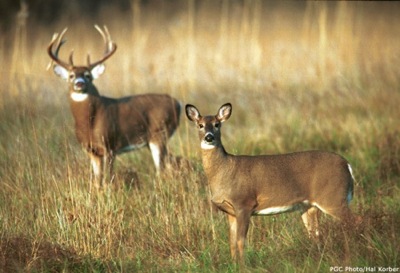
Valley Forge National Historical Park officials plan to begin culling white-tailed deer with sharpshooters in November. Pennsylvania Game Commission photo.
Barring a court order, shots will again ring out across the landscape of Valley Forge National Historical Park beginning in November as the National Park Service embarks on an effort to cull the park's white-tailed deer population.
The sharpshooters are tasked with reducing Valley Forge's deer herds from some 1,200 animals to about 165-185 during the next four years. The current phase calls for the sharpshooters to work from November through next March.
No longer the sleepy, bucolic landscape that existed when General George Washington and his troops wintered here in eastern Pennsylvania in 1777-78, Valley Forge today is surrounded by development, not the least of which is the King of Prussia Mall, one of the largest malls in the country in terms of commercial space.
With its 3,500 acres, many lush and green with vegetation, the park has become a magnet for white-tailed deer, which officials say are overrunning the vegetation.
The issue of too many deer did not arise overnight. While in 1983 there were an estimated 165-185 deer at Valley Forge, according to park research, by 2000 the herd had grown large enough that Congress directed the National Park Service to begin assessing the problem. Three years ago the park launched efforts to develop a deer-management plan, an effort that recently led the park officials to decide to employ sharpshooters and birth controls to cull and contain the herd, which peaked at 1,647 animals in 2008 before dipping to 1,277 last year.
Park officials say the culling, along with birth-control methods, should allow Valley Forge's native forests to grow and mature and at the same time improve habitat for native wildlife species such as ground- and shrub-nesting black-and-white warblers and thrushes. Fewer deer also should improve the availability of acorns in fall that help feed squirrels and other ground foragers, according to park officials.
"Over four years, sharpshooting, plus capture and euthanasia, will achieve an initial deer density goal of 31 to 35 deer per square mile from the current density of 241 deer per square mile," a park release said. "Subsequently, the park will maintain the park deer population level though reproductive control, once an acceptable agent becomes available."
While park managers believe culling and using birth control are the best approaches to managing the deer, two animal advocacy groups filed a lawsuit last November to stop that plan. In their filing, the Friends of Animals and Compassion for Animals, Respect for the Environment argued that the Park Service's approach violates the National Environmental Policy Act, as well as the National Park Service Organic Act, and even the Valley Forge National Historical Park's enabling legislation.
“Decisions under the National Environmental Policy Act cannot be based simply on seizing upon the apparently easiest answer to a perceived problem,” Lee Hall, legal director for Friends of Animals, said in an interview a year ago. “Killing deer is not the answer to the decline of plant life in a sprawling, concrete-covered suburb.”
Allison Memmo Geiger, president of CARE, added that she didn't know what was worse, “shooting deer or compromising their social and reproductive interactions by imposing birth control on them.”
And Michael Harris, a law professor at the University of Denver's Environmental Law Clinic that filed the lawsuit, said the decision runs counter to the National Park Service's preservation mission.
“For the National Park Service to enter Valley Forge National Historical Park in the cover of winter to slay white-tailed deer is not only an appalling twist on the park’s history, it is another sign that the Service has abandoned its century-old mission to strive for parks in which conservation of nature is paramount,” he said in a release.
Those groups would rather see the Park Service rely on coyotes to reduce the deer numbers. But Valley Forge officials have said they did in fact consider using predators to control the deer numbers, but discarded it as unrealistic, noting that past research has demonstrated that predators are not capable of controlling suburban deer populations.
If the culling begins in November as planned, park officials say they will employ "extensive measures to ensure a safe, humane, and successful operation include using highly qualified and experienced marksmen familiar with the park’s geography and with conducting reduction activities in a highly suburbanized environment."
"The National Park Service will work with biologists from the United States Department of Agriculture, Animal and Plant Health Inspection Service, Wildlife Services. This agency has a long history of conducting safe and effective actions to reduce wildlife populations, including the reduction of deer populations at multiple locations in the Philadelphia region," the Park Service added. "Additional safety measures include conducting population reduction actions when the park is closed, establishing safety zones, using bait to attract deer to safe removal locations, conducting shooting actions from an elevated position, and utilizing specialized, non-lead ammunition that is safe for use in urban areas and the environment."
Story Categories:
A copy of National Parks Traveler's financial statements may be obtained by sending a stamped, self-addressed envelope to: National Parks Traveler, P.O. Box 980452, Park City, Utah 84098. National Parks Traveler was formed in the state of Utah for the purpose of informing and educating about national parks and protected areas.
Residents of the following states may obtain a copy of our financial and additional information as stated below:
- Florida: A COPY OF THE OFFICIAL REGISTRATION AND FINANCIAL INFORMATION FOR NATIONAL PARKS TRAVELER, (REGISTRATION NO. CH 51659), MAY BE OBTAINED FROM THE DIVISION OF CONSUMER SERVICES BY CALLING 800-435-7352 OR VISITING THEIR WEBSITE. REGISTRATION DOES NOT IMPLY ENDORSEMENT, APPROVAL, OR RECOMMENDATION BY THE STATE.
- Georgia: A full and fair description of the programs and financial statement summary of National Parks Traveler is available upon request at the office and phone number indicated above.
- Maryland: Documents and information submitted under the Maryland Solicitations Act are also available, for the cost of postage and copies, from the Secretary of State, State House, Annapolis, MD 21401 (410-974-5534).
- North Carolina: Financial information about this organization and a copy of its license are available from the State Solicitation Licensing Branch at 888-830-4989 or 919-807-2214. The license is not an endorsement by the State.
- Pennsylvania: The official registration and financial information of National Parks Traveler may be obtained from the Pennsylvania Department of State by calling 800-732-0999. Registration does not imply endorsement.
- Virginia: Financial statements are available from the Virginia Department of Agriculture and Consumer Services, 102 Governor Street, Richmond, Virginia 23219.
- Washington: National Parks Traveler is registered with Washington State’s Charities Program as required by law and additional information is available by calling 800-332-4483 or visiting www.sos.wa.gov/charities, or on file at Charities Division, Office of the Secretary of State, State of Washington, Olympia, WA 98504.
INN Member

The easiest way to explore RV-friendly National Park campgrounds.

Here’s the definitive guide to National Park System campgrounds where RVers can park their rigs.
Our app is packed with RVing- specific details on more than 250 campgrounds in more than 70 national parks.
You’ll also find stories about RVing in the parks, tips helpful if you’ve just recently become an RVer, and useful planning suggestions.


Comments
why does the subject say Culling "ELK"
Obviously I've written too many elk culling stories from Theodore Roosevelt National Park, Rocky Mountain National Park, and Wind Cave National Park!
Thanks for the copy-editing. It has been corrected.
While growing up in SE Pennsylvania, spotting an occasional deer was exciting. Now, since living in Valley Forge for 25 years I have witnessed the deer population increase to a level where they can be seen in large numbers day and night all over and around Valley Forge Park. And, at home, very little vegetation survives on my property due to their 'round the clock activity. Most distressing, in those 25 years, 6 deer at different times have jumped into the path of, and hit my vehicles. One time nearly totaling my car, and my truck still shows the dents in the door. The deer are a big problem. A serious cull is long overdue. Introducing natural predators to the park would be far less humane than sharpshooters. Congress FINALLY did one thing right.
I think a lot of folks who read this would be a lot more comfortable if they knew what will be done with the deer after they are dispatched. 1000 deer carcasses would certainly be welcomed by homeless shelters and the like.
How are they doing this. Over at Point Reyes National Seashore, they've been taking out the non-native axis and fallow deer via helicopter.
All the meat is being donated to food pantries and food kitchens in the Harrisburg area.
Im i reading this right there going to pay someone to shoot the deer? why not charge hunters to do this and make a little money?
I don't know of many NPS areas that allow general public hunting, unless it was specifically written into establishing legislation or it's a National Preserve with slightly different reasons for being.
Kurt's article also mentions the proximity to developed areas, including the King of Prussia Mall. This is not a national forest - it's a suburb. There's a deer overpopulation issue in my heavily suburban wooded area, but nobody is suggesting allowing the general public to hunt. However - recently the Oakland Police got some bad publicity when they shot a "threatening" deer.
Hiring professional sharpshooters is probably due to a liability issue. They would be insured and would be experience enough to know when to not make a shot. I would worry about an amateur hunter perhaps getting overeager and maybe taking a shot with a higher risk of sending a stray bullet into a populated area, hitting a tourist, maybe causing damage to some of the historical buildings, or pehaps letting one fly into the Pennsylvania Turnpike.
Just check out a map of the area and see how close it is to dense housing:
http://maps.google.com/maps?f=q&source=s_q&hl=en&geocode=&q=Valley+Forge...
Please consider the reason that parks exist. It is for the rest and relaxation of our people. Everyone is welcome to use the park and to learn about the reasons for its existence. The National Parks are even more special as they commemorate people and events that are important to our people. Childeren are our future. If you have ever witnessed the pure joy a child exhibits at seeing live deer in the park, you would never want to remove a single animal. Children today have very few opportunities to see animals in their natural habital. Zoos abound, but it is anything but a natural habitat. When you go to a zoo, you expect to see animals. When you go to Valley Forge National Park, you see animals in a place where they really live and their appearance may be totally unexpected or it may simply be the chance to see the deer as you drive through the park. Each experience is magical to many adults but expecially to children. Plants are important but not in equal importance to the deer. If replanting is the only to keep the deer, please let me know and I will come to help accomplish the planting and bring as many helpers as I can find. Please don't,
"Pave paradise and put up a parking lot." Deer create problems, I am sure, but they offer a magical experience to all those who love and respect God's creatures and isn't that a happier and better goal than saving natural plants in a park meant for rest and relaxation. Please don't kill the deer.
Like I said, it's not exactly a rural area. It's bordered by housing and businesses. There are a couple of expressways and the Pennsylvania Turnpike right along the southern edge. I don't know if you've ever seen a deer get slammed by a vehicle; I have. It's bad for the deer. It's bad for the vehicle. I can especially be bad for the occupants of the vehicle. I've heard of people in the hospital for weeks after a collision with deer. Some people die. I could imagine it's also a liability issue with the NPS.
I live in a suburban neighborhood with deer. A few deer died in my parents' backyard. Frankly deer stopped being magical for me years ago. All the large predators have been driven out and there's a severe overpopulation issue. It seems like the same issue in this part of Pennsylvania. What might work is the reintroduction of mountain lions, but I'm guessing that wouldn't sit well with the neighbors.
I understand there are way too many deer in the area. There are also way too many vacant corporate parks, strip shopping centers, housing developments and so on, BUT, they just keep building more and more. I don't get how it is allowed for the developers to build brand new suburban office buildings and corporate parks, when there is a plethora of empty ones just sitting there, all over this area! Oh yah, it's the tax breaks the developers get at the cost of the rest of us. Where the heck ARE the deer supposed to go, and the red fox? It's not about to change, so I guess the answer is to just start blasting away at the wildlife. How on earth did the developers get the clearances they did to build their stupid houses INSIDE the park limits anyway? I thought the parks were for EVERYONE, not a select few who can brag their house is actually inside the park! The deer are essentially disposable creatures...simply in our way of concrete and paved progress, kind of sickening when you break it down.
My Question is, was it ever considered to tranquilze a couple truck loads of deer and transport them up in the northwest part of the state? Why wouldn't this be possible? They can tranquilze black bear and relocate them, why not at least a portion of the deer population? I have heard many hunters complain of the actual shortage of white tail deer in other parts of the state. Was it ever considered or studied and if not, then why not?