
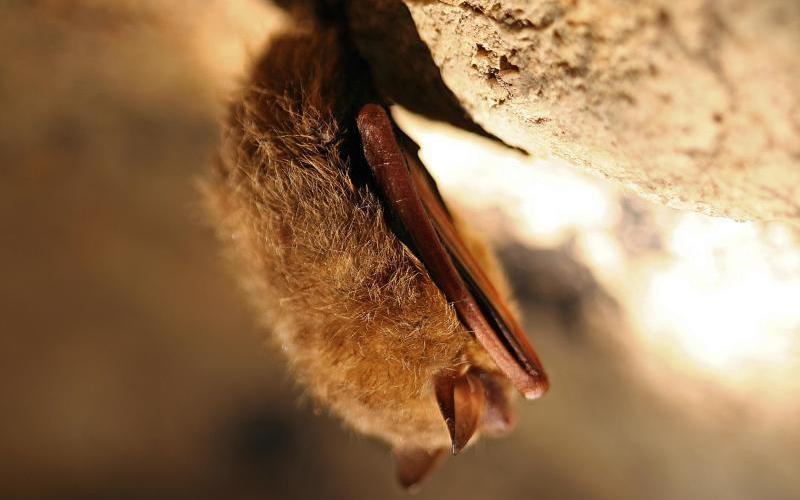
On a recent afternoon, deep in Virginia’s Shenandoah Valley and less than an hour’s drive from Shenandoah National Park, a tricolored bat was moving its mouth rapidly, as if it was trying to chew something. In fact, it was echolocating, using its mouth to shape and direct pulses of ultrasonic sound as a way to survey its surroundings.
In this case, its immediate environment was Bat Conservation & Rescue of Virginia, a private wildlife rehabilitation center. The little bat fit tidily in the palm of Leslie Sturges, founder of the center and an unabashed bat enthusiast. Sturges is caring for the bat because it is currently unable to gain sufficient altitude in flight, in the hope that someday it could be released into the wild.
This was a rare chance to get an up-close view of a Shenandoah bat species that is hard to spot in the wild for two reasons: One, the tricolored bat is the least common of the park’s nine known bat species. And two, as a state-listed endangered species, and one that has been recommended for federal endangered listing, the tricolored bat’s numbers are shrinking at an alarming rate.
A tricolored bat uses echolocation to survey its surroundings, in this case, the Bat Conservation & Rescue center in Virginia. / Kim O'Connell
Although they are often misunderstood or even feared, bats are widely variable creatures that provide essential ecosystem benefits, from eating insects (and providing natural pest control in agricultural areas) to pollinating plants in certain regions. According to the U.S. Fish and Wildlife Service, bats save the U.S. corn industry more than $1 billion per year in crop damage and pesticide costs, in just one example.
Across the country, however, bat species face numerous threats, most notably white-nose syndrome (WNS), a fatal disease caused by an invasive fungus that has wiped out or otherwise weakened numerous bat colonies, with casualties in the millions. Other threats include climate change, habitat loss, and collisions with wind turbines. Because of these threats, the nonprofit Bat Conservation International (BCI) estimates that 53 percent of North American bat species have a moderate to very high risk of extinction or elimination in the next 15 years and that 90 percent of North American bat populations have decreased or likely decreased over the past 15 years.
Ten bat species are currently listed as federally endangered, including the northern long-eared bat, Indiana bat, Florida bonneted bat, gray bat, Virginia big-eared bat, Mexican long-nosed bat, and more. “Species susceptible to white-nose syndrome, particularly little brown bat, northern long-eared bat, tricolored bat, and Indiana bat have all decreased over the last ten years,” says Dr. Rick Toomey, a cave resource specialist for Mammoth Cave National Park, home to 13 species of bats. “Some, like northern long-eared bats, are rarely seen in the park now.”
Similarly worrying decreases are happening elsewhere, too.


A sand-colored pallid bat, a Townsend's big-eared bat, a light brown tricolored bat, and a dark brown big free-tailed bat. / NPS photos
A Fatal Fungus
About 150 species of bats are endemic to North America, with more than 50 unique species found in the National Park System. The only mammal capable of true flight, bats play vital roles in their ecosystems, eating insects, and pollinating plants, in some cases, or spreading seeds. Largely nocturnal or crepuscular, meaning active in twilight, bats rule the darkness, usually offering only fleeting glimpses to keen-eyed park visitors.
“It is simply amazing," noted bat expert and author Merlin Tuttle once wrote, "how quickly attitudes improve when people finally understand bats as they really are—sophisticated, beautiful, even cute, quite aside from their crucial roles as primary predators of insects, pollinators of flowers, and dispersers of seeds.”
Although pop culture almost always portrays bats as large and black, bats come in many shapes, sizes, and colors. Park species range from the Western small-footed bat, with its yellowish-brown fur, which is found in parks such as Badlands, Rocky Mountain, and Guadalupe Mountains, to the Florida bonneted bat, one of the nation’s largest bats with a wingspan that can reach 20 inches, found in Everglades National Park and Big Cypress National Preserve. Parks with extensive cave systems, such as Mammoth Cave and Carlsbad Caverns national parks, also are popular with large bat populations.
Because so many species live in colonies and prefer caves or other enclosed spaces that serve as hibernacula, or roosting areas, white-nose syndrome can spread quickly. Thought to have originated in Europe or Asia, WNS was first discovered in New York in 2006. Caused by a fungus, Pseudogymnoascus destructans, that thrives in cold, damp places, WNS attacks the skin of bats while they’re hibernating and can lead to the appearance of a chalky white fuzz on bat faces, which gives the disease its name. Once infected, bats with WNS use up their energy stores quickly, leading to mass die-offs.
National parks that have confirmed WNS or the Pseudogymnoascus destructans fungus include Acadia, Wind Cave, Great Smoky Mountains, New River Gorge, Rocky Mountain, Olympic, and North Cascades, among others.
What is white-nose syndrome?
White-nose syndrome is a fatal disease caused by the fungus Pseudogymnoascus destructans, which has caused mass die-offs in bat populations since its introduction to North America 20 years ago. The name comes from the chalky white fuzz that appears on bats' faces when they contract the disease.
How does white-nose syndrome spread?
The Pseudogymnoascus destructans fungus that causes white-nose syndrome thrives in cold, damp places like caves, where bats prefer to roost. Because bats live in colonies, the disease spreads quickly from animal to animal and can also survive in the environment over long periods of time, infecting bats from winter to winter.
What is a hibernaculum?
A hibernaculum (plural: hibernacula) is a zoological term for an animal's preferred refuge, usually a sheltered or underground spot such as a cave, burrow, or den where animals such as bats, bears, snakes, or other creatures take shelter, often during winter, to withstand cold weather and avoid predators.
Leslie Sturges tells the story of a thriving colony of more than 1,000 little brown bats that she once monitored in a McLean, Virginia, park—which might have migrated over from Great Falls Park, a unit of the National Park System—when she lived nearby. There, the bats had taken up shelter in a series of bat boxes, which are artificial roosting sites similar to birdhouses, that had been built with local support, including a Boy Scout troop.
Bat species are often seen in urban areas as well as rural ones; even now that she is in the Shenandoah Valley, many of the bats she rehabilitates are sent to her from high-development places like northern Virginia, where natural habitat is at a premium.
“I stopped at that park on my way home, sometimes daily,” Sturges says. “A couple years after white-nose hit, I could see that they weren’t taking up all the bat boxes like they once had. Over four years, we watched them go from that thousand-plus to literally nothing. It wasn’t like they dwindled. It was just a total crash.”
WNS has now been confirmed in 40 U.S. states, and evidence of the fungus has been noted in seven more states, leaving only Alaska, Florida, and Hawaii unaffected, for now. Despite the enormity of the threat, however, there are some moderate reasons for hope.

In the next two decades, more than half of all North American bat species are estimated to have a moderate to very high risk of extinction, according to Bat Conservation International.
At left, an endangered little brown bat. / NPS
Counting And Conservation
Across the National Park System parks are working to protect bat populations in numerous ways, from closing access to certain caves and mines frequented by bats, requiring the cleaning of clothing or gear of those who entered these areas to not inadvertently spread fungus, and conducting ongoing surveying and research.
Understanding the status, location, and activity of park bat populations is critical to management and conservation. Parks collect data via several methods, including field surveys, emergence counts (where bats are counted as they leave their roosts), and mist netting, in which a very fine, nearly invisible net is used to capture bats for data collection before they are released.
At Mammoth Cave, for example, park staff count the populations of Indiana, gray, and little brown bats during their hibernation to contribute to national population data, according to Toomey. In addition to winter hibernation surveys, the park also does emergence counts in the summer months using night vision and thermal infrared technology. They work with a researcher who puts radio tags on bats to study how they use their hibernacula and move from those sites to their maternity sites in the springtime.
“Bat survey work is very labor intensive,” Toomey says. “Not only do you need to assemble a team of park employees, interns, and volunteers to conduct the counts, you also have to ensure that you have enough people and time to reach all the sometimes difficult-to-reach caves or cave passageways.”
This animated map shows the spread of white-nose syndrome over the past 20 years from its introduction in New York to the south and west. / U.S. Geological Survey
Shenandoah staff have also used acoustic monitoring, including recording bat calls, and net trapping, which has confirmed the presence of some of the park's more elusive endangered bat species. “Through these methods,” says park spokesperson Allysah Fox, “we have identified the presence of northern long-eared bats, including one maternity colony. Although Indiana bats have not been captured within the park, acoustic data suggests that they may occasionally use the park’s habitat too.”
Although surveying can bring bad news of declining populations, it also can reveal when populations are stabilizing and growing. At Mammoth Cave, for example, gray bats, evening bats, and red bats are all increasing in number or staying stable, Toomey says. He notes that he is particularly gratified with how the park restored a key gray bat roosting site in the park’s Long Cave: Where once only a handful of bats could be counted, now the site boasts more than 700,000.
"Bats face many threats, such as WNS and habitat loss, but the best way to keep their populations strong is to manage caves and other habitats they depend on in ways that keep their ecosystems healthy." — Dr. Rick Toomey
U.S. Fish and Wildlife Service photo
Collaboration And Hope
Because bats cross boundary lines, collaboration is critical. National Park Service representatives regularly collaborate with state and federal agencies, universities, nonprofits, and individuals like Sturges, who serves on a regional interagency bat conservation group, to exchange information, trend data, research discoveries, and best practices. Mammoth Cave, for one, works with the U.S. Fish and Wildlife Service, the Kentucky Department of Fish and Wildlife, and The Nature Conservancy on two large gray bat hibernation sites on lands near the park.
Scientists are also searching for ways to eradicate WNS, including a vaccine that might be sprayed on roosting bats to inoculate them against the disease, and the use of ultraviolet-C light, which has germicidal qualities, to kill the fungus in caves and passageways. Research is ongoing around the world, too. In 2025, a new bat species, Pipistrellus etula, was officially discovered on Bioko Island in Africa’s Equatorial Guinea, according to Bat Conservation International, bringing the number of known bat species worldwide to exactly 1,500.
For rehabbers like Sturges, she knows that she can’t save an entire endangered species alone, but she views her work to save individual bats as a key part of saving species as a whole. Maybe one day, she hopes, her tricolored bat will be released. It's not hard to imagine it flying across the invisible boundary into Shenandoah National Park.
"When we go running around looking for silver linings in terrible storm clouds, white-nose syndrome helped a lot with public awareness," Sturges says. "People have heard that bats are important pest control. They have heard that, elsewhere in the world, bats pollinate things. And you have organizations like Bat Conservation International that have been in the trenches for way longer than me. So I do think that, in part because white-nose syndrome has gotten a lot of press attention, bats have captured the public's imagination."
Contributing Editor Kim O'Connell writes about nature, history, and life. Her writing appears in numerous national and regional publications on topics ranging from American history to landscape architecture to conservation and sustainability to parenting. She has served as an artist in residence at both Shenandoah National Park and Acadia National Park, where she researched astronomy tourism and the ways parks are regenerative for plants, animals, and people.
This article was made possible in part thanks to the Park Foundation.
Story Categories:
A copy of National Parks Traveler's financial statements may be obtained by sending a stamped, self-addressed envelope to: National Parks Traveler, P.O. Box 980452, Park City, Utah 84098. National Parks Traveler was formed in the state of Utah for the purpose of informing and educating about national parks and protected areas.
Residents of the following states may obtain a copy of our financial and additional information as stated below:
- Florida: A COPY OF THE OFFICIAL REGISTRATION AND FINANCIAL INFORMATION FOR NATIONAL PARKS TRAVELER, (REGISTRATION NO. CH 51659), MAY BE OBTAINED FROM THE DIVISION OF CONSUMER SERVICES BY CALLING 800-435-7352 OR VISITING THEIR WEBSITE. REGISTRATION DOES NOT IMPLY ENDORSEMENT, APPROVAL, OR RECOMMENDATION BY THE STATE.
- Georgia: A full and fair description of the programs and financial statement summary of National Parks Traveler is available upon request at the office and phone number indicated above.
- Maryland: Documents and information submitted under the Maryland Solicitations Act are also available, for the cost of postage and copies, from the Secretary of State, State House, Annapolis, MD 21401 (410-974-5534).
- North Carolina: Financial information about this organization and a copy of its license are available from the State Solicitation Licensing Branch at 888-830-4989 or 919-807-2214. The license is not an endorsement by the State.
- Pennsylvania: The official registration and financial information of National Parks Traveler may be obtained from the Pennsylvania Department of State by calling 800-732-0999. Registration does not imply endorsement.
- Virginia: Financial statements are available from the Virginia Department of Agriculture and Consumer Services, 102 Governor Street, Richmond, Virginia 23219.
- Washington: National Parks Traveler is registered with Washington State’s Charities Program as required by law and additional information is available by calling 800-332-4483 or visiting www.sos.wa.gov/charities, or on file at Charities Division, Office of the Secretary of State, State of Washington, Olympia, WA 98504.
