
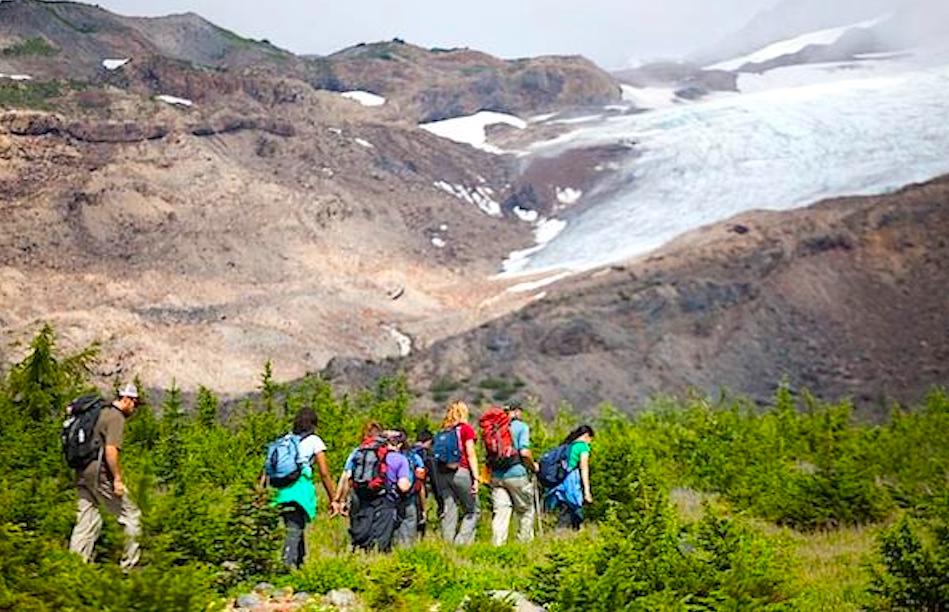
Fundraising helps nonprofit organizations such as North Cascades Institute provide environmental education in settings such as North Cascades National Park/Ethan Welty
A report that highlighted flaws with how the National Park Service oversees Residential Environmental Learning Centers mischaracterized how those nonprofit operations work and failed to reflect the benefits they bring to the parks and their visitors, according to some of the organizations that operate those centers.
There are 18 environmental learning centers across the National Park System, from NatureBridge operations in a handful of parks and the North Cascades Institute at North Cascades National Park to the Cuyahoga Valley Institute at its namesake park and Yellowstone Forever in Yellowstone National Park. Some of these nonprofit centers date to the 1960s, when they were welcomed by the National Park Service to provide environmental education in park settings.
These nonprofit organizations offer programs that last anywhere from a day to two weeks or more in some of the grandest natural settings in the world: Yosemite National Park's iconic valley, the Inner Gorge of Grand Canyon National Park, the glaciated roof of North Cascades National Park, the tangle of forests in Great Smoky Mountains National Park, and North America's Serengeti, the northern sweep of Yellowstone National Park.
The value of their work was underscored in Richard Louv's 2006 book, Last Child in the Woods. In it Louv painted not only a disturbing picture of how the United States was losing bits and pieces of its natural landscape, but also how it was failing youth by not working harder to introduce them to nature.
America's frontier, he wrote, "which existed in the family farm, the woods at the end of the road, the national parks, and in our hearts, is itself disappearing or changing beyond recognition." A few pages later Louv added that, "In the space of a century, the American experience of nature has gone from direct utilitarianism to romantic attachment to electronic detachment."
"Urban children, and many suburban children, have long been isolated from the natural world because of the lack of neighborhood parks, or lack of opportunity -- lack of time and money for parents who might otherwise take them out of the city," wrote Louv. "But the new technology accelerates the phenomenon."
The environmental education centers work to reverse that concerning trend. They introduce inner city elementary school students to nature and science, instruct high school students in environmental education and team building, and in some cases work with college students on master's programs. For example:
* North Cascades Institute, with help from the National Park Foundation and North Cascades National Park, in 2009 shepherded a diverse group of 19 high school students from Chicago, Washington, D.C., Denver, San Francisco, and Seattle through the national park for a month. While the program's official title was Parks Climate Challenge: North Cascades 2009, the students not only were introduced to the science and impacts of climate change visible at North Cascades, but also sampled the out-of-doors - the forests, the lakes, the streams.
* NatureBridge's programs revolve around four core areas: academics, leadership, stewardship, and team building that can be customized based on a teacher's desires.
* The Great Smoky Mountains Institute at Tremont, Tennessee, has offered more than 30 programs ranging from photography to a Backcountry Ecological Expedition, which enabled teens to contribute to the All-Taxa Biodiversity Inventory in Great Smoky Mountains National Park during week-long backcountry trips.
* The Schoodic Institute at Acadia National Park partners with the National Park Service on science and education initiatives to provide students and participants of all ages opportunities to contribute to research that provides information valuable to Acadia and the region. Students early in their college careers also can land internships working alongside scientists.
These operations are supported through grants from the National Park Service, in some cases through utilizing park facilities, and through an organization's own fundraising. But a bit more than two years ago Public Employees for Environmental Responsibility questioned the centers' financial models and asked the Interior Department's Office of Inspector General to evaluate the propriety of RELC operations and fundraising, as well as how the Park Service monitors and audits their operations.
"PEER believes that many of the RLC activities are contrary to law and are supported by improper yet substantial monetary and in-kind taxpayer subsidies," read part of the request sent in October 2017 by Jeff Ruch, then PEER's executive director and now its Pacific director. "We believe that the National Park Service has been bypassing the typical contract requirements designed for non-governmental service providers within national parks. In addition, many of the RLCs are providing services that are not educational and mirror the services provided by concessioners, thus circumventing the requirements of the National Park Concessions Management Improvement Act, the Cooperative Agreement Act, and the National Park Service and Related Programs Act."
In its 33-page report, issued shortly before Christmas, the OIG "found that the NPS did not ensure that all activities and services provided by the RELCs complied with agreements, statutes, and regulations."
Additionally, OIG concluded that the Park Service over the years didn't always use the proper regulatory authorities to permit RELC activities; some, such as hosting weddings, seemed to stray from an organization's environmental education mission.
The Inspector General's findings reflected not only a failure by the Park Service to properly monitor the operations, but also a lack of understanding by some of the nonprofits as to exactly what they were required to report to the Park Service on an annual basis. But the OIG also indicated that some of the reporting failures might have been the Park Service's fault, not that of the RELCs.
In one region of the Park Service, according to the OIG report, while financial assistance staff had created an email account for RELCs in its region to send their financial reporting documents to, "no one monitored the e-mail account, and thus they were unsure which recipients were in compliance."
Officials at RELCs contacted by the Traveler agreed the Park Service needed to address the various operational policies that have been used over the decades to permit the education centers to work in park settings. But they strongly disagreed with PEER's contention that they were being "subsidized" by the federal government and profiting illegally.
While the OIG report stated that RELCs were required to reduce their federal funding grants by any program revenues they generated, some RELC officials told Traveler they were never told of that expectation, while others said it would be impractical to expect the centers to be financially viable if they couldn't raise money on top of the federal grants.
"All NPS RELCs are operated by nonprofit park partners that depend on business models that require a wide range of earned and contributed income throughout the year," Saul Weisberg, co-founder and executive director of the North Cascades Institute, told the Traveler. "Collectively, the RELCs raised more than $78 million through fundraising efforts alone from 2013 through 2017 to support school, youth, adult and family educational programs in the parks."
Weisberg pointed out that during the five years' of his organization's operations that OIG reviewed, "the NPS provided funds in three years, representing 13 percent of the total program cost. The remaining balance was supported by North Cascades Institute from additional contributions, grants, and earned income."
While he said his staff tracks the revenue flows to "guarantee that no program is overfunded," he also welcomed a review of the Park Service's policies and permitting requirements for the environmental centers. Weisberg also pointed out that while the OIG report claimed "the NPS has never received an SF-425 (financial reporting form) from the NCI," the institute submitted those reports "every year as required. We have copies of the reports submitted and email correspondence with NPS officials."
North Cascades Institute does host four weddings a year, said Weisberg, adding that the affairs "bring in some of our most diverse audiences. Every wedding group is offered activities including park orientation, morning nature walks, introduction to national parks and public lands, watershed/climate change, campfire activities, etc. As in all of our conferences and retreats, all net proceeds support youth education programs in the park."
At Cuyahoga Valley in Ohio, Deb Yandala, CEO of the Cuyahoga Valley Conservancy, said Park Service officials encouraged fundraising the group's efforts, as "this is what allows us to provide reduced cost and free programs to many urban youth."
Yandala also took strong exception to the OIG report's contention that some of the RELCs were operating under "inappropriate" agreements.
"We are fully transparent with our NPS leaders, locally and nationally. The issue is the need for the right tools that allow us to do the important mission-oriented work of both the NPS and our organization," she told the Traveler. "We are stewards of the facilities and dollars assigned to us and we aim to serve as many people as possible in giving them a quality national park experience.
"In our case, many of the children we serve—45 percent are supported through our fundraising efforts—are from urban school districts and this may be the only national park they visit," she added. "For these children, a residential environmental education experience in a national park is truly life changing—many call it the 'best week of their life.' We need the ability to have a healthy financial model that will sustain this work."
Yandala also said her organization routinely filled out the required financial reporting forms and submitted them to the Park Service.
"If we have filled out the forms incorrectly, this is the first time that we have been told this," she said.
NatureBridge has been operating since 1971 to connect youth with the outdoors, with operations in Yosemite and Olympic national parks as well as Golden Gate National Recreation Area, Prince William Forest Park, and Santa Monica Mountains National Recreation Area. While it does offer to host weddings at some locations, revenue generating from such special events are put back into the daily operations, the group said.
"As a nonprofit, public benefit organization, all dollars raised by NatureBridge, including from generous donors and weddings, are invested in delivering transformational environmental education programs in national parks to America’s youth," Claire Martin, the organization's communications assistant, told the Traveler. "NatureBridge is responsible for the maintenance of NPS facilities from which it operates, thereby decreasing the maintenance backlog for the National Park Service.
"In the 2018-19 school year, NatureBridge provided $1.2 million in scholarship support to connect kids to their national parks," she added. "We are grateful to the National Park Service for nearly 50 years of partnership and will continue to work with our park partners and the Office of the Inspector General to ensure our programs and activities benefit this and future generations, including the more than 30,000 kids served by NatureBridge each year."
In Maine at the Schoodic Institute, Nicholas Fisichelli said the organization since its inception in 2004 has "worked hard and collaboratively to consistently comply with all of the National Park Service requirements and policies as we and our partners at the park and the regional NPS office have understood them. As a non-profit organization committed to science and education, we have worked closely with the NPS in all of our work, and sought to be completely transparent about our costs and income."
As did Yandala at Cuyahoga Valley, Fisichelli, Schoodic's interim president and CEO, said his organization was unaware that it was supposed to offset its federal grant dollars by revenues it raised through conferences or other fundraising programs. "We are seeking guidance from the NPS on the OIG conclusions regarding the offset," he said.
In response to the OIG findings, Park Service officials said the agency was:
* Reviewing the various RELC agreements with Interior attorneys to "determine the appropriate legal vehicle(s) that should authorize services and activities in each location;"
* Also working with legal staff to determine whether other contractual documents were needed to address RELC activities;
* Working to clarify which services and activities the RELCS may provide, and;
* Clarifying the annual financial filing responsibilities of RELCs.
It also reported that it had revised its financial reporting documents to include a mandatory section for RELCs to report program income. However, the OIG was not convinced that the Park Service had implemented a process to ensure that RELCs comply with financial auditing requirements.
Traveler footnote: North Cascades Institute in the past has been a financial supporter of National Parks Traveler, and Traveler Editor Kurt Repanshek was hosted at the Schoodic Institute this past summer to speak at a scientific education conference.
Stories about:
Story Categories:
A copy of National Parks Traveler's financial statements may be obtained by sending a stamped, self-addressed envelope to: National Parks Traveler, P.O. Box 980452, Park City, Utah 84098. National Parks Traveler was formed in the state of Utah for the purpose of informing and educating about national parks and protected areas.
Residents of the following states may obtain a copy of our financial and additional information as stated below:
- Florida: A COPY OF THE OFFICIAL REGISTRATION AND FINANCIAL INFORMATION FOR NATIONAL PARKS TRAVELER, (REGISTRATION NO. CH 51659), MAY BE OBTAINED FROM THE DIVISION OF CONSUMER SERVICES BY CALLING 800-435-7352 OR VISITING THEIR WEBSITE. REGISTRATION DOES NOT IMPLY ENDORSEMENT, APPROVAL, OR RECOMMENDATION BY THE STATE.
- Georgia: A full and fair description of the programs and financial statement summary of National Parks Traveler is available upon request at the office and phone number indicated above.
- Maryland: Documents and information submitted under the Maryland Solicitations Act are also available, for the cost of postage and copies, from the Secretary of State, State House, Annapolis, MD 21401 (410-974-5534).
- North Carolina: Financial information about this organization and a copy of its license are available from the State Solicitation Licensing Branch at 888-830-4989 or 919-807-2214. The license is not an endorsement by the State.
- Pennsylvania: The official registration and financial information of National Parks Traveler may be obtained from the Pennsylvania Department of State by calling 800-732-0999. Registration does not imply endorsement.
- Virginia: Financial statements are available from the Virginia Department of Agriculture and Consumer Services, 102 Governor Street, Richmond, Virginia 23219.
- Washington: National Parks Traveler is registered with Washington State’s Charities Program as required by law and additional information is available by calling 800-332-4483 or visiting www.sos.wa.gov/charities, or on file at Charities Division, Office of the Secretary of State, State of Washington, Olympia, WA 98504.
INN Member

The easiest way to explore RV-friendly National Park campgrounds.

Here’s the definitive guide to National Park System campgrounds where RVers can park their rigs.
Our app is packed with RVing- specific details on more than 250 campgrounds in more than 70 national parks.
You’ll also find stories about RVing in the parks, tips helpful if you’ve just recently become an RVer, and useful planning suggestions.


Comments
Defend those sponsors!
I agree with those pushing back on this on this one. Yes, the RELC's used the wrong forms basically. But nothing was illegal or even against policy. Not sure it warranted the amount of money spent to conduct the investigation by the OIG. I actually think the OIG should list the amount of money their investigations cost as part of their public report release. Transparency there might be good to see.
As with many things...there is often a desire to grab a headline rather than solve a problem. This is another one of those instances.
Thanks for this article, for pointing out the misdirection of this investigation and for publishing some of the rebuttal to the findings from some of the RELC leaders who have dedicated their careers to the parks that they serve through building these valuable programs.
These RELCs exist to support the NPS mission and do and outstanding job of engaging people with the national parks through in-depth experiences within the parks they serve. RELC programs create champions for the parks and do so with very little funding. Their staffs work alongside NPS staff but receive a fraction of the salary and benefits that their NPS colleagues do.
They operate with budgets that make the most of the dollars they are able to earn or raise, putting it all back into their programs, in support of the parks they exist to serve. They do not "profit" from these funds but the park's profit from the increased number of people that are impacted by RELC programs. Investigate what these non-profit RELCs produce per dollar versus what NPS can do within the same and you will find a significant benefit provided as well as good reason for the federal government and NPS to give all the support they can to help these organizations be successful.
I have witnessed the value of these programs, the impact that they have on their participants, and the significant benefit that they provide to the people, and parks they serve. I worked as a RELC and Cooperating Association leader for 34 years. I've known and worked alongside many RELC leaders and can speak to their passion and dedication to our parks, public lands, and connecting people to our public lands in life-changing ways. I have also worked both alongside and as an employee with an NPS concessionaire and now in retirement as an NPS seasonal ranger. I have worked with many talented NPS staff who saw the value of their relationship with RELCs and have sought to support and build those relationships and programs.
This is critical work and more parks could benefit from more RELCs. I hope that NPS will use this OIG report to further strengthen their ability to support RELCs and enhance the ability of NPS and RELC staff to work together to meet today’s and future generations of park visitors where they are, engaging them in meaningful ways.
Thanks again,
Ken Voorhis
Nicely put Ken. Good for the RELCs and glad they pushed back on the OIG on this report. If only the NPS leadership would ever do the same.
What a load of hooey from the above accounts and it's not like NPT actually reported the OIG report separately then allowed the RELCs to respond. Instead, this site went into immediate spin on behalf of people to which this site and its owners feel kinship (monetary or spiritual).
This is unsurprising as most of the RELCs and their leaders trade on affinity fraud with wealthy and well-educated (though not actually intelligent) white visitors. How else would a place like NCI get away with charging exorbitant program and event rates when a not insubstantial part of their program staff are paying for the privilege of working there through enrollment in an expensive and mostly worthless M.Ed. program.
There's no crime of the century here; but, this isn't really just about RELCs using the wrong forms.
The RELCs are supposed to be official adjuncts of the NPS, which is why exist at all and why they are allowed to operate in the federal visitor centers. Their educational mission is supposed to be focused on the kind of educational experiences that 1) are, in some way, effectively unique to the park in which they operate and that 2) federal rangers or other federal personnel would offer as part of the park's mission if the agency were properly funded. These nonprofits only exist because the agency is not properly funded and only properly chartered to engage in activities that the agency would do if it had sufficient funding. In that context, nature walks, field seminars, and classroom sessions focusing on unique or special park resources or the particular reasons that a specific park was designated are all core elements of a RELC's mission because they are park focused and especially relevant to being taught in the park.
I can't think of a single NPS asset that was designated because of its focus on weddings, cocktail parties, and other such anthropocentric flibberty gibbetry. Those activities can and properly do take place in other places, like Vegas or the nearest gateway community church, hotel, or courthouse or even in the park in the lobby of a concessionaire operated lodge. However, regardless of how generous the NPS budget might hypothetically get, I can't imagine those activities being considered appropriate parts of the duties of federal personnel. In fact, I can imagine the public raising a royal and fully justified stink, complete with GAO and OIG investigations, at the very thought of NPS Rangers involved in officiating at, catering, supervising, planning, or otherwise arranging weddings, cocktail parties, or other such anthropocentric flibberty gibbetry. Those are not the jobs of federal personnel and they're not the jobs of their official adjuncts either. In fact, I'm surprised that certain elements of the private sector haven't already raised a stink about unfair federal competition because, technically and contrary to what you might believe, market competition with the private sector by the federal government generally is illegal and almost always against policy.
Sure, the park nonprofits are supposed to raise funds for the park; but, they're supposed to do it a manner that assists, augments, and extends the proper functions of the federal government with a particular emphasis on parts of the educational mission of the NPS that the agency is not adequately supported to accomplish. Operating bookstores that provide maps, guides, books, and educational games that encourage learning about the park and related issues meets those criteria; providing the aforementioned nature walks, field seminars, and classroom sessions focusing on unique or special park resources meets those criteria; but, hosting weddings, cocktail parties, or other such anthropocentric flibberty gibbetry doesn't really meet those criteria. If it did, then we could expect some of the RELCs to soon be proposing race tracks and casinos on what their management sees as underutilized park lands and I'm sure local interests would consider that to be illegal competition with private business.
So, this isn't just some desire to grab a headline; it's probably a sincere effort to get RELCs back to focusing on their proper educational mission, which is to bolster the beleaguered state of serious education in America, not searching for an Elvis impersonator for their next nouveau riche shindig at their newly renovated Little Chapel of the Extinct Butterflies and Forgiven Invasives.
Dear Col, it would have been irresponsible to simply report the guts of the OIG report and point fingers at the RELCs without letting them comment. The fact that the report came out during "dead week," that period between Christmas and New Year's when most folks are out of the office, added to the lag in our report. To put the report out and let the allegations stew unanswered for more than a week would have been irresponsible and maligning.
Perhaps if you used your real name and organization we'd have better insights into your concerns.
As a retired NPS ranger and North Cascades resident at the eastern gateway, I can attest to the validity of Saul Weisberg's responce.