
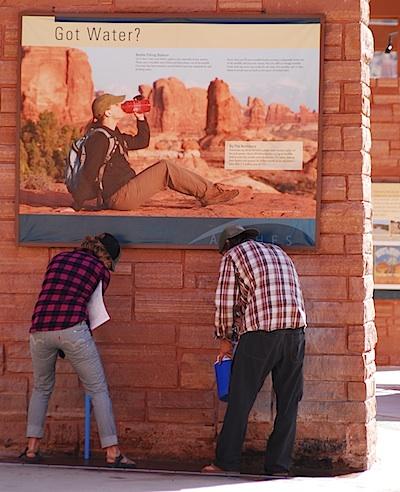
A sidenote to the omnibus appropriations bill that is keeping the federal government running through September contains a single sentence that directs the National Park Service to lift its ban on the sale of disposable water bottles in parks. However, it's not legally binding.
The battle over bottled water dates to December 2011, when then-National Park Service Director Jon Jarvis gave park superintendents the option to impose a ban in a move to reduce litter in the parks and waste in landfills. Since then, at least 22 parks have banned their sale, and installed water stations for visitors to refill their reusable bottles and hydration packs.
But the move was never popular with the bottled water industry, and their lobbyists found allies in Congress to push back against the Park Service ban. Indeed, even before Director Jarvis agreed to a ban, the Park Service's commitment to a green environment was partially derailed when Coca Cola in November 2011 raised concerns over plans to ban disposable water bottles at Grand Canyon National Park with the National Park Foundation and Director Jarvis, who initially blocked the ban.
The bottle ban had been in the works for some time. In anticipation of it, Grand Canyon crews early in 2011 installed nine free water stations throughout the park at a cost of more than $300,000, according to calculations made at the time by Public Employees for Environmental Responsibility. Six were installed on the South Rim, three on the North Rim.
In coming around to agree to a ban of disposable plastic water bottles, Director Jarvis cited the Park Service's Green Parks Plan, which had a goal of reducing waste in the parks, in part by offering water bottle refilling stations in at least 75 percent of park visitor centers by 2016, the year the agency marks its centennial. (Note: The NPS failed to reach that goal.)
As for banning the sale of disposable plastic bottles, the director outlined three steps superintendents must take to implement a ban: "Complete a rigorous impact analysis including an assessment of the effects on visitor health and safety, submit a request in writing to their regional director, and receive the approval of their regional director."
In his correspondence to the field, Director Jarvis touched on the "symbolism" of banning the bottles from national parks, but also noted the potential consequences of such a move.
"Banning the sale of water bottles in national parks has great symbolism, but runs counter to our healthy food initiative as it eliminates the healthiest choice for bottled drinks, leaving sugary drinks as a primary alternative," he wrote. "A ban could pose challenges for diabetics and others with health issues who come to a park expecting bottled water to be readily available.
"For parks without access to running water, filling stations for reusable bottles are impractical. A ban could affect visitor safety; proper hydration is key to planning a safe two-hour hike or a multi-day backcountry excursion. Even reasonably priced reusable water bottles may be out of reach for some visitors, especially those with large families.
"For these reasons, the National Park Service will implement a disposable plastic water bottle recycling and reduction policy, with an option to eliminate sales on a park-by-park basis following an extensive review and with the prior approval of the regional director."
Since that directive went out, there have been occasional moves to force the Park Service to lift the ban.
Early in 2013 the bottled water industry pushed back against the ban, saying it would encourage visitors to turn to unhealthy alternatives to quench their thirsts. According to the International Bottled Water Association, research shows that in the absence of bottled water products, "63 percent of people will choose soda or another sugared drink – not tap water."
In 2015, the House of Representatives approved an amendment to overturn the ban, but then the bill it was attached to, the House Interior Appropriations bill, was pulled back due to a fight over whether Confederate flags could be displayed at national cemeteries. The Bottled Water Association at the time said the House's move to overturn the ban "is a vote for public health and safety."
Then last year the funding bill for the Interior Department drafted by the House contained language that would have blocked the Park Service from using its budget to enforce the bottle ban.
And now this year, in a report that accompanied the omnibus appropriations bill, a note directed the Park Service to put a hold on the ban.
Bottled Water.-The Committees note continued expressions of concern relating to a bottled water ban implemented under Policy Memorandum 11-03. The report provided to the Committees in April 2016, in response to a directive in the explanatory statement accompanying Division G of the Consolidated Appropriations Act, 2016, did not provide sufficient data to justify the Service' s actions. The Committees understand that the Service plans to reconsider this policy and therefore directs the incoming National Park Service Director to review Policy Memorandum 11-03 and to report to the Committees on the results of this evaluation. Accordingly, the Committees direct the Service to suspend further implementation of Policy Memorandum 11-03 and urge the Service to examine opportunities to partner with non-govemmental entities in developing a comprehensive program that uniformly addresses plastic waste recycling system-wide.
Technically, though, since that language was contained in the report and not the actual legislation, it's not binding on the Park Service to follow it. That said, when a new director for the Park Service is appointed, he/she is expected to review the policy, according to agency spokesman Tom Crosson.
Story Categories:
A copy of National Parks Traveler's financial statements may be obtained by sending a stamped, self-addressed envelope to: National Parks Traveler, P.O. Box 980452, Park City, Utah 84098. National Parks Traveler was formed in the state of Utah for the purpose of informing and educating about national parks and protected areas.
Residents of the following states may obtain a copy of our financial and additional information as stated below:
- Florida: A COPY OF THE OFFICIAL REGISTRATION AND FINANCIAL INFORMATION FOR NATIONAL PARKS TRAVELER, (REGISTRATION NO. CH 51659), MAY BE OBTAINED FROM THE DIVISION OF CONSUMER SERVICES BY CALLING 800-435-7352 OR VISITING THEIR WEBSITE. REGISTRATION DOES NOT IMPLY ENDORSEMENT, APPROVAL, OR RECOMMENDATION BY THE STATE.
- Georgia: A full and fair description of the programs and financial statement summary of National Parks Traveler is available upon request at the office and phone number indicated above.
- Maryland: Documents and information submitted under the Maryland Solicitations Act are also available, for the cost of postage and copies, from the Secretary of State, State House, Annapolis, MD 21401 (410-974-5534).
- North Carolina: Financial information about this organization and a copy of its license are available from the State Solicitation Licensing Branch at 888-830-4989 or 919-807-2214. The license is not an endorsement by the State.
- Pennsylvania: The official registration and financial information of National Parks Traveler may be obtained from the Pennsylvania Department of State by calling 800-732-0999. Registration does not imply endorsement.
- Virginia: Financial statements are available from the Virginia Department of Agriculture and Consumer Services, 102 Governor Street, Richmond, Virginia 23219.
- Washington: National Parks Traveler is registered with Washington State’s Charities Program as required by law and additional information is available by calling 800-332-4483 or visiting www.sos.wa.gov/charities, or on file at Charities Division, Office of the Secretary of State, State of Washington, Olympia, WA 98504.
INN Member

The easiest way to explore RV-friendly National Park campgrounds.

Here’s the definitive guide to National Park System campgrounds where RVers can park their rigs.
Our app is packed with RVing- specific details on more than 250 campgrounds in more than 70 national parks.
You’ll also find stories about RVing in the parks, tips helpful if you’ve just recently become an RVer, and useful planning suggestions.


Comments
Nothing wonderous about. Its called doing research rather than spouting off baseless speculation.
As to your linked propaganda, I am not concerned about any of those issues and apparently neither are the people that buy 50 billion plastic bottles a year.
"I am not concerned about any of those issues and apparently neither are the people that buy 50 billion plastic bottles a year. "
Yup. That has been made nauseatingly clear for a long time. But some people in America do care. Some of us are sincerely interested in being good stewards of our little planet.
Now we need to figure out how to go about educatiing those who don't.
By the way, how many cubic yards of landfill would be required to handle 50 billion plastic bottles? You just provided one more good reason to ban the things.
Meanwhile, for those out there who do care, here is a link to some "propaganda" provided by one of America's largest waste management companies. I guess to some folks, facts are dismissed as propaganda. But to those who are capable of understanding the mess we've made for ourselves, facts do matter. https://www.wm.com/location/california/ventura-county/west-hills/recycle...
Careful reading of this shows that plastics DO have some distinct advantages over other materials. But that does not mean we can use them without accepting responsibility for that use any more than we can be irresponsible with fire in a dry forest. Our use of any natural or man-made resources needs to be guided by common sense and wisdom.
Then, there is this: In a lifetime the average American will throw away 600 times the amount of his or her adult weight in garbage. For example, a 150 pound adult will leave a trash legacy of 90,000 pounds.
Some of us are trying not to be "average." We can do better.
About 5 million cubic yards or less than 1% of our annual landfill load. And that is assuming no recycling.
By the way, fueling 1.3 million cars would be .49% of the fuel spent on cars and fueling 190,000 homes would be .15% of the homes.
The numbers may sound big but they are insignficant when put into full context. And of course the NPS share of those 50 billion bottles is miniscule.
He just doesn't care. Period.
Rick; ebuck is the kind of person who HAS to be right. I admire and thank you for your writings but he will never stop. Horrible person. I've written to Kurt about him, he really makes this website uninviting. I am a Yosemite campers (60 years) and used to enjoy all the information and comments. Not so much anymore. Again, thanks for putting up a good fight.
I hate to chime in so late on a topic whose sides are so entrrenched. Still, having just returned from several days at the North Rim Grand Canyon (so much more than this argument!), I felt like the message there was being appropriately conveyed. A multi spigot water station with clear educational graphics was one of the first things seen when coming from the parking lot . . . And it was well used, including refilling storebought bottles. . . hey, if it works. . . As with so much in our society -- environmental and otherwise -- education is the key.
This is Rick B, on a Kindle in a relative's fancy car with a mobile WiFi hotspot, but without my passwords. I'm typing with fat fingers on a touchscreen so please forgive typos.
Yesterday we visited a tiny NPS site, Ulysses S Grant NHS in St Louis. The drinking fountaIn in the visitor center had a spigot above with a backplate showing where to place your refillable bottle for water. These things aren't too hard, unless you have an investment in plastic bottles.
Last post is the link to the NPS report to Congress that ebuck asked for a link to. A read shows that it doesn't say what some (PEER and others) have claimed it does about actual reductions.
So Kurt, it looks like the NPS didn't lie to Congress, PEER lied to us.
Pages