
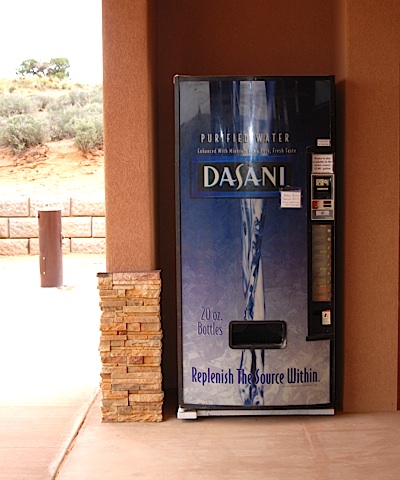
Well-placed marketing. At the Island in the Sky Visitor Center at Canyonlands National Park, you can buy bottled water right at the front door....or walk about 20 feet to the free water spout (that cylindrical feature in the background) nearby. Kurt Repanshek photo.
Efforts to showcase the National Park Service's commitment to a green environment were partially derailed when Coca Cola raised concerns over plans to ban disposable water bottles at Grand Canyon National Park with Park Service Chief Jon Jarvis, who blocked the ban.
Coca Cola officials approached both the agency directly and the National Park Foundation with its concerns, according to a report in the New York Times. Coca Cola is a major player in bottled water through its Dasani brand.
Park Service spokesman David Barna told the Times that Mr. Jarvis made the “decision to put it on hold until we can get more information.”
"Reducing and eliminating disposable plastic bottles is one element of our green plan," Mr. Barna added. "This is a process, and we are at the beginning of it.”
In a bid to see if any undue influence was wielded, Public Employees for Environmental Responsibility today filed a lawsuit to obtain Park Service correspondence related to the matter.
"Why in the world would the Park Service director swoop down at the last minute to veto a common-sense conservation measure that a park had spent significant taxpayer dollars to implement?” asked PEER Executive Director Jeff Ruch, noting that Director Jarvis often speaks about climate change and how national parks need to “teach us how we relate to the natural world.”
“In this agency, when a matter goes under ‘director’s review’ it never reemerges – in other words, the bottle ban is likely dead," the PEER official said.
Reportedly among the director's concerns was how a ban would impact the safety of visitors to dry, arid Southwest parks such as Grand Canyon, Zion, and Canyonlands.
The bottle ban had been in the works for some time. In anticipation of it, Grand Canyon crews early in 2011 installed nine free water supply stations throughout the park at a cost of more than $300,000, according to PEER calculations. Six were installed on the South Rim, three on the North Rim.
In addition to the NPS filling stations, Delaware North Companies’ Desert View and Canyon Village Marketplaces also installed their own in-store, water bottle filling stations. The new filling stations augment the water already available from sinks and water fountains in buildings and facilities throughout the park.
Some existing water fountains were also being equipped with bottle filling spigots. All of the water available at sinks, faucets, water fountains and filling stations can be used to fill bottles free of charge and is pure Grand Canyon spring water from the park’s “approved public water supply,” located at Roaring Springs on the North Rim.
The filling stations were part of a green initiative being implemented to encourage park visitors and residents to think about the environmental impacts of the choices they make every day, starting with the water they drink.
“The amount of litter associated with disposable water bottles has been increasing along park trails and walkways. It’s one of the major contributors of trash below the rim, and it’s currently estimated that disposable water bottles make up as much as 30 percent of the park’s solid waste stream," Tim Jarrell, the park's chief of facilities management, said last March.
Park concessioners, retailers, and cooperating association bookstores (Xanterra South Rim, LLC, Delaware North Companies Parks & Resorts at Grand Canyon, Inc., Forever Resorts, L.L.C., and the Grand Canyon Association) also said they would sell reusable water bottles at a variety of price points in their facilities throughout the park.
According to the Times' story, the National Park Foundation's chief executive officer, Neil Mulholland, confirmed that Coke officials had approached him with concerns about the bottle ban, but did not threaten to withhold its donations to the foundation if nothing was done.
“There was not an overt statement made to me that they objected to the ban,” Mr. Mulholland told the newspaper. “There was never anything inferred by Coke that if this ban happens, we’re losing their support.”
PEER officials, however, questioned that position, saying a major gift from Coke was contingent on the ban being lifted.
“It would be outrageous if corporate contributions are influencing national park management decisions,” stated Mr. Ruch, noting that Director Jarvis has called for creation of a billion dollar endowment drawn largely from corporate donors.
“As the Park Service expands its dependence on corporate largesse, we need to make doubly sure that no strings that come attached. The circumstances of these gifts and how they are used should be on the public record.”
Coca Cola officials, meanwhile, told the Times bans are never right, that those moves "don't necessarily address the problem."
Story Categories:
A copy of National Parks Traveler's financial statements may be obtained by sending a stamped, self-addressed envelope to: National Parks Traveler, P.O. Box 980452, Park City, Utah 84098. National Parks Traveler was formed in the state of Utah for the purpose of informing and educating about national parks and protected areas.
Residents of the following states may obtain a copy of our financial and additional information as stated below:
- Florida: A COPY OF THE OFFICIAL REGISTRATION AND FINANCIAL INFORMATION FOR NATIONAL PARKS TRAVELER, (REGISTRATION NO. CH 51659), MAY BE OBTAINED FROM THE DIVISION OF CONSUMER SERVICES BY CALLING 800-435-7352 OR VISITING THEIR WEBSITE. REGISTRATION DOES NOT IMPLY ENDORSEMENT, APPROVAL, OR RECOMMENDATION BY THE STATE.
- Georgia: A full and fair description of the programs and financial statement summary of National Parks Traveler is available upon request at the office and phone number indicated above.
- Maryland: Documents and information submitted under the Maryland Solicitations Act are also available, for the cost of postage and copies, from the Secretary of State, State House, Annapolis, MD 21401 (410-974-5534).
- North Carolina: Financial information about this organization and a copy of its license are available from the State Solicitation Licensing Branch at 888-830-4989 or 919-807-2214. The license is not an endorsement by the State.
- Pennsylvania: The official registration and financial information of National Parks Traveler may be obtained from the Pennsylvania Department of State by calling 800-732-0999. Registration does not imply endorsement.
- Virginia: Financial statements are available from the Virginia Department of Agriculture and Consumer Services, 102 Governor Street, Richmond, Virginia 23219.
- Washington: National Parks Traveler is registered with Washington State’s Charities Program as required by law and additional information is available by calling 800-332-4483 or visiting www.sos.wa.gov/charities, or on file at Charities Division, Office of the Secretary of State, State of Washington, Olympia, WA 98504.


Comments
Would hate to see people gample on their health by making a choice not to buy water instead of spening $10 on a reuable bottle. Also, keep in mind that the small plastic bottles out of a machine are reusable.
Interesting. It seems that Jon Jarvis’s
hand is frequently seen near the cookie jar.
/2011/10/national-park-superintendent-and-his-questionable-real-estate-deal8860
Isn't there a better way to solve the problem than banning water bottles in the desert? How about invest in a recycling program instead? I mean, what are hikers supposed to do for water, especially non-serious hikers? Invest $100 for a water backpack or a bunch of recyclable bottles, buy water outside the park and fill them? So, I couldn't go into a store on either rim and buy a bottle of water? Really? Clearly, the ban was not thought out well. And, I was just at the Grand Canyon and did not see any signs of trash around. People are pretty good about putting their trash in trash cans, especially at national parks.
"...a bunch of recyclable bottles, buy water outside the park and fill them?"
Not sure if you read the story completely, as it spells out all the locations that waters spigots for refilling water bottles are located, including the new ones that were built as well as the ones that the park concessionaires installed in all of their facilities.
Plus, all the water in the park comes from the same drinking source, so even bathroom faucets can be used to refill water bottles.
And you wouldn't need to buy "a bunch of recyclable bottles" as one 32oz reusable bottle will last much longer than buying multiple smaller vending machine bottles.
In a way, I think it would make safety stronger at the park, as many "non-serious hikers" carry just one or two of those little vending machine bottles out with them on hike, not knowing that is not enough water in the desert. I am sure a review of the logs could show that many rescue calls are for exhuastion due to dehydration. If people actually bought reusable (i.e. larger capacity Nalgene, etc) and not small recyclable bottles, they would have enough water for their trek.
Zion has a fine approach. At several places around the park you can find water bottle filling stations with interpretive signs explaining the environmental costs of disposable bottles. There were no water vending machines there. (And I hope this is still true.)
Yet at Hovenweep, there is a water bottle vending machine beside the VC front door. That was a shocker. It's really pretty pathetic when our national parks are so desperate for dollars that they must resort to that kind of thing.
But then Coca Cola is one of those powerful "people" who can spend money on political contributions. Or contributions to groups that support the parks.
Follow the money. That usually explains it.
One of the problems is recycling the plastic bottles. No one really wants the stuff and it ends up costing NPS to get rid of it appropriately. Water sold in bottles was still available on the North Rim this last summer in the Deli. Yet I saw a lot of people taking advantage of the new "spring water" dispensers. It's good water.
I'd hate to see Coke start running national parks. However, due to budget constraints private donations have become a necesitty just to keep parks operating. How much are you willing to pay to visit your National Parks?
If you cannot find a source of water other than a plastic bottle of water, then please stay in your home. Plastic bottles are a scourge placed upon this planet by greedly profiteers. Recycling the bottles is not the answer, banning them is.
Follow the money, that usually explains it
/review/2011/backpack-grand-canyon8973
If banning isn't going to happen, then at least add a large, per bottle, deposit to encourage people to pick them up. The damages to the Earth that these things are responsible for is a problem that will take a more concerted effort beyond the National Parks. But a 25 cent per bottle deposit will at least keep the Park cleaner. Although I'm sure, Coke will veto that as well.
I'm a strong fan of both Director Jarvis and of the NPS in general, but this is a sad and disappointing report.
I would be more impressed if the NPS stopped their concessionaires from using plastic forks, knives, etc. I saw so much plasticware tossed about on the south rim and it was all stuff handed out by concessions. It really doesn't cost that much extra to use cornmeal based products that biodegrade.Of course I would also like to see all vending machines dissapear. I bought a Nalgene for $7 at a store 10 years ago and I've never had to replace it.
Boycott Coca Cola!
Corporations, regardless of the amount of their philanthropic contributions, should not have a major influence on the management of our national parks. This is upsetting news.
Ban the damned bottles.
Coca-Cola is not the problem - its poor NPS leadership. In this case, the buck stops with NPS Director
Jarvis. He made the call to stand the program down, obviously feeling the
pressure of incredible wealth and power from an influential corporate donor and
"partner." This incident, as well as, the interference with
Freedom of Information Requests and the managed cover-up of the Mt. Rainer
Superintendent's incredible conflict of interest issue with one of the park
concessionaires - where that concessionaire paid the Superintendent $425,000
for an $85,000 house, says it all. Mr. Jarvis is in the middle of both of
these unethical issues, not to mention many more. Until the NPS addresses
its leadership culture and lack of qualified leaders, we are going to continue
to get more of the same. Always remember, organizations rise and fall on the
quality of their leadership - "the fish always rots from the top."
Personally, having been a presenter of several issues of concern directed at NPS, serious issues I believe, I do not feel comfortable throwing Superintendent Ubureauga into the same pot that I know others belong. I just don't. I have other reasons but the home assessed value versus selling price differential, even after the crash I sold property for twice the assessed value. There just may be people inside NPS that just might surface and bring what they know inside to be the right course. Somehow, I remain hopeful and I just got served with two citations from NPS, lol! Forgive them, they know not what they do:)!
Owen - that is the beauty of America. If you don't want to buy Coca Cola products - then don't buy them. Boycott. We won't force your to buy them. If enough people agree with you - KO will change their practices. But, the fact is that the VAST majority of people don't agree with you. Don't force your opinion on the rest of us.
Capitalizing 'vast' don't make it so.
I'm glad Coke raised the issue and there doesn't appear to be any wrong done here. I don't drink out of the faucet at home - I only drink bottled water - why would I want to drink out of a faucet in a national park or a bathroom, as suggested above? Water supply stations are helpful but that should not be the only water source. In an area as hot and potentially dangerous as the Grand Canyon, water should be readily available in all shapes and sizes and places, etc. And, I shouldn't have to go outside the park to get bottled water.
Perhaps, Julie, because often bottled water is only tap water put in a bottle? Most municipal water in the US is as safe as bottled water, but at much less of a price to produce and consume?
Check out this report: http://www.sfphes.org/water/FactSheets/bottled_water.pdf
PETE is probably the easiest plastic material to recycle. Scrap PETE is worth as much by weight as aluminum. There are whole cottage industries in some countries around scavenging for PETE bottles.
Right now I'm using a blanket that made from recycled water bottles. Several clothing companies (most notably Patagonia) sell polyester fleece jackets spun from recycled PETE water bottles. It's not that great for making new water bottles, but there are lots of everyday plastics made from recycled PETE bottles.
I don't mean to insult Julie, but I really have to wonder about the wisdom level of people who are willing to waste (and I do mean to say waste) their money on bottled water when we can all open a faucet and fill a bottle with pure water. Pure water that was provided by EPA laws -- that some people hate. Pure water that millions of people in other lands are dying because they don't have it.
I'll bet Julie, like other Americans, complains bitterly about gasoline prices. But bottled waterholics ignore the fact that they are spending enormous dollars for a liquid that is free if we only open a faucet.
If you're spending $1.49 for a tiny 9-ounce bottle of Evian, that's $21 a gallon! It's all put into perspective with gallon prices for most brands of bottled water, which in most cases is just filtered tap water. (And usually these bottlers have to add a few mineral ingredients to provide a taste users will like because filtered or distilled water tastes "flat.") Actually, most people already get enough water through the food and beverages they consume throughout the day. Is it possible the bottled water companies have created all this hype about "hydration?" Wow, the power of advertising!
When I filled my car yesterday, it cost $3.32 a gallon. So let's see -- I saved a cool $17.68 per gallon yesterday by filling up with gasoline instead of water.
I think paying for bottled water is a choice. I'm trying to cut back when I don't absolutely need it. I have a reusable bottle that I take to work, and I almost always drink out a reusable bottle on the trail. However, I do put packaged bottled water in my car and keep some around to share and might stash a few bottles in my pack. I also tend to reuse a lot of bottles. On a backpacking trip I kept several empty disposable bottles that I reused several times.
Frankly when I buy the stuff, I'd rather get real water from a mountain spring and not filtered tap water. Even so, I sometimes find myself in a pinch where my family is screaming that they need something to drink.
I'm actually too cheap to buy bottled water from a vending machine. I don't see the point of paying $1.50 for a bottle that I can get for less than 30 cents as part of a case.
The bottled water companies are trying to reduce waste. Bottles are lighter and just as strong as they used to be with more advanced manufacturing technology. I've noticed my cases often won't come with a cardboard bottom any more.
Lee - If you don't find value in bottled water then so be it. Don't buy it. But quit trying to force everyone else to do what you want rather than what they want. And if you are so anti banks, corporations, oil companies or what ever you Occupiers are railing against stop buying their products. I'm sure they won't miss you.
I personally see nothing wrong about the NPS banning the sale of drinks contained in plastic bottles by stores inside the Grand Canyon. It's the mission of the NPS to protect and preserve resources, and if it's determined that litter created by plastic bottles has become a problem, one way to reduce this litter is to ban the sale of this product inside the parks. Such programs have already been implemented successfully in other major desert parks of the NPS system.
Of course, there's no ban on taking such materials along on parktrails, as long as the bottles were purchased outside of the parks.
My main gripe is that an NPS plan has been derailed given the appearance of pressure applied by the Coca Cola corporation, a major contibutor to the National Parks Foundation, and intervention by the NPS Director himself. That just doesn't seem nor sound like a correct mode of action, given that this plan was already well on its way to becoming reality.
ec -- I'm not in any way trying to "force" anyone. And, like most other Occupiers, I'm also not anti-bank, anti-corporation, or anti-oil. I chose not to buy bottled water, but recognize it's up to others to make their own choices. Although more than once when I've mentioned the cost of bottled water, I've had people suddenly become aware of how much it really costs.
I moved my money to a credit union long ago when our Utah legislators -- several of whom worked as bank executives -- tried to pass a special set of taxes on credit unions to make them "more competitive" with their banks.
I drive a small motor scooter when weather allows and a car when it doesn't. I have no choice but to use oil company products because there are no other options right now. But I can't try to force others to use a scooter even though it gets 80 mpg and could save others a bundle of money. Can't I, though, support development of alternatives to oil?
What I am trying to do, and will continue trying to do, is to wake up others about the abuses and dishonesty of powerful people who seek to rob ordinary Americans of their rights and things we have worked hard for.
I don't shop at WalMart and urge others not to do so because we are not helping our job situation by allowing them to forward our jobs and dollars to China. I'm sure they don't miss me. But I keep hoping that if others like me will keep calling them out and trying to persuade other sensible Americans to recognize the dishonest practices of powerful people, pandering politicians, and organizations, more will join in our efforts to clean up our government and the abuses of corporations and others. Maybe if we succeed in getting others to take action, these outfits will begin to miss a lot of us.
If you choose a different way, then I'll respect that. But is it okay if I feel sorry for your gullibility? If you want to feel that I'm gullible, then I guess you have that right.
Maybe we're all gullible. But I keep hoping that somehow we might all be able to sit down together and start to reason with one another. Maybe if we could do that, we might find some workable solutions. Trouble is, we're so divided now that chances of that seem very slim. And chances will remain slim until we all start to unlock our minds, stop shouting at one another, and consider the possibility that there might be other ways to keep our nation the great place it always has been. Perhaps we need people every once in a while who are willing to stand up and try to call attention to the falsehoods that surround us -- on all sides.
Lee - Sure you can support the development of alternatives to oil. Just don't use my money to do so.
I would sure like to know who is robbing ordinary Americans. I suspect those you think are being "robbed" are actually indulging in voluntary consumption. Like you buying your gasoline. You do have alternatives but you don't actually believe your rhetoric enough to sacrifice your life style to use those alternatives.
I have great faith in our capitalist system. I believe it can give us workable solutions as long as government stays out of the way.
Ec -- there are alternatives and then there are realistic alternatives. As for using "your" money to find alternatives, you probably should do some research. If you do, you will discover that governments have always had a hand in helping develop new technology. When it works, it benefits all of us. When it doesn't, it gives us all one more thing to complain about. But we've still learned something, so that in itself might be a benefit.
Our own Senator Hatch in Utah was recently yowling about Solyndra while conveniently forgetting that he had pushed hard for -- and won -- support for another try that failed.
What it all comes down to is reasonableness. And until we can somehow find a way to work together, reasonable solutions will remain elusive.
Keep smiling.
Lee - Unfortunately, governments "help" has too often hurt technology. And i can't seem to recall a prior technology that governments gave 30% tax credit for capital investments by those that used a less efficient technology - but perhaps you can educate me.
And I'm always smiling.
Oil companies? Coal companies removing Appalachian mountaintops? But we can go back and forth like this all day. Probably won't change much.