
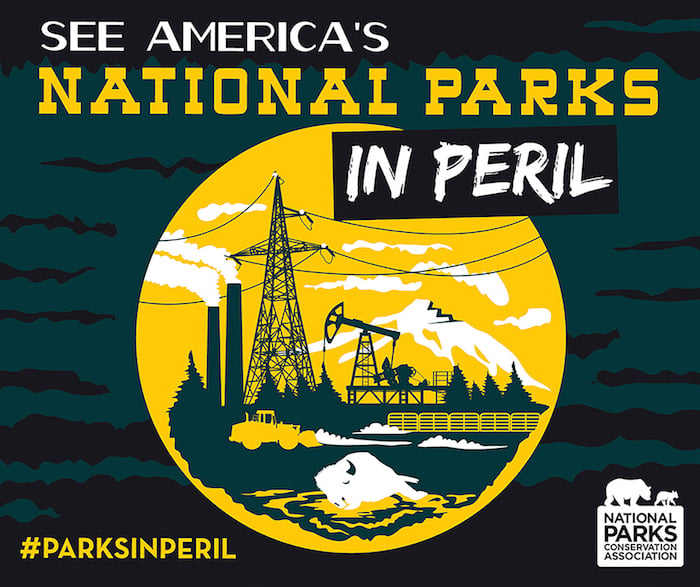
A National Parks Conservation Association campaign launching today is designed to rally public support against threats facing such iconic national parks as Yellowstone, Yosemite, and Grand Canyon with hopes the Obama administration will step up and use the tools and authority it has to protect the parks.
"The public knows that there are problems in the parks, but it does take an advocacy group sometimes to elevate the dialogue," said Kristen Brengel, NPCA's senior director of legislation and policy. “Our effort is to make sure we’re amplifying these issues and engaging the public.”
At 9 a.m. EST today the park advocacy group was launching a social media campaign on Facebook, Twitter, Instagram and other channels to raise the profile of threats facing parks from coast to coast:
* In Florida the campaign zeroes in on Biscayne National Park and efforts by the National Park Service to create a marine reserve zone in a bid to improve the health of fisheries and the only tropical coral reef system in the continental United States.
* At Grand Canyon National Park in Arizona the group points to the prospect of a mega-development just south of the park's boundary, a development some fear could disrupt the park's groundwater flows.
* In Wyoming, Yellowstone National Park's bison herds need a sound management plan that will "(E)nd the senseless slaughter of bison and provide these living symbols of wild America with more room to roam..."
* In Utah energy development on public lands threatens the viewshed and natural sound at Arches National Park.
There are other parks threatened by development and resource issues, such as Acadia National Park with large crowds brought to the park by cruise ships, Bryce Canyon National Park with a surface coal mine not far from its borders, and national parks and preserves in Alaska where state wildlife regulations often impinge on natural predator populations in those parks.
By focusing this campaign on parks such as Yosemite National Park and its issues with air pollution, Grand Teton National Park with inholding issues, Glacier National Park with nearby energy development, and even Colonial National Historical Park in Virginia confronting the prospect of a massive electrical transmission line strung across the landscape, NPCA hopes to leverage public concern specifically for these places and also raise the national conversation about protection for national parks.
“The reason we think this campaign will strike a cord with the public is these are mostly iconic park units," said Ms. Brengel during a phone call Tuesday.
Interior Department officials have the requisite authority and tools at hand to take steps to protect the parks, the advocacy group maintains:
* At Biscayne they could speed the adoption of regulations for the marine reserve zone;
* at Yellowstone the federal agencies involved in wildlife issues could press for quicker resolution of the bison management conundrum;
* at Grand Teton it could possibly get the National Park Foundation to work to raise private funds, much as it did to finance repairs to the Washington Monument, to close the gap in purchasing private inholdings within the park from the state;
* at Colonial the U.S. Army Corps of Engineers could be directed to conduct a full-blown environmental impact statement before deciding on the proposed transmission corridor;
* at the Grand Canyon, the Forest Service doesn't need to issue the permits and rights-of-way to allow a project on the scale of the one now proposed;
* at Mojave National Preserve in California the administration could deny the permit being sought for a 2,000-acre solar farm nearby and require that it be relocated;
* for clean air and vistas at Yosemite and other parks, the Obama administration could "close loopholes and strengthen park clean air protections so polluters aren’t let off the hook," and;
* at Glacier National Park the administration should cancel energy exploration leases for the Badger Two-Medicine area outside the park, rather than allow exploration.
In the case of Glacier, the U.S. Forest Service already is on record opposing the leases.
"This administration can do something to get us closer to protecting these national parks. They don’t need a court, they don’t need Congress, they can do it themselves," Ms. Brengel said.
NPCA officials are counting on the social media campaign will convince the adminstration to do just that.
“If action isn’t taken by the Obama Administration now, park visitors could see a mega-mall outside Grand Canyon and energy development in sensitive wildlife habitat right next to Mojave. Fortunately this administration has the opportunity to make decisions now that will protect and enhance these iconic national parks for future generations," said Mar Wenzler, NPCA's vice president of conservation programs, in a release. "Through our Parks in Peril initiative, National Parks Conservation Association will mobilize our more than one million supporters across the country to encourage the administration to seize its unique opportunity to protect our incredible national parks.”
Stories about:
Story Categories:
A copy of National Parks Traveler's financial statements may be obtained by sending a stamped, self-addressed envelope to: National Parks Traveler, P.O. Box 980452, Park City, Utah 84098. National Parks Traveler was formed in the state of Utah for the purpose of informing and educating about national parks and protected areas.
Residents of the following states may obtain a copy of our financial and additional information as stated below:
- Florida: A COPY OF THE OFFICIAL REGISTRATION AND FINANCIAL INFORMATION FOR NATIONAL PARKS TRAVELER, (REGISTRATION NO. CH 51659), MAY BE OBTAINED FROM THE DIVISION OF CONSUMER SERVICES BY CALLING 800-435-7352 OR VISITING THEIR WEBSITE. REGISTRATION DOES NOT IMPLY ENDORSEMENT, APPROVAL, OR RECOMMENDATION BY THE STATE.
- Georgia: A full and fair description of the programs and financial statement summary of National Parks Traveler is available upon request at the office and phone number indicated above.
- Maryland: Documents and information submitted under the Maryland Solicitations Act are also available, for the cost of postage and copies, from the Secretary of State, State House, Annapolis, MD 21401 (410-974-5534).
- North Carolina: Financial information about this organization and a copy of its license are available from the State Solicitation Licensing Branch at 888-830-4989 or 919-807-2214. The license is not an endorsement by the State.
- Pennsylvania: The official registration and financial information of National Parks Traveler may be obtained from the Pennsylvania Department of State by calling 800-732-0999. Registration does not imply endorsement.
- Virginia: Financial statements are available from the Virginia Department of Agriculture and Consumer Services, 102 Governor Street, Richmond, Virginia 23219.
- Washington: National Parks Traveler is registered with Washington State’s Charities Program as required by law and additional information is available by calling 800-332-4483 or visiting www.sos.wa.gov/charities, or on file at Charities Division, Office of the Secretary of State, State of Washington, Olympia, WA 98504.


National parks and their natural resources belong to you. The National Parks Traveler works to ensure you know how these essential places are being cared for.
Sign Up For Our Weekly Newsletter
Unsubscribe at any time.
INN Member

The easiest way to explore RV-friendly National Park campgrounds.

Here’s the definitive guide to National Park System campgrounds where RVers can park their rigs.
Our app is packed with RVing- specific details on more than 250 campgrounds in more than 70 national parks.
You’ll also find stories about RVing in the parks, tips helpful if you’ve just recently become an RVer, and useful planning suggestions.


Comments
The really scary thing is that this list is nowhere near complete.
All of these parks face serious threats. However, the best way to protect Bryce Canyon, Yellowstone, Glacier, Grand Canyon, and Arches National Parks and Mojave National Preserve is to expand the parks to encompass adjacent or nearby lands that are under development pressure.
In addition to the threats listed above, Biscayne National Park should be expanded to include more of Biscayne Bay and Virginia Key, which are imperiled by misplaced development. Denali, which is listed above but apparently not in the final NPCA report, should be expanded onto adjacent state lands, where wolves that leave the national park are being slaughtered by trophy hunters and trappers.
Numerous other National Park System units are also threatened by adjacent development and need to be expanded. Prime candidates include, Olympic, North Cascades, Crater Lake, Golden Gate, Great Basin, Dinosaur, Glen Canyon, Canyonlands, Mesa Verde, Chaco Culture, Rocky Mountain, Badlands, Theodore Roosevelt, Mammoth Cave, Delaware Water Gap, Ocmulgee, Great Smoky Mountains, and Shenandoah.
Most of these lands and waters are already owned by the public, but are being mismanaged by another "multiple-use" oriented agency, such as the U.S. Forest Service, Bureau of Land Mangagement, or states. They could be transferred to the National Park Service with little or no land acquisition cost.
We urgently need to expand threatened existing National Park System areas and add new areas that are endangered by resource extraction and industrial development. NPCA should go beyond important but limited defensive efforts, such as this, and launch a major campaign to expand the National Park System.
Michael - are you going to pay for it? Are you going to make up for the lost resources? If these parks are expanded won't that just create more "nearby lands" that will have exactly the same issues?
Hi EC,
Most of the adjacent lands are already public, so they would just need to be transferred to the National Park Service. In some cases, such as phasing out subsidized livestock grazing, the taxpayers would save money. In other cases, such as banning fracking and mining, the taxpayers would save a huge amount of money avoiding the costs of cleaning up the mess, mitigating air and water pollution, and restoring the industrial sites after the development interests leave town.
Also, the exploitation and development around the parks may well discourage some people from visiting in the future. That would have negative impacts on local communities. That has been pointed out in the case of the proposal to delist the grizzly bear, which a study indicated could cost millions of dollars per year in reduced tourism. The same may well be the case with the killing of Denali wolves and the ugly and dirty fracking happening around Theodore Roosevelt.
In terms of recources being "lost," I think everyone agrees that there are places so special that they should not be developed. Areas critical to the integrity of a national park come under this category. Moreover, some of these resources, such as dirty coal that would be minded near Bryce Canyon, should stay in the ground to help to mitigate impacts on climate change. In other cases, such as the mega-development near Grand Canyon, this is a place that is inappropriae for any development and there are alternative places that are available. In the case of Yellowstone bison (and grizzly bears), they are being killed because they supposedly conflict with livestock grazing. Phasing out livestock grazing in the Greater Yellowstone region would have a huge positive impact on wildlife populations and an infinitesimal impact on livestock production.
Expansion would theortically create other "nearby lands," but in many cases lands farther afield do not have exploitable resources, they already have some level of proteciton, they are not visible from or in the watersheds or airsheds of national parks, or they are not an integral part of park ecosystems.
Of course, there would be strong political opposition from entrenched special interests, but that has always been the case for new or expanded national parks. I think if the American people knew the problems and opportunities at stake, they would support expanding these parks.
How ya doing, Eric? Having a nice hump day?
1. Nope - we all should. We pay too little to protect the parks as it is.
2. Moving away from dollarizing wilderness is a healthy thing, unless - as some do - 'profit' is their primary paraphilia.
3. In some cases yes, in some cases no. Life to the rest of us is all in the shades of gray, not your polarized black and white.
Have a smurfy day.
Sorry Rick, my view is much more balanced. I recognize there are costs and trade offs that have to be made with any decision. For you and Michael (et al) its all or nothing - full steam ahead and damn the cost or how it is going to be paid for. Heck, you guys make NCPA look middle of the road.
Michael, you are both dreaming and terribly misinformed. Adding lands that need to be managed and reducing income from grazing and resource exploitation will hardly save money. And the cost of "cleaning up the mess", to the extent it exists on those lands, in today's world is total bourne by the lessor. Further, these activities bring far more dollars to the communities than they chase away from adjacent parks. I won't even start with your "dirty coal" climate change nonsens.
Eric, I sort of agree with you, insofar as My view is more balanced, which is what you said. Just a different subjective viewpoint.
That's the thing - no one ever sees themselves as the bad guy, everyone thinks they are in the middle average everyone should agree with me middle. You do realize, of course, that making statements like " For you and Michael (et al)..." puts you off on a little island separate from et al [sic].
" For you and Michael (et al)..." puts you off on a little island separate from et al [sic].
Seperate from your group for sure but squarely in the majority. If I weren't, people would be electing Congressmen that put a far greater priority on the Parks.
And if you were representative of the majority, the Presidential mandate over the past 8 years would be grotesquely different.
We're straying a bit afar from the forum. Again, have yourself a perfectly smurfy day.
We have very different definitions of "mandate". But, nice attempt at shifting the discussion from National Park policy to entitlement policy.
"Seperate from your group for sure but squarely in the majority. If I weren't, people would be electing Congressmen that put a far greater priority on the Parks."
Two obvious problems with that statement:
1) EVERY poll taken shows overwhelming support for national parks by Americans of all kinds.
2) Unfortunately, national parks are not included in any of the sound bites flying around at election time. So certainly a majority of voters are not even thinking of parks when they cast a ballot. Most probably don't even understand the relationship between parks and the candidates for whom they are voting. It's terribly true that the average American voter (on both sides of the aisle) is woefully uninformed because they are depending upon undependable media and too often outright dishonest campaign promises for their information.
That's why organizations like NPCA and others are necessary. They are needed to try to educate voters.
Oh, and by the way, I agree the NPCA fills a purpose. I agree with many (though not all) of their suggestions. It was Michaels suggestions that were way over the top and ecomically unsound.
Hi EC,
I would like to see your documentation showing that reducing livestock grazing on public lands would be a net loss for American taxpayers, that companies doing fracking and mining on public lands are covering all the costs of mitigating the massive damage they are doing to our lands, waters, and air, and that extractive industry provides more economic benefits to local communities than would be provided by the protection of those lands as new or expanded national parks. Regarding climate change, if you still believe that it is "nonsense," there is no use in belaboring that point.
Because for the majority it is not a priority item. If it were a priority item, you could bet it would be in every sound bite. The "majority" would rather get their handouts than fund the Parks.
And yes, the polls say people support the parks. That is because the question is "do you support the parks". If the question were, "Are you willing to give up your (fill in the blank entitlement) to fund the parks" the answer would be quite different. That is why those polls need to be taken with a grain of salt.
It's great to see NPCA undertaking this initiative, great to see the Traveler supporting it, and great to see the comments that have been posted. I'm grateful for all that the commenter Michael Kellett does for national parks, and I'm glad to see commenter Lee Dalton say, "The really scary thing is that this list is nowhere near complete."
Indeed it isn't. Mr. Dalton will remember the conversation (http://www.nationalparkstraveler.com/2013/03/updated-five-national-monum...) that he and I and others had in these online pages two and a half years ago about the fake, split national monument at Fort Monroe, Virginia. It too needs fixing.
The present conversation shouldn't go past without Fort Monroe being mentioned. As national civic memory of the Civil War continues to evolve--with increasing awareness of black people's role not just in benefiting from emancipation, but in actively pressing for it--more and more people are coming to understand why the Civil War historian Edward L. Ayers once referred to Fort Monroe as the site of "the greatest moment in American history."
Links to that and much else are available at http://cfmnp.org/, the original website of Citizens for a Fort Monroe National Park (which now uses http://fortmonroecitizens.org/). The prominent illustration there shows, in red, the land that Virginia's leaders, acting on behalf of developers and a handful of insiders in the city of Hampton, extracted from what could have been a real national monument. One link leads to an update article from earlier this year in Civil War News. There's a chance that Virginia's present governor will succeed in his surprising, but eminently welcome, determination to overturn the pro-developer Fort Monroe policies of his predecessors of both parties. Fort Monroe might not be lost after all.
It's important to report that NPCA has publicly supported the governor in this eleventh-hour effort, as a link at http://cfmnp.org/ explains. So has the Civil War Trust. Unfortunately, though, the National Trust for Historic Preservation persists in its resolute sympathy for the developers--a policy that NTHP devised right when the Pentagon, in 2005, announced the Army's impending departure from Fort Monroe.
NTHP was already with the developers before the public was even invited to comment. Fort Monroe was already framed as a development issue before the public was invited in. We're still trying to recover from that NTHP-supported misframing. Time is short, and the official plan--unless Gov. McAuliffe can overcome it--is to build condos on the bayfront, completely destroying the Chesapeake Bay spirit of place of this 400-year-old national treasure. (Again, please see the area marked in red at http://cfmnp.org/ .)
NTHP is a great organization, and it has to pick its battles, I guess. But it doesn't have to falsely present all of Fort Monroe as a national monument when in fact Fort Monroe is bifurcated **for** developers' benefit and **against** maintenance of, and respect for, the spirit of place. Even NTHP president Stephanie Meeks participated in this misrepresentation; see for example http://blog.preservationnation.org/?p=21962#.Vjt7xb-2q0M .
Over a year ago, Gov. McAuliffe declared his intentions to fix the fake, split national monument. Then, at a non-Fort Monroe event last December that many of us attended with supportive signs, he reiterated, off the cuff, those intentions. He gave a passionate, extemporized, two-minute declaration that the pro-development local newspaper, the Daily Press, only excerpted, but refused to run in full.
The other local daily, the Norfolk Virginian-Pilot, is on the side of the angels on this issue. See the editorial and online comment at http://hamptonroads.com/2015/08/preserve-more-fort-monroe .
I'm going to ask some other Fort Monroe stakeholders to submit comments here too, as in 2013 when Mr. Dalton asked great questions and gave good encouragement.
Back then, Mr. Dalton advised that we not give up. We didn't. But we need national help.
Thanks to the perfidy of NTHP, which for absolutely good reasons has great credibility in the national press, this crazy situation gets zero national coverage. America is losing a national treasure that ranks with the Liberty Bell, Elllis Island and Monticello (and someone please challenge me on that), but doesn't even know it.
For some reason my long Fort Monroe comment is listed under "anonymous." In fact I've been deeply, and quite visibly, involved in the struggle to save Fort Monroe for over a decade. Thanks. Steve Corneliussen (Kurt, if you fix it, maybe then just delete this reply? Thanks.)
Anon's post excellently illustrates one of the greatest challenges we who support public lands and parks are facing.
To be honest, I had completely forgotten about Fort Monroe. It's far from where I live and there are so many other very pressing challenges to our parks and public lands that it was easy to let it slip from mind.
It's terribly difficult to get information out a public that is being swamped by so many "Big Crisis of the Day" sound bites. So many that perhaps many of us have simply tuned them out unless they are close enough to bite our butts every day.
That's exactly why we need NPCA and Traveler and Southern Utah Wilderness Alliance and any others willing and ready to speak up and try to spread the messages that need to be spread.
" The "majority" would rather get their handouts than fund the Parks."
Is that you, Mitt? Or are you talking about ranchers with grazing allotments or oil companies, hedgefund managers, or other similar partakers at the American Buffet of Subsidies?
Be sure to read the article today about starving land managment agencies.
reducing livestock grazing on public lands would be a net loss for American taxpayers
Documentation? Its common sense. Rancher pays X for grazing. Fed government receives X. If they no longer graze, Fed government gets zero. That is a loss to tax payers. In addition, rancher has to pay higher fees on private property, that raises the cost of his product. American taxpayers pay more. That is a loss to taxpayers.
As to fracking and mining damage, you made the claim, you provide the documentation that they create massive damage and the cost of cleanup to the Feds exceeds Fed receipts.
See answer to Michael
What about them? I suspect you don't have a clue about the issue or the reality. But as part of overall "entitlement" reform, I would give up carried interest. Of course that would raise a small fraction of what getting rid of Obama phones would raise. Its an an easty target to beat up on hedge fund managers, its much harder to face the reality that it is a non-issue. Meanwhile the spending on Obama phones matches the entire NPS budget for operations.
But to stay on point, whether its your entitlements or your perception of other's entitlements, the NPS isn't the priority for either group.
Obama Phones??????
Huh? This telephone assistance program started in 1984! Who was president in 1984?
Snopes says: claiming that "the Obama administration created a program to give free cell phones paid for by taxpayer money to welfare recipients." All the elements of such statements are erroneous or exaggerated:
The Lifeline program originated in 1984, during the administration of Ronald Reagan; it was expanded in 1996, during the administration of Bill Clinton; and its first cellular provider service (SafeLink Wireless) was launched by TracFone in 2008, during the administration of George W. Bush. All of these milestones were passed prior to the advent of the Obama administration.
Just a couple of minutes of Google searching shows that this program is not funded by any taxpayer money. Want to try again, Comrade?
As for the claim that the government would lose money if grazing fees were not coming in, that's simply the kind of stuff we find around waterholes where cattle graze. The AMU is so low that it doesn't come anywhere near covering the costs of maintaining the grazing lands we so generously provide to ranchers.
Be careful, Comrade. Vet your sources more carefully.
EC, should the government lose money on grazing fees and subsidize a small percentage of livestock growers (supposedly just 2.7 percent of the country's livestock growers graze on U.S. Forest Service and BLM lands)?
Especially when fees on state lands and private lands can be many-fold greater?
http://www.sltrib.com/news/1410101-155/grazing-lands-blm-livestock-135-fee
http://www.gao.gov/products/GAO-05-869
Kurt, that "subsidy" is reflected in lower prices to the consumer. Would I prefer the government exploit otherwise underutilized land to lower the cost to the consumer. Absolutely. Same is true for oil and gas, coal, etc. Note, this is a far different "subsidy" than taking monies from productive activities and giving it to a select group of recipients.
EC, if just 2.7 percent of the nation's livestock growers graze their cattle and sheep on public lands, how much benefit is that $1.35 AUM charged by the Forest Service and BLM vs. the $7-$8 being charged on state and private lands providing shoppers?
Can you cite any study that addresses prices affected by the low federal fees vs. the higher private and state fees, where supposedly the bulk of livestock -- upwards of 97 percent -- are grazing?
And if the low fees are costing the federal government $110+ million, could the coin be flipped and it said that taxpayers would benefit from higher grazing fees on public lands?
I don't have the answers to these questions, but I think they're critical to the perception that federally subsidized grazing fees benefit either the consumer, taxpayer, or public lands.
Hi EC,
I think Kurt's comment adequately supports my contention on below-cost public land grazing. Regarding oil and gas development, you say:
A recent article summarizes a study released in June, which extensively covers this issue:
"Oil companies are drilling on public land for the price of a cup of coffee. Here’s why that should change." https://www.washingtonpost.com/posteverything/wp/2015/06/16/oil-companie...
According to the article:
You can find the full study at the New York University School of Law's Institute for Policy Integrity website http://policyintegrity.org/files/publications/DOI_LeasingReport.pdf
You are making the standard mistake of static analysis. You assume that if the price was increased that there would be no change in rancher behavior. How much impact does the 2.7% have. I'm not aware of any studies on that specific question but there is plenty of economic evidence that lower costs leads to lower prices (look at gas prices today). But if 2.7% is 80-% cheaper, that implies a 2 percent reduction. The beef industry sold $127 billion in the US last year. 2% of $127 billion is a lot of money.
Below market price and below cost are two very differnet things. The Feds do charge below market (and the American taxpayer benefits). The Feds cost is virtually zero, so if they charge anything, they are not "below-cost". The same holds true for oil and gas. I skimmed through your linked report and saw nothing that quantified any damages. The industries pay billions of dollars annual in lease fees, I see nothing that suggest the Feds pay anywhere near that for cleanup. But if it makes you feel better, I do believe that lessors should pay for restoring the property as it was when they have completed their extraction. But then, I believe current regulations already require that.
Folks, I just started to research "damage from fracking" and the data was overwhelming. Of course, at the same time I realized that it is so overwhelming that no one open to being educated about it would start from a denial point of view, so I'll simply leave it to Eric to "do your own research". I'm not going to butt my head up against that wall.
Wild claims yes - most dismissed by the likes of the EPS - data no. Please show me "data" from an independent source that shows systematic and irrepairable damage to federal lands due to fracking.
Yes and like many programs it started small with well intended purposes to help the truely needy. This program has been dramatically expanded into a $2 billion + give away by Obama. Regardless of who or when it was started, it is now a $2 billion + give away. Personally, I would rather see that money go to the parks.
is not funded by any taxpayer money.
Really? Where does it come from? The phone fairy?
Tell me Lee, how much money is spent "maintaining the grazing lands" that wouldn't be spent if there was no grazing?
Upon further research, I will concede the grazing program nominally spends more to administer than it receives in fees. I say nominally because I suspect the "administration costs" wouldn't go away if the grazing stopped. Further, I think this is more a testament to the inefficiency of the federal government than anything else. An administration cost of $2,000 per permit is unfathonable.
Nevertheless, it doesn't dilute the argument that the lower fees benefit the general public and the net deficit is a drop in the bucket relative to the other give away programs.
Are you sure the phone give away was Obama? Do a little research and you'll learn it's a product of Congress.
And thanks, Comrade, for doing a little actual research on grazing fees. Do a little more. You still have a lot to learn.
I do have a problem with the title of this article, however. It matters not who is president, it's Congress that needs to step up to protect our parks. Congress actually controls the purse.
So Lee - I will ask again, where do the monies for those phones come from? The phone give aways measure in the Billions - no matter who's name we put on it. The grazing defict is in the tens of millions - assuming in fact the costs would go away if there were no grazing. And of course the phones are but one small example of the entitlements that the "majority" are putting ahead of the parks.
Yes, I totally agree. I only listed the large natural areas where expansion could protect the park from damaging activities on adjacent lands. But Fort Monroe National Monument and numerous other smaller — but equally important — areas are also seriously threatened by adjacent development. Fort Monroe is now split in two with key lands in between proposed for an ill-conceived commercial development project.
Fortunately, as Anon noted below, there is a chance ot take care of this problem by expanding the existing Fort Monroe monument to include the lands in between. Virginia's governor and a conservationsts support such an expansion.
I hope President Obama takes action to add the lands between to the existing monument. These lands are state owned, so all it takes is a transfer to the Department of the Interior and a proclamation by the President under the Antiquities Act. The time for action is now.