

The only sure-fire way to avoid a shark attack is to stay out of the water/NPS, Bill Fisher
After all is said and done, there's no single approach that can be taken at Cape Cod National Seashore to 100 percent prevent a shark attack if you go in the water, according to consultants retained to study 27 suggested alternatives.
The Woods Hole Group, in a nearly 200-page paper, dissected the proposals. They ranged from using spotter planes and drones to physical shark barriers and reducing the population of gray seals that great white sharks feast on.
"The most important finding to emphasize from this preliminary assessment is there is no single alternative or suite of alternatives that can guarantee the safety of 100 percent of individuals who choose to enter the water," the consultants said.
Sharks attacks at the national seashore in Massachusetts have greatly raised the concern of National Park Service staff, seashore communities, and the visiting public. Twice during the summer of 2018 swimmers were attacked, leading to the death of one of them.
Great white sharks rule the waters off Cape Cod during summer and early fall each year. But in recent years they have been drawn closer to shore to feed on gray seals, whose numbers have skyrocketed off Massachusetts since being protected by federal law nearly 50 years ago.
Against that backdrop, the National Park Service has greatly increased its outreach and education messaging to inform beach goers, and frequently closes beaches temporarily to swimming during the summer when sharks are spotted.
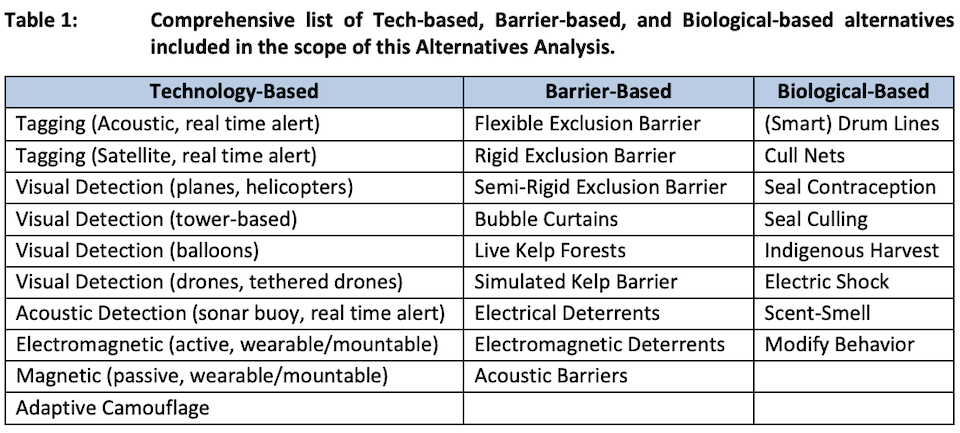
The Woods Hole Group examined each of the proposals and scored them from "high" to "low" in terms of likely effectiveness.
"However, because many of these alternatives have not yet been tested or are not currently commercially available, specific documentation related to effectiveless, limitations, and costs were not always available," the consultants said.
Alternatives that scored "high" or "medium high" in terms of likely success included modifying human behavior and electromagnetic deterrents.
The consultants didn't recommend any one alternative, but said it would "be prudent to review the lessons learned from pilot studies and deployments of shark mitigation strategies elsewhere in the world. Dealing with shark-human interaction is a global issue, not one that is isolated to our region," they said.
Stories about:
Story Categories:
A copy of National Parks Traveler's financial statements may be obtained by sending a stamped, self-addressed envelope to: National Parks Traveler, P.O. Box 980452, Park City, Utah 84098. National Parks Traveler was formed in the state of Utah for the purpose of informing and educating about national parks and protected areas.
Residents of the following states may obtain a copy of our financial and additional information as stated below:
- Florida: A COPY OF THE OFFICIAL REGISTRATION AND FINANCIAL INFORMATION FOR NATIONAL PARKS TRAVELER, (REGISTRATION NO. CH 51659), MAY BE OBTAINED FROM THE DIVISION OF CONSUMER SERVICES BY CALLING 800-435-7352 OR VISITING THEIR WEBSITE. REGISTRATION DOES NOT IMPLY ENDORSEMENT, APPROVAL, OR RECOMMENDATION BY THE STATE.
- Georgia: A full and fair description of the programs and financial statement summary of National Parks Traveler is available upon request at the office and phone number indicated above.
- Maryland: Documents and information submitted under the Maryland Solicitations Act are also available, for the cost of postage and copies, from the Secretary of State, State House, Annapolis, MD 21401 (410-974-5534).
- North Carolina: Financial information about this organization and a copy of its license are available from the State Solicitation Licensing Branch at 888-830-4989 or 919-807-2214. The license is not an endorsement by the State.
- Pennsylvania: The official registration and financial information of National Parks Traveler may be obtained from the Pennsylvania Department of State by calling 800-732-0999. Registration does not imply endorsement.
- Virginia: Financial statements are available from the Virginia Department of Agriculture and Consumer Services, 102 Governor Street, Richmond, Virginia 23219.
- Washington: National Parks Traveler is registered with Washington State’s Charities Program as required by law and additional information is available by calling 800-332-4483 or visiting www.sos.wa.gov/charities, or on file at Charities Division, Office of the Secretary of State, State of Washington, Olympia, WA 98504.
INN Member

The easiest way to explore RV-friendly National Park campgrounds.

Here’s the definitive guide to National Park System campgrounds where RVers can park their rigs.
Our app is packed with RVing- specific details on more than 250 campgrounds in more than 70 national parks.
You’ll also find stories about RVing in the parks, tips helpful if you’ve just recently become an RVer, and useful planning suggestions.


Comments
We're going to need a bigger boat!!
Pretty simple: leave the sharks alone; post clear warning signs to the effect that anyone entering the water does so at their own risk.
I agree with James Linnane. Leave the sharks alone and swim at your own risk.
maybe each town should pay a person to fly a drone at certain beaches that keep a live eye on the coast of certai town beaches during daylight hour. Drones are fairly inexpensive and easy to use and it would also help gain scienti data. I really don’t think it would be a big deal for towns in the summer to make a budget for such an affordable action the drone operations can be simply run and paid for like a lifeguard on duty. I know I would take the job watching and piloting a drone with the hopes of gaining more insight into the local white shark population and it would make anyone in the water comfortable knowing there are real-time eyes on the surrounding waters.
I think that is a great idea. It's extremely affordable, and I think it would be quite effective.
Instead of looking towards tech, look at nature. Float replicas of killer whales and play recordings of their "speech". Killer whales rarely visit the Cape and their presence has been known to scatter Great Whites in other parts of the world.
I agree with both Mr. Linnane and Mr. Rufo. Very simple and logical.
.
White shark's are apex predators who mainly prefer seals but if a human goes into the area where sharks feed on seals, they may die from a large shark attack. Surfing, spear fishing, snorkeling, scuba diving have all been on the record as activities that humans have been doing when a predation occurs. Yes, swimming is also on the list. So, I am in agreement with those who have stayed that you enter the water at your own risk. Here's my advice to all the Cape Cod citizens who believe they should be able to purchase a shark free zone. White shark's don't take cash, American Express Gold or Platinum, your life is worth the same as a homeless person to a white shark, or any shark for that matter. Build a pool and leave the shark's alone.
Reduce the population of gray seals through ethical hunting. Hunting will bring more tourism ergo more tax revenue and more eyes on the shark population, also which would be a great resource for the communities and researchers alike.
Reducing the gray seal population will only have the sharks turn even more towards human seeing there has also been an enormous increase in the great white population as well
Sharks are increasing every single year, and no doubt that's surely going to happen this year. In truro and wellfleet, beaches were closing every day, sometimes 2 times a day at the same beach. The sharks need more tagging and more monitoring and more drones and more alarms and buoys and whatever it takes. The state needs to renew Greg skomals contract again and spend some of that 20 million they have and stop wasting time. July is 6 months away .I was one beach away when that attack happened at newcomb beach. That was so remote and rare but to know there's a problem and neglect to do anything... is criminal in my mind. How much revenue does the state gain from Cape Cod? And where are all the locals who have banded together on a cape agenda? Dig in folks. My neighbor was 10 feet away from that young man. Come on Cape Cod.
Who's kidding who here? Let's get real.
People are swimming in waters in which sharks are swimming.
I'm an engineer .
I cannot imagine anyone createing an " impenetrable barrier " to separate sharks from swimmers and my opinion anyone that thinks they can is foolish.
Personally, I think the money spent on try to identify a way to separate sharks from people was a waste of money.
you should really have an independant study and not one done by the people who are researching sharks by gathering data for science rather than safety A study on shark attacks makes more sense. i mean seriously it's like Trump's cabinet members. you are sending the people out who want to keep the sharks here to do a study on how to keep them away! DUH!
What happened to 'don't go in the water'?
Take a leaf out of Australia's book at put up drum lines. Humans are more important than sharks. And there is no danger of sharks becoming extinct.
Hi. Could culling the seal population force the sharks to look harder for food and in turn, more attacks on humans?
branchstacker @gmail.com
I have studded a drone to drop a solution in front of the shark and it will disappear..I nee6 funding to prove this if an organization wants to join me it will save lives .just email me BARRY WINCHESTER BRISBANE AUSTRALIA