
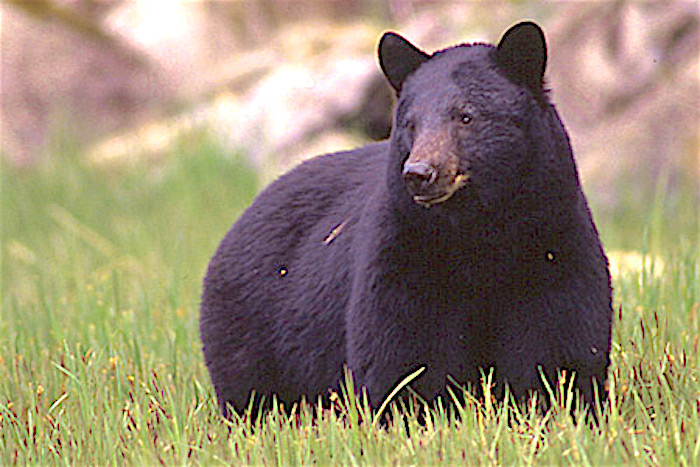
In a move that could have dire effects on wildlife in national park lands in Alaska, the Interior Department has ordered the National Park Service to reconsider wildlife regulations that are at odds with hunting and trapping regulations enforced by the state of Alaska. The directive, while legally questionable, could greatly impact bear populations on National Park System lands, such as national preserves, if the Park Service reversed rules designed to protect predators.
The order, signed by Virginia Johnson, currently Interior's acting assistant secretary for Fish and Wildlife and Parks, directs the Park Service to reconsider rules it adopted in October 2015 regarding hunting and trapping on national preserves in Alaska where sport hunting is allowed. Under those regulations, hunters on national preserves cannot:
- Use bait (donuts, grease-soaked bread, etc.) to hunt bears;
- Use of artificial light to spotlight dens to kill black bears; and
- Kill bear cubs or sows with cubs.
"I have concluded that it would be prudent to reassess the need for the rule and give further consideration to certain elements," wrote Ms. Johnson on July 14 in a memo to Mike Reynolds, the Park Service's acting director. "I anticipate that you will focus this recommendation on certain aspets of the rule that I believe are particularly worthy of additional review.
"Most notably, these include the various prohibitions that directly contradict State of Alaska authorizations and wildlife management decisions, thereby potentially reducing opportunities for sport hunting and commercial trapping on National Park Service lands."
Tom Crosson, the Park Service's chief spokesman, told the Traveler on Friday in an email that the agency "has received the Assistant Secretary's memo and is working with the Office of the Assistant Secretary and Department's solicitors to determine the best way to implement the memo's instructions. We expect to provide additional information and opportunities for public comment throughout the process."
A similar directive regarding wildlife regulations was sent to the U.S. Fish and Wildlife Service, according to Public Employees for Environmental Responsibility.
The directive to the Park Service drew immediate condemnation from the National Parks Conservation Association President and CEO Theresa Pierno.
“U.S. Interior Department Secretary Ryan Zinke’s directive to the National Park Service is shameful. The National Park Service must have the authority to prevent the potentially indiscriminate killing of bears and their cubs on national parklands," she said. "The directive also ignores the years, taxpayer dollars and investment by individuals who spoke up in support of bears and wolves on national park land in Alaska during the lengthy public process.
"In fact, more than 70,000 Americans said ‘no’ to baiting bears with grease-soaked donuts in Denali. They said ‘no’ to sport hunters crawling into bears’ dens and using flashlights to wake and kill mother bears and their cubs on lands managed by the National Park Service," she added.
At PEER, Rick Steiner, a retired University of Alaska professor and PEER board member, noted the inherent conflicts between the state of Alaska's approach to wildlife and what the Park Service and Fish and Wildlife Service are mandated to do.
“Alaska's national parks and wildlife refuges are required by federal law to be managed not as private game reserves but to protect natural diversity, including natural predator-prey dynamics,” he said. “The State of Alaska’s unethical predator control practices have no place in modern society, and certainly not on Alaska’s magnificent national parks and refuges.”
According to PEER, it could take the Park Service years to reconsider the regulations. Beyond that, the group said the memo from Ms. Johnson is legally tenuous.
"The factors cited by Ms. Johnson are political in nature and not a legitimate basis for regulation. Further, the NPS is constrained by statutory mandates that a Trump White House cannot fiat away," a PEER release said. "Thus, assuming a new rule is promulgated before Trump leaves office, it will almost certainly be swarmed by litigation challenging its validity."
Desires by Alaska wildlife officials to reduce the number of predators while boosting elk and caribou populations for hunters have led to the wiping out of wolf packs that roamed Yukon-Charley Rivers National Preserve.
Back in 2015 when the Park Service adopted the regulations in question, the agency noted that sport hunting in national preserves continues to be primarily regulated by the State of Alaska. But, the state-authorized practices being prohibited conflict with National Park Service law and policy, Park Service officials said in a release at the time.
Units of the National Park System are managed for naturally-functioning ecosystems and processes. While sport hunting is allowed in national preserves in Alaska, NPS policies prohibit manipulating native predator populations, typically bears and wolves, to increase numbers of harvested species, such as caribou and moose, they added.
Stories about:
Story Categories:
A copy of National Parks Traveler's financial statements may be obtained by sending a stamped, self-addressed envelope to: National Parks Traveler, P.O. Box 980452, Park City, Utah 84098. National Parks Traveler was formed in the state of Utah for the purpose of informing and educating about national parks and protected areas.
Residents of the following states may obtain a copy of our financial and additional information as stated below:
- Florida: A COPY OF THE OFFICIAL REGISTRATION AND FINANCIAL INFORMATION FOR NATIONAL PARKS TRAVELER, (REGISTRATION NO. CH 51659), MAY BE OBTAINED FROM THE DIVISION OF CONSUMER SERVICES BY CALLING 800-435-7352 OR VISITING THEIR WEBSITE. REGISTRATION DOES NOT IMPLY ENDORSEMENT, APPROVAL, OR RECOMMENDATION BY THE STATE.
- Georgia: A full and fair description of the programs and financial statement summary of National Parks Traveler is available upon request at the office and phone number indicated above.
- Maryland: Documents and information submitted under the Maryland Solicitations Act are also available, for the cost of postage and copies, from the Secretary of State, State House, Annapolis, MD 21401 (410-974-5534).
- North Carolina: Financial information about this organization and a copy of its license are available from the State Solicitation Licensing Branch at 888-830-4989 or 919-807-2214. The license is not an endorsement by the State.
- Pennsylvania: The official registration and financial information of National Parks Traveler may be obtained from the Pennsylvania Department of State by calling 800-732-0999. Registration does not imply endorsement.
- Virginia: Financial statements are available from the Virginia Department of Agriculture and Consumer Services, 102 Governor Street, Richmond, Virginia 23219.
- Washington: National Parks Traveler is registered with Washington State’s Charities Program as required by law and additional information is available by calling 800-332-4483 or visiting www.sos.wa.gov/charities, or on file at Charities Division, Office of the Secretary of State, State of Washington, Olympia, WA 98504.


National parks and their natural resources belong to you. The National Parks Traveler works to ensure you know how these essential places are being cared for.
Sign Up For Our Weekly Newsletter
Unsubscribe at any time.
INN Member

The easiest way to explore RV-friendly National Park campgrounds.

Here’s the definitive guide to National Park System campgrounds where RVers can park their rigs.
Our app is packed with RVing- specific details on more than 250 campgrounds in more than 70 national parks.
You’ll also find stories about RVing in the parks, tips helpful if you’ve just recently become an RVer, and useful planning suggestions.


Comments
"In fact, more than 70,000 Americans said ‘no’ to baiting bears with grease-soaked donuts in Denali. They said ‘no’ to sport hunters crawling into bears’ dens and using flashlights to wake and kill mother bears and their cubs on lands managed by the National Park Service,"
Personally, I don't see much sport in doing stuff like grease-soaked donuts and using flashlights to go into dens to kill mothers and cubs. To what end? Gonna eat the bear meat? Gonna throw a bear skin on the floor? Doing it just for the fun of killing something? Killing a mother and her cubs? Is that an ego trip? Does that prove one is a bonafide hunter? Any justification for that kind of crap is pure bulls**t.
Actually, Rebecca, a lot of my friends in Alaska consider hunted bear a primary protein source.Subsistence life in rural Alaska is a totally foreign life to city folk, just as congresscritters a foreign life form to the rest of us.
I totally get that Rick B. And I get the difference between responsible hunters and those not-so-responsible (which is what I think of the trophy-hunting kind out to get a head for their wall art). It's just that I don't particularly care much for those methods they want to allow. I find something harsh about going into a bear's den with a flashlight and shooting an animal and it's babies while they are sleeping and defenseless. That would be like some psycho coming into my own home and killing me while I am asleep and not able to reach for my own gun (yeah, a liberal with a gun). Not too keen on the grease-soaked donuts, either. My father never used any "easy" or enticement methods when he went elk hunting in Montana. We did not live a subsistence life, granted, but we ate what Dad bagged and Dad enjoyed the challenge of the hunt without the extra help of a flashlight or donuts.
Understood, Rebecca. Context and circumstances matter. My Buddhist wife never wanted to eat bear meat, feeling it was too sentient of a being. On the other hand, she asked me to train her in firearms so that she could defend herself if a bear tried to break into our home. Life is what happens while you're making other plans and we just do the best we can.
And, frankly, I call crawling into a sleeping bear's den with a flashlight to be well on the path to a Darwin Award.
The issue here is not about whether hunting for bears is ethical in a general sense. I do not support it. But at least one can make a case for killing a bear for meat.
Not so for the use of unethical and cruel "sport hunting" practices to kill bears. There is no excuse for despicable practices such as bear bating, spotlighting dens, and killing sows and cubs. They should be universally banned, just like many other abusive practices of the past.
This is the reason why the National Park Service restricted these practices, which it should have done long ago. Unfortunately, as with other state fish and game agencies, the State of Alaska "wildlife" agencies are dominated by trophy hunting, predator hating, and gun promotion interests. Now, Zinke is serving those selfish special interests try to drag national parks down to their level.
I wouldn't do it either Rick, but entering bear dens is fairly common for scientific purposes (YouTube has videos). For example:
http://www.nbcnews.com/id/17635072/ns/technology_and_science-science/t/b...
https://coloradooutdoorsmag.com/2017/03/29/entering-the-bear-den-cpw-con...
It might even lead to human hibernation for space travel:
http://www.pbs.org/wgbh/nova/nature/bear-essentials-of-hibernation.html
It is up for comment. What is the best way to comment if you are opposed to such actions? Ask them to prove it does not change predator prey relationships? As them if any scientific evidence made them change their stance?
If true I too am troubled by some of the methods described and don't see them as a very sporting way to harvest game. The baiting of bear I have mixed opinions on. Given bear are primarily nocturnal creatures and the relative short seasons I'm begrudgingly OK with this practice. We have allowed bear baiting for many many years in my state and even with baiting, the success rate is not that high and I'll add do to good management we have far more bears in our state than ever before. It also takes a great deal of effort to bait a bear. Its not quite as simple as buying a box of donuts and setting it in front of your tree stand. I've never cared for using dogs for bear hunting and don't understand going into dens except as a means of predator control. Where I live coyotes have become a real problem for people with pets and no, these aren't areas where people are branching out and intruding on their territory. They are found in urban areas in the middle of the day. Frankly I'd rather see a wild coyote than someones pet dog running around but I understand the angst pet owner feel encountering aggressive coyotes. The quote about national parks not being game preserves is a bit disingenuous given many of the parks own practices but then the more I learn about peer the less credibility I give anything they say.
Black bears aren't particularly agressive. Bear researchers have taken cubs right away from sows and they generally do nothing other than perhaps run away.
NM