
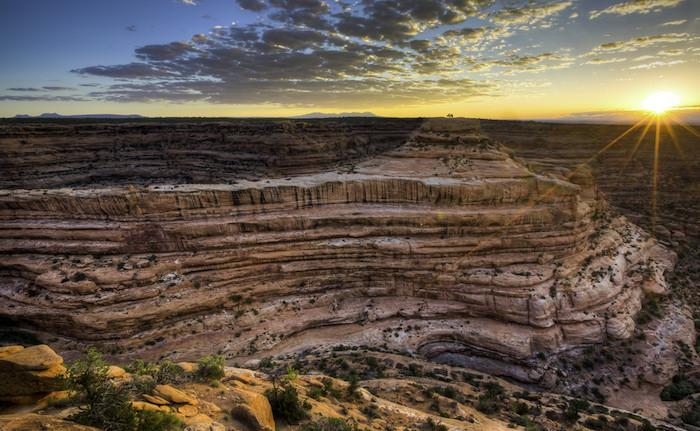
Bears Ears National Monument in Utah is unnecessarily large at 1.35 million acres, according to Interior Secretary Ryan Zinke, who has recommended to President Trump that the monument be reduced in size, but not abolished.
How much of a reduction in acreage remains to be determined, the secretary told reporters Monday.
“The goal is to protect the historic and prehistoric structures, for sure. It’s a little premature to throw out an acreage," he said.
In an interim report sent to the president Saturday, Secretary Zinke said the monument boundaries should be shifted to focus on preserving cultural and scientific objects in as small an area as necessary, as the Antiquities Act states.
Additionally, he recommended that tribes co-manage the monument, that Congress identify areas within the current monument boundaries that could better serve as national recreation areas or conservation areas, and that Congress clarify "the intent of the management practices of wilderness or WSAs (wilderness study areas) within a monument." That last recommendation was needed, the secretary told reporters, because wilderness protections are more stringent than those provided via a national monument designation.
The Interior secretary told reporters he did not recommend that the monument designated by President Obama near the end of 2016 be abolished because there are cultural and scientific sites that should be protected.
“There is no doubt that there are historic and prehistoric structures and other objects of scientific interest within the Bears Ears Monument. These items and objects can be identified, segregated, and reasonably separated," he said during a half-hour conference call. “Certainly, rescinding the monument was an option, but looking at it, there are some antiquities within the monument that I think deserve to be protected."
Secretary Zinke's recommendation was requested by President Trump back in April. In signing an executive order calling for it, the president said his aim was to "end another egregious abuse of federal power, and to give that power back to the states and to the people where it belongs."
Specifically, President Trump said his predecessor had used the Antiquities Act "to unilaterally put millions of acres of land and water under strict federal control. Eliminating the ability of the people who actually live in those states to decide how best to use that land."
Along with calling for a review of the Bears Ears designation, the president also directed Secretary Zinke to review 26 other monuments designated as long ago as 1996, when President Clinton established the Grand Staircase-Escalante National Monument, which, like Bears Ears, is in southern Utah.
Secretary Zinke planned to visit Maine later this week to review Katahdin Woods and Waters National Monument, which was designated late last year after Roxanne Quimby, the Burt's Bees heiress, donated 87,500 acres of her own land to the Interior Department to create the monument.
By July 10, the Interior secretary is to provide the president with a final report on his views of how the last three presidents have used the Antiquities Act and whether any revisions to monuments they designated should be made.
One key message the secretary made clear in his call with reporters Monday was that the Obama administration had been "heavy handed" in designating Bears Ears without appropriately considering local input. Utah's all-Republican congressional delegation and its governor, also a Republican, had called on President Trump to rescind the monument designation.
Pressed on how small he thought the monument should be, Secretary Zinke declined to give a specific acreage, but focused on the geologic area right around the two buttes known as the Bears Ears, as well as cultural artifacts and sites ranging from Newspaper Rock -- a Utah state historic monument centered on a rock panel with hundreds of Native American petroglyphs on it -- continuing on north an unspecified distance.
"One could argue that those are the areas that stick out among it, and those are the areas we’re going to concentrate on," the secretary said.
He also called for infrastructure that would provide a visitor center, access roads and parking areas, as well as bathroom facilities, and said a management plan needed to be crafted. Law enforcement also was needed to prevent pilfering of sites, said Secretary Zinke.
While the secretary said there was buy-in to his plan from the Utah congressional delegation, the governor, tribal leaders, and local community leaders, others were critical of his decision.
“The Secretary’s report is nonsense. The memo released today doesn’t give any accounting of the public comments the Interior Department received as part of this review process," said U.S. Rep. Raúl M. Grijalva, the ranking Democrat on the House Natural Resources Committee. "It doesn’t reference any maps or specify legislative language. It doesn’t explain what the president will do regarding Bears Ears. It doesn’t even explain what alleged problem this review is trying to solve.
“If you stack this memo up against the years of administrative work that went into designating Bears Ears, including extensive, detailed consultations with Utah’s elected representatives, it’s not worth the three pieces of paper it’s printed on," the Arizona Democrat added in a written statement. "This is just like health care. Republicans want to wreck everything Barack Obama put in place, but in each case they can’t seem to explain what the real problem is or what they actually plan to do about it.”
Jennifer Rokala, executive director of the Center for Western Priorities, called the secretary's recommendation "an undeniable attack on our national monuments and America's public lands. The decision should be an easy one — more than 1 million Americans, including Utahns by a 9 to 1 margin, have asked President Trump to leave Bears Ears National Monument alone. Instead of reinforcing America’s conservation heritage, Secretary Zinke is recommending President Trump take actions that are both unprecedented and illegal."
"The law is clear: only Congress can modify or erase a national monument. This report, while disappointing, is not a surprise," she added in a statement. "President Trump made it clear the fix was in from the moment he signed the executive order, despite overwhelming public support for national monuments."
Also speaking out against the secretary's recommendations was Trout Unlimited.
“Attempting to remove protections for public lands by diminishing a national monument would be unprecedented in the modern era and may jeopardize other monuments,”said Corey Fisher, senior policy director for Trout Unlimited’s Sportsmen’s Conservation Project. “President Trump will still need to act on recommendations from the Secretary. We hope that the president sees the folly in such an action and the harm it would cause to our public land legacy and special places.”
Stories about:
Story Categories:
A copy of National Parks Traveler's financial statements may be obtained by sending a stamped, self-addressed envelope to: National Parks Traveler, P.O. Box 980452, Park City, Utah 84098. National Parks Traveler was formed in the state of Utah for the purpose of informing and educating about national parks and protected areas.
Residents of the following states may obtain a copy of our financial and additional information as stated below:
- Florida: A COPY OF THE OFFICIAL REGISTRATION AND FINANCIAL INFORMATION FOR NATIONAL PARKS TRAVELER, (REGISTRATION NO. CH 51659), MAY BE OBTAINED FROM THE DIVISION OF CONSUMER SERVICES BY CALLING 800-435-7352 OR VISITING THEIR WEBSITE. REGISTRATION DOES NOT IMPLY ENDORSEMENT, APPROVAL, OR RECOMMENDATION BY THE STATE.
- Georgia: A full and fair description of the programs and financial statement summary of National Parks Traveler is available upon request at the office and phone number indicated above.
- Maryland: Documents and information submitted under the Maryland Solicitations Act are also available, for the cost of postage and copies, from the Secretary of State, State House, Annapolis, MD 21401 (410-974-5534).
- North Carolina: Financial information about this organization and a copy of its license are available from the State Solicitation Licensing Branch at 888-830-4989 or 919-807-2214. The license is not an endorsement by the State.
- Pennsylvania: The official registration and financial information of National Parks Traveler may be obtained from the Pennsylvania Department of State by calling 800-732-0999. Registration does not imply endorsement.
- Virginia: Financial statements are available from the Virginia Department of Agriculture and Consumer Services, 102 Governor Street, Richmond, Virginia 23219.
- Washington: National Parks Traveler is registered with Washington State’s Charities Program as required by law and additional information is available by calling 800-332-4483 or visiting www.sos.wa.gov/charities, or on file at Charities Division, Office of the Secretary of State, State of Washington, Olympia, WA 98504.
INN Member

The easiest way to explore RV-friendly National Park campgrounds.

Here’s the definitive guide to National Park System campgrounds where RVers can park their rigs.
Our app is packed with RVing- specific details on more than 250 campgrounds in more than 70 national parks.
You’ll also find stories about RVing in the parks, tips helpful if you’ve just recently become an RVer, and useful planning suggestions.


Comments
We are in danger of losing a significant portion of our public lands. The Secretary still has not named a new Director and the budget for 2018 is lean and mean. Watch out,
Cedar Mesa in the Bears Ears NM has thousands of archaeological and cultural sites. How these can be "segregated, and reasonably separated" is beyond me.
This monument, like many others, has always been cast as a "Federal Land Grab" by Orin Hatch and others which it is not. This is simply a change of federal control and also honors existing treaties, leases and private lands. The process by which Obama finally made this a monument began back in the 1930s and has involved Utah legislators and the general public; it is not an inpulsive act. And Zinke's refusal to name a new NPS director is not a good sign--he's doing Trump's dirty work first. Pathetic.
Zinke is not the friend of these lands that he tried to convince us of when he first got here.
Good point, Mike Painter.
SHort-sighted. Stingy. Mean spirited. Lack of vision. The Secretary of DOI is from my home state. I am ashamed that he is in a position in D.C. to eviscerate, harm, hurt, chop, knife, and demean our public lands.
"And then they came for me" - https://www.ushmm.org/wlc/en/article.php?ModuleId=10007392
That's the first thing that came to my mind after I heard and read that our secretary of the Interior wants to shrink Bears Ears National Monument in Utah. I had never heard of this monument before.
He'll go after other monument in your state and in my state, in the Southeast where I have been to every national park unit.
Yes, a national monument sometimes turns into a national park - witness Congaree National Park in South Carolina, a jewel in the state.
We need to let our Congress know how dangerous this move might be.
Danny Bernstein
It appears the oil and gas industry is already drooling over prospects for drilling in Bears Ears area.
From today's Salt Lake Tribune:
http://www.sltrib.com/home/5351997-155/if-bears-ears-monument-gets-smaller
Lee said as he drove his gas guzzling RV to his next destination.
Yup. We're stuck with those things. And with Drumpf's cancelling Obama's fuel economy standards it may be a long time before we can do any better. Unfortunately, we're pretty limited by what's available out there. (But my "RV" is a 5-cylinder Chevy Colorado that gets 20 mpg even when I'm pulling my small solar powered camper trailer as long as I maintain speed that provides the best gas mileage I can coax from it. I guess it sometimes irritates folks in those humongous things who want to run 80+)
That's why we all need to support anything we can do to improve things and decrease our dependence upon oil and other fossil fuels. What's so frustrating about all this -- at least to those of us who care -- is the idea that right now U.S. fuel production is at an all time high; we are importing very little foreign oil and gas; and that any increases in production from new wells will be shipped to overseas markets to boost oil company profits. Whatever happened to "America First?"
What do you drive, Esteemed Comrade?
Me? A car that does 30+. But then, if it did 15 it wouldn't bother me but for the cost. Thankfully, with fracking and a national policy based on self sufficiency, I am paying $2.00 a gallon rather than $5.00. What ever the fuel standards, you are more than able to buy a car with good or bad mileage. You chose bad but want to chastise the oil companies that provide your gas.
Okay. But in the meantime, is it okay with you if I continue to support efforts to improve fuel economy in our vehicles and alternataive energy sources while I try to get along as best I can with the mess we've all been handed?
No Lee, I am not OK with you forcing your values on others, especially when you yourself don't live a lifestyle that reflects those values.
ecbuck...forcing his values on others? And calling Lee a hypocrite for what? wanting to save National Parks of Monuments? maybe others do NOT share the values of the Trump administration and are still free to speak out. And ecbuck...do yougive a buck about the parks or are the a commodity for the rich and greedy only?
That's a good place to leave the discussion. But can we agree on one thing?
Happy Father's Day everyone!
Yes - we can agree on that.
So, does ecbuck give a Buck about the national parks? does he support the prospective losses of our national Parks and Monuments?
And yes, fracking ..so healthy for the environment.
When the rich and greedy can do as they please with public lands..it's time to push back and hard.
Yes Eric I do care about the Parks and Monuments- which is why I would like to see them economically sustainable. I have no problem with a review of the existing inventory. Its a process undertaken by any healthy organization. As to fracking - I haven't seen it be unhealthy to the environment but have seen it as very beneficial to American economy and its people. Far more beneficial than the likes of Gore and DiCaprio flying round in their private jets yelling the sky is falling.
No, he doesn't.
He certainly doesn't care about Indians. They were conquered fair and square, so who cares about their religions and gravesites?
Since I haven't expressed an opinion about Bears Ear, it interesting your reach that conclusion LMGTFY. Oh, and by the why, the indians conquered it fair and square and gave little heed about their predecessors's religion and gravesites. But then, that is the way mankind has acted for tens of thousands of years all over the world.
Thanks guys, for your supportive comments. Some people, however, just don't seem to realize that all of us who live on this poor, beat up old planet have to try the best we can to get along in the world we've inherited from those who went before.
None of us can go back to change anything in the past. But those who care may try as hard as we can to change the future. We may have only very limited choices of the kinds of cars we drive, houses we live in, sources of our food and utilities, and so many other things that have been handed to us. But that doesn't mean we can't --- or shouldn't --- work to try to ensure that the future will be better and wiser.
Then there are those poor folks who fear the future because they fear any kind of changes. Or they fear some kind of possible inconvenience or reduction in personal wealth. They cling desperately to a past they remember as safe and secure and happy. A past that actually is probably more imaginary than real. They lack courage required to face uncertainty and changes.
They forget that the people who actually made our nation free and strong and great were those who didn't fear the future but embraced it and worked to make it better. Think of where we'd be today if people like that hadn't had courage to declare independence or write a Constitution or explore the West and invent the tools we enjoy and depend upon today.
We can move backwards or we can move forward. One depends upon fear, the other upon optimism and hope.
I know which course I've chosen. And it's usually not difficult to figure out which route others have selected.
For me, I'll stick with trying to make the future better for all of us. Maybe I'll even help us all succeed.
No we don't. Our choices are unlimited as long as we don't allow the government to dictate what our choices are. Of course you are limited if you are waiting for "things that have been handed to us" We all want to make the future better, we just have different views on how to make it happen. Others have suggested some readings. I will suggest "A Conflict of Visions" by Thomas Sowell.
Sowell's book posed some interesting ideas, but I much prefer the philosophy found in "The Righteous Mind" by Johnathan Haidt (I think I spelled that correctly). Haidt's ideas don't tend to pigeonhole people into only two main categories and allow the option that even within one person there may be widely differing beliefs and reactions to various pressures and influences at play within that person's experiences and accumulated knowledge.
He points out that optimism is an essential component of "progressivism," while "conservatism" is largely a product of a pessimistic view of the world.
Lee, you must not have read Sowell very carefully. He repeatedly makes the point that the constrained and unconstrained visions aren't black and white but intead cover a broad spectrum and can lead to many differing beliefs. As to conservatives being the pessimistic ones, that is laughable. What is more pessimistic than the statement "We may have only very limited choices of the kinds of cars we drive, houses we live in, sources of our food and utilities, and so many other things that have been handed to us.". Conservatives are realistic about the nature of man but believe the opportunities are unlimited for those that strive to achieve and aren't hindered by undue government interference.
This is getting a bit far afield and it's been at least ten years since I read Sowell, but if what you say: "Conservatives are realistic about the nature of man but believe the opportunities are unlimited for those that strive to achieve and aren't hindered by undue government interference." is true, why don't we have world peace and trucks that get 50 mpg? Could it be that another hindering force is the profit motive in some folks.
As for our parks, all we can do is hope that Drumpfiment hinderance doesn't mess them up too badly.
Thanks for a happy exchange of philosophies. Now it's time to allow other readers to make their own decsions regarding all this.
Well we can start with "undue government interference." I think you would be hardpressed to find where the profit motive has been a hinderence to the advancment of the individual. That would only be true if you have the pessimistic view that assumes a zero sum game. Conservatives are far more opptomistic looking for ways to expand the pie rather than just arguing over how to cut it.
Utah's PBS Channel 7 just ran an excellent and very well balanced discussion of what's happened -- and happening -- to Bears Ears and Escalante/Grand Staircase. It featured David Nimkin, National Parks Conservaton Association's regional director; Boyd Matheson, head of the conservative Sutherland Institute; and Judy Fahys, environment reporter for Utah's public radio station. It was moderated by Jason Perry of Utah's Hinkley Institute for Politics.
This program was the very best thing I've seen regarding the questions surrounding the monuments and trump's actions to reduce them. If you are someone who is interested in this issue, I'd highly recommend that you take half an hour to watch this.
You should be able to find it online at : http://www.kued.org/whatson/the-hinckley-report/depth-public-lands-utah
And this excellent op-ed just popped up on Deseret News' website:
https://www.deseretnews.com/article/865694341/Op-ed-Utahs-public-lands-a...
Maybe we can begin to hope that once the emotional explosion about Bears Ears and Grand Staircase have started to calm down a bit, more moderate voices will begin to be heard.