
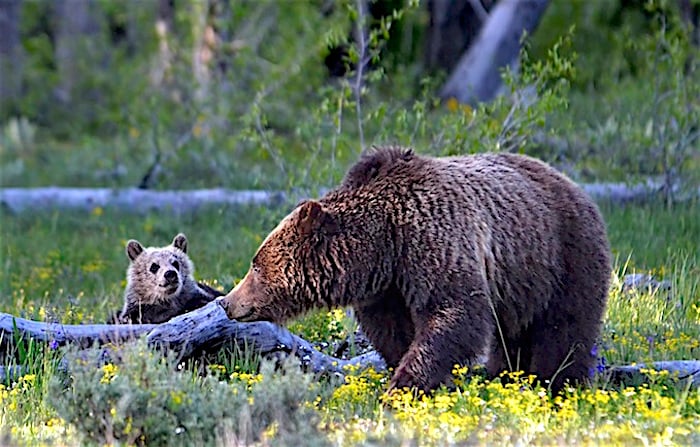
Concerned that the proposed delisting of grizzly bears in the Greater Yellowstone Ecosystem could soon be followed by a grizzly pelt being hauled out of Grand Teton National Park in Wyoming, two conservation groups have sued the National Park Service in a bid to force the agency to take back its authority to manage wildlife on all lands within the park's boundaries.
By deciding in 2014 that the state of Wyoming could manage wildlife on some 2,300 acres of privately- or state-owned lands located inside the park's borders, the Park Service opened up the possibility that hunters could pursue wildlife such as wolves, moose, bison, elk, and possibly grizzlies if they are eventually delisted on those acres, and that trappers could go after beavers.
On Wednesday the National Parks Conservation Association and the Greater Yellowstone Coalition filed a lawsuit in a bid to reverse that decision.
“We are committed to ensuring Grand Teton National Park’s remarkable wildlife is managed consistently throughout the park and with the highest level of protection possible, which park visitors expect,” said Sharon Mader, NPCA's Grand Teton program manager. “For more than 65 years, the National Park Service rightfully and lawfully exercised authority to protect all park wildlife. It should continue to do so moving forward.”
Many inholdings, or land not owned by the Park Service, within Grand Teton National Park are near places that are enjoyed by the park’s 2.8 million annual visitors, the two groups said in a release. A large number of visitors come to see the park’s wildlife.
"But under the Park Service’s decision, bison, moose, coyote, beaver, elk, and potentially in the future, grizzly bears that wander onto such inholdings could be shot and killed under Wyoming law," the release went on. "Park visitors’ experience will also be negatively impacted by the sights and sounds of such activity. Since the Park Service’s decision, a number of the park’s iconic bison have been killed by private hunters under state law within the park’s boundary."
At the Greater Yellowstone Coalition, Executive Director Caroline Byrd sounded almost flummoxed by the Park Service's decision.
“We find ourselves taking the National Park Service to court to force the Park Service to maintain Park Service authority over Park Service resources,” she said. “After trying for months to convince them to reassert their long held authority over park inholdings, we were left with no choice but to go to court.”
While it's currently illegal to hunt grizzly bears due to their protection under the Endangered Species Act, if they are delisted as the U.S. Fish and Wildlife Service is proposing, Wyoming could establish a hunting season for the bruins and could possibly even allow "baiting" of the bears to draw them to certain areas for hunters, as is allowed in some parts of the state during the black bear hunting season.
The Greater Yellowstone Coalition and National Parks Conservation Association argue that the Park Service’s decision to turn wildlife management on inholdings over to the state violates federal law. The Park Service, which has the legal authority to prohibit hunting anywhere within the boundary of the park, has the responsibility under its governing statutes to exercise that authority to protect the park’s wildlife, the groups maintain.
"NPS's abdication of its responsibility and authority to control or prevent the killing of park wildlife on inholdings was contrary to law because federal law prohibiting anyone from harming park wildlife does apply on inholdings in Grand Teton," a section of the lawsuit states. "Furthermore, in determining incorrectly that federal law does apply, NPS acted arbitrarily and capriciously, including by failing to consider all relevant facts."
According to the lawsuit, the Park Service changed its position regarding who had authority to manage wildlife on inholdings within Grand Teton after a wolf was killed on private land inside the park. In 2015, the lawsuit added, the Park Service agreed with the Wyoming Game and Fish Department that bison could be hunted on private lands inside Grand Teton. A similar agreement later was reached regarding elk hunting on the Pinto Ranch, a 450-acre spread within park boundaries, the lawsuit claims.
Those decisions were flawed and unnecessary, the groups claim, because in 1950 when the park's enabled legislation was passed by Congress, "the federal government and the state government had agreed that federal law applied to prohibit killing wildlife on Grand Teton inholdings as well as on federally owned park land."
The one compromise was that "public hunters were allowed to shoot elk in the park under a program under which the state would play an unprecedented role concerning hunting in a national park. Specifically, an advisory committee would be set up to develop annual and long-term plans for 'control' of the elk herd. The committee's recommendations would be submitted to the Interior Secretary and (Wyoming Game and Fish Department), which would have the responsibility to issue orders and regulations to implement the hunt recommended by the committee."
Stories about:
Story Categories:
A copy of National Parks Traveler's financial statements may be obtained by sending a stamped, self-addressed envelope to: National Parks Traveler, P.O. Box 980452, Park City, Utah 84098. National Parks Traveler was formed in the state of Utah for the purpose of informing and educating about national parks and protected areas.
Residents of the following states may obtain a copy of our financial and additional information as stated below:
- Florida: A COPY OF THE OFFICIAL REGISTRATION AND FINANCIAL INFORMATION FOR NATIONAL PARKS TRAVELER, (REGISTRATION NO. CH 51659), MAY BE OBTAINED FROM THE DIVISION OF CONSUMER SERVICES BY CALLING 800-435-7352 OR VISITING THEIR WEBSITE. REGISTRATION DOES NOT IMPLY ENDORSEMENT, APPROVAL, OR RECOMMENDATION BY THE STATE.
- Georgia: A full and fair description of the programs and financial statement summary of National Parks Traveler is available upon request at the office and phone number indicated above.
- Maryland: Documents and information submitted under the Maryland Solicitations Act are also available, for the cost of postage and copies, from the Secretary of State, State House, Annapolis, MD 21401 (410-974-5534).
- North Carolina: Financial information about this organization and a copy of its license are available from the State Solicitation Licensing Branch at 888-830-4989 or 919-807-2214. The license is not an endorsement by the State.
- Pennsylvania: The official registration and financial information of National Parks Traveler may be obtained from the Pennsylvania Department of State by calling 800-732-0999. Registration does not imply endorsement.
- Virginia: Financial statements are available from the Virginia Department of Agriculture and Consumer Services, 102 Governor Street, Richmond, Virginia 23219.
- Washington: National Parks Traveler is registered with Washington State’s Charities Program as required by law and additional information is available by calling 800-332-4483 or visiting www.sos.wa.gov/charities, or on file at Charities Division, Office of the Secretary of State, State of Washington, Olympia, WA 98504.
INN Member

The easiest way to explore RV-friendly National Park campgrounds.

Here’s the definitive guide to National Park System campgrounds where RVers can park their rigs.
Our app is packed with RVing- specific details on more than 250 campgrounds in more than 70 national parks.
You’ll also find stories about RVing in the parks, tips helpful if you’ve just recently become an RVer, and useful planning suggestions.


Comments
"...in 1950 when the park's enabled legislation was passed by Congress, "the federal government and the state government had agreed that federal law applied to prohibit killing wildlife on Grand Teton inholdings as well as on federally owned park land." Is that written in the founding legislation somewhere? Because I thought the U.S. District Attorney for the state of Wyoming concluded in 2014 that the NPS did not have jurisdiction over wildlife management on privately owned land within NP boundaries. Or at least, that's how High Country News reported it: https://www.hcn.org/articles/wolves-grand-teton-national-park.
Renee, follow the link to the lawsuit in the first sentence above, and scroll down to page 21. NPCA and the Greater Yellowstone Coalition maintain that the NPS misinterpreted that section.
The question of jurisdiction must be in keeping with the fundemental purposes of the park and the interests of the public. Federal law takes prescidence over state or local law insofar as basic the management of the park and protection of its resources and character. The National Park Service should never surrender that principle unless forced to do so by court decision after all avenues of maintaining it have been exhausted. Individual private or state owned inholdings should not be allowed to turn into public or private killing grounds within a national park.
Thanks for the reference, Kurt. I do believe that most national park supporters (and possibly NPS staff) will hope that the lawsuit is decided in favor of the plaintiffs. Certainly they are welcome to sue over the application of the statute, but I still find it odd that most groups are blaming the NPS for "its reading" and "its interpretation" of the statute, if it was the US Department of Justice who decided how the law should be applied in this case. Was the NPS supposed to defy the DOJ?
Most people want their Wildlife managed with science and non-lethal methods, contrary to F&W agencies catering to special interest groups corruptly influencing with a bloodlust. The facts are that Wildlife Watching generates much more revenue for the states Wildlife management than the 5% of Hunters fees. Our Wildlife agencies murder 2.7 million animals a year, they are a rouge agency and need to be restructured with non-lethal methods only, now before you lose all the wildlife watchers in favor of sociopathic murderers. I welcome any hard legal stand to change this madness for good.
Could you document that?
And that.
EC, looks like Wyoming hunting revenues are about $33 million per year, and tourism is about $3.4 BILLION.
https://www.hcn.org/issues/46.8/hunting-for-conservation-dollars/hunting...
http://www.wyomingofficeoftourism.gov/tourism-matters/why-tourism-matters/
In 2011, more than $350 million was spent on wildlife watching specifically in Wyoming.
file:///Users/kurtrepanshek/Downloads/1907.pdf
And those hunters don't spend any tourism dollars and every tourist is touring for the purpose of animal watching?
Now you're just arguing for the sake of arguing. As I noted, there was a separate, $350 million, breakout on wildlife watching specifically. Or roughly 10 times what hunting specifically brought in. So no matter how you want to cut it, according to those sources, wildlife watching brings in roughly 10 times what hunting brings in.
Only if you limit what hunting "brought in" to the license fees. How much in license fees did "animal watching" bring in? The link in your earlier post indicated $175 million in total local and state taxes from tourism so how does animal watching bring in $350 million?
PS this link doesn't work: file:///Users/kurtrepanshek/Downloads/1907.pdf
Retail sales accounts for $350 million in Wyoming. Here's the link:
http://digitalmedia.fws.gov/cdm/ref/collection/document/id/1906
So how is it valid to compare retail sales to license fees? Hunters generate $33 million in license fees. Animal watchers generated......wait for it.......ZERO. Your report guesstimates that wildlife viewing generated $46 million in state and local taxes in Wyoming. License fees alone cover 72% of that. How much in retail sales and tax revenues did hunters generate? Probably far more than $13 million. And how is it valid to compare "wildlife viewing" of all species with hunting of a handful?
EC, you'll have to take up your questions with USFWS and the Wyoming Game and Fish Department, which calculated those revenues.
Now, perhaps justifying your point is that the Wyoming Game and Fish Department receives only about 6 percent of its operating revenues from the state coffers. The rest is from hunting and fishing licenses. What's unknown is how much the NPS spends on wildlife management.
Can we please get past the argument of what the national parks "pay" the country? As J. Horace McFarland noted a century ago, our health and patriotism were the real beneficiaries, "which would make the parks worth while, if there were not a cent of revenue in it, and if every visitor to the parks meant that the Government would have to pay a tax of $1 simply to get him there."
Hunting in Grand Teton National Park should end no matter what it "pays." There are plenty of other places to hunt, but only one Grand Teton National Park. Nothing against hunting--I love my hamburgers. But let's get serious just for once. We can't keep playing these games without losing our greater vision that the parks are something "special." If we want Grand Teton National Park to be just another landscape, we should turn it over to the people of Jackson. They would be glad to make it a city park, with hunting allowed. Just keep your heads down while you go shopping.
EC, most of the people paying gate fees at Yellowstone/Grand Tetons, which is by the way the biggest tourism related revenue generating machines in the entire state of Wyoming are voting with their wallet to go to a place to see wildlife/nature. SO stating that they are paying 0 in fees is wrong. Same can be said when they purchase a boat permit to go on a rafting adventure, or pay a state park entrance fee. These count too as fees/licenses!
And, just because there isn't hunting, doesn't mean these species are fully protected. I've seen this over and over again in Yellowstone, and now in the Great Smoky Mountians. In Yellowstone, unethical hunting guides will line up at the border during the migration and give their high paying clients an easy target shoot. There's been many cases where hunters will have a "mole" that isn't armed, but is used to push elk out of the park into the waiting gunsights of so called hunters and this has been documented in the tetons many times.
In fact, in the hunt zones outside of the tetons, close to 25,000 elk were killed in a 10 year period if you add up all the harvests from the wyoming, idaho, and montana F&G harvest database which is easily accessible online. Then people blame the elk decline all on the wolves...
In the Smokies, i've documented idiots running their bear dogs in the park 3 times over the last year trying to push bears out of the park to tree and shoot them. It's amazing how this sort of thing goes on, but it does.
First, they are paying no fees to Wyoming. Second, is seeing wildlife the only reason they go, or even the primary reason? How many people visit Zion, Arches, Yosemite, the Grand Canyon where where wildlife viewing beyond a few domesticated elk and deer is rare. What constitutes a "wildlife watcher"? Someone that saw an animal on his trip? I saw a Pika on Half Dome, does that mean all the money I spent to drive to Yosemite, camp and the hike Half Dome is attributable to "wildlife watching", of course not. Would I go to Yellowstone if there were half as many Bison, you bet. Would I go somewhere and spend my vacation money if there were no Yellowstone, you can bet on that again.
The kind of studies Kurt put forth are pure junk. Just like the climate "science", they are based on little actual data and a lot of assumptions, speculation and extrapolations.
And I do agree with Alfred, at least partically. Economics should not be the justification for or against any particular activity in the park. But I don't buy his argument that are "plenty of other places to hunt". There are plenty of other places to hike, boat, fish, camp, mtn climb....... but that is not a valid reason to rule them out in GTNP. And BTW, I'm not a hunter.
No Kurt, they calculate the revenues but they aren't the ones making the bogus comparisons.
Really?!?? With all the national forest lands, BLM lands, state lands, and private ranches that allow hunting?
Really?!?? With all the national forest lands, BLM lands, state lands, and private ranches that allow hunting?
Did you read the whole sentence? I find in no more valid than to argue that camping, fishing, boating.... should be banned because there are "plenty of other places" to do those activities.
You're comparing apples (hunting) with oranges (camping, fishing, boating) when it comes to national parks and what they can be used for.
On what basis do you make that distinction Kurt?
Hunting typically is not permitted in "national parks," though it is in national preserves. Camping, fishing, and boating traditionally are permitted. Beyond that, no one is arguing that camping, fishing, and boating should be banned from Grand Teton...though there are plenty of places elsewhere in Wyoming for those activities.
I think the better description would be non-consumptive visitation vs consumptive. Consumptive use would assume they would be doing something like hunting, removing fish, logging, rock hounding etc. Non-consumptive use would be wildlife watching, skiiing, going on a hike, backpacking, or just road trekking etc.
It's evident in my time spent in the tourism based economies, that non-consumptive use tends to well exceeds consumptive use in many areas of the country.
National Parks and a few of the monuments ran by the NPS are the only places where non-consumptive use is promoted by law, with the Grand Tetons being one of the few in the NPS where it's still allowed. I do hope this is changed, though. The state of wyoming has more than enough places that allow hunting, and hunters make up a decreasing faction of the population.
But why is that? That is the question I am asking. Why is hunting any less legitimate than fishing, camping hiking etc. The answer can't be because there are "other places" because there are "other places" for fishing, camping, hiking etc. Now I am sure there are places where hunting could threaten a species and where the science shows that, it should limited or even banned. But where science doesn't show that, I see no reason not to permit it - with limitations of course. Tell me, what makes an Elk in the Tetons any more sacrosanct than one is some randon National Forest?
Sorry Gary, I don't see anything inherently evil in consumptive actives, especially with a renewable resource.
I don't have a problem with consumptive use in USFS areas or state game lands. Where I have a problem with it is in NPS lands. So quit putting words in my mouth, overlord troll.
What words did I put in your mouth? You have a problem with consumptive on NPS lands. I don't - at least not if the science indicates they won't be destructive to the long term health of the ecosystem. I will ask again, what makes an Elk in GTNP any more sacrosanct then one in a National Forest.
Because, ungulate species in the USFS and state game land are usually unnaturally inflated to keep the fish and game agencies in the state afloat because that's their bread and butter money when they sell tags. Whereas in the NPS, that is not the case, and not a factor, and carnivore species are protected and not intentionally minimized so that the F&G agency can promote unnaturally large herds of ungulates. Idaho was terrible for this practice. Many states fall victim to this practice, especially poor states that don't have much of a tax base.
Same goes for fish species. In most F&G agencies, they tend to only be concerned with "game fish". In the NPS, preserving the entire ecosystem, and going beyond just maintaining game fish is a key role of the agency. Hence, the ecosystems are a lot more complete and intact in most NPS lands, compared to USFS lands. That's why the NPS has been trying to remove non-native lake trout in Lake Yellowstone or preserving species like darters (far from a game fish) in the southeast. Some of the best science is done in the NPS, because the system has a much more evolved mission, than say a F&G agency.
Once again, it gets kind of old butting heads with a realtor whose full time job seems to be a troll on this site that constantly pretends to act like he cares about the NPS, but whose posts when reviewed seems to crave dismantling everything it is about.
Gary the issue isn't ungulates versus carnivores. The issue that was being discussed was hunting in general. If the science shows there is no ill effects on the ecosystem, I see no logical reason to ban it.
Once again, you asked and I gave you an answer. Obviously, it didn't register. Once again, in NPS lands, carnivores are usually a key component, and especially in the Yellowstone ecosystem they play a key role, which is usually not allowed to occur in other areas outside of the boundaries, because these state game agencies intentionally try and mininimize the role of grizzlies, wolves, or other carnivores like wolverines or lynx so that they can intentionally overinflate ungulate and game species. That's why the only solid wolverine habitat left is in national park service units. Same goes for grizzlies. These ares should be seen and maintained as pure wildlife sanctuaries.
The NPS at GTNP is not ran like a typical NPS unit. In this case, the state of wyoming is calling the shots, not the NPS. A majority of state ran F&G agencies are not in the game of ecosystem science as much as promoting and fostering game species. In many cases, carnivore species are completely minimized to allow for an unnatural amount of ungulates so that the fish and game can then hunt about 30 to 40% of their population per year (which is their way to get funding). Obviously, this isn't sinking into your head. That's why the state of colorado doesn't want wolves or grizzlies in their boundaries to touch any of their precious elk that hunters can shoot. Elk in colorado are also unnaturally overpopulated. They'll do whatever they can to make sure that they stay out of their boundaries, even if wolves and grizzlies played a role on the landscape well before those f&g agencies came into being.
Im not really a big fan of what goes on around Jackson either. They intentionally inflate elk numbers at the elk refuge by basically creating a domesticated feedlot. I'm glad that the NPCA is willing to step up to the plate and fight this. The feedlot should end, and so should the hunting within the national park boundaries. Glad to see a real conservation organization standing up for what is right, and maintained by many years of science. They need to kick the F&G agencies out of our national parks, and let it be done by real scientists not set on just inflating game species. I guarantee, if the wyoming F&G (who I consider a barbaric agency ran by the cowiphate in that state) truly had their way, they'd pretty much eliminate most of the wolves and grizzlies in their state, but thanks to the feds, their role is at least minimized throug the ESA. In this case though, they have an inroad that is not in the best interest in the protection of what a national park is and could be. Basically, these acres are a glorified state game land. National Parks go beyond state game lands, and should be held at a much higher standard of protection.
delete post.. duplicate.
Obviously, it didn't register,
The only thing that has registered is your wild conspiracy theories about various wildlife agencies. The question, which you continue to refuse to answer is "If the science says there will be no ill effects and maybe even a beneficial impact, why not allow hunting".
So now we believe in science. But what if the scientists have a hidden agenda? What if, in working for a federal agency, they do exactly as they are told?
This just happened in Searchlight, Nevada. A big wind farm planned between the town and Lake Mead National Recreation Area listed no "ill effects"--that according to the U.S. Fish and Wildlife Service and BLM. Eagle strikes? Not a problem. The "scientists" found only three.
Ah, but the amateurs found dozens more and took the feds to court. The judge threw out the environmental impact statement, prepared by the "scientists," and went with what anyone's eyes could see.
Searclight is Harry Reid's hometown--allegedly a Democrat. Right. And what does that have to do with "money?" You want to believe in scientists? So do I. But I know better when it comes to politics.
There is nothing scientific about the elk hunt in Grand Teton National Park. Historically, it goes back to Wyoming's objections to John D. Rockefeller, Jr., and the establishment of Jackson Hole National Monument. To get the monument added to Grand Teton National Park, the federal government agreed to accept Wyoming's "science." One may see the same "science" all across the national park system where local interests are involved.
In other words, once again, stop looking for heroes in your political party. There are none, the history shows. All politics is local; the people electing you are the ones you listen to the most.
In the few instances when the nation has done the right thing, it has listened to a broad consensus. But often that only came following blood. The national park idea, lest we forget, was itself born in the midst of civil war. We allow local interests to prevail over the national interest at the expense of our best idea. Senator Reid, this one's for you. You lost at Searchlight. Now take your lumps. And while you're at it, help clean up the mess in Grand Teton National Park.
Do you have any science to indicate it is detrimental? Seems it was a pretty attractive trade, to get GTNP (or its predecessor) for a hunt that has no ill effects.
Because once again it didn't provide an answer. If it does no harm or even is beneficial, why ban it.
My guess is that if Wyoming's elk feeding grounds were closed, the elk problem would solve itself and there would be no need to cull/hunt elk inside Grand Teton.
Mission: The National Park Service preserves unimpaired the natural and cultural resources and values of the National Park System for the enjoyment, education, and inspiration of this and future generations.
When you have a small segment of the population blasting elk, grizzlies, wolves in a wildlife sanctuary, it makes the cultural resources impaired. Where does this inroad end? What's next? When condor's are considered recovered, will Arizona G&F decide it's ok to add a trophy hunting season inside GCNP? But, fortuantely, that won't happen under current laws.
If it wasn't for the Everglades NP, there more than likely would have never been the recovery of the alligator, or the egret. Our NP's should be held to higher standards than ecosystems controlled by your atypical F&G agency. Currently Glacier is one of the last strong strangleholds of the wolverine in the lower 48.
Once again, I await the day when the barbaric state of Idaho, and their fiddle players in the F&G say hey "you know what, over 10,000 grizzlies were once in the state of Idaho a century ago, maybe we should allow them to return back into their key habitat".
But that doesn't happen. All they care about is elk, mule deer, and moose. Instead of culling grizzlies in the borders of Yellowstone because a few f&g scientist deem them recovered because they are now expanding outside of the park and potentially feasting on their precious elk hunting stock, they need to instead be taking some of the population and re-establishing them back into places like Rocky Mountain National Park, the Frank Church Wilderness, etc where they are far from recovered, but have traditional range and a lot of habitat available to them. Put them back in telluride!
That perhaps is true Kurt, but what would be gained by that? From what I can see, having the feeding grounds and a brief hunt does not harm while providing recreation and food for a good number.
Well, that's a discussion that could go in many directions. Personally, I have no objections to hunting. But the feeding grounds have been identified as a source of disease, and some would say artificially inflate elk numbers beyond carrying capacity.
How to manage wildlife resources on public lands is a tough, politically charged issue. As Gary notes, too often it is designed to bolster prey for hunters, and not predators to naturally manage prey. And then there's the oddball: trying to artificially maintain a low Yellowstone bison population in the name of brucellosis prevention when it's been said that elk are carriers, too, and more likely to spread the disease to livestock.
And I see nothing wrong with that. What is the difference between feeding elk and having a hunt and feeding cattle and having a slaughter? As long as its done without negative impacts to the park, I don't see the problem. And to bring it more to home with this article, as was pointed out by som sai elsewhere and the article itself, this is about hunting on private not public land.
Listen, guys, to the Old Professor. You just can't make this up as you go along. Private property or government property, wildlife is governed by laws that go back hundreds of years. If a deer is sitting in my front yard, I just don't have the right to shoot it. I can if the deer is in season, but again, not without the proper permit. You bet, EC. The government can tell you what to do with wildlife, because wildlife has always been identified as "mobile." You don't own it any more than you would own an airplane forced down in your driveway.
You keep saying: Show me where hunting is detrimental to the national parks. I will be glad to show you that. A few years ago, kids hunting bear along a trail in one of Washington State's national forests happened to shoot a hiker instead. They mistook her for a bear and killed her. High-powered rifles can kill from a mile or more. Who wants that in a national park?
If I am wrong, go shoot whatever next comes into your yard. I am sure they have wi-fi in jail. You can tell us what it felt like being John Colter. The only problem is: He lived 200 years ago when the West was sparsely populated and not in need of national parks. Now that we need them, we have the right to manage them properly. Or would you like to be mistaken for an elk? Don't laugh. Hunters still tie cows to their bumpers in upstate New York, claiming they are deer. It moved and so I shot it, and now I am taking it home! And believe me, hunters are good at culling one another, as well. You may find that acceptable in a national park. I don't, and I don't care what the "science" says.
Because, the consequences is carnivore species are mostly minimized in the process, and that goes against the National Park Service mission because it creates an impariment of cultural resources.
National Parks should not be, nor should be domesticated feedlots to bolster prey species at the sacrifice of other species so that it can inturn make F&G agencies a revenue stream. F&G agencies should not be making money off of our National Parks with resource extraction. National Parks were set aside to protect against resource extraction. It's cut and dry in my book. Anything within the set boundary of a National Park should follow a national standard that trumps state law, no matter how barbaric or progressive it may be.
Having an ecosystem in balance should be the goal, no? A natural, not artificial, balance. But that's a pretty lofty goal in this crowded world.
As for som sai's comments, that interpretation was not part of the enabling legislation for Grand Teton:
Nowhere in the enabling legislation does it allow for hunting on either federal, state, or private lands within the park's boundaries outside of the annual elk culling.
https://www.nps.gov/grte/learn/management/upload/Grand-Teton-NP-enabling...
It has no jurisdiction over those lands to allow or prevent hunting as acknowledge by "The park shall comprise, subject to valid existing rights,...."
Gary, you keep talking about consequences - which may or may not be valid. I am trying to address this at a higher level. My questions have been prefaced with "if there is no negative impact". If you can't agree its OK if there is in fact no negative impact then your argument is totally an emotional one.
Sorry Gary, I can't buy that. I believe in property rights. You want to control hunting in those areas, buy the property.
Really, a higher level? The guy that can't write more than 2 sentances in a comment to express his thoughts. Please. When something is removed from a system, it does have consequences. Define "negative impact" in this case, please? Please express your thoughts at a higher level, because your comment is way too vague, and if you think killing elk in a national park doesn't have an impact, then explain why you think that is not negative in more than 2 sentances. Why would killing or removing native wildlife from a wildlife sanctuary not have at least a negative impact, regardless of the size of the impact? Please express this in a more rational context. I realize, that might be tough for you, but let's dig deep and try... Then maybe I can take you and your trolling a little bit more serious. Right now, I just see you as a site irritant, that should be eliminated like an invasive species.
By the way, the inholdings fall under NPS jurisdiction, and hopefully, this lawsuit will bring this out into the open, and force other parks to follow these standards. Zion could also use this ruling.
...and then there's this:
..and then there's this:
Which means nothing regarding authority over private property. Do you really think the US Government can buy property surrounding my home and then tell me what I can do in my front yard?
I guess that depends on what you agree to. In many cases, the NPS has told inholders they can live on their lands for X number of years, and then the property goes over to federal ownership.
That said, I've requested the background docs that the plaintiffs are basing their case on and will share their contents if they're made available. But in their lawsuit they maintained that, "the federal government and the state government had agreed that federal law applied to prohibit killing wildlife on Grand Teton inholdings as well as on federally owned park land."
I would like to see such cases where inholders, against their will and without compensation where thrown off their land. I think you may be confusing that with cases where people have agreed to sell with a stipulation they can stay on for a certain period of time or until certain events occur.
As to applicable law, the state can certainly enact (and resind) law that says their hunting rules are in line with federal rules but they cannot cede their authority over state lands and private property to the feds.
Pages