
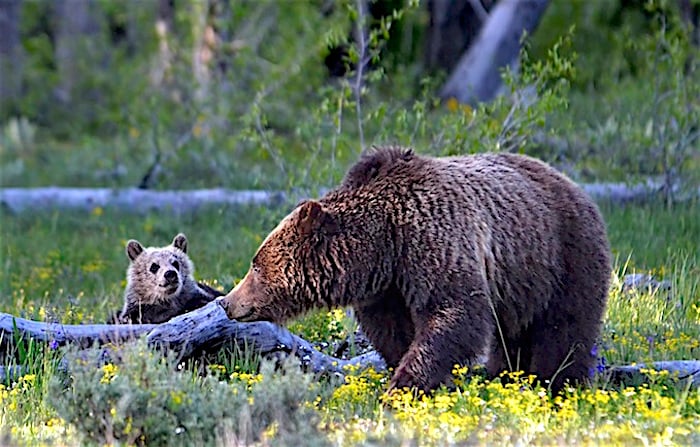
Concerned that the proposed delisting of grizzly bears in the Greater Yellowstone Ecosystem could soon be followed by a grizzly pelt being hauled out of Grand Teton National Park in Wyoming, two conservation groups have sued the National Park Service in a bid to force the agency to take back its authority to manage wildlife on all lands within the park's boundaries.
By deciding in 2014 that the state of Wyoming could manage wildlife on some 2,300 acres of privately- or state-owned lands located inside the park's borders, the Park Service opened up the possibility that hunters could pursue wildlife such as wolves, moose, bison, elk, and possibly grizzlies if they are eventually delisted on those acres, and that trappers could go after beavers.
On Wednesday the National Parks Conservation Association and the Greater Yellowstone Coalition filed a lawsuit in a bid to reverse that decision.
“We are committed to ensuring Grand Teton National Park’s remarkable wildlife is managed consistently throughout the park and with the highest level of protection possible, which park visitors expect,” said Sharon Mader, NPCA's Grand Teton program manager. “For more than 65 years, the National Park Service rightfully and lawfully exercised authority to protect all park wildlife. It should continue to do so moving forward.”
Many inholdings, or land not owned by the Park Service, within Grand Teton National Park are near places that are enjoyed by the park’s 2.8 million annual visitors, the two groups said in a release. A large number of visitors come to see the park’s wildlife.
"But under the Park Service’s decision, bison, moose, coyote, beaver, elk, and potentially in the future, grizzly bears that wander onto such inholdings could be shot and killed under Wyoming law," the release went on. "Park visitors’ experience will also be negatively impacted by the sights and sounds of such activity. Since the Park Service’s decision, a number of the park’s iconic bison have been killed by private hunters under state law within the park’s boundary."
At the Greater Yellowstone Coalition, Executive Director Caroline Byrd sounded almost flummoxed by the Park Service's decision.
“We find ourselves taking the National Park Service to court to force the Park Service to maintain Park Service authority over Park Service resources,” she said. “After trying for months to convince them to reassert their long held authority over park inholdings, we were left with no choice but to go to court.”
While it's currently illegal to hunt grizzly bears due to their protection under the Endangered Species Act, if they are delisted as the U.S. Fish and Wildlife Service is proposing, Wyoming could establish a hunting season for the bruins and could possibly even allow "baiting" of the bears to draw them to certain areas for hunters, as is allowed in some parts of the state during the black bear hunting season.
The Greater Yellowstone Coalition and National Parks Conservation Association argue that the Park Service’s decision to turn wildlife management on inholdings over to the state violates federal law. The Park Service, which has the legal authority to prohibit hunting anywhere within the boundary of the park, has the responsibility under its governing statutes to exercise that authority to protect the park’s wildlife, the groups maintain.
"NPS's abdication of its responsibility and authority to control or prevent the killing of park wildlife on inholdings was contrary to law because federal law prohibiting anyone from harming park wildlife does apply on inholdings in Grand Teton," a section of the lawsuit states. "Furthermore, in determining incorrectly that federal law does apply, NPS acted arbitrarily and capriciously, including by failing to consider all relevant facts."
According to the lawsuit, the Park Service changed its position regarding who had authority to manage wildlife on inholdings within Grand Teton after a wolf was killed on private land inside the park. In 2015, the lawsuit added, the Park Service agreed with the Wyoming Game and Fish Department that bison could be hunted on private lands inside Grand Teton. A similar agreement later was reached regarding elk hunting on the Pinto Ranch, a 450-acre spread within park boundaries, the lawsuit claims.
Those decisions were flawed and unnecessary, the groups claim, because in 1950 when the park's enabled legislation was passed by Congress, "the federal government and the state government had agreed that federal law applied to prohibit killing wildlife on Grand Teton inholdings as well as on federally owned park land."
The one compromise was that "public hunters were allowed to shoot elk in the park under a program under which the state would play an unprecedented role concerning hunting in a national park. Specifically, an advisory committee would be set up to develop annual and long-term plans for 'control' of the elk herd. The committee's recommendations would be submitted to the Interior Secretary and (Wyoming Game and Fish Department), which would have the responsibility to issue orders and regulations to implement the hunt recommended by the committee."
Stories about:
Story Categories:
A copy of National Parks Traveler's financial statements may be obtained by sending a stamped, self-addressed envelope to: National Parks Traveler, P.O. Box 980452, Park City, Utah 84098. National Parks Traveler was formed in the state of Utah for the purpose of informing and educating about national parks and protected areas.
Residents of the following states may obtain a copy of our financial and additional information as stated below:
- Florida: A COPY OF THE OFFICIAL REGISTRATION AND FINANCIAL INFORMATION FOR NATIONAL PARKS TRAVELER, (REGISTRATION NO. CH 51659), MAY BE OBTAINED FROM THE DIVISION OF CONSUMER SERVICES BY CALLING 800-435-7352 OR VISITING THEIR WEBSITE. REGISTRATION DOES NOT IMPLY ENDORSEMENT, APPROVAL, OR RECOMMENDATION BY THE STATE.
- Georgia: A full and fair description of the programs and financial statement summary of National Parks Traveler is available upon request at the office and phone number indicated above.
- Maryland: Documents and information submitted under the Maryland Solicitations Act are also available, for the cost of postage and copies, from the Secretary of State, State House, Annapolis, MD 21401 (410-974-5534).
- North Carolina: Financial information about this organization and a copy of its license are available from the State Solicitation Licensing Branch at 888-830-4989 or 919-807-2214. The license is not an endorsement by the State.
- Pennsylvania: The official registration and financial information of National Parks Traveler may be obtained from the Pennsylvania Department of State by calling 800-732-0999. Registration does not imply endorsement.
- Virginia: Financial statements are available from the Virginia Department of Agriculture and Consumer Services, 102 Governor Street, Richmond, Virginia 23219.
- Washington: National Parks Traveler is registered with Washington State’s Charities Program as required by law and additional information is available by calling 800-332-4483 or visiting www.sos.wa.gov/charities, or on file at Charities Division, Office of the Secretary of State, State of Washington, Olympia, WA 98504.
INN Member

The easiest way to explore RV-friendly National Park campgrounds.

Here’s the definitive guide to National Park System campgrounds where RVers can park their rigs.
Our app is packed with RVing- specific details on more than 250 campgrounds in more than 70 national parks.
You’ll also find stories about RVing in the parks, tips helpful if you’ve just recently become an RVer, and useful planning suggestions.


Comments
Here is the enabling legislation. Not a peep about the feds controlling hunting on state or public land.
https://www.nps.gov/grte/learn/management/upload/Grand-Teton-NP-enabling...
In what form did this "agreement" occur and who actually were parties to the "agreement".
I appreciate your efforts in trying to chase down the documents.
Here is the lawsuit. There is no evidence or even a claim that there was a formal agreement.
https://drive.google.com/file/d/0B9ViaezzbfznU3ViRy1tdjBxeUU/view?pref=2...
Still can't (won't) answer the question. I don't need to write a disertation to ask it. There are culling kills that take place all over the country supported by "scientific" analysis that has determined they are beneficial to their environments. Clearly not every elk, deer, python...... kill is a detriment. You come at this with the foregone conclusion it is always a detriment. Obviously there are many that disagree with you. So once again - IF it is shown not to be detrimental, why ban it?
Could you please provide the federal law or Constitutional provision that establishes that fact? Because if true, it is a very scary proposition.
Once again, you seem to think that National Parks < State lands. Not the case. National Parks are and shall be our highest level of land protection within the entire public lands system. This act is a inroad to eroding the system. I know that's what you like about it, and why you sit here and defend it, because you have proven many times in your trolling that you are no fan of the National Parks in this system, and will say and do anything to subvert and possibly erode the system that has been built with a century of hard standing politics and science from dedicated conservationists, scientists, and politicians.
While, it's definitely true that culls have gone on, most of the time that has occurred because they are either 1. An invasive species and a detriment to the ecosystem (you should relate), or 2. They have no natural predators because they were wiped out, so man has to step in (rocky mountain national parks absence of native species like wolves, and grizzlies leading NPS biologists to sterilize, and in some cases euthanize female elk when the population gets to a point of eroding the range. 3. The migration routes of these species are completely disrupted because of politics outside of a NPS boundary (hence bison hazing, and cull in yellowstone)
In the case of GTNP where wolves, grizzlies, and cougars are within the ecosystem I don't see those factors being the case. What I do see however, is that the domesticated feedlot that is used for wintering elk, along with these actions by the wyoming F&G are corrupting the overall mission of the NPS to administering and unimpaired natural resource for future generations. They are artificially inflating elk species, and of course the Wyoming F&G is using this artificial inflation to create a hunt within the park (hence, resource extraction). The idea of a feedlot should be disbanded and hopefully this lawsuit forces the hand of the NPS to kick out the F&G which is nothing more than a ungulate game management entity. The wyoming fish and game has millions of acres of USFS and BLM land to administer their game farms. Turning GTNP into a yearly hunting ground is a corruption of the NPS mission. The NPS should be held at a higher standard of not allowing resource extraction in their park boundaries.
I realize nothing I say will penetrate into that thick numbskull... so this my last comment to you. Now good riddance.
So you finally have (kind of) given an answer. There is no valid reason other than your personal emotions.
I gave you that answer many miles back. You have a terrible reading comprehension problems, so of course, I don't expect you to comprehend most of what is said on this site when people respond to your useless, but always annoying trolling.
And that has nothing to do with emotions. It is protecting the NPS mission, something I firmly trust in.
And I agree with Alfred, one of the best part about going to National Parks during elk hunt season in the northern rockies, is because you aren't going to get shot. Parks are a refuge for non-hunters to enjoy wildlife in a natural state.
I'm going to add something else. One of the reason, many of the bucks in the Great Smoky Mountains National Park make the cover of hunting magazines, is because it's one of the few places you can actually see 13 point bucks, because they get to live naturaly long lives free from hunting and extraction.
Yes - the state government can tell you. The federal government has no jurisdiction.
Never said that. My question has been if it is not detrimental, why ban it.
And I see nothing necesarily in conflict between hunting and the NPS mission. If there is a conflict in a certain situation, it should be banned. If their is no conflict, it shouldn't.
BTW where are the citations for the laws and Constitutional powers that give the NPS jurisdiction over private lands. You are great at calling names and casting aspertions but very short on providing the facts.
Of course you don't because you've never invested any time, effort or thought into what it means. You have no skin in the game other than your misguided self trolling a national park site for years on end. You're a realtor with little comprehension of what a National Park is about. You probably just look at the land as something that should be carved up and sold, because it would be valuable to your clients. It's evident the longer you are on this site, you are just here to anger and stir up people, because you seem to get a rise off of it. Either that, or you are a paid troll. What a very sad life you must lead. I try not to fall into your trap, but I did today. Why Kurt allows you to ruin this site, is beyond me.
National Parks are wildlife sanctuaries. The mission is clear on that. Killing the largest, biggest animals for trophy hunting defeats the mission of a sanctuary.
And I suppose the missionary statement to that effect is in the same place as the laws and Constitional powers that give NPS jurisdiction over private land. - i.e. nowhere.
Once again, you have the reading comprehension of a shrimp. I can't help you interpret the national park service organic act, 16 U.S.C.1. It's evident the school systems you attended failed you, so I can't help you further along. I'm just spinning my wheels here and this is now hit a level of pointlessness.
No, you can try to insult people but you can't provide the facts. Show me the language in 16 U.S.C.1 that says hunting is contrary to the mission. Show me the language in 16 U.S.C.1 that give the NPS jurisdiction over private lands. It isn't there which is why you pursue the avenue of personal insults rather than civil discussion.
EC, you're a gem (I will not say shrimp). Yes, wildlife generally falls under state law, but there are federal laws, as well. Tell you what. Go out and shoot an eagle and see what government takes your head off. Then there is the Migratory Bird Treaty Act. Certainly you have heard of that. And the Endangered Species Act, but yes, President Obama ignores that, too. Got to have those wind farms saving us from global warming. . .
We're saving nothing here but our selfishness and refusal to face the facts. Our national parks are not personal playthings just because we want to play. But yes, EC, you are an important reminder of why even the Park Service ignores the law. It is easier to cave than to protect, and when someone powerful is asking you to cave, your government career may be on the line.
The National Park Service can only protect what the people want protected. Only when the people tell Congress and the lobbyists to back off do we get the kind of protection we deserve. You know me. I am all for any method--even privatizing services--if that will really help us protect the parks. But straining credibility is not a method. It is not credible when you say that "if [something] is not detrimental, why ban it." Because taste figures in the equation, too. A prostitute ring working Jackson Lake Lodge would not in and of itself be detrimental. But I still think we would want to ban it inside a national park.
I think there are tasteful ways to hunt, and I believe all of my friends to be tasteful hunters. None has ever wanted to hunt in Jackson Hole. Similar to the trademark issue in Yosemite, this only proves how selfish some people are. Like the two bicyclists today who ran a stop sign in front of me, selfish people expect us to apply the brakes. Next time they might not be so lucky. That is what happens when you push good taste.
Alfred, I am listening to the "old professor", nice posts, thanks.
Guys. He's TEFLON. Nothing sticks. He has the same rejoinders, the same chinese-finger-trap conversations, for years, and he's getting a lot of us all stirred up. Before i retired I could have pointed at the page in DSM but I plan on staying retired. The past couple of days he has had a bunch more spare time on his hands and pops up like a whack-a-mole game, to no end result other than his satisfaction.
Walk away. The month after my house burned down this winter followed a few days later by major surgery, I glanced in here occasionally and avoided raising my blood pressure by engaging. It was good. Ignore him. He gets just enough of a hook into you to make you want to snap back - let it go.
Good point Alfred. Please point to the provision in the Constitution that gives the Government that power. But more importantly, does the government allow you to shoot an eagle on public property but not on certain private property? No.
You mean in the constitution where congress was given the rights to make such laws protecting wildlife within the border of the US. My gosh, this guy sounds like Ammon Bundy. "It's not directly in the constitutions". It's almost like the constitution has to be written like a Dr. Seuss book for these idiots with a reading comprehension level less than a kindergartner to understand it.
Ohh well, the NPS determined a long time ago that hunting went against it's mission of an unimpaired natural resource. Many smart people came to that conclusion a long time ago. Like Rick said, this guy is just a teflon poster. Nothing sticks, and nothing permeates that thick skull with an obviously hollowed out membrane. He really just needs to try a new stick, but I don't think he's self-aware enough to get it.
Gee Gary, tell me what Article and section you find that designated power. Once again heavy on the name calling and insults but very light with the facts.
Article 1, Section 1. I realize it's not written in dr seuss prose, so I can understand why you have a hard time comprehending that the constitution grants congress the power to create legislation like the ESA. And by the way, the supreme court has ruled on that descision many times now. I realize, you have a very rudiementary understanding of the three branches of our Federal Government, but i'm not here to teach a total dullard a civics 101 class. That's not my role in life. So carry on in your constant state of ignorance. Quit asking me such stupid questions, that you can find out yourself, if you learned to do some basic research. If you need further help, I suggest looking at this site: http://www.congressforkids.net/Constitution_threebranches.htm
Article 1 Section 1. read "All legislative Powers herein granted shall be vested in a Congress of the United States, which shall consist of a Senate and House of Representatives."
That section doesn't grant any legislative power. All it does is indicate what power is granted will be vested in Congress. If the power isn't granted its not vested.
The powers are granted in Section 8. And in the words of the Constitution's author James Madison, those powers are "limited and defined" (See Federalist 45). In Section 8 there isn't a word about Congress having the power to pass laws regarding wildlife on non Federal property.
I give up on EC.. He's not worth my time. The rules that the NPS has followed in regards to hunting in national parks were established well before I was born, so at this point, i'm glad the NPCA is taking charge in filing a lawsuit to make the GTNP follow the same rules as other National Parks in the system. They will win this one, I feel.
As in "land forces" and "naval Forces". Now we really see who has a reading comprehension problem.
Ok guys, if we're not going to plow any new ground, let's move on to something substantive.
It appears that all these arguments have long ago been settled by laws enacted by Congress as they "make all Laws which shall be necessary and proper for carrying into Execution the foregoing Powers, and all other Powers vested by this Constitution in the Government of the United States, or in any Department or Officer thereof" as they "regulate Commerce with foreign Nations, and among the several States and with the Indian Tribes." The Supreme Court has decided many times what that means.
As with the Bible, anyone can imagine any interpretation of the Constitution as they wish. But in the case of the Constitution, that also requires ignoring the fact that the Constitution provided for a court system to interpret the document for us.
That's where the Bundys and others like them are fantasizing.
There is nothing in the Constitution that calls for the Court to "interpret". The purpose of a Court is to apply the rules. [ There is some discussion by Hamilton in the Federalist Papers about "interpretation" but not in the sense that interpretations should change over time] Unfortunately like much of the Constitution, this propensity to "interpret" has moved us far from the original language and intent of the Constitution. I think Section 3 is one area where our founders really messed up. ESA is a prime example. The "Constitutional" argument for the ESA is the Commerce Clause. But this, like most modern reliance on the Commerce Clause, is a complete perversion of the authors' intent. The Commerce Clause was written to prevent states from treating (taxing) trade from other states or countries disproportionately. There was no contemplation (or intent to infer power) to control what would or could be traded or under what circumstances - other than taxes and tolls and other laws that would make the trade unequal. Unfortunately, Section 3 gives us no recourse for this Judicial legislation. It may be the law but it is not in conformance with our Constitution.
Pages