
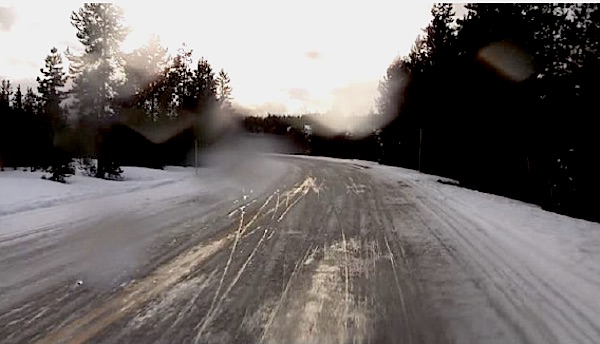
These poor snow conditions in Yellowstone, photographed in February, might reflect the new norm, not merely an aberration, according to snowpack research in the park.
This past winter saw an earlier-than-usual decline in snowpack on Yellowstone National Park roads, one that forced the park to shut down access to some snowmobilers and snowcoaches. While some might write that off to simply an unseasonal winter, record-keeping in the park shows less snow is falling there and that in some parts of Yellowstone the once-typical Rocky Mountain winter is actually much shorter than it used to be.
One can debate whether this is simply a natural cycling of the Earth's climate or human-driven global warming -- Yellowstone researchers point to the latter -- but the bottom line, as they note, is that "(D)espite all these caveats and complications, we are confident in saying the long-term forecast in Yellowstone calls for less snow. There may be a few decades-long bumps and flat places in the trend, but the overall picture of a declining staircase is clear. People who rely on water that begins its life as snow in the mountains of Yellowstone should be aware of this fact and plan accordingly."
The snowfall study was released this week in a special climate change edition of Yellowstone Science. The issue offers a range of articles involving climate change in Yellowstone, from the trends in snowfall to how the park's forests will fare under a changing climate.
Whitebark pine was projected to have the greatest loss in area of suitable habitat in the GYE. The areal extent of adult reproductive aged stands has already declined dramatically across the GYE due to mortality from mountain pine beetles. Will whitebark pine be entirely lost from the GYE? Hope for the persistence of whitebark pine in GYE is bolstered by its history. Pollen records indicate that five-needle pine (whitebark and/or limber pine) remained in the region over the past 10,000 years even during the relatively warm hypsithermal period (Iglesias et al., in revision). More research is needed, but various hypotheses suggest viable populations can remain through the projected harsher climate in 2100.
As for snowfall in the park, the researchers detected a trend the layman might find interesting: "We have seen that the longest snow course records in Yellowstone had no significant gain or loss of April 1 SWE (snow water equivalent) from the early 20th century to present day because they include both low snow eras of the Dust Bowl 1930s and the 2000s."
However, the authors went on to note, if you measured snowpack from 1961-2012 -- the longest continuous period during which researchers could rely on SNOTEL data collections from the same sites -- "...70% (21/30) of the sites had significant declines during this 52-year period."
What was behind the decline in snowpack?
"... taken as an average, sites with declining snowpack during 1961'2012 generally had lower precipitation and higher average daily maximum temperatures during the winter months," the article's authors wrote.
"These patterns suggest increasing temperatures during January, February, March, and April have caused significant snow declines in locations with higher average temperatures by pushing them over the freezing point more often. Other factors contributing to site-to-site differences in snowpack patterns include wind scouring (removes snow) and amount of tree cover (protects snow from sun and wind). Interestingly, the elevations of declining vs. no-trend sites overlapped and were not a good explanation of site-to-site differences."
They go on to say that warmer temperatures are the most likely cause for the decline, and that "(L)ocations that were generally wetter and cooler have not yet demonstrated declines, but with continued climate change will begin to lose their snowpack too."
Strikingly, the researchers found that in recent years some parts of Yellowstone have experienced 80-100 more days of above-freezing temperatures that they did in the mid-1980s. "In other words, the season during which temperatures are above freezing is roughly 3 months longer now than it was 25 years ago at the Northeast Entrance."
Stories about:
Story Categories:
A copy of National Parks Traveler's financial statements may be obtained by sending a stamped, self-addressed envelope to: National Parks Traveler, P.O. Box 980452, Park City, Utah 84098. National Parks Traveler was formed in the state of Utah for the purpose of informing and educating about national parks and protected areas.
Residents of the following states may obtain a copy of our financial and additional information as stated below:
- Florida: A COPY OF THE OFFICIAL REGISTRATION AND FINANCIAL INFORMATION FOR NATIONAL PARKS TRAVELER, (REGISTRATION NO. CH 51659), MAY BE OBTAINED FROM THE DIVISION OF CONSUMER SERVICES BY CALLING 800-435-7352 OR VISITING THEIR WEBSITE. REGISTRATION DOES NOT IMPLY ENDORSEMENT, APPROVAL, OR RECOMMENDATION BY THE STATE.
- Georgia: A full and fair description of the programs and financial statement summary of National Parks Traveler is available upon request at the office and phone number indicated above.
- Maryland: Documents and information submitted under the Maryland Solicitations Act are also available, for the cost of postage and copies, from the Secretary of State, State House, Annapolis, MD 21401 (410-974-5534).
- North Carolina: Financial information about this organization and a copy of its license are available from the State Solicitation Licensing Branch at 888-830-4989 or 919-807-2214. The license is not an endorsement by the State.
- Pennsylvania: The official registration and financial information of National Parks Traveler may be obtained from the Pennsylvania Department of State by calling 800-732-0999. Registration does not imply endorsement.
- Virginia: Financial statements are available from the Virginia Department of Agriculture and Consumer Services, 102 Governor Street, Richmond, Virginia 23219.
- Washington: National Parks Traveler is registered with Washington State’s Charities Program as required by law and additional information is available by calling 800-332-4483 or visiting www.sos.wa.gov/charities, or on file at Charities Division, Office of the Secretary of State, State of Washington, Olympia, WA 98504.
INN Member

The easiest way to explore RV-friendly National Park campgrounds.

Here’s the definitive guide to National Park System campgrounds where RVers can park their rigs.
Our app is packed with RVing- specific details on more than 250 campgrounds in more than 70 national parks.
You’ll also find stories about RVing in the parks, tips helpful if you’ve just recently become an RVer, and useful planning suggestions.


Comments
Why, if the period had lower precipitation, are they solely blaming less snow on warmer air? Even if it were cold, if there is less precipitation, there would be less snow. The paper doesn't include a single charge on total precipitation. It does say, however:
the 2000s
EC, did you see the section on tree ring data, which point to a long-term decline in preciptation as snowfall?
Which is likely due to a precipitation decline. The tree doesn't care if it falls as snow or rain.
It does if that snowfall creates a deep snowpack that slowly releases its moisture through the spring and into the summer months....Decline in snowpack = less overall moisture release.
Yes Kurt, but the tree rings can't tell if they have gotten less moisture because of less snow or because of less precipitation. Less precipitation will cause less moisture, whether it falls as rain or as snow.
What we certainly can conclude from the tree ring data, is that human stupidity has never been higher at any time during the last 3,000 years. ;-)
EC, snowpack holds that moisture, whether great or small, for longer periods of time and slowly releases it and makes it more readily available for trees to absorb. Rain events lead both to comparatively rapid runoff as well as evaporation that whisks that moisture away more quickly and so makes it unavailable to trees and other vegetation.
Kurt I understand that. My point is if there is less precipitation, there is going to be less snow. This study does not take into account how much precipitation there was over the time frame - although they did note it was less. Was the snowpack lower because it was warmer, or was it lower because there was less precipitation? The tree rings don't answer that question and neither does the "study", it just jumps to the conclusion its the temperature. But then, that is what might expect from a publications whose existence is predicated on the believe in global warming.
I think Kurt has it right and that trees do 'care' whether precipitation falls as rain or snow. Snowpack accumulation helps extend the period of moister soils into the high sun-angle summer season when most conifer photosynthesis occurs and when their water demand is highest.
In a hard rain, much of the moisture runs off and is not soaked in for the trees. Snow would act more like a long drizzle. So how moisture falls does effect the plants and species that live somewhere.
Beachdump, please speak for yourself. The only people that look foolish in today's world are those that deny that the planet is warming.
But EC, regardless of the amount of precipitation that falls as snow, leading either to a deep or thin snowpack, longer periods of temperatures above freezing will melt that snowpack more quickly.
If you get 2 inches of snow, and the temperature is 20 degrees for weeks, that snow will stick around quite a bit longer, and provide a longer period of moisture for vegetation, than if you get 2 inches of snow and two days later the temperature is 35 degrees and rising fast.
If you look at Figure 8 in the study, the graphs clearly point out the impact rising temperatures have had on the park's snowpack.
Would it be nice if they had annual measurements of moisture that fell as both rain and snow in the study? Sure. But if the temperature trend is to more days above freezing, it doesn't really matter, does it?
True, but is that a greater contributor or is less precipitation the major (predominant) contributor? The tree rings don't know and this study doesn't even address the issue.
Yes it does.
Temperature increase globally will cause some parts of our globe to be wetter, some to be drier, some to be hotter, some parts to be colder. And is important to study to see how it may or may not effect you locally, nationally or globally. Human caused or not.
I agree 100% with that David. Someone made that point earlier in a guest article and was aggressively attacked.
I think everyone agrees the planet is warming, Gary. They just don't agree what we can do about it--or should do about it. In the words of the human ecologist Garrett Hardin, "We can never do merely one thing." All things are related, and all things have consequences. And even if we do the "right" thing there are no guarantees.
I miss the humility educators had in the 1970s when all of this was first being "studied." On one point, however, scientists seemed to agree. More people on the planet would not making solving its problems easier, no matter what the problem was.
So here we are--now deep into the "Grand Experiment" as to what Mother Earth can absorb. How much plastic? How much carbon? How much CO2? How much land scraped bare for cities and agriculture, when the land itself has always "known" something else? That Yellowstone cannot escape the consequences, either, should not surprise us at this late date.
Then what are we selling? A panacea? Those humorous wind turbines pictured on the top of Half Dome the other day? None of it is going to work the way we want it to work, because we can never do merely one thing.
The only certainty is that someone will get rich making the sale. I say we should be selling birth control, but then, I believed the first book I read on the issue way back in 1968.
Kurt, is the snowpack in the Sierra Nevadas low because of temperature or because of lack of precipitation? Is Lake Mead 136 feet below pool level because of temperature or lack of precipitation? Precipitation level is a critical variable to snowpack levels. One has to wonder (not really) why those doing this "study" failed to consider it.
Eric, my feeling is with global warming you have precipitation change. It effects ocean currents, which effects where the moisture goes.
And without global warming, you have precipitation change.
True, but in some locals, it may be a more dramatic shift. In studies of the dust bowl days they say the cultivation of ground that had never grown crops, contributed to the cause of the dust bowl.
A recent Gallup Poll shows that very few intelligent people buy into the global warming scam.
http://www.gallup.com/poll/182159/college-educated-republicans-skeptical...
Cute. You think it's news that a poll found that republicans thought less of climate change than democrats?
Beachdumb is confusing education with intelligence particularly when it comes to Republicans. Their views have more to do with Fox News and ideology and little to do with intelligence.
News Flash! A big storm is blowing into the Pacific Northwest this weekend and will dump up to two feet of snow in the mountain passes. People are advised to carry chains. And just when you thought it was safe to believe in global warming!
Seriously, Mother Nature has an agenda of her own. She thinks in 10,000-year soundbites, the last one of which began with ice covering much of North America. She then destroyed the Bering Land Bridge and hasn't stopped since. Meanwhile, somewhere out there in the Asteroid Belt, another behemoth has our name on it. Shoemaker-Levy crashed into Jupiter, but that will not always be the case.
Living is dangerous to your health. Stop worrying about things you cannot change. Every day is a gift, and yes, the earth will go on without us. Now, where is that wind farm you want to sell me again? You say the earth will not survive without it? She's been doing a pretty good job for 5 billion years without us. But yes, the bumps and bruises of that are hard for us 70-year machines to take.
An excellent book to read if you want something that will make a thinking person think.
THE HUMAN AGE - The Earth Shaped by Us
Diane Ackerman - Pulitzer Prize author
Does she explain why they left precipitation out of the study?
Given this review:
As Diane Ackerman writes in her brilliant new book, The Human Age, "our relationship with nature has changed…radically, irreversibly, but by no means all for the bad. Our new epoch is laced with invention. Our mistakes are legion, but our talent is immeasurable."
I am surprised you recommended it.
Lee, thank you for this reference. Also, could you resend me the the name of the book dealing with the escaped prescribed fire at Los Alamos, I am interested in reading it. Speaking of the efforts by researchers in Yellowstone, and many thanks to them, the Traveler might want to review a new excellent book, "Speaking of Bears" by Dr. Rachel Mazur.
Just an outstanding book, "the bear crisis and a tale of rewinding from Yosemite, Sequoia and other National Parks, Rachel Mazur demonstrates again what scientific investigation and the resulting contribution to our own understanding of the wonderful diversity of life on earth and how important it is to respect and acknowledge it. Thank you Rachel. Also thanks to the Traveler for its articles, contributing authors and book reviews. From "Worth Fighting For" to Barbara Morstich and the "Soul of Yosemite" (and so many more), it is the reason I appreciate the website so much.
Roger Siglin, you nailed it, thanks.
Ron, it's INFERNO BY COMMITTEE. I don't remember the author's name right now and don't have time to look it up. But I'm sure you can find it. I got it by interlibrary loan. (edit - author is Tom Ribe.)
One of the constant threads in Diane Ackerman's book is how far behind the U.S. is in tackling the challenges involved in dealing with our changing earth. Political pressures and profiteering have placed us at a real disadvantage. We are losing some terrific opportunities for jobs and innovative businesses that could provide big profits for many if only we'd just get our heads out of the sand. (Or perhaps get our heads out of the coal pile and oil barrel, would be more accurate.) Yet Ackerman manages to do it without political posturing or seeming to take sides. But it is alarming to learn how many other nations -- even many that are usually considered to be at least somewhat "backward" -- are outstripping the U.S. and leaving us behind.
No matter what your political leanings or beliefs regarding climate, you should still read the book. Its subject matter stretches far beyond just climate into places many of us probably haven't even considered. If it doesn't cause at least some serious thought something is wrong.
Thank you Lee, now you have me interested in Diane Ackermans book, take a look at "Speaking of Bears". Just Rachel Mazur's chapter on Black Bear biology is very informative. Just a wonderful book.
Thank you Lee, now you have me interested in Diane Ackermans book, take a look at "Speaking of Bears". Just Rachel Mazur's chapter on Black Bear biology is very informative. Just a wonderful book.
Could you identify these nations that are "outstripping the US and leaving us behind"?
Read the book EC, perhaps it names some of them.
Yes Roger, I could order the book, spend $20 wait a few days to get it and then see if in fact any such countries are named. Or, I could ask someone to substantiate their claims and have the answer in a few minutes. What is more important, the information or how it is obtained?
A good teacher knows that allowing a struggling student to take the easy way out and simply give them the answer to a question will not help them develop independent thinking and learning skills.
Roger's advice is spot on. Besides, it's essential to actually read the book for oneself because then the reader must actually interact with the book and information it contains. Then, and only then, can the reader make rational decisions whether or not to agree or disagree with its contents.
Trying to provide any information to lazy students is a futile effort that enables them to make only trifling comments or instigate endless round robins of argument without substance.
Read the book. You might surprise yourself and actually learn something.
My experience is that anyone that says " read the book" either hasn't read the book themselves, doesn't understand the book or knows the book doesn't substantiate their argument.
i'll just put this down as another example of your failing to substantiate your claims.
And somehow a person, who you already have made clear you don't believe, quoting to you from their copy of the book that the nations were "Inner Slobovia, Upper Turkey Trot, and Uztrollistan" and you would then feel that they had in fact substantiated their claims?
You can "put it down" to the ceiling being cheddar, but it still won't expose you to the information you were referred to.
Lonely, in your world.
It's that kind of slothfulness that has allowed so many lazy Americans to be hornswaggled by the Limbaughs of the world.
I'll just put this down as another example of your failing to actually have any interest at all in trying to learn the truth about so many of the things you troll about.
I'm sure other readers here are capable of deciding who is worthy of belief and who is not.
As one who has spent a number of winter excursions into Yellowstone in the last fifteen years or so, I can certainly attest to the fact that snowfalls have frequently (but not always) been lacking. Warmer water in the Pacific was predicted to strengthen the normal western high pressure ridges and pull wamer, drier air into the western part of the country even as it pushed low pressure further east and set up a polar jet stream pattern. It looks like that prediction is beginning to play out. The future will tell. If the patterns persist as predicted, it's gonna be grim both in the west and in the east.
So Lee, you can't answer the question. Once again you can't substatiate your claim.
No Rick, I then could evaluate whether their claims were valid. If they don't identify the countries, then by default, their claims are invalid.
Good lard. If I said that same statement you would jump all over me for my logical falacies. Never leave your small little internally consistent and ever so lonely world - the jarring incongruities of the world at large that you can't control would drive you bonkers.
I seem to recall that not long ago I did try to point out some of the things I'd learned from Ackerman's book only to have ec claiming I was deliberately misrepresenting a book he had not read. I think I even identified some of the countries. But that was declared invalid. Now it's invalid if I don't because it was invalid when I did but before that it was invalid because he said it was. Wow.
As I've said before, even if God Herself spoke to him from a burning bush in his front yard and presented him with information carved on stone tablets, he'd still reject it if it didn't conform to his rigid ideolgical dogma.
Perhaps it's that attitude that has left him wandering in the wilderness for the last forty years or so.
In the meantime, it's easy to see why Rafael Cruz can so easily fool so many similar people. Obviously the photo accompanying this article was photoshopped and all the data collected in Yellowstone (and around the rest of the world) has been altered by environmental wackos.
Read the book. Then comment. Until then all you're providing is nothing more than ideological flatulance.
Happily, other readers are certainly intelligent enough to decide for themselves.
Really, when did that happen?
Asking a question is "ideological flatulance"? I would say that making a declaration and then not be willing to back it up would more appropriately fit in that catagory.