
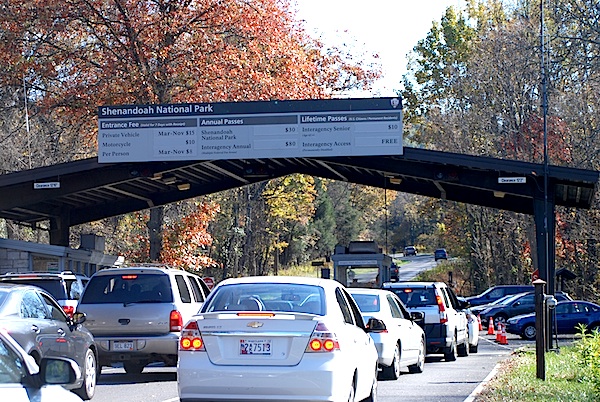
Not everyone is embracing higher entrance fees proposed for national parks/Kurt Repanshek
As more and more units of the National Park System propose higher entrance fees as directed by Park Service Director Jon Jarvis, opposition is being voiced around the country, with one mayor saying higher fees to enter Yellowstone National Park could lead to reduced tourism dollars in her town.
With Congress poised to create at least four new units to the park system, and approving expansions of other parks, funding the Park Service likely will become even more difficult if the lawmakers don't also find more money for the agency. While park officials across the country say higher entrance fees are needed to fund various improvements and provide for visitor services, they are seeing some pushback.
In Cody, Wyoming, Mayor Nancy Tia Brown is opposed to the higher fees being proposed at Yellowstone -- a 3-day pass for $30, a 7-day pass good for both Yellowstone and Grand Teton for $50 -- arguing that the fees would result in fewer tourist dollars spent in her town.
At Cape Cod National Seashore in Massachusetts, a former fee supervisor for the park said the proposal to increase fees would create a "logistical and political nightmare."
"The Seashore has not made the enforcement of its current $3 daily individual pass a priority because of the park's unique permeable nature, and because of the wish to encourage visitors to use alternative forms of transportation aligned with the Climate Friendly Parks initiative. While parks like the Grand Canyon have gates, the Seashore does not, so attempting to charge that fee would be logistically impossible," Karl Thompsen wrote in a letter to the Cape Cod Times.
"Actually implementing such a draconian change would also prove politically disastrous for the park's community and visitor relations, which both undermines the park's interdependent relationship with surrounding towns and places an unnecessary burden on the rangers interacting with the public," he added.
At Gulf Islands National Seashore, a proposal to relocate entrance fee booths on the eastern and western ends of U.S. 399, also known as the J. Earle Bowden Way, and then charge $15 per vehicle to use the road that connects Pensacola Beach to Navarre Beach was being criticized by nearby residents who frequent the national seashore. Superintendent Dan Brown has tried to downplay the matter, telling the Pensacola News Journal the collection booths won't be moved if the public strongly opposes it. But he also noted that most locals would probably buy an annual pass to the seashore and so not encounter the entrance fee every time they headed to the seashore.
"Most of the comments so far have emphasized the worst-case scenario," the superintendent told the newspaper. "They're talking about a $15 toll, and you know no one who lives here locally and drives that on a regular basis would pay the fee every single time. '¦ If you drive it 240 days of the year to commute, it wouldn't be $15 times 240 days ' they would pay $30 for an annual pass."
Back in Wyoming, Jackson town leaders opposed higher fees proposed for Grand Teton National Park and the proposal to "unlink" Yellowstone and Grand Teton from one pass good in both parks. Fishing guides and other outfitters also opposed the increases.
'It is a little discouraging that the Park Service is going to go ahead and double the weekly cost of a pass from $25 to $50,' Taylor Phillips, who owns a wildlife safari company, told the Jackson Hole News & Guide. 'I would say 90 percent of our guests visit both parks.
A proposal to boost the entrance fee at Cabrillo National Monument near San Diego from $5 per car to $15 drew an angry response from Paul Nestor, who called the proposal "one of the most aggravating things I've ever heard."
"It is families who don't have a lot of money who come up here to show off this beautiful place in San Diego for all the residents. For them to bilk them out of $15, it's going to turn a lot of people away," Mr. Nestor said told ABC 10 News.
Mr. Nestor's view might play out across the National Park System at some of the small, urban parks where many visitors stop by during lunch or after work, or stop after seeing the park sign as they pass by. Five dollars per vehicle for a quick visit to enjoy a view or learn something about the park and why it was created might not sway people from stopping, but when the fee jumps to $15, those casual visitors might not pull in. If that scenario plays out, some park units could possibly lose money.
Another issue is that once parks collect more than $500,000 in entrance fees, they have to send 20 percent of the revenue to Washington for redistribution to other parks. Up to $500,000, they keep it all, thus creating another possible reason not to raise fees.
Story Categories:
A copy of National Parks Traveler's financial statements may be obtained by sending a stamped, self-addressed envelope to: National Parks Traveler, P.O. Box 980452, Park City, Utah 84098. National Parks Traveler was formed in the state of Utah for the purpose of informing and educating about national parks and protected areas.
Residents of the following states may obtain a copy of our financial and additional information as stated below:
- Florida: A COPY OF THE OFFICIAL REGISTRATION AND FINANCIAL INFORMATION FOR NATIONAL PARKS TRAVELER, (REGISTRATION NO. CH 51659), MAY BE OBTAINED FROM THE DIVISION OF CONSUMER SERVICES BY CALLING 800-435-7352 OR VISITING THEIR WEBSITE. REGISTRATION DOES NOT IMPLY ENDORSEMENT, APPROVAL, OR RECOMMENDATION BY THE STATE.
- Georgia: A full and fair description of the programs and financial statement summary of National Parks Traveler is available upon request at the office and phone number indicated above.
- Maryland: Documents and information submitted under the Maryland Solicitations Act are also available, for the cost of postage and copies, from the Secretary of State, State House, Annapolis, MD 21401 (410-974-5534).
- North Carolina: Financial information about this organization and a copy of its license are available from the State Solicitation Licensing Branch at 888-830-4989 or 919-807-2214. The license is not an endorsement by the State.
- Pennsylvania: The official registration and financial information of National Parks Traveler may be obtained from the Pennsylvania Department of State by calling 800-732-0999. Registration does not imply endorsement.
- Virginia: Financial statements are available from the Virginia Department of Agriculture and Consumer Services, 102 Governor Street, Richmond, Virginia 23219.
- Washington: National Parks Traveler is registered with Washington State’s Charities Program as required by law and additional information is available by calling 800-332-4483 or visiting www.sos.wa.gov/charities, or on file at Charities Division, Office of the Secretary of State, State of Washington, Olympia, WA 98504.
INN Member

The easiest way to explore RV-friendly National Park campgrounds.

Here’s the definitive guide to National Park System campgrounds where RVers can park their rigs.
Our app is packed with RVing- specific details on more than 250 campgrounds in more than 70 national parks.
You’ll also find stories about RVing in the parks, tips helpful if you’ve just recently become an RVer, and useful planning suggestions.


Comments
As they should. About the only place you find staunch defense of double taxation for the use of public lands is on this forum by folks associated with the NPS.
Okay. Don't raise the fees. Then operate the parks with only the money available. Lay off personnel. Don't maintain facilities or roads. No snow plowing or shoveling in winter. No visitor services. No search and rescue. Close the campgrounds. Let trails go to pot.
Won't be long before there will be a different tune being howled.
Double taxation? How's that? I'm not associated with the NPS in any way, except that I enjoy their services and are happy to pay for what I use. If you are referring to supporting the parks by paying both taxes and entrance fees as "double taxation," I wonder if you'd apply that standard to any other government function? I pay state taxes, but also will have to pay in-state tuition for a college for my kid. I pay gas taxes, but also occasionally have to pay a toll. There are plenty of other examples.
Lee, for what it's worth, I believe the sum total raised each year from entrance fees is in the neighborhood of $180 million.
I believe the cost of a single B1B-Lancer long-range bomber is approaching $300 million. If Congress can't find a way to add another $200 million to the NPS budget....
Exactly, Kurt. But they absolutely won't. And now with a GOP Congress out to prove whatever point they want to prove, nothing is going to change except to get worse. Remember, the key tenants of the Tea Party's nonsense is insistance that taxes must be eliminated and the government mummified.
In the meantime, what do our park managers do?
I'm afraid the only thing that will awaken Americans is when they suddenly realize that all the privileges of citizenship that have been supported by taxes are gone. Then maybe we'll turn off the football games and start to look around at the reality of life without taxes that support things we've long taken for granted. Ranting about taxes and promising to simply eliminate them is so much easier than doing the hard work of finding sensible solutions to legitimate problems of waste. Goodness, that might even require some compromises and we certainly can't have that!
By the way, B-1 Lancers are no longer in production. Of the 100 built, only 68 remain operational at an operating cost of somewhere near $58,000 per hour. The B-2 Stealth bomber runs more than $162,000 per flight hour. The $335 million number is for the estimated real cost of each F-35, the new "advanced" multi-tasking aircraft that none of our services wanted until Congress told them to shut up and fly it.
Here's a link to an interesting article that reports on operating costs of USAF aircraft:
http://nation.time.com/2013/04/02/costly-flight-hours/
It's all a matter of priorities. What's more important, having national parks or protecting our national parks against all those boogeymen who threaten to annihilate all of us?
John Bick,
Do you pay a cop everytime he arrests someone? Do you pay the garbage collector extra when he picks up your garbage? do you pay the library when you check out a book? What about the fire dept when they put out a fire. Do you pay the Defense department when they bomb a Pakistani village with a drone for which you paid? Taxes fund their existence. Jon Jarvis is a poster child for Federal malfeasance.
Once again Lee you show total ignorance of or intentional misrepresentation of the Tea Party platform.
Actually, raising the fees would be closer to the Tea Party "nonsense" than not.
Immigrants pay fees when applying for citizenship. Medicare recipients make copays. I pay for interlibrary loan, $3 a pop. Happy to do it. It's a convenience and it's worth it to me. And Kurt, come on. The "something else costs a lot more" argument is among the weakest that can be made. The same could be said of NPS funding by people who want to spend more on [pick your favorite cause]. The fact is, we're $18 trillion in debt, and going a half trillion in debt deeper every year. The Chinese are paying for the National Park Service, in essense, by lending us the money to operate our parks (and buy bombers, and run HUD, and on and on). And our grandchildren and great grandchildren will be taxed to death to pay them back. So I'm for setting priorities, and they're probably different than yours. But asking people to pay what is a very small amount is not too much to ask. Also, Smokies, re: double taxation. Do you really want to set up a station at park entrances to see who paid income tax and who didn't? Because tens of millions don't. By your reasoning, they should be paying fees while the rest of us don't.
John, as you say, it's about setting priorities, something Congress seems incapable of doing unless it's in their own backyard, and even then...did you notice that the defense bill, while funding the military to the tune of $521 BILLION, contains no mention of paying for the parks in the bill?
How much will it cost the NPS to administer these new parks? How much will it cost the agency to raise these entrance fees? Will they staff entrance gates to collect them or, as now is the case in a number of parks, leave some gates unstaffed? Will the $5 parks that are proposing to charge $15 see an increase in traffic and so more entrance fee revenues, or a decrease? Will the inner city residents the NPS wants to lure into the parks be put off by the higher entrance fees?
Has anyone studied these questions? Why is there no increase in the $10-for-a-lifetime senior pass? What about higher fees for international visitors?
We do need to come up with a better way of funding the parks, but the current proposals as a whole beg some questions that should be asked.
I pretty much agree with all of that, and would throw-in a lack of leadership from the executive branch to go along with the inability of Congress to act. I'm getting a new annual pass this weekend. It's $80, I think. Based on current fees and typical usage, I get five times that in value. It could cost more. Senior passes could cost more (imagine the hue and cry if that were tried). Collecting the fees is a problem at many places, as you note, and many don't bother to check or have no practical way to check. I am a supporter of the system, would like to see it grow (and to see what we already have well maintained), but I'd also like to see us live within our means. I prefer higher fees to higher taxes because I prefer to see what I pay for; with taxes, I'm confident -- as many have said here -- that the money will be wasted one way or the other. That's not to say fee revenue doesn't get wasted, by the NPS or others. But if that's the case, I can vote with my feet. I can't just refuse to pay taxes.
And much of that deficit was two wars written on credit cards into the future and corporate tax cuts written on credit cards into the future. Unfortunately, the future for some of those debts incurred 10 or more years ago is now.
Rick,
Could you identify how much of that debt comes from "two wars written on credit cards" and what "corporate tax cuts" you are referring to? The first is a minor fraction of the debt, the second does not exit. But it does suite your narrative.
John,
You are deluded if you think you have any "vote" within the NPS. Public comments, sentiment and community input hold zero sway with the NPS. Now the chamber of commerce, that is another story. But as an average taxpaying citizen, show me an instance where a citizens group has voiced any concern recently to the NPS that was acted upon.
Packer--Check Muir Woods parking or Yellowstone winter use. Citizen groups played huge roles in these cases. Also your "double taxation" argument makes me giggle.
Rick
Before the NPS considers raising entrance fees it needs to rein in the micromanagers and the bean counters in WASO and remove the self-inflicted restrictions on the use of fee revenue. Makes no sense to raise entrance fees when they cannot be used to support park operations.
With regards to funding, the NPS can do more to improve its financial position. Reallocating a third of $600+million that is currently spent on HQ, Regional offices and administrative support to the field would be a start.
DOD always makes an easy target when advocating for more NPS funding. Given that DOD funding makes up about 19% of the federal budget while entitlement/safety net programs are close to 66% of the federal budget, there are better places to find more NPS funding than DOD.
Brutus, are you sure the restrictions are self-imposed? Or do they come in large part from Congressional meddling?
Are you sure the real problem with finding solutions to our budgetary and debt problems really are caused by the "entitlement/safety net programs," or are they caused by a Congress that lacks the integrity and courage it would take to actually try to work together to seek real answers to real problems?
Could the real problem be a gutless Congress filled with greedy career politicians who are becoming wealthy by pandering to a loud minority of Americans who control Congress by manipulating fear based on threats of ousting those politicans come next election? And is not the problem fed by a majority of Americans whose leanings lie not at the extreme left or extreme right, but somewhere in the middle, but who seem to have no voice -- and perhaps even more tragically -- don't want to turn off their entertainment to learn what needs to be done to change things with their votes?
What's happening to the NPS is just one tiny portion of the incredible mess we have made for ourselves.
Lee,
Unfortunately, the FLREA restrictions are another example of self-inflicted gunshot wounds that the NPS seems to love. Want to use fee revenue $ to restripe the park entrance road or parking lot - can't do it. Want to use fee $ to purchase a new plow truck so you can keep the roads plowed for visitors in the winter - can't do it. Want to reduce DM on a "non-visitor" facility - can't do it. Want to use fee $ to hire seasonal rangers, LERs, to assist with operations during peak visitor season - Can't do it. Only staff that can be hired out of fee $ are those that collect the entrance fees - and WASO is even restricting what the parks can spend on cost of collections. In fact in FY14, we paid a portion of the cost of the fee collection operation out of ONPS base funds because the amount WASO approved was insufficient to cover the operational costs of collecting fees. No, this is all self-imposed.
The actual FLREA law gives the agencies wide latitude on the use of fee revenue. Guess the geniuses in WASO know more about the needs in the parks than the folks that are responsibel for day-to-day operations.
There is enough blame to go around, and Congress certainly has a large share to bear. That being said, there is a lot the NPS can do to get its own house in order that IMO doesn't require any new funding.
Brutsman,
FLREA didn't stop the Smokies from saying they were going to use fees to hire backcountry rangers. Dedicated backcountry rangers who, after the first year, returned to DUI patrol on frontcountry for a big part of their time.
The bottom line is, the NPS does what it wants. It cherry picks portions of FLREA to suit its needs and ignores the rest. Just like they do with the designated Wilderness Areas. They pick and choose which of the Wilderness area protections that suit their needs at the time and ignore the rest. It is good to be King with no oversight.
Smokiesbackpacker,
My comments are specifically related to FLREA. There are a number of authorities that allow for permits/fees to be charged - parking, tour tickets, camping, permits, etc. - none of these typically fall under FLREA and each have their own rules/regulations. I'm not familiar with the specifics of the situation at the Smokies, but from what you described it sounds like a program/authority other than FLREA is being used.
As I mentioned in my previous post, agencies have wide discretion in how they chose to implement various programs. Like you, I am not happy. Some things you can change, Some things you can seek to change by raising your concerns, and some things you can do nothing about.
As Niebuhr put it " God grant me the serenity to accept the things I cannot change; courage to change the things I can; and the wisdom to know the difference."
Keep your powder dry.
John, can you please tell me which wilderness areas the NPS has neglected? The only wilderness areas under NPS control in the southeast are in Congaree, the Everglades, and Shenandoah. Or like usual, are you misinterpreting reality once again by thinking that the Smokies is wilderness? Or are you just pulling stuff out of your behind like you usually do?
Also, the NPS does have backcountry rangers in the Smokies. You constantly sound like the heckler that sits far up in the nose bleed sections. You have no clue what you are talking about 99.999999% of the time.
Those of you who are happy to/can afford to pay the higher fees, please just donate the difference. Thank you.
Don't raise fees on US citizens, raise fees on non-citizens in any fees really need to be raised. The Parks are for the enjoyment of the American people, so let the foreignors pay for the deficitis in running the Parks. Yellowstone has about 3 million visits per year, but only takes in about $9 million in entrance fees (2013 FY). That's about $3 per visit. That seems low too to me. Maybe the fee collection process needs improvement. How about an audit of the Parks use of money? I have seen wasteful and stupid projects that are about removing the "human footprint" rather than using the money to improve visitor services. Park managment is so stupid that they confuse wildlife trails with human trails and attempt to remove wildlife trails in Grand Teton National Park that were only used by bison. Stuff like that goes to show the ignornace and wastefulness of National Park Service managment. What about the millions wasted in Effigy Mounds National Monument desecrating Indian graves? I went to Grand Canyon NP last spring and the movie theatre was closed at the visitor center. The sign center for 30 days. That was a lie, the theatre had been closed for months and nobody with the NPS could figure out how to get it fixed. What a bunch of incompetenty and waste. The National Park Service has the burden of proof. Let them prove that they really need the money and that they will use the money to benefit the American people.
Here's more evidence of Park incompetence and crooked behavior as well as why they don't need to increase entrance fees: http://www.startribune.com/nation/284857071.html
Whipperin, your rant is a bit funny. You rant about how the parks gate receipts at YSNP seem too low because they only pull in about 9 million. Then you go off about NPS removing bison trails. BOY, that sounds like a stretch, but i'll consider the upper deck hecklers if they can showcase some evidence. I did a quick search on that and came up with nothing. Can you provide some links to show that this is being the case? And are you talking about the IMAX theatre that is ran by Nat Geo on the south rim, or something else?
If I do recall, the Superintendent in charge of the Effigy Mounds fiasco was demoted, but to apply that case to a big broad brush is once again a stretch. The parks would be rather hideous looking if they allowed EVERYONE to do what they wanted. I'm not saying the Park is perfect, but man, the hecklers on this site make it seem like they do everything wrong. It gets old. You, like Mr Quillen need to provide evidence, not just hearsay, if you want to be taken seriously.
I did an FOIA request on the Grand Canyon theatre closure, so I have the evidence. The attempted destructtion of bison trails was personally witnessed by me and I have FOIA documents in regard to the trail destruction. I do not say that the NPS does everything wrong but neither do I say that whatever the NPS does is right.. I and others have a right to be critical of our government including the NPS. My personal dealings with NPS employees have been mixed. I have that the NPS employees are very friendly until asked a critical question and then they act rude and haughty. They forget they are public servants and act more like public masters.
Do you mind posting the documents? I'd prefer to read through them and form my own opinion.
I would be happy to post all the documents if I had them in digital form. The NPS sent the documents to me in paper form and I don't have a way to post them. The NPS claims to be green and then rountinely uses snail mail and paper documents. They had my email address so why not just send me and email with the documents attached? Better yet why not give citizens access to the NPS electronic files?
Re the Valor of the Pacific - I was there yesterday. While getting tickets is an issue the Park itself looked to be extremely well run. The services were very efficient and I saw no signs of disrepair.
Smokies, I can vote with my feet by not going to a park and therefore not paying a fee. There's no delusion required. It's an entirely optional expense.
The same reason, Whimpering1, that I invite folks into my garden but tend to keep the gate locked against folks who just want to wander and trample on the flowers.
Of course, looking at electronic files would do no harm - accept maybe to the reputation of those that are supposed to be serving the American public.
Transparency and critical questions are the last thing that crooks in government want. We need to hold our government responsible and we need information to do just that. There is no good reason for the NPS to not make all its documents easily available to the American people. We the people are the masters of our government and we should have the same access to our documents as are servants have.
Whipperin, your local library should be able to convert them. If that doesn't work, then take it to a local copy center. You could probably get it done for 5.00 or less. They obviously gave you the information, so even if it's in paper form, it can be easily converted. I agree these should be in electric format, but that's not always feasible.. Regardless, you have the information, so whether it is in paper or digital form, it doesn't matter. It's still the same and the words will be the same.
It really matters what form the information is in in terms of efficiency and being "green". The NPS sends me the information in the most ineffcient and ungreen way, so why should I agree to entrance fee increases when I know from experience that the NPS is not effcient?
You got your freakin' FOIA.
Quitcherbellyaching. You have moved far past sounding like a whiner.
If he really had this documented information, he can post it. Until then, I think he's just here to whine. I haven't heard of the NPS covering over buffalo trails at Grand Teton, but I have seen them try to divert traffic along heavily used trails where people are creating switchbacks and destroying vegetation. I think the NPS is a little smarter than what he wants to attribute to them, and they would definitely know the difference between game trails, and human created shortcuts. Regardless, I also know that the NPS doesn't run the IMAX theatre on the South Rim, and that IMAX technology is special equipment, you can't just run down to your local hardware store to fix. But hey... I'll gladly change my opinion once whipperin posts the FOIA documents he supposedly recieved and shows this is not the case.
The NPS called the trails that it tried to remove "horse trails" when the trails were only used by bison. Yes, the NPS is that stupid. The closed theater was not the IMAX Theater outside of the Park; it was the theater in the Visitor Center. I was there for 3 days and the NPS had a sign up that said "theater closed for 30 days". The time on the sign never changed in 3 days. More lies. I found out through the FOIA that the theater had been closed for months. I really have the documents and I don't think it is possible to post documents on this site.
And when he posts on this site using his real name instead of hiding behind a fake one.
Rick
Perhaps Whipperin is talking about the theater next to the South Rim VC that opened in 2011. NPS used more than $3M in fee revenue to pay for the theater and film.
http://www.nps.gov/grca/parknews/2011-04-14_film.htm
Whipperin,
Of course you will be blasted by these NPS employees. I suggest ignoring the Gary Wilsons of the world and others who have financial ties to the NPS. Their sole purpose is to curry favor with their bosses and follow the NPS dictum of discrediting the folks who bring NPS wrongdoing to light. Just remember that the louder the dogs squeal, the more the rocks are hitting the pack. Thanks for informing me of those issues. I intend to look into that stuff more deeply as a result.
That's hilarious coming from you, Johnny boy. I'm not the one that suffers from constant delusions that causes me to constantly crank out conspiracy theories that the NPS and taxpayers then have to spend money to counter. But, I will say the NPS response to your lawsuit of trumped up theories has been an entertaining read. Regardless, i'm not an NPS employee, but I have no issue being part of a team that helps fund projects for the NPS. Thats the difference between me and you. I provide and produce. You just take away and cause taxpayers money due to your insane delusions. The anger and hostility you wage is always a hoot. Like I said, you and whipperin' are like a bunch of hecklers sitting way up in the nose bleed sections. And I definitely could see you being an animal abuser. Only an ass would throw rocks at dogs - what an idiotic analogy.
Utah has been experiencing record warm December days for the entire month and tail end of November. Here's a link to a fun cartoon fron the Salt Lake Tribune:
http://www.sltrib.com/opinion/1933569-155/bagley-cartoon-warm-december-days
Smile!
Looks like Utah is the exception.
http://investmentwatchblog.com/november-9000-record-cold-temps/
US record lows outnumber record highs by almost 4.5 to 1.
Of course neither the temperature in Utah nor these 1 year statistics mean anything in the context of AGW but 18 years of flat temperatures does.
"November 2014 was the second warmest November in the 36-year global satellite temperature record, according to Dr. John Christy, a professor of atmospheric science and director of the Earth System Science Center at The University of Alabama in Huntsville.
With a global average temperature that was 0.33 C (about 0.60 degrees Fahrenheit) warmer than seasonal norms, November 2014 trailed only November 2009, which averaged 0.39 C (about 0.70 degrees Fahrenheit) warmer than seasonal norms."
Whipperin1,
There is an $8,261 purchase order for the repair of a theater projector with effective date of July 9, 2014 and expected completion date of August 1, 2014.
http://www.usaspending.gov/search?form_fields=%7B%22search_term%22%3A%22...
Dahkota - The earth is 4.5 billion years old and you think 36 years of satellite history is significant? You think one month that is below the same month from five years ago is significant? Obviously you are in the same camp as Gruber.
Fact - CO2 has risen steadily over the last 18 years. Fact - temperatures have trended flat over the last 18 years. Fact - the AGW models have been horribly wrong.