
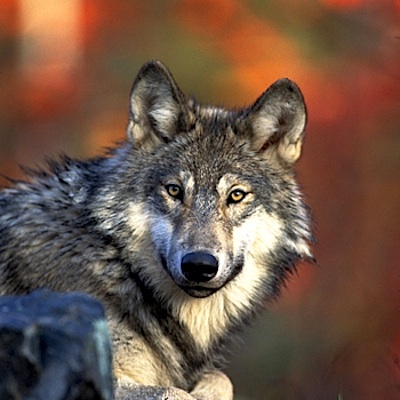
How should the gray wolf be viewed by humans? US Fish and Wildlife Service photo by Gary Kramer.
Editor's note: Earlier this summer the U.S. Fish and Wildlife Service proposed to remove Endangered Species Act protection from the gray wolf. In this guest column, ecologist Barbara Moritsch, author of The Soul of Yosemite: Finding, Defending, and Saving the Valley's Sacred Wild Nature, questions that decision.
This morning as I washed the breakfast dishes, I pondered the U.S. Fish and Wildlife Service’s proposal to remove the gray wolf from the endangered species list. I considered arguments I had read that contested this proposal: wolves had not yet fully recovered in the lower 48 states; after spending so many millions of dollars to re-introduce wolves, it is stupid to de-list them prematurely and allow people to hunt them; wolves play an important role in natural ecosystems, and are proving to be an asset to ecosystem processes; and wolves have a right to life, just as humans and all other species have such a right.
I agree with all of these points, and I am strongly opposed to the proposal to de-list wolves. But as I considered how I wanted to frame my comments to the agency, something kept nagging at me. My heart told me that the wolf controversy, of which this recent proposal is only one element, goes much deeper than ecological principles and species recovery. The wolf controversy, particularly the strident and very ugly anti-wolf campaign, is a pure reflection of a very dark side of human nature—a side that does not bode well for the future of any living thing on the planet.
To wolf advocates, wolves symbolize wildness, freedom, and big, open country. To wolf haters, the animal may symbolize everything that is wrong, evil, or vicious in their lives—a scapegoat. To trophy hunters, the killing of a wolf may symbolize strength and manhood. Note my use of the word “may” on these latter two—I am speculating because I neither hate nor hunt wolves.
It suddenly struck me with great force that the wolf symbolizes something much greater, something much more important than these fairly superficial human emotions. The wolf symbolizes, as perhaps no other species does, the inability of many humans to co-exist with anything that competes with or threatens them in any way—even if that competition or threat is largely imaginary. The wolf symbolizes the mistaken opinion that, when push comes to shove and either a human gets to hunt the elk or the wolf gets to hunt the elk, the human has the greater God-given right to that elk.
This opinion holds true for cows and sheep, as well as elk. The attitude of too many humans toward wolves epitomizes selfish human nature, at the expense of all other species, as well as their habitats.
Anyone who is paying attention knows that the human tendency to take whatever he or she wants from the Earth with little consideration for the long-term consequences is quickly catching up with us, and the consequences of our inattention may be dire. The truth is, unless we change our ways rapidly or there is a massive die off of humans, we will experience shortages of clean water and food, probably in the not-too-distant future.
Given how poorly we are coping with wolves, I can’t help but wonder how we will react when we are faced with these shortages, and there is not enough to go around, when instead of wolves, we are “competing” with other humans. A lot of people think things will get ugly, and they are stockpiling weapons and ammunition, so they can fight for “their share.” Do you really want to live in a world like that? I don’t.
It’s time to change our collective ways. It’s time to view the Earth and all of its inhabitants as important and precious. It’s time to learn to share, instead of compete. Learning how to make peace with and co-exist with wolves and other species is the first step in this shift.
Some Native Americans believe the wolf symbolizes the teacher. I believe we have much to learn from our brother the wolf, and these are lessons we need to learn quickly. Transmute the anger, transcend the fear, and embrace all other life with compassion and reverence—this is how we will survive and thrive as conditions on Earth change
Story Categories:
A copy of National Parks Traveler's financial statements may be obtained by sending a stamped, self-addressed envelope to: National Parks Traveler, P.O. Box 980452, Park City, Utah 84098. National Parks Traveler was formed in the state of Utah for the purpose of informing and educating about national parks and protected areas.
Residents of the following states may obtain a copy of our financial and additional information as stated below:
- Florida: A COPY OF THE OFFICIAL REGISTRATION AND FINANCIAL INFORMATION FOR NATIONAL PARKS TRAVELER, (REGISTRATION NO. CH 51659), MAY BE OBTAINED FROM THE DIVISION OF CONSUMER SERVICES BY CALLING 800-435-7352 OR VISITING THEIR WEBSITE. REGISTRATION DOES NOT IMPLY ENDORSEMENT, APPROVAL, OR RECOMMENDATION BY THE STATE.
- Georgia: A full and fair description of the programs and financial statement summary of National Parks Traveler is available upon request at the office and phone number indicated above.
- Maryland: Documents and information submitted under the Maryland Solicitations Act are also available, for the cost of postage and copies, from the Secretary of State, State House, Annapolis, MD 21401 (410-974-5534).
- North Carolina: Financial information about this organization and a copy of its license are available from the State Solicitation Licensing Branch at 888-830-4989 or 919-807-2214. The license is not an endorsement by the State.
- Pennsylvania: The official registration and financial information of National Parks Traveler may be obtained from the Pennsylvania Department of State by calling 800-732-0999. Registration does not imply endorsement.
- Virginia: Financial statements are available from the Virginia Department of Agriculture and Consumer Services, 102 Governor Street, Richmond, Virginia 23219.
- Washington: National Parks Traveler is registered with Washington State’s Charities Program as required by law and additional information is available by calling 800-332-4483 or visiting www.sos.wa.gov/charities, or on file at Charities Division, Office of the Secretary of State, State of Washington, Olympia, WA 98504.
INN Member

The easiest way to explore RV-friendly National Park campgrounds.

Here’s the definitive guide to National Park System campgrounds where RVers can park their rigs.
Our app is packed with RVing- specific details on more than 250 campgrounds in more than 70 national parks.
You’ll also find stories about RVing in the parks, tips helpful if you’ve just recently become an RVer, and useful planning suggestions.


Comments
Wow!
This is one of the very best articles I've ever seen in Traveler. Thank you, Barbara. And as you pointed out, the attitude that is directed toward wolves is also seen in other aspects of modern life -- like economics.
Another thing to consider is the apparent difference in attitudes toward wolves in different parts of our country. A few weeks ago, I was on the shore of Lake Superior and heard wolves howling twice while I was there. I asked some locals -- not NPS people, but real locals -- about it and they expressed pride in the fact that wolf howls are frequently heard around there. I asked a couple of them about the feelings of farmers in the area. One of them told me that he is a farmer and that he has about twenty head of cattle. A few years ago he had a calf killed by a pack of neighborhood dogs, but has never lost one to a wolf. Game for hunting is plentiful -- too plentiful when deer get into his crops. And, he explained, if a farmer loses an animal to a confirmed wolf kill, he is paid for the loss by both the state and Federal governments. "In fact," he said, "when the market for beef is down, I wish the wolves were hungrier."
It appears that wolf attitudes may fall into two categories: Those based on facts and actual experience, and those based on folklore and fantasy.
Thanks again, Barbara.
Thanks for your article, Barbara.
And for your comments, Lee. Were those locals dairy farmers? Because they see their cows twice a day, their presence tends to discourage wolves - so it's easier to coexist.
Honestly, Bob, I'm not sure. But he did mention beef prices . . . . . and I did see a lot of what looked like beef cattle in some places. (I was never a farmer myself, but worked on a dairy farm when I was a kid, so I think I can tell a milch cow when I see one.)
Whatever the difference may be, there didn't seem to be the unreasoning fear of wolves that I've seen in western states. People seemed proud to have them around.
I agree that it is premature to lift protection for gray wolves. They have only recovered a small part of their ancestral range. Wolves are starting to repopulate Oregon and I look forward to hearing their howls in the mountains and forests of Northern California in the near future.
I subscribe to several western State Fish & Game agencies, for their special reports on wolf-doings. I'm just west of the Elwha River, on the Olympic Peninsula.
Washington and Oregon are anxious not to make missteps; to get in the dog-house with the Federal people, or to tie a rope around their own neck that wolf-advocates can use to drag them into court, hog-tie them, etc. Oregon is currently wearing a funny-looking scarf, to hide fresh rope-burns.
Idaho, Montana and Wyoming continue to work very closely with the same Federal people that WA, OR and CA are all careful staying in lock-step with, even though the first 3 are substantially 'on their own', now.
Similar relationships pertain, in the Upper Midwest.
Idaho of course is having a tough time meeting the harvest levels that their own biologists & Federal agencies agree are compatible with maintaining a solid genetic pool of wolves. Few 'old time'-style hunters & trappers (some of whom are "old", but plenty of whom are just "old-style") are surprised that hunted & trapped wolves continue to spread, out-reproduce harvest-levels, and are getting better at evading hunters as time goes by. We know from the High North, where trapping & suppression have been ongoing, that they get very cagey.
While we do see heated exchanges on the Internet, those who have 'established' themselves as hunters do not usually have a "personalization-thing" going on, with the critters. They have a high esteem for the resource, the population, and their actual 'take'. Difficult or challenging hunting & trapping undertakings do produce an 'excitement', at certain times during the effort, and upon actual success.
This thrill, though, is about the success of the effort, rather than at vanquishing or destroying, say a wolf, because it is a predatory species, etc. That some animals are predators, and some are prey, is something that hunters already have straight. Wolves don't have a theatricized persona, for hunters. No more so than bears or coyotes or cougar, etc. Same thing, wildlife-wise.
It does appear, of course, that the Fed want to 'hand it off' to the states. Get them up to speed on a program both can agree on, and then step back from it and have the states doing actual management. WA & OR are still in rapid flux: populations remain small, but are growing & spreading. Conflicts continue at pretty high levels. This suggests that they should remain in a dependent status, and be 'baby-sat' by the Fed, for a little while yet.
It is possible, though, the Fed will just bail on them, any ol' time now, and then deal with any issues as/if they arise.
Attached is a post from someone, a sheepherder (and author) who actually lives with dangerous predators in the Western U.S. as opposed to the author of this piece, who only dreams of predators.
Predators are part of our environment and should be protected...to a point. So should people and property. Hate isn't a part of this sheepherders feelings about wolves or bears. Give him the same consideration regarding his opinions about predators.
http://stephenbodio.blogspot.com/2013/09/of-livestock-predators-guardian...
Thank you, Lee Dalton and Ted Clayton, for your comments and information. And thank you MikeG, for the link to Stephen Bodio's blog--I am sorry to read of Mr. Bodio's losses. I do suggest, though, MikeG, that you do not load your comments with crass assumptions about me, my life, or my experiences with predators--you do not know about any of it. Granted, I do not raise sheep or work dogs in wolf country; I would never choose to put any of them--the sheep, the dogs, or the wolves--at risk in that way.
So no one should have sheep or dogs anywhere that wolves might have roamed? Sorry, the human does have the greater God given right.
ec--WHAT????
@Rick Smith 1:51pm makes the motion:
Seconded.
Both WA and OR are taking notable methodical steps to define in Law, and clarify in test-cases, under Federal guidance, how much prudence an animal-owner has to show, the degree of pains they must take, in recognition that wolves are, uh, wolves. And (still) under the ESA.
A balance is called for ... or perhaps an uneasy tension.
But it's not that tough - and it isn't without precedent. Much of the same ground has long been a posted mine-field, and extensive precedent already established, in the case of domestic dogs & their neighbors who have things the dog finds intriguing.
The property & livestock owner has responsibilities & obligations ... the wolf has limits and liabilities. The Law is working.
We can't expect God to be jumping-to for our every petty dispute. ;)
Rick, what part didn't you understand?
Ted - If my dog goes into my neighbors yard and gets in trouble - its my fault. If my dog (or sheep) is in my yard its the intruders fault and I feel no obligation to move because Barbara likes wolves.
ec--"Sorry, the human does have the greater God given right." This is where we differ, as I disagree with you completely, and that is okay.
Ted - If my dog goes into my neighbors yard and gets in trouble - its my fault. If my dog (or sheep) is in my yard and is threatened by intruders, it is the intruders fault and I feel no obligation to move because Barbara likes wolves.
So Barbara - you are face to face with a wolf. You lay down and die?Do you not eat meat or plants? Do you not condone cutting a tree to build a house or road? Do you condemn the bird for eating the worn? The lion for eating the fawn?
Do you really not recognize any hierarchy in our world?
I forgot that God is a Calvinist.
And with that one sentence, ec has explained his opinion and point of view on just about everything he posts here.
So dahkota - a wolf is attacking your child. Does or does not your child have "the greater God given right" to live or do you let the wolf kill him?
[edit] Barbara - you are welcome to answer as well.
Sorry, ec, bad example. The number of people in the US killed by wolves is miniscule compared, for instance, to those killed by pit bulls and other similar aggrressive breeds. Do those killed have a "God given right" in comparison to the right that some people claim to have to own these dogs as "pets"?
Rick
He's a TROLL, people. Go back to the top of the page - nice discussion. He steps in and the fecal matter has become well stirred. For pete's sake!
Rick - You totally ignored the question (as usually) We are discussing here the supremacy of humans over animals. The number killed is irrelevant.
And yes, humans have a "God given Right" over pit bulls.
@ecbuck 5:41pm appears to err;
I'd like to say he's wrong. That we're discussing Guest Column: Pondering The Proposal To Remove ESA Protection From Gray Wolves", which pragmatically is a matter of government policy & Rule of Law. That it's a secular matter, under Caesar.
However, author Barbara Moritsch already put the discussion in terms of "personal beliefs".
She is objectively, factually and legally wrong. We kill animals industrially, by the millions, every year, and no rights are being violated.
Barbara goes on to define her Devil:
That's just a thinly veiled way to paint her opponents as "evil", removing her argument from ... anything the U.S Fish & Wildlife people can have anything to do with, since they operate under the Law.
She tries her hand at Doomsday Prophesy:
An ancient tradition, heavily illustrated in the Bible ... and by hundreds of modern & contemporary Prophets of Doom.
Less poetically, it's time for everyone else to believe as Barbara believes. That's all she's really talking about - her beliefs. But the U.S. F&G need down-to-earth, verifiable, testable information that can be taken before a Judge, and evaluated by a Jury of our Peers. They can't be making ESA-calls on the basis of believe-systems, religion or faith-based opinions.
Instead of giving those making ESA decisions something they can actually use, Barbara spent her time talking about ... her version of what ecbuck talks about.
That makes it tough to write ecbuck off as a troll, even if he is, since he is, upon more careful review, simply continuing the conversation that Barbara started, on the same terms she set forth.
Honestly, personally, I just kinda glossed over Barbara's faith-based stuff, and then bristled at ecbuck doing the same thing. At the end of the day, she brought it on herself. It is she who made the conversation about stuff that only exists in our personal beliefs, imaginations, fantasies, etc.
Pretty simple question Rick B. - and one very important to the management of our parks. Is the health and welfare of humans more important than animals - or for that matter flora and landscape. It may not be a question you want to answer in your fantasy world but it is one very relavent in the real world.
Would you kill a wolf to save your child? Your children would like to know.
It all depends. On some days, many parents might be inclined to toss some catsup on the kid to make it even more tasty.
ec, neither my child nor the wolf has a greater God given right. All life is sacred. All life is equally valuable. I may be stronger or more able to kill something but that does not give me greater rights to anything. It just makes me more capable. You err in believing that physical supremacy grants "rights" that physical weakness does not. You err in believing that greater intelligence grants "rights" that lesser intelligence does not. If I want to follow your slippery slope, men have greater God given rights than women. Adults have greater God given rights than children.
It is not a matter of "do let the wolf kill him." A life and death battle has nothing to do with rights. If I am killing a wolf's pup, she will equally try to kill me to stop me. God given rights have nothing to do with it. You really need to find a better example to defend your argument.
Ted does have a valid point: in our society, we do not grant animals rights. We are starting to, kind of, with respect to pets and livestock. Of course, that seems to be more akin to property rights rather than any right to life. However, just because our judeo-christian society deems animals as lesser beings (man has dominion over all animals) does not make it so, nor does it make it morally right. Other societies (and religious beliefs) hold opposing opinions on animal rights.
So dahkota - I guess you let your child die because if you really believe that humans are not above animials, you have no moral right to intervene,
BTW - I am not the one that brought "God" into the discussion - that was Barbara in the orgininal article. So Ted - go read the article again - it does discuss (what Barbara believes is the false position) "the human has the greater God-given right to that elk
{edit} My appologies Ted, you did acknowledge that in the end.
Traveler, thank you for a thought provoking post by Barbara Moritsch. The discussions that have followed are quite interesting. Both Ted Cayton and dahkote have contributed excellent comments along with many others including EC, at least in my own opinion. I must admit I subscribe to dahkote's viewpoint on this issue. As Barbara has pointed out, there are some serious problems, as we humans and our actions continue to expand into the habitats of all other living creatures from amphibians to wolves what with our use of pesticides, destruction of forests, etc. Know this is a very complex discussion, I have no answers, but I do want to thank the Traveler and Ms. Moritsch for generating the discussion.
rmackie - Thank you for acknowledging that I have legitimate arguments and am not just a "troll", an accusation typically thrown out by someone that is losing the argument or has nothing to contribute.
I too share your concern about things such as pesticides and the destruction of forests to the extent they have real impacts. In fact, in my opinion, it is our superiority as humans that gives us the ability and responsibility to make these moral judgements. It is the absolutism of statements/implications such as Barbara's that we shouldn't intrude in any habitat the bothers me. Its all about balance. We can have legitimate disagreements as to where those balance points are but to declare absolutes makes no sense at all.
I think Barbara is right about the conversation. There seem to be two competing readings of divinity, which are somewhat incommensurable. I'd say that ec's position comes out of a Christian tradition influenced by a Calvinist interpretation of Scripture. Whereas Barabara's (I would only suggest) comes out of an earlier reading of Christianity--one of an immanent God; that is, a god that isn't outside Creation, but is its assembly and boundary, in which hierarchies are collapsed into an immanent divine presence. It's a reading that makes the later Passion closer to compassion and where some read an overlapping of Christianity and Buddhism. It's a also a reading of creation that, since we are talking about the parks, seems to underwrite Muir's reading of the natural world.
Justin -I don't have clue what you just said or meant.
Without walking through the particulars of that post, how about this? In short, we might all be aware of this kind of contradiction below, which finds a way of insinuating itself in a conversation like this one:
I see no contradiction. When looking at humans vs pit bulls - there is no "scale" Either they are superior or they are not. When it comes to what land should be available - all or none are not acceptable answers - it lies somewhere in between. Same with wilderness, trail use, .....
Perhaps if all of the god stuff was avoided we could all agree that humanity should stop polluting the oceans, the air, and the water we drink for the benefit of current and future generations of humans. That should mean preserving the diversity of life including predators and prey, and plants etc. because that benefits the quality of human life. The same goes for natural beauty like parks. My problem, but the subject of god given rights makes me sick to my stomach.
ec,
If you can't see that "And yes, humans have a 'God given right' over pitbulls" is an absolute statement--i.e. one that asserts an understanding of God at the exclusion of all others--I don't know how to show you.
Roger Sigglin1 You just voiced my sentiments on the concept of "God-given rights" very well--thank you! If I could re-write my sentence (and I can, thanks to this great feed), I think the following more clearly expresses my thought:
"The wolf symbolizes the mistaken opinion that, when push comes to shove and either a human gets to hunt the elk or the wolf gets to hunt the elk, the human has been given some sort of greater "God-given right" to that elk."
Thank you all so very much for this discussion. These issues are truly at the heart of most, if not all, of our most pressing environmental and social challenges.
I guess our Founding Fathers disgust you too.
And no one disagrees that we need to work to perserve the oceans, air and water and the diveristy of of life. The disagreement is what is or is not a threat and how far we should sacrifice to reach those goals.
Well Barbara, I have never heard anyone express that opinion. Perhaps you can show us where someone has said that.
Finally we get a clue from ecbuck that his opinions are based on his religious views. That is OK since most of us have faith in something. But arguments based on a persons religious faith often means a discussion based on reason will get nowhere.I have always had faith in humanities ability to seek solutions based on reason, but I am losing that faith. Incidentally I thought our founding fathers did not favor a theocratic government and some were deists. If you don't know what that means look it up. I think our founding fathers were pretty intelligent compared to our current crop of politicians.
Pardon my last comment. I forgot the discussion was about wolves. According to a MoveOn .org email "In the lower 48 states there are fewer than 5,500 wolves, less than 1% of their original numbers. Wolves are found in only 5% of the area they once roamed."
Many of us would agree those figures should be raised but at some point enough is enough. I am not smart enough to know or even have an opinion on where that point is except I don't want them in my yard.
Really? And what are my "religious views"? For your edification, I haven't been in a church/synagog/mosque for other than a wedding (not mine or my kids) or funeral in 40 years. I have no "religious faith" per se. As I noted before, I was merely using the nomenclature introduced by Barbara. But then, those of religious faith don't "make me sick" either.
To ecbuck, oops my guess was a bad as yours on my view of the founding fathers and I didn't say those of religious faith make me sick. Let's call it a draw and get back to wildlife management including wolves mountain lions, bears, mice, bees, etc.
No, ec, you still don't get it.
It has nothing do to with being "above animals." In your example, whether human or animal, the response is the same, just as I tried to point out to you. Here, think of this: if two humans are fighting, which has the "God given" right to win? Are they on equal footing or does one have supremacy over the other? You must believe one has greater rights over the other, yes? Is it the stronger one? Is it the smarter one? As I pointed out, a mother wolf will defend her pup to her death, regardless of whether you are human or not. Supremacy has nothing to do with it. I hate to tell you, but human animals react the same way, whether the predator is a wolf or another human. Life is the supreme "God given" right, regardless of whether it was given to a wolf or a human. You either have it or you don't. There are not 'degrees' of life, or rankings of life, a thing is either alive or it is not.
Personally, I respect all life, regardless of what form it resides in.
Dahkota - I respect all life as well, but I believe human life is more valuable than that of any animal. A wolf may protect her pup - but will she defend someone elses? If a stranger's child is threatened by a wolf are you going to declare them morally equivalent and let the wolf have at it? I hope not.
BTW are you a vegetarian? Do you not use leather or other animal products? Is your home not built in what once was free range for some animal. I suspect your lifestyle is not a sanctimonious as your commentary.
I believe the life of my dog, Scout, is more valuable than that of Stalin, Idi Amin, Bin Laden, Charles Manson, etc. So, I guess we disagree, ec.
ec- you still don't get it, which is why you resort to name calling and projecting. And you still have avoided answering my question: What makes human life more valuable than any other other life? So far, all I have gotten out of you is that the value is "God given." Yet, you profess to 'not be religious.' Maybe, if you explain your point of view, rather than just insisting that other points of view are wrong, I may learn something. And, you might be able to change my way of thinking.
Name calling? Where?
That human life is superior to animals is self evident. It is demonstrated in the daily activities of the vast majority of humans on this planet. Anyone that eats meat demonstrates their belief that their life is above that of an animal. Anyone that builds a house (disturbs animal habitat) demonstrates their belief that humans are above animals. Anyone that wears leather shoes, boots and belts. Our legal system that allows hunting or penalizes biting pit bulls. And if you would be honest you would admit it as I suspect you engage in most if not all these activities.
If it came down to saving the life of a human or an animal, which would you choose? Or would you just let nature takes it course?
And once again - "God given" was not my language it was Barbara's.
If it came down to saving my dog's life or a terrorist's life, I'd save my dog. According to your belief system--that "human life is more valuable than that of any animal"--you would save the terrorist's life instead of your dog's. As Barabara notes, "that's okay."
And of course Justin - you take things to the absurd.
The terrorist is inhuman so he doesn't rate above the dog.
So how do you define "human"?
I'm not sure what's absurd here. This is your belief system I'm quoting.
And who annoints the person able to declare others 'inhuman'?
What happened to discussing wolves?
Pages