
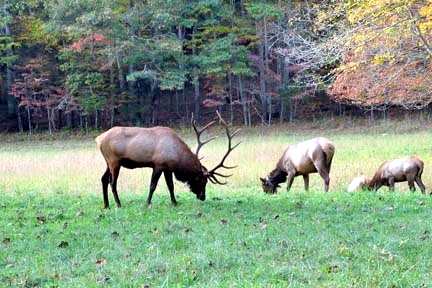
Are elk in Great Smoky Mountains National Park about to lose their protected status? Danny Bernstein photo.
The elk restoration project in the Great Smoky Mountains National Park is about to be declared a success. But does that mean their protective status should be removed and that elk should be hunted in North Carolina forests surrounding the park?
Though elk are native to North Carolina, they had been absent from the state since before the 19th century. But the species returned in 2001 when a band of the animals was released in the Cataloochee Valley on the North Carolina side of the national park to kick-start a recovery program. Another band of elk was released in the valley in 2002, as well. Now the herd has grown to more than 100 elk from a start of 52 animals from the two introductions.
Under that recovery program, the elk had been protected from hunters through their listing as a "Special Concern" species by North Carolina wildlife officials. But now the North Carolina Wildlife Resources Commission, a state organization chartered to manage the state's wildlife resources, is moving to remove that classification. This commission, which sets the rules on hunting and fishing in the state, recently issued an updated draft of hunting, fishing, and trapping regulations. In this 24-page document the commission calls for removing elk from the state's list of Special Concern species.
Remove elk (Cervus elephus) from the state’s list of Special Concern species.
Justification: The only free-ranging population of elk in North Carolina was introduced by the National Park Service into the Great Smoky Mountains National Park. The Park Service has indicated to the Commission that they will soon declare their elk-restoration project a success, and elk will no longer be an “experimental population.” Because of the current status of the restoration effort and elk population in western North Carolina, the extra protections afforded Special Concern species are no longer necessary for elk.
The NC Camouflage Coalition, a network of hunters and fishers that is part of the North Carolina Wildlife Federation, opposes the change in protection. They say the designation shouldn't be lifted "until a management plan for elk has been developed and is in place to define the status of elk when they leave the confines of the Great Smoky Mountains National Park. At present, wandering elk are protected as species of special concern; what will be their status if we remove that classification?"
You can weigh in on this debate by going to the North Carolina Wildlife Resources Commission website and registering your concern (see the box in the upper right-hand corner of the site). Better yet, if you live in the area go to one of the open meetings and speak your mind. The proposed regulation is H6 – interesting that they classified it under “hunting."
The last day to comment is Friday, January 22.
Story Categories:
A copy of National Parks Traveler's financial statements may be obtained by sending a stamped, self-addressed envelope to: National Parks Traveler, P.O. Box 980452, Park City, Utah 84098. National Parks Traveler was formed in the state of Utah for the purpose of informing and educating about national parks and protected areas.
Residents of the following states may obtain a copy of our financial and additional information as stated below:
- Florida: A COPY OF THE OFFICIAL REGISTRATION AND FINANCIAL INFORMATION FOR NATIONAL PARKS TRAVELER, (REGISTRATION NO. CH 51659), MAY BE OBTAINED FROM THE DIVISION OF CONSUMER SERVICES BY CALLING 800-435-7352 OR VISITING THEIR WEBSITE. REGISTRATION DOES NOT IMPLY ENDORSEMENT, APPROVAL, OR RECOMMENDATION BY THE STATE.
- Georgia: A full and fair description of the programs and financial statement summary of National Parks Traveler is available upon request at the office and phone number indicated above.
- Maryland: Documents and information submitted under the Maryland Solicitations Act are also available, for the cost of postage and copies, from the Secretary of State, State House, Annapolis, MD 21401 (410-974-5534).
- North Carolina: Financial information about this organization and a copy of its license are available from the State Solicitation Licensing Branch at 888-830-4989 or 919-807-2214. The license is not an endorsement by the State.
- Pennsylvania: The official registration and financial information of National Parks Traveler may be obtained from the Pennsylvania Department of State by calling 800-732-0999. Registration does not imply endorsement.
- Virginia: Financial statements are available from the Virginia Department of Agriculture and Consumer Services, 102 Governor Street, Richmond, Virginia 23219.
- Washington: National Parks Traveler is registered with Washington State’s Charities Program as required by law and additional information is available by calling 800-332-4483 or visiting www.sos.wa.gov/charities, or on file at Charities Division, Office of the Secretary of State, State of Washington, Olympia, WA 98504.
INN Member

The easiest way to explore RV-friendly National Park campgrounds.

Here’s the definitive guide to National Park System campgrounds where RVers can park their rigs.
Our app is packed with RVing- specific details on more than 250 campgrounds in more than 70 national parks.
You’ll also find stories about RVing in the parks, tips helpful if you’ve just recently become an RVer, and useful planning suggestions.


Comments
If the elk are dispersing out of the park, then they've probably built up as large a population as possible. So, why not allow the hunt?
But NC should wait for the NPS to declare it a success rather than jumping in front.
Bob, let's be honest here. You do not "hunt" habituated elk any more than you "hunt" habituated bison or "hunt" habituated bears. You just shoot them. I know that there are logical arguments on both sides of this issue, but it really galls me to see this killing referred to as "hunting." Call it harvesting, or culling, or something like that, but when you call it "hunting" you insult ethical hunters everywhere. I take this personally, Bob. I've been hunting for nearly 60 years now, and I apologize to no one for being an ethical hunter.
Well Bob, those elk will learn quickly to use survival skills once they've experienced the threat, I believe. It's just the way it works. Sure the first few should be pretty dumb but then it'll be increasingly difficult. Kind of like throwing in a few wolves :) to the mix.
Just because the elk restoration project within the park will be considered a success does not mean that there is a viable, sustainable population, that could withstand "hunting" pressure outside the park. The NCWRC justification appears to indicate that the State does not want an elk population to become established outside the park. As a hunter and a North Carolina resident, I would love to see a widespread, sustainable elk population outside the park before an elk season is established. There needs to be a geographically wide spread population so that you don't have people just lining the park boundary to shot an elk that wanders out. That is not a hunt, that is a shoot and just plain madness!
I'm not a hunter, so it's funny that I'm the one supporting hunting here against the two hunters. For me it isn't about hunting, ethical or not, but about the lack of a natural predator. The wolf introduction failed. Without predators, the elk will be hoofed locusts that destroy vegetation in the Smokies.
I don't want hunting (or culling or whatever) in the park, so the control has to come on the adjacent national forest lands. Politically, NC hunters will insist on being the ones that pull the trigger. Legally, NC "owns" the elk once they're outside the park.
Both Bob & Jon are right that a "firing line" outside the park is crazy. I'm surprised to hear from Jon that NCWRC doesn't seem to want a sustainable elk population outside the park. I'd have guessed that most NC hunters, like Jon, would like a widespread elk population available for hunting. That's what I'd rather see too.
One small correction, Bob. The predator translocation failure you mentioned was an attempt to reintroduce the red wolf to Great Smoky. Can't leave off the "red" part of that descriptor, since it changes everything. The red wolf translocation project (1991-1998) at Great Smoky Mts. failed primarily because the animals couldn't find enough food, were plagued by parasites and disease, and ended up miserably wandering outside the park.
we dont want wolves. yellowstone national park is horrible . there are no elk. the elk are being consumed by wolves at record numbers. Wolves are locust. BAD BAD BAD. Nobody wants the wolves there. SHOOT SHOVEL SHUT UP to the wolves. They have no control of the wolves over there. There will be no elk then. Look at the statics in the park of yellowstone you will see that I dont lie. WOLVES and ELK dont mix. Bad combo. Hunters in a controlled huntis the way to go. PLEASE NO WOLVES. I DONT LIE=WOLVES BAD.
When I was at Yellowstone I saw no shortage of elk. Wolves and elk do mix and have mixed for thosands of years. The goal of the NPS is to protect the parks. As such they should restore the parks to how they were before human intervention. Also i would like to point out that the wolves that are native to the Smokys are red wolves not the gray wolves of Yellowstone.
Wow, what a fascinating turn of events in the hunting-at-parks debate! The hunters want a clear, defined policy and a report of elk herd sustainability before lifting a hunting ban! This is a terrific surprise!
I personally haven't hunted in years, but I have lots of ethical hunters amongst my family and friends, and they know full well the dangers of overhunting any species. Kudos to Bob & Jon and the NC Camouflage Coalition!
==========================
My travels through the National Park System: americaincontext.com
It is definitely prudent to wait for the determination. I personally feel that the Elk should be given more time to grow in population. A herd of 100 is not that many. Especially when you consider predators, disease, accidents, and hunting. It just seems to me that with all of those stimulators the small population would not last long. Just recently we saw the awful poaching of one of the original herd that was introduced. I agree about controlling of the hunt once it is allowed. It would be no more than a "turkey" shoot once the Elk crossed into NC. There are a lot of us ethical hunters but unfortunately there a plenty of unethical ones who would just love to kill them right as the Elk come over. I was raised to hunt as a good sportsman. This includes giving all animals a fair chance. That is why I will not even hunt with dogs.
Keith, I agree with almost everything you said, but I do take exception to your remark about hunting with dogs. Dogs trained to retrieve game shot by hunters recover many wounded birds and animals that might otherwise never be found. Since preventing unnecessary suffering is a cornerstone of ethical hunting, using dogs where the situation calls for it is to be applauded instead of condemned. Most of the controversy here in the Deep South seems to center on the use of dogs for deer hinting. There seems to be no middle ground on that one, and I'm staying out of it. [Full disclosure: I've hunted all my adult life with dogs, in many U.S. states and in Germany.]
I do agree with what you said. I was referring to using dogs to chase down animals to help one kill them such as deer and rabbits, etc. I do see the need to use them to retrieve waterfowl. Thanks for reminding me.
I have always recognized hunters a conservationist but they are often polarized in heated debates and controversies, especially about predators. As a hunter it is pleasing to here more civilized comments from hunters on the subjects. Elk should be confirmed stable and sustainable before hunting is considered. Predators were a key component when elk were here originally. Now we are restoring them to a habitat that is missing the key predators, wolves and cougars. It is therefore, a perfect time to consider restoration of them, especially cougars. Even thought the red wolf restoration failed once it may need to be tried again if the resource of the species could produce some more acclimated stock. Elk as a food source could be a future plus also. When elk are to be hunted they should be "hunted", not ambushed as they parade across a park boundary. If there could be natural predators it would disperse the elk more whereby they would be less likely just to herd up and parade in front of hunters. Environmentalists and hunters really need to team up to work together on a common goal of restoring biodiversity to our little bit of remaining wilderness.
It is continually amazing to see people who know nothing of hunting comment. Remember Lincoln who said "it is better to be thought a fool and keep your mouth shut, rather than to speak, and remove all doubt".
1. No-one just shoots an elk. One hunts an elk to find them and then makes a conscious decision on whether to take the shot.
2. There is no such thing as "hunting Pressure" in a regulated hunting initative, as the game is a resource owned by the people of the state. The number of permits issued is a proven method of conservatation to ensure that new blood lines are created to strengthen the herd and prevent single bulls within an area from domination of that contribution. The kills are recorded and examination of the carcass contributes to the maintenance ofthe herd condition and permits veterinary follow up.
3. Hunters invented conservation not greenines or anti gun anti hunters.
4. Hunters through their own initatives such as the Rocky Mountain Elk Foundation (for which I am not a member and have never been in contact) put their own money and fund raising efforts to work which is why the elk are reinstated in their native lands in the Smokey Mountains.
5. Only Hunters love animals they may never hunt enough and spend their own money to ensure that future generations can enjoy game such as elk in lands where they wer edepleted through lack of management.
6. Anti groups and negative comments are too often the snake oil of power hungry idealogs who contribute nothing to the welfare of anything from people to animals and are always the first in line for a government handout so they conserve the only thing they really love, their own money.
I believe in keeping the heard protect for a couple more years. Our deer hunters here in NC hunt all thru the season and take up to there limit every year. Now look at the deer population versus the elk population. If you give out open season the heard wil be killed off within the first years or so. In my home state of Kentucky they opened their elk season with a stron population of over 10,000 animals. This year Kentucky only issued 400 tags for elk, once North Carolina reaches a respectable number of animals then you can allow for a small number of tags for harvest. I am a hunter and have hunted for a number of years, I only like to kill mature animals and am more willing to kill a big doe rather than waiting on a buck, I am in it for the meat not the trophy. Most of the hunters in my area will kill anything that walks from fawns to yearlings. So once the heard is strong and big enough then allow hunting.
I grew up in Montana for 30 years, and the one thing that I know is that elk are not easy to hunt like deer are once they get the idea that they are being hunted. The Yellowstone national park had a lot of elk on it and supported it till the herd ventured from it during winter migration. We will see that once the herd is allowed to hunt and is viable the hunters become crazy. Poachers will be abundant. We need to let the herd get to the population that Tennessee has. Theirs is at 400 when they introduced the hunt. I am one to want to have a chance to hunt elk here, however the state needs to develop and do a lot of research on stipulations on how to harvest correctly. Our state cant even come up with a good program to hunt deer. We are so worried about churches that we dont even allow hunt to control deer populations. Now we want to start the thought of hunting elk. We are doomed. Our state needs to get the big boy pants on and get with the times. Look at the rest of the states. If we start hunting elk in this state the big money people get involved and do what they want to. Elk is a big money sport. Us middle class hunters that want a chance to hunt one would be awesome, but lets get real. MONEY talks. Look at what a tag costs for a guide and a hunt in the big elk states. If the state wants to start the hunts to early then allow only bows. I agree that we do it to ourselves on negative stuff that our fellow hunters do. Stupid stuff, like poaching. Get the population to at least 400 before hunting begins.
I all sow grew up in Montana if they start the Elk hunt now they will kill off the heard before it even gets strarted. I have killed at least 15 elk in my life ther is nothing better than that.
It's a shame the red wolf reintroduction at GSMNP didn't take hold. I wonder if there's any chance of trying again at some point.
I SAY NO TO WOLVES. WOVLES ARE PRETTY. PRETYY DEVISTATING TO HERD POPULATION. THEY WILL KILL ALL THE ELK. NO WOLVES
No elk in Yellowstone?
Someone must have forgotten to tell the elk. They don't seem to know that they are gone.
When hunting I am most concerned that the species being hunted and harvested are done with hunting laws that are designed to positively assure that the targeted species remains viable,strong and healthy. This means not just killing the biggest strongest most fit animals (trophy). The legal ethical constraints of hunting should complement that.
All hunters are not created equal and dont have the same hunting skills. That is why we have outfitters, guides etc.
Seems to me that the NC population of elk needs to be a lot larger before a season starts. If there is a healthy population some animals will be quickly killed the first year. The animals that survive will become increasingly more difficult to kill and the better hunters will become the successful hunters.
Just make them permit hunts, harvests for you who think you're farming elks... I'd pay 1 dollar a pound for a hunt, tomorrow.