
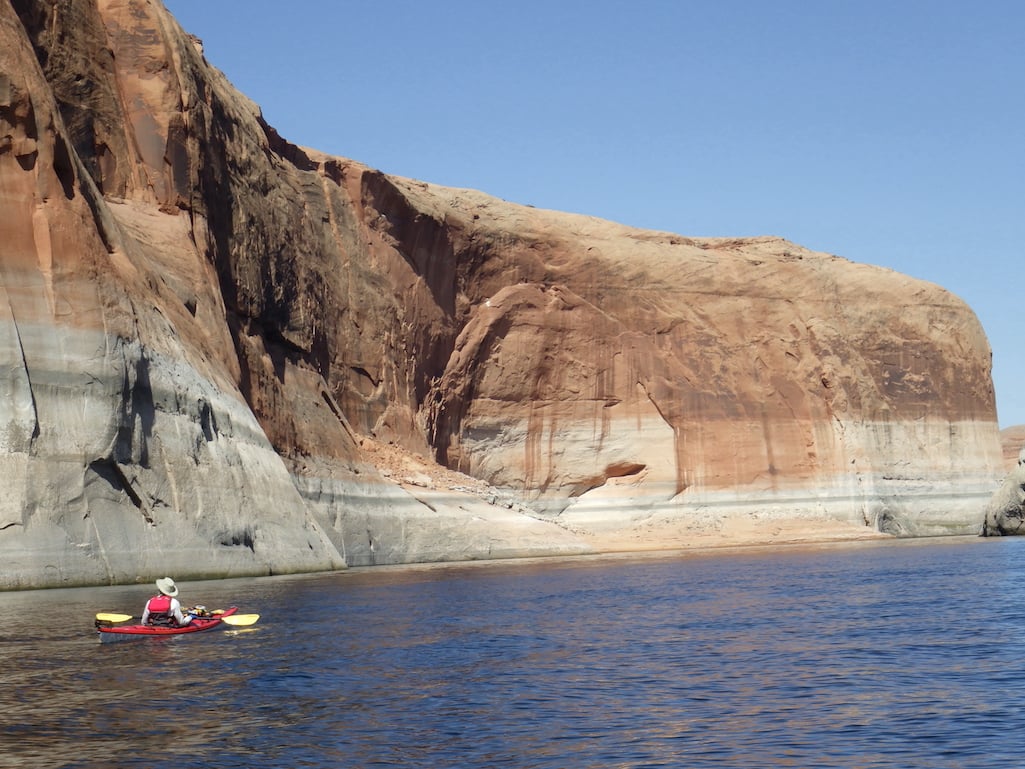
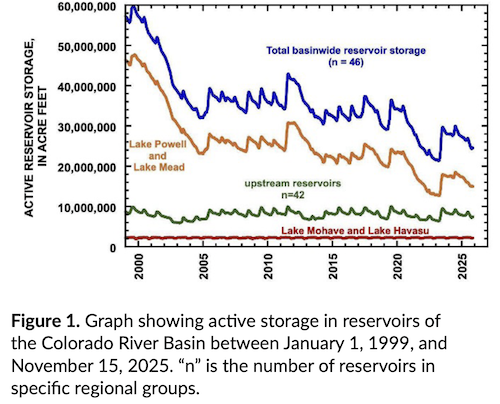
Lakes Powell and Mead on the Colorado River are less than two-thirds full, leaving scientists, economists, and water law experts fearful that the reservoirs could soon be useless.
Compounding the water flow problems created by diversions and climate-change impacts are disagreements between the Upper and Lower basin states on how best to manage a dwindling, invaluable, resource.
"Both the water supply and institutional systems are failing; many of the environmental systems failed years ago, with others just hanging on desperately," reads the executive summary of the inaugural Colorado River Insights, 2025 Dancing With Deadpool report. "Another year or two of low inflows and we will completely blow through the cushions provided by reservoir storage and the 20-year truce known as the Interim Guidelines, entering a world where physically moving water downstream becomes limited both by hydrology and engineering..."
This past summer Sarah Porter, an Arizona State University professor, pointed out in an article for The Conservation that, "[T]he seven Colorado Basin states have been grappling with how to deal with declining Colorado River supplies for a quarter century, revising usage guidelines and taking additional measures as drought has persisted and reservoir levels have continued to decline. The current guidelines will expire in late 2026, and talks on new guidelines have been stalled because the states can’t agree on how to avoid a future crisis.
 And yet, the executive summary of Colorado River Insights points out that, "[T]he reality is that most of the problems in the basin are, and continue to be, to some degree self-inflicted, and that viable paths forward are available."
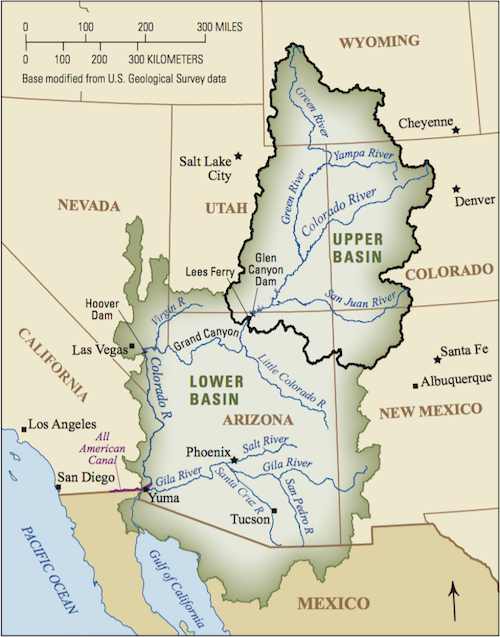
The stakes certainly are high, as the Colorado River drainage furnishes water for tens of millions of people, some 5 million acres of croplands, critical habitat for species, hydroelectric power, and recreation.
Colorado River Insights examines these issues through a series of submissions, or chapters, from experts on the river, agriculture, economics, and water law. The executive summary underscores the dire conditions confronting those who rely on the river.
"If winter 2025-2026 continues to be relatively dry and inflow to Lake Powell and other Upper Basin reservoirs is similar to that of 2024-2025, it is likely that less than 4 million acre feet in Lake Powell and Lake Mead would be realistically available—given infrastructure and hydropower production constraints limiting consumption of some active storage—for use during the nine months between late summer 2026 and the onset of snowmelt runoff in 2027," the summary reads. "If winter 2026-2027 continues to be dry, water supply would be further constrained. The present reservoir operating rules that remain in place through 2026 are insufficient to avert this potential water supply crisis."
How that would affect National Park Service operations at Glen Canyon and Lake Mead national recreation areas, not to mention the national parks that line the river, remains to be seen. The report does note that low levels of Lake Powell could lead to an "invasion" of smallmouth bass into the river through Grand Canyon National Park, an event that could impact threatened and endangered fish in the river as it runs through the park.
Both NRAs in recent years have spent millions of dollars to extend boat ramps to deal with declining water levels. Last July the surface of Lake Powell at Glen Canyon NRA was 3,557 feet above sea level, far below the 3,700-foot elevation of "full pool," yet about the same distance in feet from the 3,370-foot elevation of "dead pool," when there's not enough water in the reservoir to be released downstream.
On December 20, the lake's elevation was 3541.23 feet, according to the Bureau of Reclamation, and while it will decline more in the coming months, spring runoff should boost it some.
The authors of Colorado River Insights acknowledge that they can't predict the future.
"Our scenario is merely one of many possibilities, but our assumptions are sufficiently realistic to serve as a warning of how close the Basin is to a true water crisis," they note. "Our results should serve as a call to action. We need to adopt additional and immediate measures across the Basin to reduce water consumption even further during the next year, well before any new guidelines are in place."
Stories about:
Story Categories:
A copy of National Parks Traveler's financial statements may be obtained by sending a stamped, self-addressed envelope to: National Parks Traveler, P.O. Box 980452, Park City, Utah 84098. National Parks Traveler was formed in the state of Utah for the purpose of informing and educating about national parks and protected areas.
Residents of the following states may obtain a copy of our financial and additional information as stated below:
- Florida: A COPY OF THE OFFICIAL REGISTRATION AND FINANCIAL INFORMATION FOR NATIONAL PARKS TRAVELER, (REGISTRATION NO. CH 51659), MAY BE OBTAINED FROM THE DIVISION OF CONSUMER SERVICES BY CALLING 800-435-7352 OR VISITING THEIR WEBSITE. REGISTRATION DOES NOT IMPLY ENDORSEMENT, APPROVAL, OR RECOMMENDATION BY THE STATE.
- Georgia: A full and fair description of the programs and financial statement summary of National Parks Traveler is available upon request at the office and phone number indicated above.
- Maryland: Documents and information submitted under the Maryland Solicitations Act are also available, for the cost of postage and copies, from the Secretary of State, State House, Annapolis, MD 21401 (410-974-5534).
- North Carolina: Financial information about this organization and a copy of its license are available from the State Solicitation Licensing Branch at 888-830-4989 or 919-807-2214. The license is not an endorsement by the State.
- Pennsylvania: The official registration and financial information of National Parks Traveler may be obtained from the Pennsylvania Department of State by calling 800-732-0999. Registration does not imply endorsement.
- Virginia: Financial statements are available from the Virginia Department of Agriculture and Consumer Services, 102 Governor Street, Richmond, Virginia 23219.
- Washington: National Parks Traveler is registered with Washington State’s Charities Program as required by law and additional information is available by calling 800-332-4483 or visiting www.sos.wa.gov/charities, or on file at Charities Division, Office of the Secretary of State, State of Washington, Olympia, WA 98504.
INN Member

The easiest way to explore RV-friendly National Park campgrounds.

Here’s the definitive guide to National Park System campgrounds where RVers can park their rigs.
Our app is packed with RVing- specific details on more than 250 campgrounds in more than 70 national parks.
You’ll also find stories about RVing in the parks, tips helpful if you’ve just recently become an RVer, and useful planning suggestions.

