
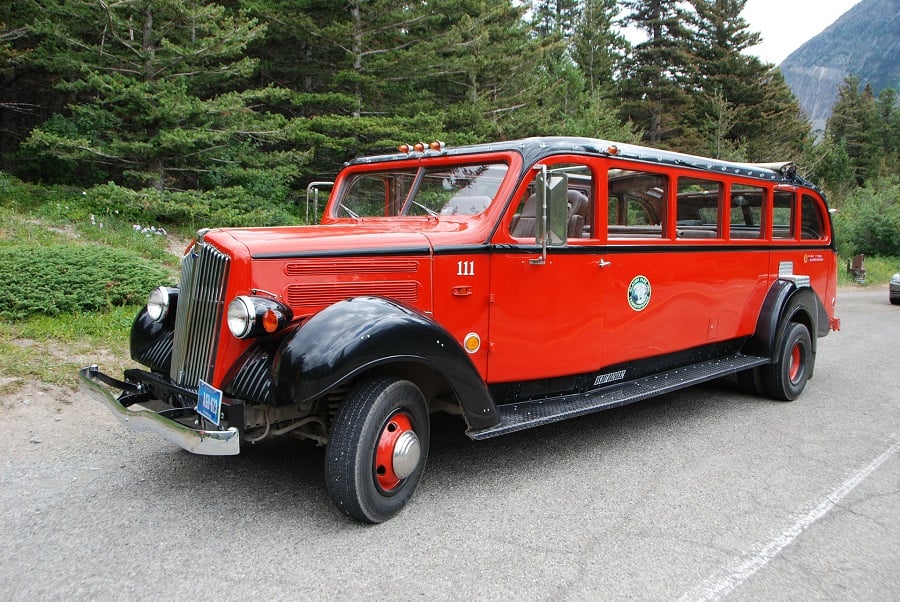
Glacier National Park's famed Red Buses will get overhauled this year/Pixabay
For those visiting Glacier National Park, the iconic red buses remain a trip favorite. Black and crimson, shiny, and comfortable, the buses transport their riders back in time. However, even they need some modern upkeep, and park staff begin an extensive rehabilitation project this year.
The White Motor Company Model 706 buses were manufactured between 1936 and 1939, painted the color of ripe mountain ash berries, and originally purchased by the Glacier Park Transportation Company. The Ford Motor Company donated time and money for the previous red bus rehabilitation, which occurred in 1999.
The rehabilitation will replace the current Ford engines with a Ford 6.2L V8 engine assisted by an electric hybrid system to reduce fuel consumption and emissions. The electric hybrid system will be powered by a battery bank that will charge when the vehicle decelerates including on downhill runs, which are frequent in the park. The buses will be remounted on new Ford chassis retaining the existing 176’ wheelbase, as they were with a previous restoration. Tire size will be expanded from 16’’ to 19.5’’ to approach historical dimensions. The dashboard and gauges will be replaced with historic replicas, and the buses will undergo refinishing, including rust removal and painting using the historic mountain ash color.
President Taft designated Glacier National Park in 1910, making Glacier the 10th unit in the national park system. The red buses have been a signature fixture in the visitor experience for the vast majority of the park’s history. The improvements will ensure that the fleet continues to operate in Glacier National Park for the foreseeable future, with improved safety and serviceability, while retaining the same visitor experience in the park that has existed for over 80 years.
The National Park Service included the rehabilitation as a responsibility in the most recent concession contract that Xanterra Travel Collection was awarded in 2014. Xanterra Travel Collection has selected Legacy Classic Trucks, based in Driggs, Idaho, to do the rehabilitation. Once complete, visitors will once again be able to choose tours that last 2.5-9.5 hours, taking in the beautiful sights and sounds of Glacier National Park.
One recent rider – Steve – says it all in his review on Trip Advisor: “My wife and I recently visited Glacier NP. We took the Red Bus Tour and it was the highlight of our visit. The old restored White Truck Red Buses held 17 guests and had an open top which is open if the weather is agreeable. Thankfully it was while we were there. Our tour guide GLEN was extremely [knowledgeable] about the park, the history, plants, animals, etc. We can't thank him enough for the wonderful experience. Anyone visiting GNP should take this tour. It is worth every penny.”
Stories about:
Story Categories:
A copy of National Parks Traveler's financial statements may be obtained by sending a stamped, self-addressed envelope to: National Parks Traveler, P.O. Box 980452, Park City, Utah 84098. National Parks Traveler was formed in the state of Utah for the purpose of informing and educating about national parks and protected areas.
Residents of the following states may obtain a copy of our financial and additional information as stated below:
- Florida: A COPY OF THE OFFICIAL REGISTRATION AND FINANCIAL INFORMATION FOR NATIONAL PARKS TRAVELER, (REGISTRATION NO. CH 51659), MAY BE OBTAINED FROM THE DIVISION OF CONSUMER SERVICES BY CALLING 800-435-7352 OR VISITING THEIR WEBSITE. REGISTRATION DOES NOT IMPLY ENDORSEMENT, APPROVAL, OR RECOMMENDATION BY THE STATE.
- Georgia: A full and fair description of the programs and financial statement summary of National Parks Traveler is available upon request at the office and phone number indicated above.
- Maryland: Documents and information submitted under the Maryland Solicitations Act are also available, for the cost of postage and copies, from the Secretary of State, State House, Annapolis, MD 21401 (410-974-5534).
- North Carolina: Financial information about this organization and a copy of its license are available from the State Solicitation Licensing Branch at 888-830-4989 or 919-807-2214. The license is not an endorsement by the State.
- Pennsylvania: The official registration and financial information of National Parks Traveler may be obtained from the Pennsylvania Department of State by calling 800-732-0999. Registration does not imply endorsement.
- Virginia: Financial statements are available from the Virginia Department of Agriculture and Consumer Services, 102 Governor Street, Richmond, Virginia 23219.
- Washington: National Parks Traveler is registered with Washington State’s Charities Program as required by law and additional information is available by calling 800-332-4483 or visiting www.sos.wa.gov/charities, or on file at Charities Division, Office of the Secretary of State, State of Washington, Olympia, WA 98504.
INN Member

The easiest way to explore RV-friendly National Park campgrounds.

Here’s the definitive guide to National Park System campgrounds where RVers can park their rigs.
Our app is packed with RVing- specific details on more than 250 campgrounds in more than 70 national parks.
You’ll also find stories about RVing in the parks, tips helpful if you’ve just recently become an RVer, and useful planning suggestions.


Comments
Always a highlight of visiting Glacier. We've taken several red bus tours. Drivers are friendly and knowledgeable!
Good for GNP! Way to keep up with the times and protect our magnificent environment! Love your red bus tours!
Thank you GNP and Xanterrs! I love the red busses. When I grow up, I hope to be a red buss guide. Looking forward to maximizing efficiency with this new hybrid power train.
Nothing like running those buses on coal.
What the hell are you trying to say? I've read a lot of weird stuff from you, but this kind of tops them all.
This is obviously based off of the same system used in the F-250 Super Duty Hybrid, which never plugs in to charge the traction battery. The electric traction motor is purely supplemental, and is charged by the gasoline engine and/or regenerative braking. And the really big deal is that the batteries get charged when braking going downhill, recapturing energy that would normally be lost as heat.
https://news.pickuptrucks.com/2018/04/xl-ford-super-duty-f-250-hybrid-qu...
https://helenair.com/lifestyles/recreation/glacier-national-park-jammer-...
calm down
Never been to Glacier, but one movie my kid wanted to see was Disney's Planes: Fire & Rescue. They had a ficitional national park visited and operated by various motor vehicles and aircraft. However, I never figured out why the Chief Ranger was "Ranger Jammer". He wasn't red though.
https://ohmy.disney.com/wp-content/uploads/2014/03/planes-fire-and-rescu...
Y_P_W - I stand corrected. I wonder what the payback period will be.
Likely none. Can’t find anything specific on the current conversion, but the 1999 conversion to propane and natural gas was paid for by Ford and a couple of Glacier Park nonprofits.
So there is no cost if someone else pays for it? Why does it not surprise me that you think that way.
The vehicles are owned by the National Park Service. However, there is no "payoff period" because the operator/owner isn't paying for it, nor "paying it off". Ford and the nonprofits are doing this as a public service. The benefits of this are many fold. This will reduce the operating costs for the concessionaire, even if they don't have to pay for the hardware and retrofit. It will be quieter since the electric assist improves power while reducing output from the gasoline engine. And they're refitting the panel so that it looks closer to how they were in the 1940s.
You're the one who claimed they were being run off coal. Yeah I get you're talking about electricity, but it's yet another example of your use of inflammatory rhetoric. And your changing the subject, where "payoff period" suddenly morphs into "So there is no cost". Maybe I didn't learn much in Econ 1, but I do remember that "payoff period" meant when an investment cost is recovered by the investor via cost savings. What does that have to do with these buses, and why are you turning a feel good story into some rant against electric vehicles?
Wouldn't it be better that that money go to real and efficient maintenance of the park? Reason I bring it up is because we waste so many resources being "green" that would be much better spent elsewhere. You are right this is a "feel good" story. Unfortunately to many times people go with "feel good" rather than '"do good".
Sure. Go up to Ford and tell them, "No thanks. Please donate money. We don't want your generous donation." Do you even have a hint about how corporate donations work?
They get to choose the manner of their donations, and to specify how they get used. In this case it's a donation in kind of materials and expertise. Ford would obviously have a specific expertise in fitting an engine to a chassis. That doesn't mean Ford hasn't donated directly or indirectly to operatiions at national parks. I've been at a national park where one of the naturalists provided by a nonprofit (in lieu of park rangers) was partially sponsored by Ford.
The drivetrains eventually needed to be replaced. On top of that, the use of a quieter powerplant is a benefit. I remember when Yosemite went to diesel-electric hybrid buses for their shuttles. They were much, much quieter than the buses that they replaced. This was a choice made because a replacement for the powerplant was inevitable.
I get it. You think this is green-washing. But sometimes it's best just to accept a gift and say thank you rather than call into question the sincerity of the giver. Yout remind me of my cousin who once received a gift of some silver bullion. He actually told the giver no thanks, since he'd rather have gold.
Real and efficient? I thought reducing cars on the roads was a desired goal in this day of increased public visiting.
y_p_w - Yes I quite aware of how companies make donations. Have been involved in the process myself. And no, I wouldn't turn down the money, "I would say thank you here is how it would be best applied." And most beneficiaries would respect the recipient's wishes.
And Rick, perhaps you can explain how new engines will get cars of the road.
Ford wants to donate their specific expertise to this endeavor. They make motor vehicles, and this is right up their alley. What's so hard to understand about what they're doing and their intentions?
I've donated before to my alma mater. Sometimes it was to the general fund, and other times it was to a specific cause. When I wished to donate to a specific cause I frankly wouldn't have been happy if they tried to talk me out of it so that it could go to the general fund. I might have even said forget about it if you're trying to talk me out of it.
It may not get more cars off the road compared to the status quo. However, the alternative to not upgrading these engines is that perhaps they wear out and they shift to vans like they did in the 90s and visitors aren't happy about it and don't use them. Or just retool them with the same type of natural gas/propane engines they're currently using.
Are you just here to find something negative? It seems like it. This should be simple, noncontroversial, and a net benefit to NPS and the visitor experience. Yet you somehow come in claiming that they'll be powered off of coal or that whoever is donating money/time/materials to this cause needs to rethink it in favor of your priorities.
Let me guess what you want. They need to be powered off of "goddammed steam", right?
All this talk about donations, please don't forget National Parks Traveler in your year-end plans so we can continue this forum through 2019!
https://www.nationalparkstraveler.org/donate
While I am a bit surprised you haven't issued an admonishment to tone it down, well played!
From 20,000 feet, I think it's a discussion worth having.
No y_p_w, I am not here to be negative. I am here to learn about the parks and discuss the best way to support and maintain them. As part of that process I believe it useful to point out some of the hypocracy. People frequently complain here about the lack of maintenance but to "feel good" will spend money on items that reflect an inefficient use of the monies that are available. Unfortunately, this is a phenomenon that is not restricted to the parks.
The solution to properly funding NPS maintenance lies with Congress. That will cost money, whether it comes from taxes or fees.
As for the actual work, I re-read several articles that I previously read as reference for posting here. The work was required by the concessionaire (Xanterra) as part of their contract. Ford's input is unclear, but I wouldn't be surprised if they donated the powertrains.
Yes, the solution always seems to be more money. God forbid we spend what we have more wisely.
Sorry to stick my nose into this fascinating conversation about drivetrains and fuel sources, but asking Congress to spend money wisely is a big, big ask.
Spending money on improving the efficiency of an engine appears wise. And the red busses in Glacier each seat 17 people, compared with approximately 1 to 5 in the average POV.
And, yes, Eric, both you and I have spent way too much time being negative here over the years. We both have our internal justifications, but often enough others have complained about both you and I being negative that it is a fact to many.
That first comment was just bizarre though, although I understand his ideological bent. I don't get repeatedly changing tack and then doubling down on it every time his previous argument was countered. Of all the stories that one would think should be noncontroversial, shouldn't this one have been it? A beloved instutition is overhauled to extend its longevity, enhance the visitor experience (including visitors not riding Jammers), get closer to the original appearance, and it won't directly cost the National Park Service.
When I found out that I had a material fact (such as who is paying for it) incorrect, I admitted it and moved on. But I'm still figuring out how it was even possible to criticize the overhaul of these buses as a bad thing.
NPS managed to get the concessionaire to overhaul them, and before that they managed to get Ford to donate the powertrains and expertise, along with a couple of nonprofits to fund the rest. I'm wondering how that becomes controversial.
But of course with budgets, we're dealing with someone in a particularly high office complaining about the supposed lack of fire mitigation, while his own people would like to cut the Forest Service, BLM, and NPS budget that would go to doing just that. As well as withhold future aid to fire mitigation for a supposedly inability to mitigate fire risk. There's logic for ya.
I guess in other news, I found an article on this (an original White 706 that served in Yellowstone) sold for $165,000.
https://www.hemmings.com/blog/2017/09/13/big-yellow-different-yellowston...
President Trumps criticism has nothing to do with funding but rather Jerry Brown's succumbing to the greenies and not allowing mitigation efforts. In this case I disagree with The President. According to the Forest Service's own chief fire scientist, Jack Cohen, any mitigation efforts more than 250' from a home is a waste of money. Besides, why should my tax dollars pay for someone that wants to put his home at risk by building in a WUI?
Are you sure it isnt so much Governor Brown "succumbing to the greenies" and more local and municipal governments wanting more property tax dollars so they allow people to build further into forested areas and wildlife habitat?
In my own state, people who build up on the Wasatch bench complain when muleys come down and munch on their shrubs. Well, dont build up into their habitat then. You build up there dont complain when a deer or moose shows up in your backyard.
I live in an area where people have been living for over a century in these conditions. We don't have any more bears, but do deal with all sorts of wildlife including black-tailed deer. For some it's annoying while others find them charming.
However, I lived through the Oakland-Berkeley Hills Fire of 1991. It hit close to home, and I used to ride my road bike through the area that burnt down. I remember the one thing I noticed about homes that stayed up even though homes burned around them was that few of the still-standing homes had wood shingles. A lot of people wanted that look, but in the end it severely increased the risk of fire. And I remember when my computer lab at UC Berkeley shut down because power transmission was limited due to damaged power lines. One class project was extended a week as a result.
I don't get the blaming on the basic of political persuasion either. There was an even bigger wildfire in Oklahoma last year. I attribute these issues to more apolitical human behavior than anything else.
The President's gripe was with Brown's veto of a bill that would have allowed more mitigation. As to states encouraging building into the WUI, this is for the most part private land. Rightfully they have no real power to stop it. As to the consequences I totally agree. I live in a WUI, have deer and moose chewing on my shrubs on a regular basis and have no gripe with that. Nor do I expect the Feds to protect my home. That is my job.
The fire going through Paradise, CA was a house to house fire spread by high winds. The source may have been on federal land, but no amount of brush clearing would have mitigated that spread once it got into town. One of the issues was the use of wood shingle roofing, which is no longer allowed in new construction in California. However, there's no legal mandate for those with existing flammable roofing materials to replace them.
But you know very well that Trump had no idea what he was talking about, and most definitely wasn't referring to Brown's veto of anything. On top of that, SB 1463 wouldn't have achieved anything that wasn't already in place. It instructed the CPUC and Cal Fire to do things that were already being done. It might have also thrown a little bit of money at it. Brown's veto message made it pretty clear that he understood what he was doing.
I don't know that at all. And neither do you. But I agree, mitigation in the National Forest would have made little if any difference. Which is why I get so frustrated when we see the FS spend tens/hundreds of millions on such activities.
I don't know if there's any easy way around over a century of no questions fire supression in an environment that had millenia of natural fire taking care of the ecosystem. I'm OK with controlled burns as mitigation. They're doing what they can with the personnel and budget that they have.
But it's pretty clear that Trump blurts out stuff without asking for any input from anyone who actually knows what they're talking about. For him there's always someone else to blame - especially if it can be said in a partisan manner. You don't remember when he was blaming water policy for the severity of the fires in California? As if putting out fires with water is primarily how wildfires are fought, and ignoring that firefighting aircraft were dipping into reservoirs with no issues.
His claims are no less accurate than Brown's blaming it on climate change.
That's just ignorant. While you may or may not agree with the assessment that dry conditions and high winds are a result of human-created climate change, there's no question that the spread of the fires was extremely fast as a result of those conditions.
Trump's claims are demonstrably inaccurate. As in not subject to opinion. There's no equivalence in claiming that water policy resulted in lack of water to utilize to fight fires.
But there is no evidence that those conditions were caused by climate change. If the trend in fires is being driven by climate change then the climate is cooling. The early 1900s had far more fires and far more servere fires (measured in acres burned) than we see today despite the fact the existence of the largest cause of fires -man- has nearly tripled in that time frame.