
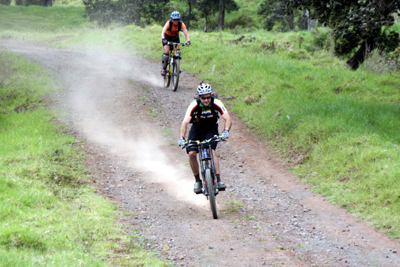
Mountain bikers in Hawaii Volcanoes National Park. Coming to a Rocky Mountain national park near you?
The International Mountain Bicycling Association has a friend in the National Park Service's Intermountain regional director, Michael Snyder. In a recent memo to park superintendents in his region, Mr. Snyder says IMBA can provide "some great partnership ... that you may want to take advantage of."
This is just the kind of reference IMBA officials have been seeking in their continued efforts to gain more access to national parks, access that includes cutting single-track trails across the park landscapes.
It does seem kind of strange to me that the regional director would recommend that his superintendents explore possibilities with IMBA at a time when the Park Service is still working under a 5-year memorandum of understanding to test mountain biking in three parks. Of course, park superintendents all along have had the authority to approve or ban mountain biking inside their parks, so why there was a need for the MOU is equally baffling, unless it was merely intended to give IMBA some name recognition and legitimacy with the superintendents.
And really, there already are quite a few miles of mountain bike trails in the park. Across the park system hundreds and hundreds of miles of dirt roads are open to mountain bikers, ranging from the renowned White Rim Trail in Canyonlands National Park to backwoods routes in Mammoth Cave National Park. In all, 40-some parks already allow mountain biking to some extent. And there are thousands of more miles that range through U.S. Forest Service and U.S. Bureau of Land Management lands.
I've asked this before but will revisit it now: Why is there a need to cut single-track trails in the parks? Is that the best use of the resource at a time when there already are innumerable mountain biking opportunities? Can hikers and mountain bikers satisfactorily exist on the same trail? Many mountain bikers love the thrill of zooming downhill. Think those in national parks won't seek that thrill?
As I noted earlier this fall, mountain biking is a proposed centennial project at Big Bend National Park in Texas.
Roger Siglin, now retired from the Park Service, recently toured the site of that trail. Here's what he had to report:
My wife and I hiked a loop around Lone Mountain following the proposed mountain bike trail. The total distance can’t be much more than two miles. An extension of 1 to 1.5 miles leaves the north end of the loop and follows an old road which ends when it reaches the Grapevine Hills road. On the east side of Lone Mountain the proposed trail stays up on the mountain slope a short distance. This made the first half of the route unpleasant to hike. It is covered with lechugilla, cacti, sotol and other typical desert plants. The ground is very rocky, mostly because fragments of the hard lava capping the mountain have covered the slope.
Trail construction will be difficult and will leave a highly visible scar from the nearby highway north of the visitor center. The flagged route does not follow the contour, but zigzags up and down the slope short distances and skirts several large boulders. I suppose that is to make the route more interesting for bikers, but it would appeal less to hikers for that same reason. We continued on around to the west side of the mountain where flagging was no longer visible. More of the high Chisos Mountains is visible from the west side.
The entire route is north of park headquarters, with a proposed trailhead directly across the road from the concession gas station. A hiking or biking trail around Lone Mountain could easily be constructed below the base of the mountain on flat to gently sloping terrain and the views would be much the same. It would be a very easy hike and a constructed trail there would leave no visible scars from a distance.
Two more phases to the project would add five or six miles of bike trail with two loops that would basically parallel the upper end of the Grapevine Hills road.
I am not a mountain biker and at 71, don’t anticipate becoming one. But if I were planning a shared-use trail I would not pick this location. For children on bicycles, or anyone else for that matter, the east side of the trail would be dangerous because of the rocks and desert vegetation. None of the trails projected in the three phases of construction would be particularly attractive, but at least they are outside of potential wilderness according to the park's wilderness plan. Phases two and three near the Grapevine Hills road and the leg on Phase one, would be unattractive to hikers, and I do not think would appeal to mountain bikers. There is a horse camp at Government Springs with a corral, but it may be moved, so even horsemen would probably not use the trails.
It is difficult to avoid the thought that this project is being proposed primarily for IMBA to get one more foot in the door, the door being widespread creation of new bike trails, or the opening up of existing NPS trails to mountain bikes. The trailhead is already one of the centennial initiative projects. Apparently the trail itself may become a centennial project as the following quote from IMBA indicates: “IMBA is a member of several coalitions that are actively campaigning for increased NPS funding and a sponsor of a Centennial Initiative project for new shared-use single-track in Big Bend National Park.”
There are some shared-use single tracks where I live. Before they were opened to mountain bikers, it was a great place to go for a quiet hike. Now on those beautiful fall days when you want to get out the trails are swarming with mountain bikers, which makes it kind of hard to have a leisurely hike.
That's not to say the mountain bikers aren't entitled to the trail, because it was designed as dual-use. But the result is that mountain bikers are displacing hikers. Hopefully that won't be the case in parks that take up IMBA's "great partnership."
Story Categories:
A copy of National Parks Traveler's financial statements may be obtained by sending a stamped, self-addressed envelope to: National Parks Traveler, P.O. Box 980452, Park City, Utah 84098. National Parks Traveler was formed in the state of Utah for the purpose of informing and educating about national parks and protected areas.
Residents of the following states may obtain a copy of our financial and additional information as stated below:
- Florida: A COPY OF THE OFFICIAL REGISTRATION AND FINANCIAL INFORMATION FOR NATIONAL PARKS TRAVELER, (REGISTRATION NO. CH 51659), MAY BE OBTAINED FROM THE DIVISION OF CONSUMER SERVICES BY CALLING 800-435-7352 OR VISITING THEIR WEBSITE. REGISTRATION DOES NOT IMPLY ENDORSEMENT, APPROVAL, OR RECOMMENDATION BY THE STATE.
- Georgia: A full and fair description of the programs and financial statement summary of National Parks Traveler is available upon request at the office and phone number indicated above.
- Maryland: Documents and information submitted under the Maryland Solicitations Act are also available, for the cost of postage and copies, from the Secretary of State, State House, Annapolis, MD 21401 (410-974-5534).
- North Carolina: Financial information about this organization and a copy of its license are available from the State Solicitation Licensing Branch at 888-830-4989 or 919-807-2214. The license is not an endorsement by the State.
- Pennsylvania: The official registration and financial information of National Parks Traveler may be obtained from the Pennsylvania Department of State by calling 800-732-0999. Registration does not imply endorsement.
- Virginia: Financial statements are available from the Virginia Department of Agriculture and Consumer Services, 102 Governor Street, Richmond, Virginia 23219.
- Washington: National Parks Traveler is registered with Washington State’s Charities Program as required by law and additional information is available by calling 800-332-4483 or visiting www.sos.wa.gov/charities, or on file at Charities Division, Office of the Secretary of State, State of Washington, Olympia, WA 98504.


National parks and their natural resources belong to you. The National Parks Traveler works to ensure you know how these essential places are being cared for.
Sign Up For Our Weekly Newsletter
Unsubscribe at any time.
INN Member

The easiest way to explore RV-friendly National Park campgrounds.

Here’s the definitive guide to National Park System campgrounds where RVers can park their rigs.
Our app is packed with RVing- specific details on more than 250 campgrounds in more than 70 national parks.
You’ll also find stories about RVing in the parks, tips helpful if you’ve just recently become an RVer, and useful planning suggestions.


Comments
Why is there a need to cut single-track trails in the parks? - Will Kirk ever write a "why do we need any new hiking trails" post or is this a barely veiled attempt to disguise his contempt for bicycles?
Is that the best use of the resource at a time when there already are innumerable mountain biking opportunities? - Should we ever have more hiking when there is already a plethora of hiking opportunities?
Can hikers and mountain bikers satisfactorily exist on the same trail? - Can Kirk ever write an article that doesn't ignore the positive experiences of those who have already posted on his other articles regarding this topic? Or, do Kirk and the bike haters always run away at the first sound of a mountain bike somewhere in the vacinity?
Many mountain bikers love the thrill of zooming downhill. Think those in national parks won't seek that thrill?
- Is it possible to create a sustainable multi-user friendly trail of moderate speed with uphill portions like the majority of biking trails across America or does he always assume that all trails and bikers participate in X-Games style solely downhill riding at great speed?
Kirk, I appreciate your other efforts and posts regarding actual detrimental activities in our parks like ORV's and drilling in ANWR, and yes my post is a little on the sarcastic side, but your disdain for mountain bikers is misguided.
I'm with Ed Abbey. Close the parks to vehicles, give everyone a bicycle, and bus the suitcases in.
Ooops, replace every Kirk with Kurt.
Anonymous,
Thanks for eventually getting the name right;-) But why do you hide your reply behind anonymity?
Now, to your points:
* I can't recall the last time there was a proposal to cut new hiking trails in the parks. But that's not the point.
* I don't profess a hatred of mountain bikes. There are two in my garage. But I do prefer my road bike.
* The majority of mountain bike trails go uphill? What goes up, must come down, no? But regardless, mountain bikes carry much more speed on flats and downhills than hikers. Especially if the hiker has a 40-50 pound pack on their back.
* Mountain bikers aren't thrill seekers? Perhaps not all, but take a look at the accompanying picture. Those are IMBA reps kicking it in Hawaii Volcanoes NP.
* And really, as much as IMBA lobbies for single-track trails in the parks, shouldn't someone offer a counter argument?
My bottom line is that I am not convinced the national parks need to be, or should be, open to every form of recreation imaginable. Forest Service and BLM lands are more focused on such multiple use. Perhaps if there weren't already thousands of miles of mountain biking opportunities on those lands I'd be persuaded about the need to open more land in the national parks to mountain bikes.
And really, there already exist more than a few mountain biking opportunities in the parks. If single-track usage is approved under the "dual-use" premise, and it's found not workable, does that mean bike-only single track should be cut across the parks? Or should wider footprints be cut? And if wider footprints are called for, should they be hard-packed or paved so Segways can travel them as well?
God bless Ed Abbey.
The photo of mountain bikers descending on a wide dirt road doesn't sound any alarms for me. It looks they're having fun, are riding in a safe situation, and are enjoying their visit. Aren't those things appropriate for a national park visit?
I'm a fan of mountain biking in national parks. Today's park managers have a better understanding of trail designs that work for all kinds of shared-use traffic. They have responsible partners to work with in the mountain biking community, and they have the power to decide which trails should be open to bikes and which should not. As you point out, shared-use trails are employed in parks across the country already, with excellent results. Why not expand on those successes?
Today's park managers also face declining budgets and lowered visitation. Integrating mountain biking in a responsible fashion can help new audiances gain an appreciation for national parks. Mountain biking holds a lot of appeal for the younger visitors that National Parks need to ensure the longterm health of the system.
Lastily ... Segways and paved roads are just straw-men targets. (So is comparing mountain biking to motorized traffic. I can tell the differerence btween a bike and motorcycle, and so can the Park Service.) Let's focus on bringing involving more people in the NPS experience, not filtering out all the potential new fans of the parks just because one user group wants to define the experience for everyone else.
Mountain bikes/bikers are a cancer in National Parks. The chemotherapy is convincing superintendents and the NPS itself that mountain bikes are an inappropriate method of access to National Parks. We're not talking about limiting access, we're talking about limiting the *method* of access - similar to the snowmobile issue in Yellowstone.
Do bikers want to see the parks or do they want to ride their bikes? Which is it? If bikers want to see the parks, they can lock their bikes up and walk in. If they want to ride, like Kurt mentioned, there's many, many miles of bike trails on other public lands.
A poll was recently taken in the mountainous west and not a single tourist came to see mountain bikes, gas or oil wells, clear-cuts or cattle crap. >Big smile<
I see no need to cut any new trails (hiker or biker) in any of Our National Parks.
In fact I believe there is way too much time and money spent on maintenance of trails already established.
When I visit I like nature to be wild, free and spontaneous (to borrow from Mr. Abbey) which must be hard for her as we endlessly cut, gouge, pave, fence, sign and bridge.
Kurt, I'm with you on this one. Many times when I take to the coastal foothills for a good days hike, I prepare myself for the weekend yahoo boys with their mucho trail bikes screaming OUTA MY WAY bellow... and blasting by me with a curse look in some cases. In all fairness, there's many well meaning and polite trail bikers that maintain a decent code of mannerism in "share-the-trail" guide lines. But, in my opinion, trail biking is something that parallels with dune bugging, snowmobiling, and off the road SUV touring that creates one the most distructive forces to nature in the National Parks. Sports utility trucks ripping up the terrain around famous legendary petroglyphics, dune buggies ripping up the cacti vegetation in the fragile desert ecosystem, and snowmobiling sprewing gas and oil along with there whining obnoxious noise, and there's the trail bikes that leave deep ruts into the soil that creates massive erosion (and water run-off)problems during heavy winter rains.
Why is it that we can't enjoy the simple things in life anymore. Why does it have to be this thrill seeking avenue of enjoyment...always has to be this adrenaline rush? Trail biking to me is another extension and example of bringing another piece of junk from your backyard, and to take it with you to the hills, the mountains or to the desert...and everthing but the kitchen sink. Give me my fifty pound pack and a silent trail, and I'll show you how not to destroy a trail with two feet...tread softly biker!
@ 1st Anon Poster-
I love mountain biking, I mountain bike all the time. I don't wear the downhilling gear and pads and can't ride the obstacle courses, but I am on the bike getting dirty at least 2 X a week. And I have to say, with a dual suspension bike with disc brakes, I HATE having to slow down and let a hiker, their dog and whatnot safely pass. I do it anyway, of course, because that's the way to keep mountain biking legal on trails, but in the parks, where you have all these people visiting to "test themselves against nature" you have a recipe for disaster. Even if you have a bell on your handlebar! ;)
Let's be realistic, the NPS can barely keep up with maintaining trails used by hikers, I'd hate to see mountain bikes come in and muck up the trails even further.
No one is advocating more trails. I think we'd all like to see more *maintenance* on the trails that exist and I personally don't see mountain biking positively contributing to the health of the trails I ride and I tend to have pangs of guilt when riding because you see the damage that occurs. Hikers cause damage to trails, I don't have my head in the sand, but trail bikes are far worse. Not that I'm going to stop, however, it is too much fun! But I would never ride in a NPS unit. USFS and BLM yes, but ride in NPS, no.
Mark, you sound as if you know this topic quite well. Are you officially aligned with the mountain bike community?
How many people do you know who can recite the NPS Mission? I certainly can't. "...to conserve the scenery and the natural and historic objects and the wildlife therein and to provide for the enjoyment of the same in such manner and by such means..."
An English teacher would have a field day editing the seemingly endless run-on sentence that describes the NPS Mission.
Regardless, I've learned to overlook the Mission's rambling wording for the value of its meaning. It's about celebrating natural America, by allowing people to responsibly (emphasize "responsibly") visit, enjoy, and marvel at some of the most beautiful, wild and fascinating places around. One creative NPS employee I know compared the national park system to a can of your favorite soda. If you stick the sealed can on a shelf, you miss the experience of opening it up to savor its color, flavor, coolness, and effervescence.
Nowadays many NPS employees are quick to close portions of national parks, whether they be facilities, trails, or vast tracts of land. "Resource protection," "budget shortfalls," and "safety" are the most frequently cited explanations. Sometimes legitimate reasons exist to close an area, but all-too-often I've seen closed areas remain that way because park staff are 1) too busy attending meetings, writing reports, and creating podcasts to notice the value of these areas to the public, and 2) many NPS employees are such environmental purists they don't believe the places should ever be touched by human feet (or bicycle tires).
"Woops! You mean we haven't reopened that trail? Must have forgotten all about the silly Mission!"
This indifference is well known to many park visitors, and it doesn't bode well for public relations. If you want a supportive public, insure that your park is available for public enjoyment.
Simple Proposal #7: Keep Your Eye on the Mission
Why not regulate each trail according to its appropriateness for biking? Seems to work on the carriage trails in Acadia and the mosquito-infested old roads of the Everglades, but it sure as heck doesn't make sense on the steep, narrow trails in places like Yosemite or Bryce. Ya?
Certainly not every park or every suggested route is appropriate for bicycle use, but "mountain biking in national parks" should not be demonized. Park managers/planners should be open to consider it as an appropriate use for dirt roads that are closed to motor vehicle traffic, an be open to the idea of allowing a small percentage of trails to be suggested mountain bike trails.
Sycamore Canyon in Santa Monica Mountains NRA sets an example of how mountain biking can be allowed along with other recreational uses in a park area. I hike and bike in this area, and the terrain, which is riddled with old ranch roads and fire roads, is well-suited for mountain biking. Also, some excellent single-track provides a wonderful experience for mountain bikers of all skill levels. There is a volunteer mountain bike patrol force riding the trails on weekends. Trail runners, bikers, hikers, and equestrians appear to get along quite well. If there is a Santa Monica ranger reading this, I'd love to hear what he or she thinks. But, best I can tell as a user, Santa Monica managers have done a fantastic job of allowing a multitude of uses in their park.
The photo chosen for this story shows two "gear appropriate" mountain bikers going downhill on a dirt road. This is why they may appear a bit aggro at first glance. If Kurt had chosen a photo of a family biking on a flat dirt road or paved path in a national park, it would have a much different impact on the viewer's perception of mountain biking.
A vast majority of people who mountain bike are what I call "hikers on bikes." I know people from 7 to 70 who enjoy this activity. The NPS should keep the mountain biking card in their hat of recreation activities they consider when planning park use. I'm guessing there are some old mining roads in Rocky that might serve well as a mountain bike trail and still leave hundreds of miles of trail to hikers only.
Disclosure: I am a former NPS ranger who is a hiker/backpacker first and foremost, yet I have riden over 2000 miles as a long-distance "thru-biker," carrying all my food, water, and equipment on my mountain bike. And I have written mountain biking guides, including one for a national park. Kurt, perhaps you should let me take you "bike-packing" one day? Maybe I can convert you.
Haunted Hiker, no need to convert, I love biking. Spent my vacation this summer doing it, as a matter of fact, and just returned from a 24-mile ride.
In fact, I agree with you that there are plenty of good dirt roads across the park system that would make wonderful mountain biking trails. The White Rim in Canyonlands is one great example, and of course the carriage paths in Acadia are another.
I also understand there are some pretty good single-track routes on non-Park Service public lands that make excellent multi-day treks. The Kokopelli Trail that winds 142 miles from Colorado into Utah is one great example.
And, to be truthful, I'd probably enjoy riding my mountain bike through Yellowstone's backcountry on a multi-day trip. But I just don't believe there's a need for it or that it'd be appropriate. I like knowing there's some backcountry where I can head without having to worry about a mountain biker coming around the bend at me.
As someone mentioned earlier, this isn't an access question. There's plenty of access already in the parks, including plenty of mountain biking opportunities, as you yourself noted. Is it so difficult to agree that the Park Service has a different mandate than the U.S. Forest Service and BLM, which are more multi-use oriented?
Lastly, that photo you mentioned? It pictures two IMBA reps cruising at Hawaii Volcanoes National Park during a demo day. I used that shot to illustrate the story because IMBA is the most ardent proponent of more mountain biking in the parks and, as the picture shows, they like to rock.
We all sure can think of plenty of ways to spend monies the NPS doesn't have now, can't we? Blasting a convenience cruise crater in Lake Powell, planning mile after mile of new bike and hike paths, hundreds of millions for a museum to house the "colorized" version of the NPS. How about this sure to be unpopular notion.....no new ammenities of ANY fashion until the system is dealing from a balanced budget with all existing billions in backlog maintenance completed. Then, we talk turkey. Or to the turkeys, whatever.
While I can definitely see the arguments made against biking, in the Big Bend's case in particular I think that a well-planned, environmentally friendly, sustainable single track trail is feasible. As it is not slated for the Basin, and as it is not slated for an area that sees a lot of foot traffic, I don't have a problem with it if done properly.
I also think it is highly possible to create a trail in this area that doesn't promote consistent down-hill thrill-seeking behaviour, but rather trails with lots of small ups and downs that prevent a rider from gaining too much speed without sacrificing enjoyment. The Texas Trail Docs (an IMBA supported group) and Talon Trail Systems (an Austin-based trail building business) are both experienced in creating such trails.
Conversely, if a new trail is not the best solution, perhaps we should close some dirt roads to vehicles and make them mountain bike and equestrian trails only. Like hikers don't appreciate mountain bikers bearing down on them, nor do bikers appreciate being run over by automobiles.
I think the case should be made for park specific regulations. The impact felt in the Big Bend region is not the same as the impact that would be felt elsewhere, and vice versa. Thus we should not judge all parks by one, or one by all, or all by three in the case of the 5 year MOA.
Ultimately, I hope that human powered activities have a fair shot over lazy vehicle-centric pursuits, lest we give way to the "pave our way to greatness" mentality that has turned Yosemite into the world's most beautiful parking lot.
Food for thought....
Full disclosure: I am an occasional mountain biker. (I spend more time rock climbing than anything else, but also very much enjoy camping/backpacking) I am not a member of IMBA, nor do I race in the Texas' local TMBRA circuit. I have hundreds of hours of trail building/maintenance experience, much of those used by mountain bikers. I am right handed. My favourite beer is Guinness, although I'm fond of New Belgium's many offerings. You can't beat the price of a good Shiner Bock though.
Cheers.
I was not aware that any for-profit, trail building businesses existed.
The fact that they exist says it all.
This issue is nothing more than mountain bike creep.
Frank and I have disagreed on this before.
But I still insist that the Organic Act has not failed. Yes, it is a paradox to conserve, promote the use of, and provide enjoyment for while leaving unimpaired. Yes, in order to fulfill such a mandate requires leaders possessing intellect, insight, and courage that the current NPS may not have or nuture. Yes, the NPS fails in small and not so small ways every day. But, all in all, the NPS has suceeded in its mandate by keeping the parks unimpaired enough to continue to provide for the enjoyment of billions of people over the last 150+ years.
The Organic Act is not "antiquated, fundamentally flawed, and needs extensive revision" any more than the Constitution of the United States is "antiquated, fundamentally flawed, and needs extensive revision." Don't throw the act out with the bathwater.
Hell, if anything's antiquated, it's evoking Edward Abbey.
Frank:
I'll bet we don't disagree that much, except maybe in certain details. Re closures of facilities/trails/areas, I'll resist citing specifics since I believe I'll risk losing my anonymity, which I find I'm thoroughly enjoying!
But I will cite an example shared with me recently by a friend. He mentioned he went to a meeting in a major western park, during which some in attendance wanted to close a certain area (to any entry, including hiking). But they couldn't agree on what justification they'd use to do so! If these folks stopped to consider who's paying their salaries, maybe they'd reconsider their intentions.
On a more humorous note, I once saw a sign on the gate leading into a remote section of a national wildlife refuge in Arizona. The sign read something like: "Area Closed, Public Entry Prohibited, Keep Out." Beneath this sign was another that read: "Your tax dollars at work."
Re the Mission, I believe the basic intent, as Haunted Hiker stated, is still a good one. Recall that I emphasized the need for "responsible" public use. Defining such terms as "responsible," "public enjoyment," "conservation," "unimpaired" etc. is what becomes problematic. The intent of my original post was to let common sense dictate how we manage these areas, not the notions of a few purists (and conversely, not the notions of a few abusers). While a hiking trail represents some impact on an ecosystem, most of us agree that trails are a good thing. Most of us also agree that allowing for personal watercraft isn't such a good thing. Then we have all those more debatable areas imbetween.
Hopefully reasonable heads will prevail and wise decisions will be made, taking into account the variables for each circumstance....and the intent of the Mission. Jeez...who am I kidding?!
Just curious: what would be your wording of an ideal Mission?
Good discussing this with you. I've admired your desire to think innovatively all along!
Frank:
If I could share the specifics of what I'm talking about re closures, I'm sure you'd agree. These decisions were all about closing trails...not closing roads, ORV routes, etc. These decisions had nothing to do with "preservation," by the way. In principle, I agree with you about the importance of preservation. But I still believe you can preserve national parks and still allow the public to respectfully enjoy them.
Perhaps other contributors can cite some examples of closures (or perhaps regulations?) they've witnessed that illustrate my original point of seemingly arbitrary decisions.
Mack P. Bray,
You said, "I was not aware that any for-profit, trail building businesses existed."
In response, though supported by IMBA and a host of other groups, the Texas Trail docs are 501(c)(4) non-profit. Talon Trails are a for-profit organization that constructs a variety of trails, including hiking-only, depending on their customers' desires.
Your comment "The fact that they exist says it all," doesn't quite say anything other than you're not contributing meaningful dialogue to this discussion, but rather relying on blanket statemtents like "Mountain bikes/bikers are a cancer in National Parks" to try and prove a point. This really doesn't seem very productive as far as reaching any sort of consensus is concerned. If you're not interested in consensus, then perhaps at least the prudent thing to do would be trying to educate the other readers rather than lambast those points of view that aren't your own.
Frank and Bart, I'm enjoying the dialogue.