
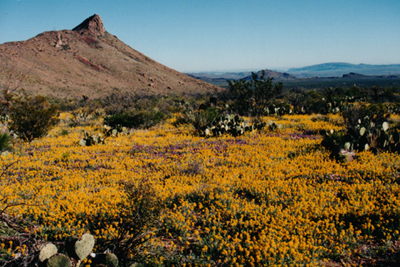
Big Bend's Lone Mountain would be circled with a hiking and biking trail under a proposed Centennial Initiative project. Photo by Jeff Blaylock, used with permission.
Among the 201 projects "certified" to meet the criteria for celebrating the National Park Service's centennial in 2016 is one to establish a dual-use, hiking and mountain biking trail in Big Bend National Park in Texas.
What seems odd, though, is that this project made the list at a time when the Park Service is in the middle of a five-year study examining mountain-bike use in the park system. Isn't that like approving a snowmobile trail through the Hayden Valley in Yellowstone before the park completes the latest environmental impact statement on recreational snowmobile use in the park? Should it be assumed that greater mountain-bike accessibility across the park system has become a forgone conclusion since that original memorandum of understanding was signed with the International Mountain Bicycling Association?
I'm told no from the folks in Washington, who point out that the Big Bend proposal is no more than that -- a proposal -- until Congress decides to fund the Centennial Initiative. And down at Big Bend, Superintendent Bill Wellman says the trail is not a done deal for a number of reasons.
For starters, the folks at IMBA have yet to come up with their half of the $120,000 proposed to fund construction of the trail and an associated trailhead, complete with picnic tables. Perhaps more importantly, an Environmental Assessment to determine whether the landscape in question is suitable for such a trail hasn't even gotten under way and could very well conclude this is not the place for such a trail, he says.
Cynics might say they're not surprised that greater mountain biking accessibility in the parks has appeared as an eligible Centennial Initiative project. After all, the Park Service's relationship with IMBA has been peculiar almost since the get-go back in 2005. When this relationship was first broached, there was to be a five-year study of mountain bike opportunities in the parks, with an eye on opening up dirt roads to the two-wheelers, as this snippet from an IMBA release clearly states:
A benefit to millions of bicyclists is the potential opportunity for new access to hundreds of dirt roads in National Park units that have been closed to bicycling. While National Park Service rules require a lengthy process to open single-track to bicycle use, appropriate dirt roads may be opened with a more straightforward administrative process.
And then, in January 2006, the group's spokesman, Mark Eller, let on that IMBA really did hope to cut some single-track trails in the parks.
"We feel comfortable, the NPS feels comfortable, with looking at the potential for trails to be opened," Eller told me at the time from the group's Colorado headquarters.
Not only does IMBA "feel comfortable," but the group already knows how those single-track trails should be constructed. According to Public Employees for Environmental Responsibility, IMBA has said it wants trails without water bars that might force riders to dismount, and trails 4-feet wide and that zigzag through the woods. Plus, IMBA doesn't want bike trails near dirt roads that might generate dust from passing vehicles.
And the National Park Service seems to be rolling along with this plan. Well, not everyone in the Park Service. It seems that a memo written back in the spring of 2006 by some of the administrative staff at Big Bend made it clear that they didn't want to see any single-track trails cut through the park.
Here's the conclusion from that memo:
"There is ... a great deal of worry, suspicion and outright skepticism about this proposal. While it is recognized that it does not set an outright precedent for other NPS areas if approved, it does make it much easier to propose in other NPS areas and more difficult to simply deny the request. The 'slippery slope' reference came up repeatedly in terms of the possibility and appropriateness of changing longstanding NPS policies with regard to wilderness use/management, motorized recreation, definitions of a "mechanized" device, agency control over examined activities, 'pay for play' implications, rulemaking and a host of other serious concerns
"The current policies are strongly supported by all levels of the park staff and they see no good reason to change them simply to allow for expanding mountain biking opportunities in the park. In a word, the park staff's answer to the possibility of expanding mountain biking opportunities in Big Bend National Park is a resounding 'No.'"
Superintendent Wellman inherited the mountain bike issue when he arrived at Big Bend in November 2006. And while he is familiar with the memo opposing mountain bikes, he also knows there are members of his staff who wouldn't mind seeing some mountain bike trails in the park.
The proposed centennial trail would start near the visitor center at Panther Junction and run roughly 8 miles in a loop, crossing the Chihuahuan desert and wrapping Lone Mountain while providing sweeping views of the Chisos Mountains, the southern-most mountain range in the country. The trail would be roughly 5 feet wide because of the need to accommodate mountain bikes.
Those are the "knowns." A number of surveys are getting under way to determine the "unknowns."
"We're just starting the archaeological survey for the proposed trail route. Then we'll do the EA," Superintendent Wellman tells me. "But what we're looking at -- and the first thing I told IMBA when we met on this -- we're interested in trails that are good trails for our park visitors and are a good way for the park visitor to experience the park, whether it's on foot or on mountain bike.
"What we're not interested in is a trail that's just a trail for mountain bikers to enjoy riding your mountain bike. The purpose of coming to a park is to enjoy the park."
The proposed location of the trail will "give us a trail in the desert portion of the park in an area where we haven't had a good way for any of our visitors to access the resource," says Superintendent Wellman, "and it's actually very close to our primary visitor center."
Though the setting can be spectacular when wildflowers -- mostly Fender's bladder pod -- are in bloom, the area is not proposed wilderness.
While Superintendent Wellman hopes archaeological surveys of the area can be completed this month, with a report on that work following in November, work on the EA isn't slated to begin until the new year, and then only if IMBA has the money to pay for it. The cost of the EA is estimated at $30,000, according to the superintendent.
Of course, if the archaeological work turns up significant artifacts, the proposal could die right there.
"There's a chance through the EA process that it won't turn out to be a viable project," says Superintendent Wellman, adding that there really is no other parcel of land in the park that would be suitable for such a trail. "It's pretty much here or nowhere in Big Bend."
Superintendent Wellman did allow that the park's existing trail system has some needs that must be addressed, and agreed that the $60,000 the park is proposing to commit to the dual-use trail could be spent on those needs. However, he added that the parking area and picnic area proposed to be built at the trailhead would meet another need of Big Bend visitors.
Nevertheless, cynics no doubt will continue to wonder why this project even made the centennial list. It takes, according to Superintendent Wellman, at least four-to-six hours to reach the proposed trailhead from the nearest interstate highway, which probably means few mountain bikers not from the area will decide to make the drive to sample this trail. And those local bikers already have miles and miles and miles of existing single-track mountain bike trails on state and other federal lands surrounding the park.
Aross the national park system hundreds and hundreds of miles of dirt roads are open to mountain bikers, ranging from the renowned White Rim Trail in Canyonlands to backwoods routes in Mammoth Cave. In all, 40-some parks already allow mountain biking to some extent. And there are thousands of more miles that range through U.S. Forest Service and U.S. Bureau of Land Management lands.
So why is there a need to cut single-track trails in the parks? Is that the best use of the resource at a time when there already are innumerable mountain biking opportunities? Can hikers and mountain bikers satisfactorily exist on the same trail? Many mountain bikers love the thrill of zooming downhill. Think those in national parks won't seek that thrill?
"If it were just building a trail to have a mountain bike trail we wouldn't be interested at all. But it's an area that looks like has a lot of benefit to general park visitors to have a trail," says Big Bend's superintendent. "The compromise is they're (IMBA) going to build it and maintain it."
"... What we're not trying to design is a high-speed, really thrilling mountain-bike ride," Superintendent Wellman added a moment later. "What they'll get here is a pretty mellow, very scenic bike ride. We get a lot of IMBA-type riders, but most of what we get are mom and pop and kids."
As for compatibility with the ongoing 5-year pilot project, Superintendent Wellman said if the pilot project ends with a decision not to expand mountain bike use in the park system beyond dirt roads, then IMBA will more than likely pull out of this project and the trail would be restricted to foot traffic.
Of course, the fact that this project was deemed worthy of centennial status sure makes it appear as if the Park Service really wants mountain biking to be a success.
Story Categories:
A copy of National Parks Traveler's financial statements may be obtained by sending a stamped, self-addressed envelope to: National Parks Traveler, P.O. Box 980452, Park City, Utah 84098. National Parks Traveler was formed in the state of Utah for the purpose of informing and educating about national parks and protected areas.
Residents of the following states may obtain a copy of our financial and additional information as stated below:
- Florida: A COPY OF THE OFFICIAL REGISTRATION AND FINANCIAL INFORMATION FOR NATIONAL PARKS TRAVELER, (REGISTRATION NO. CH 51659), MAY BE OBTAINED FROM THE DIVISION OF CONSUMER SERVICES BY CALLING 800-435-7352 OR VISITING THEIR WEBSITE. REGISTRATION DOES NOT IMPLY ENDORSEMENT, APPROVAL, OR RECOMMENDATION BY THE STATE.
- Georgia: A full and fair description of the programs and financial statement summary of National Parks Traveler is available upon request at the office and phone number indicated above.
- Maryland: Documents and information submitted under the Maryland Solicitations Act are also available, for the cost of postage and copies, from the Secretary of State, State House, Annapolis, MD 21401 (410-974-5534).
- North Carolina: Financial information about this organization and a copy of its license are available from the State Solicitation Licensing Branch at 888-830-4989 or 919-807-2214. The license is not an endorsement by the State.
- Pennsylvania: The official registration and financial information of National Parks Traveler may be obtained from the Pennsylvania Department of State by calling 800-732-0999. Registration does not imply endorsement.
- Virginia: Financial statements are available from the Virginia Department of Agriculture and Consumer Services, 102 Governor Street, Richmond, Virginia 23219.
- Washington: National Parks Traveler is registered with Washington State’s Charities Program as required by law and additional information is available by calling 800-332-4483 or visiting www.sos.wa.gov/charities, or on file at Charities Division, Office of the Secretary of State, State of Washington, Olympia, WA 98504.

Comments
In July I spent a week at Far View in Mesa Verde nat. park, where bikes of any kind are apparently not allowed, at least I never saw any. That surprised me. I just assumed bikes and specific bike trails or paved bike paths would be a natural benefit to such a location by reducing auto traffic and its air pollution. Mesa Verde is such a large park that it is otherwise impossible to see without an automobile. The beauty and mystery of the surroundings would have been much more enjoyable by being allowed to travel at my leisure from location to location on a bike instead of a car and the attendant traffic.
mountain bike trails do nothing for transportation, especially when you follow the mountain bike centric IMBA trail building standards, (http://www.imba.com/resources/trail_building/) they exist primarily for the thrill of biking on a trail, so let's be sure to minimize any expectation that the parks will somehow work to "reduce their carbon footprint" by building these trails. paved bike trails are a different thing altogether, but that's not what we're talking about here.
the mission of the park service is not compatible with mountain biking... if you allow mountain biking, what is next? tubing with a cooler of beer on the madison in yellowstone? (although, you'd have to drink a lot to stay warm!) downhill bike trails with jumps and sky bridges from the rim of bryce to the bottom? this site argues constantly about the merits of nps management in preserving a landscape, i'm surprised no one has piped up here against the idea.
i ride a mountain bike a lot (i love it, it's a great workout and very very fun) and biking causes far more erosion on trails in mountainous terrain from what i have experienced. i live in an area with much usfs wilderness (which does NOT allow mtn. biking) and in areas with similar (emphasis on similar) the erosion where bikes are allowed is much much more. also, in a day and age with declining budgets and increased spread of invasive species, why are we adding more to the parks plate? mountain bike trails take more resources (man hours and bugetary input) to maintain and have far more user conflicts given the speeds involved, to say nothing of the liability assumed. as such, they do not belong in parks in my strong opinion.
they do, however, belong on national forests and bureau of land management areas, state parks, etc. just not the parks.
Here, here, Anonomous (not verified) 2... well put.
I have to say I've hiked on trails in Yosemite Valley when illegal mountain bikers came through and I almost got beaned good. And after they were gone, the ruts and damage done to the trail really surprised me. Mountain biking is not the same as the family pedalling their Schwins from view to view. It is a recreational sport that does great damage to the resource and does not belong in our national parks.
I disagree with the last two posters. Mountain biking can be a wonderful addition to other methods of self propelled travel in national parks.
I did a 5 day "bike-packing" trip in Big Bend in Spring 2006. I biked the Old Ore Road and the Maverick Road carrying all my food and gear with me. Big Bend, like many desert areas, is a landscape that is very appropriate to mountain biking. And I expect that Bike-Packing activity will continue to increase. It's a wonderful way to travel in areas where water stops are few and far between. You guys shouldn't knock it until you've tried it.
Mr. Williams is utterly wrong. Sometimes mountain biking IS the same as a "family pedaling their Schwins from view to view." Sure, there are mountain bikers who focus on technical challenges but the majority are no more than what I call "hikers on bikes" who just enjoy another method of self-propelled sight-seeing. Also he is wrong that mountain biking has done great damage to the resource. Mountian biking has done no more damage to the resource as any other form of travel such as hiking, camping, trout fishing, river running, or stock use. Certainly, I could make an argument that well-managed mountain biking is less damaging than these other uses.
Also Anonymous II should know that tubing with "coolers of beer" is allowed in many National Parks, such as Yosemite, Zion, and Chattahoochee. The bottom line is this: Mountain biking is and will continue to be one of many different uses that visitors will expect the NPS to allow them to participate in. Choosing a location where the use is appropriate is what the Big Bend Supt is trying to do. Bravo to him.
While I can't comment on what the Park Service has actually written regarding cutting new singletrack, trails 5 feet in width are far wider than most singletrack utilized by mountain bikers.
As an avid backpacker and mountain biker, and as someone who has hundreds of hours under his belt building multi-use hiking and biking trails in and around Texas, it is more than possible to build a multi-use trail that would make far less impact than those referenced by this article, and would be quite sustainable. Whether or not the Park chooses to take advantage of that knowledge is the real issue.
As for complaints about bike erosion, it can be an issue, but if trails are closed when they're wet (definitely possible in a park setting where the trail originates near Panther Junction), it becomes a relative non-factor if the trails were built properly. This does require proper planning and would fly in the face of many trails I've found in national parks that were built directly up a fall line, had an inslope cut, etc. Guadalupe Mountains National Park comes to mind here. Again, in my experience, horse trails have far more impact than mountain bike or hiking trails combined, and Big Bend already has a multitude of Equestrian trails.
Not all mountain bike trails have to bomb directly down a steep slope, and a majority of mountain bikers in that region of Texas look for smooth sweeping narrow singletrack such as that found in Terlingua and Lajitas right outside the park (but on private land, hence the desire for public trails).
I like Grand Canyon where some of the paved roads are closed to vehicular traffic in the high volume months but allow bikes to share the road with the occasional bus -- that's more akin to "safe, family-friendly biking" where sightseeing while riding is possible without a huge risk of killing yourself. I enjoy both the road and trail. I'd prefer to see USFS, BLM, and NRA lands be the focus for trail riding (plenty of scenery to go around) and keep the National Park bike trails on the paved, gravel, and dirt roads. "Providing for the enjoyment" of the public doesn't mean every type of enjoyment you can dream up. Perhaps places like the Blue Ridge Parkway could close to vehicular traffic one or two weekends during the year rather than attempt to add new trails. One of my most memorable park experiences was riding through Teddy Roosevelt National Park's Scenic Loop Drive on my bike -- on the paved road. People enjoy offroad vehicular travel too, but like I said, we don't need to accommodate every form of entertainment or recreation in the National Parks.
All ready there is 150+ miles of trails and 260+ miles of roads stuffed into 801,163 acres,
and they are going to slash a brand new trail through the park!?!
How is this preserving nature for future generations?
A great deal of the surface along the proposed route is simply not a good surface to ride on. It is composed of gravel primarily, mixed with some organic material. I would wager my next paycheck that after 15 or 20 riders use the trail, the organic material will erode away and what riders will be left with is a loose, energy-sucking surface that certainly will not lend itself to pleasant riding.
And it's a lot more hilly than you may imagine. I'd vote no on this one in spite of being an avid rider.
Want a good ride in Big Bend? Try the Ore Road, it's already there waiting on you, there's no need to waste more national park acreage.
I am an avid mountain biker and sometimes racer. I am also an avid hiker and life-long advocate for the NPS and wilderness. I have hiked and ridden many Big Bend NP and region trails, and appreciate the arguments on both sides. Final disclosure: last year we wrote in support of the BBNP mountain bike trail proposal.
I will also admit that I do not know the terrane for the proposed trail around Lone Mountain. Having a trail head near Panther Junction would make management easier, but that should not be the only consideration. Both the trail design and the substrate need to take sustainability into account, especially as this trail will be a test case not just for BBNP but for all NPS units. And like some posters have suggested, this trail needs to emphasize the access to scenery and setting, rather than a thrill ride experience. But like good hiking trails, dealing with the natural terrane is part of the enjoyment, so a flat featureless bike trail would be a let down.
Now for some general discussion. Bikes have impact on trails, sometimes severe under poor conditions and with poor trail design. But so do feet, human and animal. At worst, it is a matter of degree and time. Just because hikers may take 10 years to wear a trail to the same state that bikers might reach in 3, does that make hikers more noble? If you really want to preserve the environment, then you have to outlaw all access--even hikers. As for existing access, as some above have written, bikes can legally ride the dirt roads in BBNP, including the Ore Road. I have ridden the Ore Road more than once, and while enjoyable, it is not the same as a twisting narrow trail. Imagine hiking the Ore Road instead of the existing trails. And anyone who thinks bikes can access 100's of miles of trails outside the park is just plain wrong. Big Bend Ranch State Park has opened some new trails to bikes that add up to about 10 miles, not counting dirt roads. The Lajitas resort allows access to the area around the airport that hosts another 20-30 miles of trail. And that's it.
The story is true for much of Texas and the US, and that's why bikers fight for access. I agree that bikes do not belong eerywhere, but we need to agree that some trails can accommodate both walkers and riders. By the way, I have seen far more bikers than hiker working to maintain trails, both in raising funds and in hands-on labor.
Many national parks do allow mountain biking on narrow, single-track trails. One recent trial conducted in Kentucky concluded that shared-use trails for hikers and mountain bikers have few problems.
Shared-use Big South Fork trail deemed a success
By Morgan Simmons
Knoxville News Sentinel
October 7, 2007
An experiment to permit mountain biking on a trail in the Big South Fork National River and Recreation Area previously designated as hiking-only has come to a close, and the result is good news for mountain bikers.
For the past year, the National Park Service has used the Grand Gap Loop Trail to test a shared-use management strategy that allows mountain biking and hiking during the week, and only hiking on weekends.
Big South Fork spokesman Steve Seven said the pilot project brought no negative comments from hikers, and that the only complaint from mountain bikers was that the trail was closed to them on weekends.
"Based on the feedback we received from hikers and mountain bikers, we made the decision that the testing phase was over, and that the project was successful," Seven said.
The Grand Gap Loop Trail, in the heart of the 125,000-acre park, is seven miles long and features numerous dramatic overlooks into the main river gorge. The trail is single-track, and rated moderately difficult for mountain biking. Some sections of the Grand Gap Look trail skirt the edge of the bluff line, while others pass through boulder gardens and rock shelters carved out of sandstone.
While "user-sharing" trails are not new - the Tsali Trail system along North Carolina's Fontana Lake designates alternate days for mountain biking and horseback riding - this is the first time the Big South Fork has put the concept to the test.
Now that Grand Gap Loop has passed the experimental phase, managers at Big South Fork can designate more trails as shared use between mountain bikers and hikers as directed in the park's new general management plan.
One candidate for inclusion into the time-share system is an extension off the Grand Gap Loop that leads to Station Camp, along the Big South Fork River. When this trail opens, the seven-mile Grand Gap would expand into a 16-mile loop, with 13 miles of that being single-track.
The park's general management plan also calls for portions of the John Muir Trail and the Rock Creek Trail to be opened to hiking and mountain biking on a time-share basis.
Big South Fork is one of the few national park units that allow mountain biking. Congress authorized the park in 1974 to protect the Big South Fork and its tributaries and to provide a variety of recreation opportunities ranging from hunting and fishing to hiking and horseback riding.
A key player in promoting mountain biking at Big South Fork is the Big South Fork Mountain Bike Club. In addition to building and maintaining mountain bike trails, the club patrols the park to aid and assist mountain bikers. The Big South Fork has about 400 miles of trail overall - 130 miles for hiking, and about 160 miles of multiple-use trails that allow horseback riding, hiking and mountain biking.
In addition, the park has three dedicated mountain-biking trails (open to mountain bikers and hikers but not horseback riders) near the Bandy Creek Visitors Center. These are the Collier Ridge Trail, West Bandy Trail and the Duncan Hollow Loop.
The park's new management plan calls for the mountain-biking trail system to expand from eight to 24 miles, with the potential for more trails in the future.