
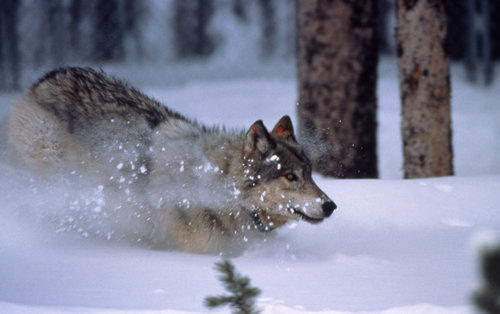
2008 was a tough year for Yellowstone's wolf population.
How healthy is Yellowstone National Park's wolf population? While wildlife biologists say the wolves overall are doing well and that the recovery program launched in 1995 has indeed succeeded, this past year was tough for the park's keystone predators.
Disease and infighting are being blamed for a drop of more than 25 percent in the numbers of wolves in Yellowstone. While the drop from 171 wolves in 2007 to 124 in 2008, or 27 percent, seems staggering, back in 2005 the numbers showed a slightly greater drop, from 171 wolves counted in 2004 to 118.
Plus, Yellowstone officials say last year's decline was the first drop in wolf numbers in the park in three years.
The greatest decline occurred on the northern range, the area with the greatest wolf population density. The wolf population there dropped 40 percent, from 94 to 56 wolves. The decline in the wolf population in the interior of the park was smaller. That population dipped from 77 to 68 animals, off 11 percent from the previous year.
The number of breeding pairs in the park also declined from 10 to six. This is the lowest number of breeding pairs recorded since 2000 when wolves first met the minimum population requirement for delisting.
Previous population declines in 1999 and 2005 were attributed to the impacts of disease, especially on wolf pups. This past year, distemper, mange, and wolves killing each other are the likely causes of the population decline.
Distemper is fairly common in wildlife and is believed to be the major contributor to the recent decline in the population of wolf pups in the park. The often fatal virus can be found in and readily transmitted between wolves and other animals such as coyotes, foxes, raccoons, and skunks.
Biologists will capture and sample wolves to confirm that distemper is indeed affecting wolves. In 1999 and 2005 distemper was found in both wolves and coyotes.
Mange is a parasitic infection of the skin. It can weaken the animal, making it susceptible to infections and other problems which can lead to death.
Finally, wolves often kill each other over competition for food or territory. Population density could contribute to an increase in wolf-on-wolf mortality.
Multi-year research projects are underway to help wildlife biologists better understand the impacts of disease and of animal social dynamics on wolf population changes.
Story Categories:
A copy of National Parks Traveler's financial statements may be obtained by sending a stamped, self-addressed envelope to: National Parks Traveler, P.O. Box 980452, Park City, Utah 84098. National Parks Traveler was formed in the state of Utah for the purpose of informing and educating about national parks and protected areas.
Residents of the following states may obtain a copy of our financial and additional information as stated below:
- Florida: A COPY OF THE OFFICIAL REGISTRATION AND FINANCIAL INFORMATION FOR NATIONAL PARKS TRAVELER, (REGISTRATION NO. CH 51659), MAY BE OBTAINED FROM THE DIVISION OF CONSUMER SERVICES BY CALLING 800-435-7352 OR VISITING THEIR WEBSITE. REGISTRATION DOES NOT IMPLY ENDORSEMENT, APPROVAL, OR RECOMMENDATION BY THE STATE.
- Georgia: A full and fair description of the programs and financial statement summary of National Parks Traveler is available upon request at the office and phone number indicated above.
- Maryland: Documents and information submitted under the Maryland Solicitations Act are also available, for the cost of postage and copies, from the Secretary of State, State House, Annapolis, MD 21401 (410-974-5534).
- North Carolina: Financial information about this organization and a copy of its license are available from the State Solicitation Licensing Branch at 888-830-4989 or 919-807-2214. The license is not an endorsement by the State.
- Pennsylvania: The official registration and financial information of National Parks Traveler may be obtained from the Pennsylvania Department of State by calling 800-732-0999. Registration does not imply endorsement.
- Virginia: Financial statements are available from the Virginia Department of Agriculture and Consumer Services, 102 Governor Street, Richmond, Virginia 23219.
- Washington: National Parks Traveler is registered with Washington State’s Charities Program as required by law and additional information is available by calling 800-332-4483 or visiting www.sos.wa.gov/charities, or on file at Charities Division, Office of the Secretary of State, State of Washington, Olympia, WA 98504.
INN Member

The easiest way to explore RV-friendly National Park campgrounds.

Here’s the definitive guide to National Park System campgrounds where RVers can park their rigs.
Our app is packed with RVing- specific details on more than 250 campgrounds in more than 70 national parks.
You’ll also find stories about RVing in the parks, tips helpful if you’ve just recently become an RVer, and useful planning suggestions.


Comments
Can't they inoculate the wolves against distemper as well as giving them rabies shots at the same time to control both diseases. This will give us a healthier population. Before anyone complains that we are messing with nature we already have that's why their populations are low in the first place. We exterminated them and then brought them back.
Of course they can't inoculate wolves against any disease. They are suppose to be wild animals. Nature will work out the survival issue. The strongest and those with a healthy immune system will survive, and their offspring will then inherit the strength of the parents. To immunize wolves would be declaring them 1) they are not a wild animal or 2) they are a non native species unable to survive without human intervention in the ecosystem to which they were transplanted.
are the wolves in yellowstone in and open or closed population?
what is there to do to help stop the decreasing of the wolf population? theres got to be way to help.
If the population was too high to support them, then a natural reduction is better than a planned hunt. It seems the mechanism to adjust population to the terriortory by natural means is in effect.
Many animals die from distemper. If you want a wild population that means you do not vaccinate.
Vaccination in human population areas by leaving out food with rabies vaccination is done to reduce rabies in rabbits, foxes and skunks to name a few and to reduce the possibilty of contamination into pets such as cats and dogs.
In a park are it is not ecofriendly to vaccinate wild animals.
Vaccinating wild animals in national parks is a controversial issue, to be sure. Wildlife biologists prefer to avoid vaccination where possible, but sometimes there's little choice, as when critically endangered populations are at imminent risk of catastrophe. One example that leaps to kind is the sylvatic plague threat to black-footed ferrets in and near Badlands National Park. Resorting to a vigorous campaign of insecticide spraying and vaccination was probably the only way to save this struggling population.
I would think the only justification for vaccinating a population of wild wolves would be the introduction of an alien disease into the ecosystem.
You mean like the State of Montana did with mange?
What is considered to be an optimal population density for wolves? Is that number the same as a naturally-occurring population density? Are there any reliable estimates for wolf population density before European settlement of North America?
Funny how I was reading this article and then received the following email from DOW:
https://secure.defenders.org/site/Donation?ACTION=SHOW_DONATION_OPTIONS&...
Strictly coincidence.
the way it sounds is that manly they are killing each other it is not our problem i mean we cant interfere it's there way of life i can understand why you are botherd but it is not our prblem people wake up and smell the coffee
This is our problem we need to get rid of the wolves they are out of control. The people that like them it's ok but they are becoming a huge problem. They need to go they're killing the elk and a lot of other animals. THEY NEED TO GO!!!
There are some wolfs getting out of the park and the people who live of the wiled the wolfs are killing there food we need to prevent this from doing this i agree with junior selby they NEED TO GO
No, we don't need to do anything about this. Drought, harsh winters, predation, and pressure from predators like wolves, and most CERTAINLY, high human harvest rates, lowered the elk population dramatically. The wolves in areas with lighter population densities were less affected, and that is as it should be. The severe reduction in wolves matches the severe reduction in elk. Nature has ALREADY fixed the problem, and all we need to do is stand back. Wolves are hardy animals, and we've already done what we needed to do--we put enough of them back for them to create a sustainable population. Now we have to leave them alone to find their balance, learn how to hunt bison and other animals in addition to elk, and populate the park more evenly. They're doing that. They do not need our help any longer, they only need our absence.
As for wolves killing livestock...buy a LGD, put up some speakers and play wolf howls, and use wolf urine to mark the outlines of your field. If that doesn't solve the problem, bean-bag shots will. Non-lethal predator training methods have proven time and again to work better than lethal methods, and they're especially effective on social species like wolves, where parents train offspring where and how to hunt for an extended period of time. Besides, ranchers who can prove a wolf kill are fully compensated for the loss of their livestock. What more do they want? They need to sit down and shut up. The ecosystem was being RUINED BY ELK. Now it isn't. That is all there is to it.