
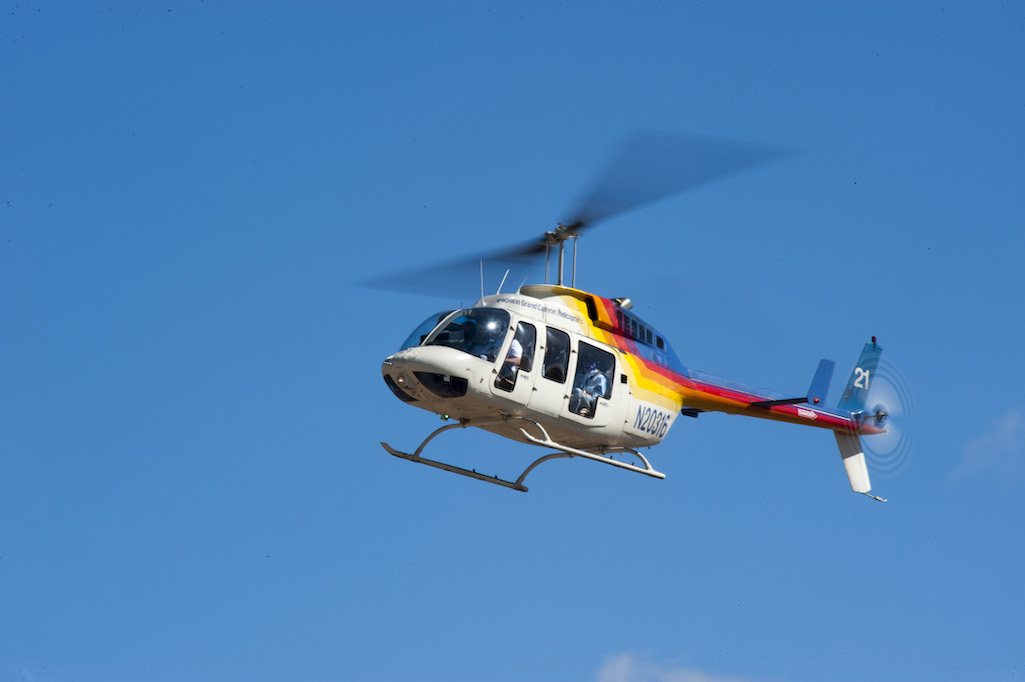
As the National Park Service and Federal Aviation Administration roll out air tour management plans for parks in the West, critics say the agencies failed to follow the National Environmental Policy Act by not conducting environmental studies in developing the plans. Park overflights can provide a unique perspective of viewing national parks, but should the Park Service be required to conduct environmental studies as called for under NEPA to help in designing air tour management plans?
For instance, in recently released plans for Bryce Canyon, Arches, and Canyonlands national parks in Utah, the plans:
- Don't seem to have considered a ban on air tours.
- Don't seem to include any sound measurements taken of air traffic noise at ground level in wilderness and non-wilderness areas of the park, levels that could be used to determine whether the aircraft currently are too loud, or to set base levels for aircraft noise.
- Don't require tour operators to have “quiet technology” installed on their aircraft, but allow those that have installed it to fly later in the day than those that haven't.
- Don't appear to have conducted visitor surveys to gauge public’s opinion of air tours and whether they benefit or detract from their park visit.
The Traveler has reached out to staff at the Utah parks to ask about those matters, but has yet to hear back. A request for Park Service Director Chuck Sams' view of the need for NEPA compliance has not solicited a reply.
Commercial air tours have occurred over national parks for many years without defined operating parameters. In producing these plans, National Park Service staff say they are designed to "protect national park resources and values by providing continued education and management oversight. "
However, outside groups such as Public Employees for Environmental Responsibility, have criticized the NPS and FAA for avoiding environmental reviews called for by NEPA in designing the management plans. According to PEER, the agencies are claiming "categorical exclusions" — claims that air tours won't have a significant impact on either the visitor experience or natural and cultural resources of a park — for bypassing the entire NEPA process.
It was 20 years ago that the National Park Air Tour Management Act of 2000 was implemented and required the FAA, in coordination with the NPS, to set limits on overflight numbers, timing, and routes to protect park resources and the visitor experience from noise and disruption in any park with more than 50 overflights a year.
An exception to the current approach parks are taking with developing these plans can be seen at Glacier National Park. Park staff there say the overflights harm the visitor experience. In its air tour management plan the park calls for all commercial air tours to be phased out by the end of 2029.
The preservation of natural sounds, protection of natural and cultural resources, wilderness character, and preserving visitor experience by addressing noise issues are priority NPS management objectives for the Park. The Park’s General Management Plan sets management direction to address commercial air tours by working with the FAA to phase out these tours. The ATMP accomplishes this goal first through attrition but, because corporations may exist indefinitely, sets December 31, 2029, thirty years after the Park’s General Management Plan was established, as a sunset date after which time no commercial air tours would be authorized over the Park or within ½ mile of its boundary. -- Glacier Air Tour Management Plan
According to the Glacier plan, "[A] major complaint that the NPS receives from visitors at the Park is the intrusion that overflights have on opportunities for solitude, hearing natural sounds, and views without aircraft within the Park."
Stories about:
Story Categories:
A copy of National Parks Traveler's financial statements may be obtained by sending a stamped, self-addressed envelope to: National Parks Traveler, P.O. Box 980452, Park City, Utah 84098. National Parks Traveler was formed in the state of Utah for the purpose of informing and educating about national parks and protected areas.
Residents of the following states may obtain a copy of our financial and additional information as stated below:
- Florida: A COPY OF THE OFFICIAL REGISTRATION AND FINANCIAL INFORMATION FOR NATIONAL PARKS TRAVELER, (REGISTRATION NO. CH 51659), MAY BE OBTAINED FROM THE DIVISION OF CONSUMER SERVICES BY CALLING 800-435-7352 OR VISITING THEIR WEBSITE. REGISTRATION DOES NOT IMPLY ENDORSEMENT, APPROVAL, OR RECOMMENDATION BY THE STATE.
- Georgia: A full and fair description of the programs and financial statement summary of National Parks Traveler is available upon request at the office and phone number indicated above.
- Maryland: Documents and information submitted under the Maryland Solicitations Act are also available, for the cost of postage and copies, from the Secretary of State, State House, Annapolis, MD 21401 (410-974-5534).
- North Carolina: Financial information about this organization and a copy of its license are available from the State Solicitation Licensing Branch at 888-830-4989 or 919-807-2214. The license is not an endorsement by the State.
- Pennsylvania: The official registration and financial information of National Parks Traveler may be obtained from the Pennsylvania Department of State by calling 800-732-0999. Registration does not imply endorsement.
- Virginia: Financial statements are available from the Virginia Department of Agriculture and Consumer Services, 102 Governor Street, Richmond, Virginia 23219.
- Washington: National Parks Traveler is registered with Washington State’s Charities Program as required by law and additional information is available by calling 800-332-4483 or visiting www.sos.wa.gov/charities, or on file at Charities Division, Office of the Secretary of State, State of Washington, Olympia, WA 98504.
INN Member

The easiest way to explore RV-friendly National Park campgrounds.

Here’s the definitive guide to National Park System campgrounds where RVers can park their rigs.
Our app is packed with RVing- specific details on more than 250 campgrounds in more than 70 national parks.
You’ll also find stories about RVing in the parks, tips helpful if you’ve just recently become an RVer, and useful planning suggestions.


Comments
Good on Glacier.
Air tours should not be allowed in National Parks. The Park's management plans state that "soundscapes" and wilderness values will be monitored and protected. Air tours are in direct conflict with management objectives. Parks are drowning in overuse. Visitor carrying capacity should be established and managed. Air tours will allow the privileged few with money to ruin the experience of the many visitors on the ground , not to mention impacts to wildlife and cultural resources.
Air tours are a Selfish way to experience a park. wrecking a peaceful happening for both animal park inhabitants and ground-bound humans. Dominating natural spaces should not be a right for the dollar-heavy few. Even if the air tours were economically priced they would still be a noise polluting contradiction to the preservation of natural beauty which the parks endeavor to preserve. If parks think they can reduce their excessive foot traffic by throwing people up in the air instead... no. Limit the number of visitors per day. Have out-of-park boundaries parking lots. Have people bicycle into entry points. Encourage exercise. Run electric bikes/shuttles on hot days.
We have sea planes running over the full length of our town for months at a time. They are disgustingily loud. I would never wish this on our parks. Please find another way to make money
Air tours in direct conflict with the mission of the NPS. Our National Parks are not consumables to be endlessly extracted from for entertainment. Most parks offer large swaths of wilderness areas where noise even from commercial flights is already an issue. The NPS's willingness to consistently bend for businesses inspite of their duty to protect these lands and disappointing at best.
So good on Glacier, but these plans are only as good as the superintendent of the day