
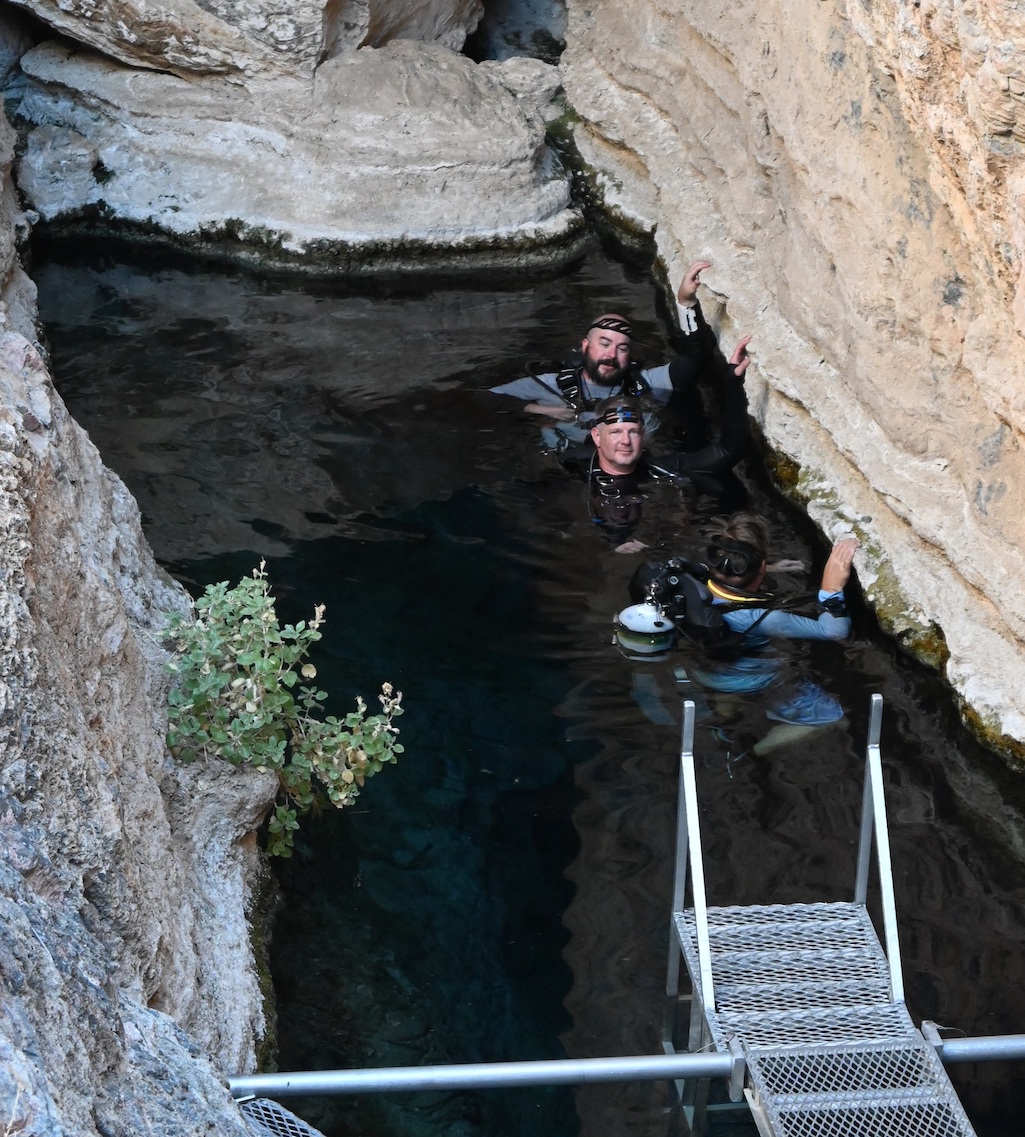
One of the most endangered fish species on the planet, one that calls a tiny water-filled cave home, has undergone a population boom. National Park Service biologists recently surveyed the Devils Hole pupfish colony at Death Valley National Park, and counted 263 individuals, the greatest number recorded in 19 years.
This count came on the heels of a magnitude 7.6 earthquake in Mexico that caused 4-foot waves in Devils Hole on September 19. Pupfish are counted using both scuba and surface visual counters. Sloshing waves removed algae, invertebrates, and other organic matter from a shallow shelf that pupfish use to forage and spawn. This made it easier for biologists to see and count pupfish from the surface. Scientists using scuba also counted pupfish at greater depths.
Devils Hole pupfish (Cyprinodon diabolis) live in the upper 80 feet of a deep water-filled cavern and sun-lit shallow shelf at the cavern’s entrance, making this the smallest range of any vertebrate species on the planet, according to the Park Service. Devils Hole is a detached unit of Death Valley National Park adjacent to Ash Meadows National Wildlife Refuge in Nye County, Nevada. U.S. Fish and Wildlife Service, Nevada Department of Wildlife, and National Park Service staff cooperate to manage this critically endangered species.
Population size is estimated by counting fish throughout its habitat, with standard counting protocols. Scientists scuba dive to count fish in the cavern, starting at depths below 100 feet. Simultaneously, other scientists count fish on the shallow shelf at the waters’ surface. The final count includes both surface and underwater fish. The official result, 263 observable pupfish, is the highest autumn count recorded since September 2003.

Before the 1990s, the population was around 400-500 pupfish in the fall. However, pupfish numbers have been especially low during the last two decades, averaging only 90 fish.
A return to higher numbers of pupfish this time of year could signal important changes in the ecosystem. Kevin Wilson, aquatic ecologist for Death Valley National Park, manages resources of Devils Hole, and says “recent high spring and fall counts show the importance of maintaining long-term data as we work to find out what’s changed.”
Brandon Senger, supervising fisheries biologist for the Nevada Department of Wildlife, has been conducting scuba -counts at Devils Hole since 2014 and noted, "I have never seen the population this robust before. Fish of all size-classes were abundant. We SCUBA-counted more fish on one level than we have in total in previous counts."
Other biologists on-site noted fish appeared in remarkable condition and were very active. Many courting and spawning pairs of pupfish were seen during the count. Jennifer Gumm, who manages the Ash Meadows Fish Conservation Facility for the U.S. Fish and Wildlife Service said “earthquake-induced spawning is a fascinating aspect of the behavior of this species.”
Having more pupfish in Devils Hole also affects the direction and focus of species recovery. This week’s count continues an overall fall increase over the last nine years from the all-time low of 35 fish.
Michael Schwemm, senior fish biologist for the U.S. Fish and Wildlife Service, said “it’s exciting to see the numbers gradually increasing over recent years. The ongoing trend, especial in this highly variable population, makes clear that habitat conditions have changed in a good way since the lowest counts, and we’re excited about the future directions for research and recovery.”
The next pupfish count occurs in spring 2023.
Stories about:
Story Categories:
A copy of National Parks Traveler's financial statements may be obtained by sending a stamped, self-addressed envelope to: National Parks Traveler, P.O. Box 980452, Park City, Utah 84098. National Parks Traveler was formed in the state of Utah for the purpose of informing and educating about national parks and protected areas.
Residents of the following states may obtain a copy of our financial and additional information as stated below:
- Florida: A COPY OF THE OFFICIAL REGISTRATION AND FINANCIAL INFORMATION FOR NATIONAL PARKS TRAVELER, (REGISTRATION NO. CH 51659), MAY BE OBTAINED FROM THE DIVISION OF CONSUMER SERVICES BY CALLING 800-435-7352 OR VISITING THEIR WEBSITE. REGISTRATION DOES NOT IMPLY ENDORSEMENT, APPROVAL, OR RECOMMENDATION BY THE STATE.
- Georgia: A full and fair description of the programs and financial statement summary of National Parks Traveler is available upon request at the office and phone number indicated above.
- Maryland: Documents and information submitted under the Maryland Solicitations Act are also available, for the cost of postage and copies, from the Secretary of State, State House, Annapolis, MD 21401 (410-974-5534).
- North Carolina: Financial information about this organization and a copy of its license are available from the State Solicitation Licensing Branch at 888-830-4989 or 919-807-2214. The license is not an endorsement by the State.
- Pennsylvania: The official registration and financial information of National Parks Traveler may be obtained from the Pennsylvania Department of State by calling 800-732-0999. Registration does not imply endorsement.
- Virginia: Financial statements are available from the Virginia Department of Agriculture and Consumer Services, 102 Governor Street, Richmond, Virginia 23219.
- Washington: National Parks Traveler is registered with Washington State’s Charities Program as required by law and additional information is available by calling 800-332-4483 or visiting www.sos.wa.gov/charities, or on file at Charities Division, Office of the Secretary of State, State of Washington, Olympia, WA 98504.


National parks and their natural resources belong to you. The National Parks Traveler works to ensure you know how these essential places are being cared for.
Sign Up For Our Weekly Newsletter
Unsubscribe at any time.
INN Member

The easiest way to explore RV-friendly National Park campgrounds.

Here’s the definitive guide to National Park System campgrounds where RVers can park their rigs.
Our app is packed with RVing- specific details on more than 250 campgrounds in more than 70 national parks.
You’ll also find stories about RVing in the parks, tips helpful if you’ve just recently become an RVer, and useful planning suggestions.


Comments
.Good News !!!
If I read this correctly, the population count increased because the water was made more clear by the September 19 earthquake. This is not the same as indicating an actual increase in the number of fish. Also, the fish were observed as more active, which could make counting them more difficult. And there hasn't been enough time since the September 19 earthquake for "earthquake induced spawning" to influence the count. No other reason was given for the actual fish population to increase. Is this science or wishful thinking?
Rob, here's a more thorough explanation from Kevin P. Wilson, Ph.D., the park's aquatic ecologist:
"The water in Devils Hole is crystal clear due to the fact it is groundwater. The water-filled cavern is of unknown depth, though divers have been to 436 feet. The earthquake did enhance visibility on the shallow shelf where surface counts take place by removing organic matter. This organic matter (algae, invertebrates, detritus) was deposited on a lower 15-foot shelf. The fish on the shelf were more active due to the removal of the organic matter. No place to stop and feel comfortable. The percentage of the number of fish observed on the shelf of the total count (+SCUBA) was similar to previous counts. A majority of the fish were counted via SCUBA, which is typical. Our count protocol has been in place for 50 years. The reader is correct that earthquake induced spawning did not influence the count. It is difficult to provide cause and effect in Press Releases due to space constraints. There isn't a smoking gun that explains the increase in pupfish this year. Food availability, disturbance frequency, a spring count closer to historical spring numbers providing more fish to contribute to recruitment if autumn, plus several other explanations can influence the pupfish population. This is science and not wishful thinking. As mentioned earlier the managing agencies have been using the same visual surveys to estimate the pupfish population for 50 years. The NPS initiated a Long Term Ecosystem Monitoring Program in 2011 and has been collecting other types of data for over half a century."
Thank you Kurt and Kevin for the more detailed explanation. Counting all those moving fish must be quite a challenge. It is good to see that higher temperatures have not reduced the population, but one might expect global warming to be a future stress on the fish, just as it is for most everything else.