
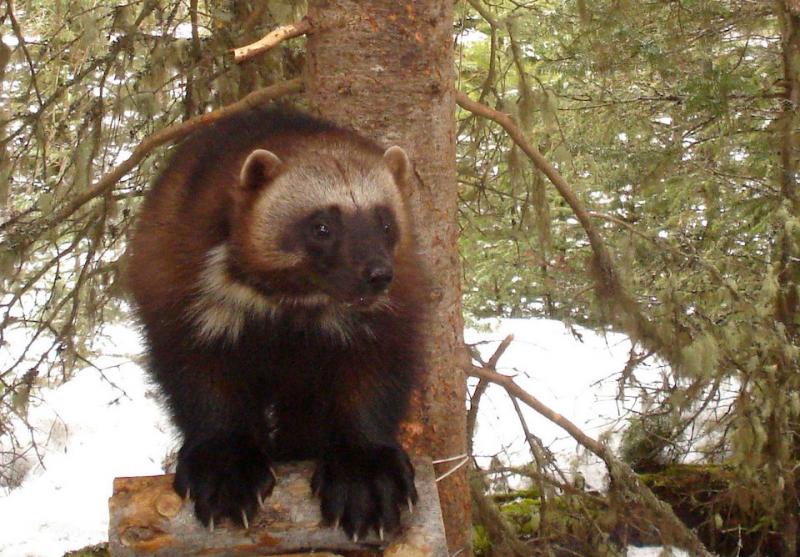
A lawsuit was filed Monday to force the U.S. Fish and Wildlife Service to protect wolverines with a listing under the Endangered Species Act, a move the agency rejected in October based on its conclusion that the fierce carnivores were doing fine, population-wise.
“This is yet another chapter in this administration’s war on science,” said Matthew Bishop, an attorney with the Western Environmental Law Center. “Public records reveal the Service decided not to protect wolverine from day one and then worked backwards to figure out how to make the decision stick. It’s really unfortunate.”
Bringing the lawsuit were the Center for Biological Diversity, Conservation Northwest, Defenders of Wildlife, Friends of the Clearwater, Idaho Conservation League, Jackson Hole Conservation Alliance, Klamath-Siskiyou Wildlands Center, Greater Yellowstone Coalition, Sierra Club and Rocky Mountain Wild.
Part of the Fish and Wildlife Service's decision in October was based on a 2018 "Species Status Assessment," which noted that "wolverine appears resilient within its contiguous United States range." The assessment pegged the wolverine population in the country at 318, with potential habitat to support 644 individuals. Canada, meanwhile, claims thousands of wolverines, according to the assessment.
But those challenging the agency's decision maintain that there are fewer than 300 wolverines left in the contiguous United States, and they say that listing wolverines as threatened or endangered would trigger new, badly needed conservation efforts.
“For more than 25 years, the government has stonewalled federal protection for wolverine,” Dave Werntz, science and conservation director at Conservation Northwest said Monday. “It is time to stop playing games, follow the science, and work together to counter threats to wolverine survival.”
“For years scientists have been sounding the alarm on how wolverines are severely affected by climate change,” added Andrea Zaccardi, a senior attorney at the Center for Biological Diversity. “The future of the wolverine in the lower 48 now stands on a knife edge thanks to the Fish and Wildlife Service refusing to do its job. We hope this lawsuit finally puts the species on the road to recovery.”
Wolverines, the largest land-dwelling members of the weasel family, once roamed across the northern tier of the United States and as far south as New Mexico in the Rockies and Southern California in the Sierra Nevada range. After more than a century of trapping and habitat loss, wolverines in the lower 48 today exist only as small, fragmented populations in Idaho, Montana, Washington, Wyoming and northeast Oregon.
In the wolverine’s last strongholds, the species is at direct risk from climate change. Wolverines depend on areas with deep snow through late spring. Pregnant females dig their dens into this snowpack to birth and raise their young. Snowpack is already in decline in the Western mountains, a trend that is predicted to worsen with a warming climate.
Wolverine populations are also at risk from traps, human disturbance, habitat fragmentation and extremely low population numbers resulting in low genetic diversity.
Wolverines have been spotted in Denali National Park, Yosemite National Park, Yellowstone National Park, Mount Rainier National Park, Grand Teton National Park, Glacier National Park, and North Cascades National Park, among others. It's difficult to say just how many wolverines are wandering around the parks. Their extensive travels, sneaky scavenger-like maneuvering, and solo dwelling make it difficult for researchers to closely monitor their patterns.
The 2018 assessment Fish and Wildlife based its decision on presented a rosy picture of wolverine populations, stating that "wolverines occupy areas in the west-northwestern United States, and have recently dispersed into historically occupied areas, including California, Utah, Colorado, and Oregon; verified reproducing wolverine populations are found in Idaho, Washington (Northern Cascades), Montana, and northwest Wyoming. One individual wolverine (female) was also documented from 2004 until its death in 2010 in Michigan."
In April 2016, U.S. District Judge Dana Christensen held that the wildlife agency erred when it decided in 2014 to reverse course and not bestow the designation. In his ruling, the judge cited the agency's decision not to fully considering climate-change impacts and genetic isolation when it decided wolverines did not need ESA protection. Judge Christensen agreed with conservation groups and individuals that "the Service ignored the best available science by demanding better science" when it came to climate change and the impact warmer winters would have on the species.
“This is something we were really hoping to avoid after the court’s 2016 decision,” WELC's Bishop said of the court filing. “I was cautiously optimistic the Service would get it right this time and we’d be focusing our time and energy on developing a conservation strategy, recovery plan, critical habitat, and possibly reintroduction efforts for wolverine. Instead, we’re back in court challenging an agency that continues to put politics over science.”
Story Categories:
A copy of National Parks Traveler's financial statements may be obtained by sending a stamped, self-addressed envelope to: National Parks Traveler, P.O. Box 980452, Park City, Utah 84098. National Parks Traveler was formed in the state of Utah for the purpose of informing and educating about national parks and protected areas.
Residents of the following states may obtain a copy of our financial and additional information as stated below:
- Florida: A COPY OF THE OFFICIAL REGISTRATION AND FINANCIAL INFORMATION FOR NATIONAL PARKS TRAVELER, (REGISTRATION NO. CH 51659), MAY BE OBTAINED FROM THE DIVISION OF CONSUMER SERVICES BY CALLING 800-435-7352 OR VISITING THEIR WEBSITE. REGISTRATION DOES NOT IMPLY ENDORSEMENT, APPROVAL, OR RECOMMENDATION BY THE STATE.
- Georgia: A full and fair description of the programs and financial statement summary of National Parks Traveler is available upon request at the office and phone number indicated above.
- Maryland: Documents and information submitted under the Maryland Solicitations Act are also available, for the cost of postage and copies, from the Secretary of State, State House, Annapolis, MD 21401 (410-974-5534).
- North Carolina: Financial information about this organization and a copy of its license are available from the State Solicitation Licensing Branch at 888-830-4989 or 919-807-2214. The license is not an endorsement by the State.
- Pennsylvania: The official registration and financial information of National Parks Traveler may be obtained from the Pennsylvania Department of State by calling 800-732-0999. Registration does not imply endorsement.
- Virginia: Financial statements are available from the Virginia Department of Agriculture and Consumer Services, 102 Governor Street, Richmond, Virginia 23219.
- Washington: National Parks Traveler is registered with Washington State’s Charities Program as required by law and additional information is available by calling 800-332-4483 or visiting www.sos.wa.gov/charities, or on file at Charities Division, Office of the Secretary of State, State of Washington, Olympia, WA 98504.
INN Member

The easiest way to explore RV-friendly National Park campgrounds.

Here’s the definitive guide to National Park System campgrounds where RVers can park their rigs.
Our app is packed with RVing- specific details on more than 250 campgrounds in more than 70 national parks.
You’ll also find stories about RVing in the parks, tips helpful if you’ve just recently become an RVer, and useful planning suggestions.


Comments
We as humans must strike a balance with nature. There are areas to develop, conserve, protect, etc. Yellowstone, other parks are beautiful because they are over the horizon, human development is limited. We must strike a balance with the wolverines and other critters out there. The earth belongs to them too. There are areas that must stay wild and a mystery to all humankind. Good luck!
Funny I've never seen an article on Politics behind LISTING an animal. I guess conservationists are all as pure as the driven snow.
There has never been a species listed without being in dire need, if that's what you're asking. By contrast, the number of species gone extinct while waiting for ESA protection is in the hundreds.
No, T Burt, it's just that, by contrast, none of us are total monsters.
The USFWS needs to be disbanded. They are nothing but mindless, brainless, ignorant, nonscientific killers. There is nothing good about that "organization"!!!!!! Let me know when I can get involved in that. We need a petition for another judge!
I would not label all of USFWS as mindless, nonscientific killers. I have never worked with that agency but as someone who spent over 30 years as a career civil servent in the Federal government i can tell you the vast majority of career employees are very dedicated to the mission of their agencies and frequently rank as some of the best scientists in the US. However, the very top of federl agencies are run by political employees. Most of the time the career folks manage to find ways to work with the political appointees and still focus on their missions. But there is only so much they can do. Take Anthony Fauci, for example. He is a career civil servent and a renound sceintist but you saw how Trump and his minions treated him--and ignored his advice. Similar actions by this Administrations have taken place in countless other federal agencies that are charged with scientificly regulating a vast variey of issues and products.
As soon as thei Administration leaves we need to replace the political appointees with Biden's own people AND give these agencies the necessary resources and training to do their jobs. it is going to be a long, hard road to correct all the damage the Administration has done but we have no other choice.
I have always felt a deep sense of respect and sadness
for our wildlife. Respect for their inate abilities to survive in the most hostile weather and sadness at the thought that by our self indulging nature we could drive so many into extinction.
So much of our wild places are gone and now with increasingly loathsome and willful ignorance our government agencies tasked with preserving our natural resources and wildlife are abandoning their responsibility to this and future generations.
For there is no sense of fascination or wonder in watching a dollar bill or sadness at the loss of one . The government can always just print another identical one.So where is our heart, our soul if not in those wild places and creatures so irreplaceable.
Biden must drain the swamp of all the Trump stooges and lackeys in key positions. The Fish and Wildlife Service is a good place to begin.