
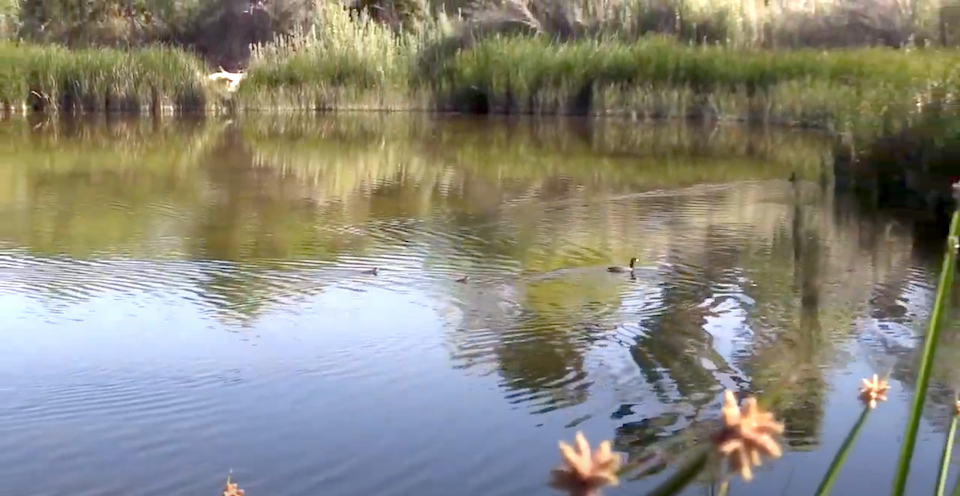
A group of ecologists say construction of the border wall through Organ Pipe Cactus National Monument has caused nearly 50 species of birds to abandon Quitobaquito Springs, a vital resting place for wildlife/Patrick Cone file
Nearly 50 bird species have been absent from Quitobaquito Springs in Organ Pipe Cactus National Monument in southern Arizona since the U.S. Army Corps of Engineers began building a wall in a bid to thwart cross-border crossings, according to ecologists.
“We have seen a drastic reduction in use by waterfowl, wading birds, hummingbirds, hawks, and songbirds that rely on riparian trees, including cottonwoods and willows, for roosting and nesting habitat, or that rely on insects in or above open water and surrounding vegetation for food," said Dr. R. Roy Johnson, the dean of riparian ecologists in the Southwest, a University of Arizona affiliate, and retired research director for the National Park Service.
"Many of these are migrants that rely on Quitobaquito as one of the few well-watered stopovers in the borderlands. Remove one more stopover in the entire migratory corridor across the vast Sonoran Desert, and you break a link that may have kept the whole migratory chain functioning," he added Tuesday in a release. "The next stopover habitat in this arid region may be dozens of miles or farther away, causing exhaustion, starvation, dehydration, or even death, in migrating birds.”
According to the ecologists, 47 species seen between January 2016 and August 2019 have not been observed again at the oasis since the September 2019 initiation of border wall work that has come within 120 feet of the oasis. Two-hundred-thirty-five species of birds have been recorded at Quitobaquito over the last 80 years, making it the richest site for bird diversity in the entire Sonoran Desert network of National Parks and Monuments, they said.
The data analyzed comes from a half-dozen research surveys of Quitobaquito oasis undertaken by professional wildlife biologists working for the National Park Service and other agencies, and from vetted data provided by both ornithologists and expert bird-watchers involved in Audubon Christmas Counts and Ebird postings managed by the Cornell Lab of Ornithology.
Among the species that seems to have abandoned the Quitobaquito area is the Willow Flycatcher, an endangered species, they said.
This finding from ecologists and ornithologists suggests that a quarter of the riparian and wetland birds have temporarily or permanently fled as their habitats have been degraded, or depleted by the construction, according to Dr. Gary Paul Nabhan, a University of Arizona research scientist who has studied the biodiversity of the Quitobaquito oasis since the 1980s.
“Desert oases like Quitobaquito in Organ Pipe, Hunter Hole on the Colorado River and the cienega wetlands at San Bernardino National Wildlife Refuge are suffering from the negative effects associated with construction of the border wall," said Nabhan. "Additional riparian habitats close to the border along the Rio Grande, San Pedro, Santa Cruz and Colorado rivers will soon be affected by the wall construction as well. These activities are adding to the many stresses already affecting these oases, pushing their imperiled wildlife over the tipping point.”
Earlier this summer a group of 25 scientists wrote the U.S. Army Corps of Engineers to express their concerns that the use of groundwater for the construction had nearly drained the pond at Quitobaquito. The loss of water led to a loss of migratory waterfowl and wading birds, they said, and the rivulets that come down the hillsides to feed the pond were vanishing.
While Nabhan said now that the water levels are rising in the pond, he pointed out that "only two cottonwoods of any stature remain on the pond edge and the few willows remaining all show signs of drought stress and impending death. These two riparian tree species have been historically important in luring and sheltering dozens of bird species."
Jonathan Lutz, executive director of Tucson Audubon, said all the activity associated with the border wall's construction poses threats to wildlife that normally use the area.
“Birds and wildlife do not recognize political borders - and can often be casualties to decisions made without their needs in mind," said Lutz. "The growing border wall on the US-Mexico has proved to be just such a threat. Construction activities, bright lighting, large barren stretches of land, and many other aspects of the border wall, are direct threats to the migratory birds and resident birds of Southern Arizona. The waivers that allow these activities to occur with no environmental review must be overturned and border wall construction halted.”
Stories about:
Story Categories:
A copy of National Parks Traveler's financial statements may be obtained by sending a stamped, self-addressed envelope to: National Parks Traveler, P.O. Box 980452, Park City, Utah 84098. National Parks Traveler was formed in the state of Utah for the purpose of informing and educating about national parks and protected areas.
Residents of the following states may obtain a copy of our financial and additional information as stated below:
- Florida: A COPY OF THE OFFICIAL REGISTRATION AND FINANCIAL INFORMATION FOR NATIONAL PARKS TRAVELER, (REGISTRATION NO. CH 51659), MAY BE OBTAINED FROM THE DIVISION OF CONSUMER SERVICES BY CALLING 800-435-7352 OR VISITING THEIR WEBSITE. REGISTRATION DOES NOT IMPLY ENDORSEMENT, APPROVAL, OR RECOMMENDATION BY THE STATE.
- Georgia: A full and fair description of the programs and financial statement summary of National Parks Traveler is available upon request at the office and phone number indicated above.
- Maryland: Documents and information submitted under the Maryland Solicitations Act are also available, for the cost of postage and copies, from the Secretary of State, State House, Annapolis, MD 21401 (410-974-5534).
- North Carolina: Financial information about this organization and a copy of its license are available from the State Solicitation Licensing Branch at 888-830-4989 or 919-807-2214. The license is not an endorsement by the State.
- Pennsylvania: The official registration and financial information of National Parks Traveler may be obtained from the Pennsylvania Department of State by calling 800-732-0999. Registration does not imply endorsement.
- Virginia: Financial statements are available from the Virginia Department of Agriculture and Consumer Services, 102 Governor Street, Richmond, Virginia 23219.
- Washington: National Parks Traveler is registered with Washington State’s Charities Program as required by law and additional information is available by calling 800-332-4483 or visiting www.sos.wa.gov/charities, or on file at Charities Division, Office of the Secretary of State, State of Washington, Olympia, WA 98504.


National parks and their natural resources belong to you. The National Parks Traveler works to ensure you know how these essential places are being cared for.
Sign Up For Our Weekly Newsletter
Unsubscribe at any time.
INN Member

The easiest way to explore RV-friendly National Park campgrounds.

Here’s the definitive guide to National Park System campgrounds where RVers can park their rigs.
Our app is packed with RVing- specific details on more than 250 campgrounds in more than 70 national parks.
You’ll also find stories about RVing in the parks, tips helpful if you’ve just recently become an RVer, and useful planning suggestions.


Comments
So, let me get this straight. Am I correct in my understanding that the Trump Administration and its republican backers and protectors waived environmental reviews, violating established environmental laws, so they could construct a racist border wall to meet the personal demands of a known criminal who has repeatedly proven himself to also be a complete idiot "within 120 feet" of the ecologically critical Quitobaquito Springs in Organ Pipe Cactus National Monument? Over two dozen qualified scientists have stepped forward to warn that the use and depletion of groundwater for construction of this wall was draining the pond and deteriorating riparian areas at Quitobaquito? But, the Trump Administration and its republican backers and protectors persisted in violating established environmental laws in order to continue constructing this racist border wall to meet the personal demands of a known criminal who has repeatedly proven himself to also be a complete idiot? Is it true that these same two dozen qualified scientists have attested that this illegal diversion of groundwater and the resulting loss of surface water has led to a loss of legally protected migratory waterfowl and wading birds? Although mature riparian trees are critical to what was once a thriving community of legally protected migratory birds that were formerly dependent on Quitobaquito and although some surface water is only just now returning to the pond, "only two" mature cottonwoods still survive? The few willows remaining, willows that were once part of thickets previously inhabited by endangered Southwest Willow Flycatchers, now show signs of drought stress and impending death? With the loss of "rivulets" from surrounding hillsides, the riparian vegetation around the area is vanishing? Am I getting this correctly? Is it true that this is the reported result of half a dozen research surveys of Quitobaquito done by professional wildlife biologists working for the National Park Service and other agencies and confirmed by ornithologists and the famed Cornell Lab of Ornithology?
If I have even half of this straight, at least a dozen state and federal laws and regulations have been and are being violated here; but, since the republican party is now in lockstep protecting and defending the Trump Administration and its autocratic leader, a known criminal who has already repeatedly proven himself to also be a complete idiot, and since this idiotic autocrat has handpicked his own outrageously corrupt Attorney General, his very own Roy Cohn, none of these state and federal laws and regulations that have been and are being openly and egregiously violated are being or will be enforced?
Correct me if I misstate; but, the destructively illegal actions associated with this racist border wall, at Quitobaquito Springs and other places, are not the first nor the only episodes of baldfaced lawlessness on the part of the Trump Administration and its republican backers and protectors. They’ve ignored the Hatch Act, actually on multiple occasions; rhetorically spit on the United States Congress and its subpoenas, again on multiple occasions; scoffed at prohibitions against Conflicts of Interest, both domestically and internationally; and sneered at the emoluments clause, to the tune of millions of dollars in illegal payoffs, money laundering, and outright bribes.
But, more important, this veritable flood of lawlessness hasn't really been random, casual, accidental, or just some byproduct of urgency in governance. No, no, no, this flood of lawlessness has been planned and deliberate. The intent of this administration has clearly been to undermine the rule of law across the board, to normalize lawlessness when it's perpetrated by their cronies or on their behalf, and to establish the precedent that they and, most important, their autocratic leader are above the law, as well as the sole arbiters of what constitutes the law.
So, where do I think they’re going with all this overt lawlessness? Well, if I have the facts straight, I need to offer a cautionary tale. Over the past few years, the republicans’ dear autocratic leader has displayed his tendency toward “tells” as they call them in poker. Unable to maintain a “poker face” or control what he says in his frequent frantic fits of self-congratulation, he reveals what he is thinking and then tries to recover by pretending his “tell” was simply sarcasm or an attempt at some kind of low populist humor. In an ecstatic moment during the recent republican convention, the dear autocratic leader tried to morph a chant of “four more years” into a chant of “twelve more years” in yet another call for lawlessness; this time to extend his terms in office past the currently legal two terms and out to sixteen years in total.
Was that just another childish attempt at low populist humor or perhaps just a jab at the last president to stay in office, then legally, for four consecutive terms, Franklin Roosevelt? Probably; but, given the high stakes, I think it might be good to look at another national leader who also disingenuously used low populist themes and also made a habit of blaming and punishing scapegoats for his own mistakes and misdeeds, as well as his followers’ economic and personal hardships. This other national leader also demanded total personal loyalty from his underlings and also tended to advocate locking up his opponents or worse. When this other national leader’s rise to power finally faltered after thirteen memorable years, his fanatical followers continued, for years, to lament how he could have succeeded, if he had only been given a few more years. In their minds, maybe sixteen years would have changed everything and given them total victory.
When he started, this other national leader was also just a minor player with a criminal background and an airplane that he liked to use to endlessly travel from one raucous rally to another. But, within a couple of years, he also had come out of nowhere to become a major national figure. Still, even with his party’s unwavering backing and leverage, he couldn’t quite gain complete control of his country's duly elected government. So, at his rallies, he also continued to fan fears of an imminent leftist disruption of the government and when his country’s capital building mysteriously burned in the middle of the night, he seized that opportunity and used the crisis to get an immediate state of emergency invoked, suspending civil rights, allowing detention without trial, and delegating, to himself personally, complete authority to protect public safety and maintain order in any manner he saw fit. He also claimed only he could fix it. He kept this state of emergency in effect and ruled under it, alongside the other leaders of his party, for almost six months. And, all of this happened in only his first few years as a national leader.
But, after six months or so, he accused his party rivals of treason, ousted many, had most of the rest dispatched in a single night, and took total control of his party’s private armed militia units. Often wearing unmarked uniforms, these militia units assumed control of the officially authorized police and military units and placed them under party command and control hierarchies. Hostility toward immigrants and other races, ethnicities, and religions were always central themes in his thinking, his party, and his rallies and this hostility intensified over the second four years he was in power. Barely over four years after dispatching his party rivals, his party militia units began ransacking the homes and businesses of immigrants and people with diverse backgrounds; moving those former home and business owners into controlled central locations; and using the proceeds of their confiscated property to fund the development of his national military capabilities. That was in his second four years as a national leader and this is a true and accurate story.
I think we have a problem.
Yes you do Humph.
Thankfully, future Trump is a problem we can fix this November, Humphrey. But for Organ Pipe Cactus National Monument, it is probably already too late. Even though Biden would halt further construction of the wall, there's no reason to believe he would dismantle what's already been put up (let alone do so unilaterally, like Trump did when he ordered the construction) - and at Organ Pipe, if I've heard and understood correctly, the wall is mere months from completion. When was the last time a major public works project in this country was ever dismantled, let alone for environmental reasons? At Organ Pipe, I'm afraid, we've lost. Our last and only real chance was at the Supreme Court last summer, but then Trump's majority (thanks to Kavanaugh and Gorsuch, their ways having been paved by Mitch McConnell since Obama's last year) ruled against us. Sigh.
Yes, we all do, Hump. The selfish minority who are cheered by these travesties some day will reflect back and have a massive come to jesus discussion with themselves. "WTF was I thinking?"