
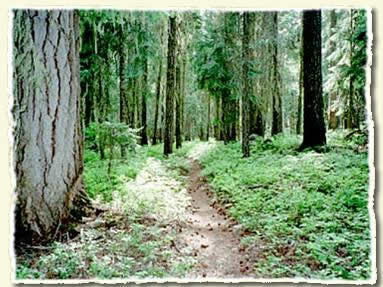
Mountain bikers have been poaching sections of the Pacific Crest Trail in California. USFS photo.
The Pacific Crest Trail ranges from Canada to Mexico, running through Washington, Oregon, and California along the way, traversing not one but seven units of the National Park System in the process.
On its way north and south portions of the trail touch or run through parts of Yosemite National Park, Sequoia National Park, Devils Postpile National Monument, Crater Lake National Park, Mount Rainier National Park, Lassen Volcanic National Park, and North Cascades National Park.
While mountain bikers are not supposed to use the Pacific Crest Trail, recently some have been poaching sections in California. While the poaching did not occur in any national park sections, some have concerns that a rule currently pending in the Interior Department could open more national park trails to mountain bikes and, in the process, lead to the following scenario.
In its February issue, the PCT Communicator, the magazine of the Pacific Crest Trail Association, reported on trail damage committed by mountain bikes near the Parks Creek Trailhead in the Shasta-Trinity National Forest in California.
From Big Bear to the Tehachapi Mountains in southern California, to Donner Summit and the Sierra Buttes north of Lake Tahoe, to Castle Crags and beyond, mountain bikes on the trail are causing damage and creating a number of "PCT Places in Need."
According to the trail association, "under U.S. Government regulation, bikes are prohibited in the PCT. The rationale for the prohibition of bicycles is based on the "nature and purpose" of the PCT, as dictated by the intent of Congress with the National Trails System Act and subsequent regulations designed to protect the experience of the primary users. The Code of Federal Regulations (36 CRF 212) directs that "The Pacific Crest National Scenic Trail as defined by the National Trails Systems Act, 82 Stat. 919, shall be administered primarily as a footpath and horseback riding trail."
"Unfortunately, however, U.S. regulations and regulators have not, thus far, been able to fully curb the illegal use of the PCT by mountain bikers," adds the article. "The resulting trail damage and user conflicts can't be taken lightly. To complicate matters, bikes are permitted on many trails that lead to the PCT, resulting in bikers reaching the PCT on such trails and then proceeding along the PCT to pick up another feeder trail. Given land management agency staffing and budget issues, policing and enforcement is sorely lacking."
The article goes on to point out the problems associated with mountain bikes on the Pacific Crest Trail: the trail was not engineered to handle mountain bike traffic, it can be easily and quickly ripped up by bikes riding in wet and muddy conditions, erosion problems can arise.
"I can't stress enough the importance of responsible trail users reporting illegal uses of the PCT," says Ian Nelson, the trail association's regional representative for northern California and southern Oregon. "It is crucial that we hear from concerned users so that we and our agency partners can strategize as to how to curb the illegal use."
Story Categories:
A copy of National Parks Traveler's financial statements may be obtained by sending a stamped, self-addressed envelope to: National Parks Traveler, P.O. Box 980452, Park City, Utah 84098. National Parks Traveler was formed in the state of Utah for the purpose of informing and educating about national parks and protected areas.
Residents of the following states may obtain a copy of our financial and additional information as stated below:
- Florida: A COPY OF THE OFFICIAL REGISTRATION AND FINANCIAL INFORMATION FOR NATIONAL PARKS TRAVELER, (REGISTRATION NO. CH 51659), MAY BE OBTAINED FROM THE DIVISION OF CONSUMER SERVICES BY CALLING 800-435-7352 OR VISITING THEIR WEBSITE. REGISTRATION DOES NOT IMPLY ENDORSEMENT, APPROVAL, OR RECOMMENDATION BY THE STATE.
- Georgia: A full and fair description of the programs and financial statement summary of National Parks Traveler is available upon request at the office and phone number indicated above.
- Maryland: Documents and information submitted under the Maryland Solicitations Act are also available, for the cost of postage and copies, from the Secretary of State, State House, Annapolis, MD 21401 (410-974-5534).
- North Carolina: Financial information about this organization and a copy of its license are available from the State Solicitation Licensing Branch at 888-830-4989 or 919-807-2214. The license is not an endorsement by the State.
- Pennsylvania: The official registration and financial information of National Parks Traveler may be obtained from the Pennsylvania Department of State by calling 800-732-0999. Registration does not imply endorsement.
- Virginia: Financial statements are available from the Virginia Department of Agriculture and Consumer Services, 102 Governor Street, Richmond, Virginia 23219.
- Washington: National Parks Traveler is registered with Washington State’s Charities Program as required by law and additional information is available by calling 800-332-4483 or visiting www.sos.wa.gov/charities, or on file at Charities Division, Office of the Secretary of State, State of Washington, Olympia, WA 98504.


National parks and their natural resources belong to you. The National Parks Traveler works to ensure you know how these essential places are being cared for.
Sign Up For Our Weekly Newsletter
Unsubscribe at any time.
INN Member

The easiest way to explore RV-friendly National Park campgrounds.

Here’s the definitive guide to National Park System campgrounds where RVers can park their rigs.
Our app is packed with RVing- specific details on more than 250 campgrounds in more than 70 national parks.
You’ll also find stories about RVing in the parks, tips helpful if you’ve just recently become an RVer, and useful planning suggestions.


Comments
This is not surprising to me, but what might be surprising to you is that I'm an avid mountain biker. I'm in my 40's and ride with dozens of other riders, they're all nice guys, however they just don't care about the environment. All of them belong to a local MTB association whose mission statement says that it is dedicated to promoting the recreational use of mountain bikes on trails, in a safe and environmentally sound manner. This is far from the truth. There are illegal trails everywhere, in fact most of the trails were illegal when they were cut and there are areas of the parks bikers have ruined because they like to ride all over everything that might be fun.
Most mountain bikers are out there to have fun, take risks/practice, and exercise. Not a bad thing unless it is at the expense of preservation for all to enjoy.
I can only hope that people do not allow mountain biking in National Parks.
There are iresponisble Mountain Bikers, hikers and horse people alike. For the last 35 years I regularly enjoy our trail systems in all three ways. Common sense, and frankly (kind) policing those that choose to break rules will keep these trails enjoyable for all.
After all, trail maintaince is the responsibility of us all. Extending the use to many will help to keep those same trail systems growing with the internest of the public that uses them.
I personally do not see the problem of sharing the trail, particularly if there are feeder mountain biking trails coming into the PCT. There is very little incentive to stop at the end of a feeder trail, whether you are hiking or biking, but especially biking. Maybe trail officials should re-engineer the trail sections inbetween mountain bike feeder trails to solve the problem.
Think on the bright side:
1. National Parks are so far not affected thus far
2. At least its not motorcross, ATV's, or snowmobiles sharing the trail
I think hikers and bikers should just get along
Careful.
The right of the people to keep and operate mountain bikes shall not be infringed.
I'm sure some federal judge can be found to rule thusly.
I think there has to be some sharing of trails, especially non-motorized forms of travel - whether it be on foot, on horse, llama, or bicycle. I agree with the other comment that at least it's not motorized vehicles - that's where you have to draw the line. I believe the CDT allows bicycles on most of it's trail system and there's been no issue there.
PCT aka the Perfect Cycling Trail. Most parts of the PCT in northern Cal and the Pacfic northwest are barely ever used. The damage accusation is complete FUD. If it's too muddy, you should not be hiking the trail either. Duh.
mountainbikes damage trails? in my experience horses are far far worse and nobody seems to have issues with them. it's the cuteness factor horses have and mountainbikes lack.
Zebulon - not sure what parts of the "Pacific northwest" you're talking about, but it's clearly not Washington state.
And your comment on mud and hiking obviously shows that you don't hike in the Pacific Northwest. Otherwise you'd realize what a silly comment that was...
That was NOT a silly comment at all. The PCT is bone dry just about whenever it is snow free. With the exception of a week or two after snowmelt and perhaps on the late fall the trail is mostly bare, dry, and perfect for cycling. Lets not even BEGIN to pretend that horses do not damage the trail. I am not an equestrian, but I have seen much evidence of trails damaged by horses. Mountain bikes do not cause significant trail damage when ridden on dry trails. Should the PCT be open to mountain bikes (probabaly, maybe, no way) I don't really have a well thought out opinion right now. There are arguments either way. I just hate it when anti biker groups cite damage as the reason for keeping bikes off of the trail. Nonsense. Just say it. You feel it is YOUR trail and you want it to yourself. Fine..just stop making excuses and tell the truth.
Kurt says "some have concerns . . . ." Talk about the ultimate voiceless passive construction, rather like "mistakes were made," or the Latin American torturer's remark "se me fué de las manos" ("the person left me from the hands") instead of saying "I killed him."
Also, I always mentally translate "concerns" in these contexts into "baseless complaints." "Concerns," like "appropriate" and "inappropriate," is a euphemistic buzzword that kills clarity of language, rendering it into a form of linguistic cotton candy.
Kurt, don't you realize how absurd these quibbles are? The tempest in a teapot you're talking about originated in a schoolmarmish scold handed down some months ago by the sometimes cantankerous and always doggedly opinionated Tom Stienstra, an outdoors writer for the San Francisco Chronicle, after he saw some mountain bike tire tracks on the PCT. The PCTA followed up by dredging up its sonorous indictment that you're now quoting. I wonder if future generations of true conservationists (as opposed to contemporary puritanical pseudoconservationist social control freaks) will marvel at the fact that, with ice sheets melting and smog blowing over here from Asia, people were clucking about a bicycle on a trail.
I don't have time to get into it now, but the regulation you and the PCTA quote is antiquated, outdated, and probably contrary to law. Even if the rule is legally tenable, it's a stupid rule. I've backpacked half of the Oregon stretch of the PCT. Because of a requirement that it have a 15% maximum grade and a certain width, it's no technical singletrack. For the most part it's relatively wide and relatively flat even in such Wilderness areas as Mt. Jefferson. There's no reason bicycles shouldn't be allowed on it. Except, of course, that "some" have "concerns."
Feel better?
Or would you prefer that in every post on this topic I point out that the American Hiking Society, the Wilderness Society, the National Parks and Conservation Association, the Coalition of National Park Service Retirees, Public Employees for Environmental Responsibility, and the Pacific Crest Trail Association all have concerns? Oh, and equestrian groups in the area of Mammoth Cave National Park have concerns, as well.
It's tough running this ship. You get criticized for taking a stand, and now, apparently, for not taking a stand. At least I don't do either one anonymously.
As for "true conservationists," are those the ones who voice their thoughts on many of the issues confronting national parks and public lands, or just the mountain bike issues?
Kurt, I'm sorry I irritated you to this extent.
I don't feel better because I never felt bad. I'm not sitting here gnashing my teeth over what appears on your website. I do sometimes, however, roll my eyes at the absurdity of what's expressed on it by a number of people. I would return to the theme of my last message: in a country that lets people operate millions of bloated, fuel-wasting SUVs and pickup trucks to take mom and junior a half-mile down a flat road to the supermarket for a Big Gulp, why are people so obsessed with the idea of a bicycle on a trail? You could do everything the most demanding mountain bikers want—open all Wilderness, National Park, and National Scenic Trail trails to mountain biking—and the world would not change an iota. You might have slightly fewer obese kids and a few management headaches in a few areas, but overall the effects, positive and negative, would be negligible.
Yes, I would prefer that you list each group that has objections and complaints to the notion of a bicycle on a trail in their bailiwick each time you refer to them. To do otherwise is to leave your readers wondering whom you're talking about. If all of the traditional antibicycle groups are tub-thumping in a particular case, just put "the usual suspects" or "the traditional antibike forces" and your meaning will get across.
As long as I am putting myself out here for criticism, I can't agree with your implicit criticism that I'm anonymous and you're not. It won't advance the discussion for me to use my own name as a handle. Seriously, I am too worried about identity theft, offers from former Angolan finance ministers to hide millions of dollars, and other scams. I hope you have remained immune to those problems.
True conservationists are interested in any number of issues. But I wouldn't criticize blacks for having been preoccupied with black civil rights during the Jim Crow era even if African-Americans like James Baldwin were interested in a number of issues. Mountain biking is an important part of our lives and we bridle at the absurd restrictions imposed on the activity we treasure and the overblown complaints that help keep those restrictions in place.
It's a federal law. The law states that there shall be no vehicles driven on PCT - period. Is that what this nation has become? A collective mass of idiots believing that they are entitled to whatever they feel is justified in their own minds? Well, as a Marine Vet, I see these types of recurring actions incessantly. From those that believe they are entitled to a handicap parking place because there aren't that many handicapped individuals to the mama and her small troupe of [disorderly children] infiltrating a public arena and flagrantly disobeying house rules. And, now, this continuance of unhealthy self-entitlement attitudes that are tearing at the very fabric of this nation and who we once were. So, what's next? What if the Hell's Angels want this trail because it affords them a shorter distance to a new watering hole, then we must relent and allow them to do so; because bike riding with the Angels is an important part of their lives, and they bridle at the absurd restrictions imposed on their activity? I know I'm exaggerating just a hair but it does bolster my point - we are a nation of soft, self-entitled, self-absorbed, little lambs that are always pouting because we're not allowed our hobbies no matter its consequences. Be real men and women such as those serving you overseas. I'm disgusted that not one response, I read, was in regards to protecting our vital land and its laws.
[This comment was lightly (and reluctantly) edited for language.]
You're comparing the mountain biker's fight for access wherever your tires can roll with that of black civil rights? Please tell me you're not serious.
As for gnashing your teeth, your complaints about "stupid rules" and "absurd restrictions" seem to indicate otherwise. What do you think about IMBA's rule that "(w)et and muddy trails are more vulnerable to damage than dry ones. When the trail is soft, consider other riding options." Is that stupid or absurd as well?
Perhaps your complaints over these matters would carry more weight if there were no other place to mountain bike, but that's not the case in the least. As for obsessions, some might say that saw cuts two ways, no, in light of your outspokenness on this issue?
In the big picture you're absolutely right. Concerns over where mountain bikes are ridden pale considerably to the lack of health care in this nation, our questionable education system, the skyrocketing debt, foreign affairs, and a multitude of other matters.
But just as you see mountain biking as an important part of your life, I see national parks and the experiences they offer just as importantly.
I was thumbing through National Geographic's book on "Natural America" the other day, and ran across the following passage. It was set up by a few graphs on how Native Americans -- the Navajo, Hopi, and Lakota -- viewed and respected the earth. It pretty much sums up how I feel.
I hiked the entire length of the PCT in 2003, and I ran into a number of cyclist on the trail. I ride a bike everyday to work and back here in San Francisco, so I am not ashamed to say that MOUNTAIN BIKES DO NOT BELONG ON THE PCT! For one, it is a trail shared with equestrians, and a mountain bike tearing around a corner could do a lot to create a hazardous situation for horse and rider. Second, I have had mountain bikes tear around the corner towards me and sneak up from behind and scare the bejesus out of me. For one who is out to experience solitude, a mountain bike can do a lot surprisingly disturb one's experience. Third, there are plenty of other trails out there for cyclists to enjoy, why conquer the PCT?
Thanks for the article.
Chris Sanderson
I am reflecting on Kurt's latest reply.
And so doing, I conclude Kurt is right that I shouldn't belittle one person's cause as less worthy of pursuit than another's just because less is at stake objectively. So I retract that aspect of my prior post.
Conversely, however, I make no apology for complaining of unfair discrimination and comparing (not equating) it to other forms of unfair discrimination. Here in the Bay Area, where I live, there is a constant dispute between gay people and black people about who can claim to speak of civil rights violations. (Just to explain, some black people around here tend to be offended when gay people assert that their issues are civil rights issues. Gays are furious in return that their deeply felt issues are being belittled.) Ultimately such attempts to create a hierarchy of grievances are unresolvable and it's fruitless to pursue them. (What about people in Mauritania who are still literally enslaved? e.g.).
It comes down to this: we're probably both obsessed with these issues precisely because they are so important to us and have become deeply woven into our respective beings. I completely identify with Kurt's quotation from "Natural America." It sums up how I feel too! (And might not the Native Americans discussed in the article have looked askance at GoreTex and GPS receivers that both mountain bikers and hikers use today? But wait: that's returning to the hierarchies, here one of comparative naturalness, that I think it best to try to avoid. Maybe hang-gliders are the least invasive wildlands visitors of all because they don't tread upon the earth until the moment they land! I'll set my comments aside.) It's unfortunate that our respective obsessions with the beauty and importance of the natural world lead us to different conclusions about how that world should be experienced. I know many people who are uninterested in the natural world—e.g., they live in Manhattan and prefer nightlife and dining out—and who would be left indifferent by the quotation from "Natural America." That's certainly not the case with anyone blogging on this site, be he or she a would-be concealed weapon carrier, a mountain biker, a traditional hiker, or a birder.
I appreciate Chris Sanderson's comment, but by its logic no mountain biker could ride any trail where horses were present. Which would pretty much close off all trails to mountain biking. As for the point that there are other trails out there to enjoy, it's true, but I look at it just the opposite: what makes the PCT so sacrosanct that no cyclist should be allowed to ride it? Nothing really.
I congratulate Chris on hiking the whole thing. That is a great accomplishment. The two people I hiked the Oregon stretch with many years ago also completed the entire distance, meaning we had to hike 18 miles a day, sometimes in rain, with full heavy backpacks. Blisters formed on top of blisters and I still have areas of darkened skin from the rubbing and jostling of the pack staps.
There's not enuf rangers to enforce the stupid rule...so do as I do...keep on bikin'!
I've been bikin in national parks on trails for 3 years and have never been caught!
Anonymous (not verified)
"On March 20th, 2009
There's not enuf rangers to enforce the stupid rule...so do as I do...keep on bikin'!
I've been bikin in national parks on trails for 3 years and have never been caught!"
Interesting attitude. I wonder how you might feel if you found that dirt bikers where cutting trails across a piece of property that you happened to own. Just fair warning, if I see you illegally on a park trail I will tell you so. If I have a camera, be sure that you will be reported. I figure that it's my park you are damaging.
Conflicts between bikes and hikers can be resolved, but I think it's going to take some form of zoning or other regulation. Here in the Wasatch Range, some popular trails are on an odd-even day system, which seems to work well and allows everyone a chance to experience the woods in the manner they desire. This obviously doesn't work for through-trails such as the PCT, though.
I do wish that more folks in the MTB fraternity would recognize that some of us hikers treasure the stillness and slow pace of travel that comes with our activity, and we don't enjoy jumping off a narrow mountain trail every time a cyclist comes rushing along. (Believe me, it's not the cyclists who make way for hikers, at least not around here.) The level of alertness that is required on "shared use" trails compromises the very feeling I am out there to experience.
Hiking trails and singletrack are two very different animals and they don't mix well. That said, there is still much we can do to segregate uses and keep everyone happy. We've had to do it with motors and I'm sure there are reasonable accommodations we can make with cyclists. Just don't pretend that there's no issue here.
Thanks again, Kurt, for providing this forum.
i love to hike- love to ride my mtn bike, too.
the thing about the PCT, is it's the PCT!! if you're an OCD avid mtn biker- you like cross off trails you've done.
so, i think that mtn bikes should be allowed on the PCT- but only so many per year. you buy a special permit that allows mtn bike access. this helps cover that "extra damage", enables the OCD mtn biker to accomplish what cannot be conquered legally, and if you catch people mtn biking without the pass- BIG TICKET. more money to help cover the costs.
yes, we can all get along.
As usual, people are rationalizing their greed and desire not to share our taxpayer funded trails. Greedy hikers...
The irony of it all is that people are arguing over miles and miles of trails that see nary a soul most of the time. It's not like mountain bikers cross your path every 2mns. Most people are too busy staying home on the couch watching TV.
Funny anecdote. On this forum, most of the comments portray the bikers as the evil trail users ("tearing around a corner", "speeding down", etc.). This morning, as I was climbing (because we need to go up to come back down) a local park in the SF bay area, I saw a hiker climbing the hill off trail. Apparently, going up the trail was not thrilling enough for him, so he apparently decided to blaze his own trail. Not the first time I've seen this kind of behavior either. I wonder what the park lovers on this site think of this. :)
Zeb, can't argue with you over the behavior of some hikers. I've seen my share of those who try to cut the switchbacks in half.
Olallie, excellent comment. I'm referring to this part of your message:
Some mountain bikers do recognize that we run the potential to compromise others' desire for solitude, absence of hypervigilance, and stillness in the wild. There's a lot of dogma on all sides on this emotional issue, and I refuse to be dogmatic. I just read a fine article in the current Skeptical Inquirer magazine on the importance and significance of open-mindedness. The author reinforced my view that being open to criticism, different points of view, and well-reasoned new ideas is vastly important. I know it is to me. I have been condemned often enough by other mountain bikers for departing from the orthodoxy that everything will be fine as long as we ride responsibly, and for embracing the heresy that our mode of travel may impair the qualities you're speaking of, depending on time and place.
That said, though, I favor allowing mountain biking on almost all trails where it has become prohibited simply because of one-size-fits-all government regulations that have proven to be unworkable, unfair, counterproductive (look at all of the Wilderness that was not created in the last 20 years), and conducive to contempt for the law. Just as you say, reasonable people can work out a mechanism that will give mountain bikers access at times and still give you the experiences of slowness, grandness of scale, stillness, and relaxation (i.e., the lack of a need to be alert to an oncoming bicycle) that you want. It can be done and many mountain bikers are prepared to help do it. Frankly, it's what most municipal swimming pools do when they divide the day up into fast-swimming and recreational-swimming hours. It's hardly rocket science.
Personally I am against mountain bikes on any trail in designated Wilderness and National Parks.
Here in my neck of the woods, on federal lands only 45% of the trails are machine free, this by being in National Parks and Wildernesses.
In all of the surveys I read the (overwhelmingly) most preferred activity on federal lands is camping/sightseeing and walking/hiking by large percentages.
I despise MTB's corporate industrial lobbyists forcing their commercialism into Our National Parks and Wildernesses, tritely thinking that the $'s they have will give them a guaranteed contract legitimizing their illegitimate abuse.
"We revere the trail for what it does, not for what it is. We honor the volunteer weed-whackers, but not to the point of wishing to "promote" them to professionals; trail work can be a form of privatization, as it most surely is when undertaken by those who do it to facilitate their wreckreation.” ~Harvey Manning~
Random Walker: your argumentation is rather pathetic and illogical. Let me explain why:
- Based on your argumentation, hikers are the majority of park users and therefore should have unrivaled access.
1) horse riders are a very tiny minority of the park users. So, should we kick them out as well?
2) this implies that a majority has a right to discriminate against the minority. Wow. What a modern way of thinking!!
3) the majority of users are not hikers, the overwhelming majority are Sunday strollers. They come in, walk for a couple miles and go back to their cars. By default these people would not be affected much by a bunch of cyclists going out for a 20 miles ride far from the trailhead.
As for for your comment about money. This makes no sense, the Sierra Club, and its ilk, spends way more money on lobbying its "preservationist" agenda than any other industry I know.
The good news: the kids are not hiking, they're riding their bikes. Years from now, we'll be the majority and we'll get access to wilderness whether you like it or not.
man, this is totally flogging a dead horse with the same people commenting the same gripes and no one is giving an inch.
zeb, your comments are as inwardly focused as those "greedy" hikers you talk about. i'd say mtn bikers are just, if not more, greedy than those hikers... as such...
1) discriminated? how!?
there is no federal legislation defining any sort of rights when it comes to recreation, so you mtn bikers aren't being "discriminated" against. look it up... that's why the alta ski area can deny snowboarders on federal property, albeit USFS. so discrimination? on what existing legal grounds?
2) as one myself, mtn bikers only really care about the "flow" of the ride and aren't typically out to enjoy nature or show up to repair trail. i've said it again, i'll say it before, they don't show up to volunteer trail repair days... too busy riding, i guess? you don't ever really see them checking out the spring wildflowers or stopping to admire a rattlesnake...
3) in terms of trail impact?
mtn bikers reek havoc on trails... mind you, not as bad as horses, but they have far greater impact than hikers. especially in mud. AND, the new type of bikers, the downhillers go beyond creating new illegal trails, they even build structures with local materials! scant use or not, zebby, this goes much farther impact wise than hikers... additionally, having created illegal trails (not downhill) while mountain biking in the past, it's just so much easier and such a greater reward to do so on a bike, at least until the trails get ruined and you have to find another adventurous route to create.
4) share the trail?
that's a novel idea, if the bikers would ever slow down, like they are supposed to, and not push the hikers/trail runners/flower sniffers off the trail... not being the fastest of riders i've been damn near pushed off the trail myself from more aggressive (i do have a better word but this is a family site) riders. so share the trail? you mean completely yield it to mt. bikers when they want to pass, right? that or you mean ME FIRST, right? i have a bell on my rig and slow down and often let those on foot pass, but i have plenty of friends who won't and don't. they can, but please. now, you can judge this and come back and say "all of my friends" blah blah blah but honestly you'd be lying if you did. period. it sucks to slow down on your bike and i'd say most people won't for walkers/hikers/etc. admit it. that, or if you disagree, you aren't a solid mountain biker and are a tortoise on your bike, pushing on the uphills and walking the downhills because yer scared.
it's time all trail users realized that they have an impact, but mountain bikers especially. i've been mountain biking for at least 20 years, depending on how pre suspension mountain bikes really qualify in that definition, so it's not like this doesn't come from some sort of rounded perspective. while they are relative newcomers (again, which i am one) they don't see their impact, but in terms of user experience and impact on the trails. maybe because they are moving too fast?
Zeb,
First you condemn the "majority" of hikers, then you proclaim that once bikers are the "majority" they'll call the shots. So are you condemning the mountain bikers of the future? You're starting to sound like one of those "law-abiding" types who picks and chooses which laws they believe is worth following;-)
You are correct Zebulon (not verified) that I am bias and a card carrying member of the Sierra Club.
I am a preservationist believing in the intrinsic value of wilderness itself and the National Parks mandate "to conserve the scenery and the natural and historic objects and wildlife therein, and to provide for the enjoyment of the same in such manner and by such means as will leave them unimpaired for the enjoyment of future generations."
I abhor the continuous lobbying for more development in our National Parks and Wildernesses; be it buildings, roads or trails for mountain bikes, horses or boots, and the belief that nature should conform to the trends of society.
"Every recreationist whether hiker, biker, horsepacker, or posey sniffer should not begin by asking, 'What's best for ME?' but rather 'What's best for the bears?'" ~Tom Butler~
Random Walker, well put...well put! I couldn't agree more with you.
The impact on trails is always brought up as a point to exclude mtbers despite many studies showing the opposite. Nobody is asking to build north shore stunts (for the uninitiated, google whistler bike park) or to create shuttle runs in Yellowstone.
Volunteer trail work: I've seen plenty of ppl showing up where I am. I'm guessing that as a percentage, MTBers show up for trailwork as much as other categories of users (i.e. the vast majority never bothers...).
Share the trail: I go plenty fast whenever possible and safe to do so, but I slow down when encountering hikers/equestrians like just about everybody else I know and ride with. Again, the trail sharing issue is overblown. Most users don't venture more than 1-2 miles into the park. Make separate trails near the trailhead and that would resolve 95% of the conflicts (not a study, just my guess).
Random Walker: sharing existing trails in a responsible manner (which is all I'm asking for) does in no way conflict with preserving nature. It's always the same thing: the nature protection is just a rationalization to not share.
You know, I cannot hike for more than a few miles due to bad knees, but I can ride for many many more because there isn't the impact on my knees. Does this mean I should try and get some trails within the park service designated wheeled access for people like me? Am I being discriminated against because my knees are bad?
You know, I cannot hike for more than a few miles due to bad knees, but I can ride for many many more because there isn't the impact on my knees. Richard Smith.
Richard, I also can no longer hike any appreciable distance, but I am easily able to cycle. Should I be permitted to ride a mountain bike on backcountry trails in a national park? My answer is, no. Frankly, I want primitive areas to remain primitive. I also want as many people as possible to literally step away from mechanical transportation devices and walk slowly and, hopefully, quitely into the natural setting. I want them to hear the small sounds of nature and to focus on the multitude of details surrounding them. If they chance to see wildlife near the trail I hope they stop and take the time to treasure the experience. Just as most mountain bikers would not want to compete with motorized ATVs on backcountry trails, there should be special places, especially national parks, where hikers can walk on trails free of mountain bikes.
I agree, Richard...I think it's time to sell off the parks to the highest bidder. Soon we won't be allowed to breathe...too much "carbon!" Frickin' ridiculous.
Time to write some letters. And I bet the liberal moderator won't post this, just like many of my posts.
Guess you lost that bet, eh?
While I don't agree with Kurt on a few subjects, I certainly applaud his desire to engage in dialogue with people he disagrees with.
Kurt, I don't think that MTBers will call the shots in the future, but I believe that once we reach critical mass, it'll be harder for any administration to keep discriminating against us. I don't wish to kick anybody out of the parks/wilderness. I just want to share.
Ray, that's all fine and dandy, but I don't think that we live in the "world according to Ray Bane". I don't see how your carbon poles, North Face jacket and high end hiking boots are any less mechanized than a bike with 2 wheels. Furthermore, there is no rational justification for the government to decide how we're supposed to enjoy the parks, as long as we don't negatively impact them. Ray likes to stop and smell the flowers. I like to flow while smelling the flowers.
Zebulon -
It's true that everyone won't share the values of Ray, or Zebulon, or ... in terms of "how we're supposed to enjoy the parks." However, I'd suggest that there is a very rational justification for a government role in managing parks and other public outdoor space.
There should be places where users with differing preferences can enjoy parks, national forests, BLM lands, and similar sites - and many of those uses are not compatible. Although many of the mountain biking supporters who have made comments clearly don't accept the idea that their activities detract from the ability of other uses to safely enjoy trails, the point is that the hikers feel differently. I suspect (hope) that at least some mountain bikers would also feel negatively about motorized dirt bikes or 4-wheel drive vehicles using their same trails.
Without oversight by the managing agency, what we'd have on public lands is chaos and destruction of the resource, and even the mountain bikers would have a hard time finding places to enjoy their activity. The difficulty for both the agency and the public lies in finding acceptable compromises among conflicting users. From my perspective, parks can't be all things to all users, and some type of "zoning" of areas for different types of use is necessary. Attempts to accommodate every type of user dilutes the value of the experience for everyone.
In the not so distant past, in very general terms, most national parks were used primarily for more "passive" activities - such as those described by Ray Bane, and the vastly larger number of acres managed by the USFS and BLM were open to more active recreation - such as mountain biking, ATV's, snowmobiles, etc. That seemed to be both fair and workable. Unfortunately, that system is breaking down under the assault of users who insist on their "rights" to engage in their favorite activity. In the end, all users are the losers if that trend continues.
Seriously, Zeb, chill out and quit speaking in ultimatums. And no one ever said anything about North Face jackets and fancy boots. Myself, I prefer a flannel work shirt and shoes I've had for years. It does no good to paint everyone with one stereotypical brush. What if a hiker said you are just someone who blows hundreds of dollars on a bike because you're too lazy to walk?
Ray Bane, your message rings well and clear into my ears. I too, must surrender to the physical elements of old age with a bad back and neck. But, this doesn't stop me from hiking the the beautiful majestic trails of Yosemite National Park or Point Reyes National Seashore. What does disgust me, is the very idea of allowing mountain biking into the national parks. I cannot imagine and seeing something that is so awkward and out of place as mountain biking in the national parks. I do cycle and a lot, but in the most appropriated and designated parks where there is the least minimal harm to the environment. Good in put Ray!!
For the record, Point Reyes has some nice single track that flows really well with no hikers to be found.
Re. carbon poles, I was obviously stereotyping for good reason. I figured that I could use the tactics of the anti cyclists on this board. Apparently, it works just well. :)
I spent way more than a few hundred dollars on my bike, but that's completely irrelevant. I've tried hiking, it just bores me to tears.
Jim, you make some good points, but miss the obvious. If different uses are incompatible, then we can develop an alternate day approach. That way, we get to share the trails, something way fairer than keeping legitimate users out. How would you feel about it? I can guess the answer, but it's always worth asking. As for the chaos and destruction, that is pure conjecture on your part and certainly not supported by actual life experience.
Zeb,
A question about alternate days -- how does that work with backcountry travelers? Say a hiker, or a mountain biker, wants to head off on a multi-day trip. Under an alternate day program, would they have to coordinate so they exit the backcountry on their respective "day"?
Kurt,
Most of the live experiments with alternate days uses allow hikers to use trails every day, and force equestrians and cyclists to alternate. Hikers can then decide whether they'd rather encounter a horse or a cyclist. For the multi day backpacking, this would have no impact. Furthermore, if one is hiking that far into the backcountry, odds are that the trails are pretty empty to begin with so that sharing them should not be a big deal.
Ray Bane mentioned a place where hikers don't compete with mtn bikers. That is called wilderness. Other trails can be used for mtn bikers, so we can all get along. He also talks of walking slowly and quietly. Thank goodness that people like him don't run parks, as I want to be able to make as much noise as I want, particularly in bear country! I also expect to be able to run if i had the ability, and no one is trying to regulate thpose activities yet i hope.
Richard,
How do you keep mountain bikes out of wilderness? There are many front-country trails that lead to wilderness areas, some officially designated, others managed as de facto wilderness and waiting for the day Congress officially designates them as such.
As a few others have mentioned, they don't really care about trail designations and where they're supposed to ride and where they're not supposed to ride. Who will manage/police these situations?
Quick followups to some of the more recent comments:
Rolling Thunder: "this is totally flogging a dead horse with the same people commenting the same gripes and no one is giving an inch."
That's not accurate. I said earlier in this thread:
Specifically, I and many others, I'm sure including Zebulon, are willing to give more than an inch. But since we have zero access now in certain places we'd like to visit by bicycle, we don't have much to give. All we can offer is that we'd go for alternate-day use and other established means of keeping disparate trail user groups as happy as possible.
Rolling Thunder, what inch would you be willing to give?
Random Walker writes:
That at least is a principled stand. I trust that Random Walker doesn't go to the national parks or Wilderness areas, lest the marginal impact of one additional visit impact nature negatively. But it's a politically untenable view. Wall off wildlands to the public and public support for them will evaporate. There's some evidence that this is happening with the national parks already. People dislike the $20 entry fee, the bureaucracy, the rules, the regimentation, and the mass-society and mass-consumption aspects of them. I have that impression, anyway. Wilderness seems to have a more stable following, perhaps because it's free and not full of parking lots, tour buses, and towaway-zone signs.
Jim Burnett writes:
That's true, and those hikers who resent mountain bikes' presence are entitled to have their view respected. At the same time, there are negative impacts to excluding mountain biking too. Economists understand that life is about tradeoffs. Mountain bikers continue to offer compromises, but regularly meet with blanket "no"s, usually couched in the language that there are "concerns" that mountain biking would be "inappropriate." (I continue to criticize this kind of amorphous language because it's unanswerable, stifles debate, and makes it impossible to know what the writer of it means.) Very few parks advocates say, "Well, maybe we could try X."
Kurt asks Zebulon:
Mountain bikers and horse-packstock outfitters would have to stay in a base camp on the days they weren't permitted to ride. Hikers won't be affected by my definition, because I consider hiking not to be multiday. Backpackers would have to put up with horse-packstock trains on Day X and mountain bikers on Day Y. That could be a negative for some. But again, society runs on tradeoffs. No mountain biking has costs too, from a larger number of sedentary and physically unfit people to a narrower spectrum of people who are brought to value our nation's wildlands.
Kurt, let me ask the same question I am asking Rolling Thunder: what inch, if any, would you be willing to give in terms of departing from the status quo?
Let me add that this is one of the very few forums I know of where these issues are seriously debated. So Kurt is doing a great service and I appreciate it.
hi zebby & pro park mountain biker folks:
i just don't think the nps lands are good for mountain bikes. we'll never agree on this, but in my opinion there are plenty of places to ride, state, local, private, usfs and blm, that you really aren't missing much. so, imtnbike, respectfully submitted, not an inch when you are talking about backcountry trails in national park service areas.
i'd love it if imba and all the local mtn bike trail orgs would just get over this and start lobbying for more trail *maintenance* dollars to come down as well as concentrate on developing new trails... but that's probably a pipe dream, this nps issue has much media attention and people don't donate to organizations they don't think are standing up for them.
i don't agree, either, that not allowing mountain biking in parks will really have an impact on the nation's physical fitness. that's a pretty silly assertion, in my opinion. people are fat because they watch too much tv or play too many video games or eat "food" which is really processed crap.... not because they are banned from riding their mountain bike in a national park.
having introduced quite a few people to the sport of riding a bike on trails, it's very cost prohibitive (you probably won't agree with me here, either! ;) and takes a much higher level of physical fitness to really enjoy... hiking, as you know (aside from boring you to death!) has a much lower heart rate zone in most cases than biking does. at least in the hilly areas most parks occupy. i mean, i can take my mother hiking here out the west's mountains and she lives in the flatlands... but i could never take her mountain biking! no way! there is an undeniable difference in the level of fitness needed. hiking is more accessible to all walks of life. besides, most parks are super far away from population centers anyway, so there is another barrier.
i do completely agree that mountain biking needs to be included on other federal lands, it's a beautiful sport and i love it. it's much different than hiking and a great way to get out, keep in shape, etc. you just don't be the same rush hiking as you do mountain biking.
also, i love bikes. i ride one to work 8 months (mostly) out of the year back and forth to work, so i'm not anti-biker. plus, i do volunteer work days for mountain bike trails... so while we don't agree on this topic, i want to be clear that i do enjoy bikes + mountain biking.
speaking of which, i need a new bike. someone suggest a good dual suspension model!? 29'er?
IMTN, I guess I don't really see a problem. There are plenty of places to ride mountain bikes in national parks. The problem is not all mountain bikers like those options.
I struggle somewhat to understand that, for reasons I'll elaborate on below, but also because there is no shortage of beautiful places to ride outside the parks, places where the beauty is national-park quality. Here's a short list:
* The Vedauvoo area just east of Laramie, Wyoming
* The Grand Staircase-Escalante National Monument
* The Sawtooth National Recreation Area
* The San Rafael Swell
* Moab's Slickrock Trail, where, by the way, you're not likely to encounter any hikers.
* The Kokopelli Trail. I'm not sure, but I don't think you'll encounter many hikers here, either.
If you've ever been to West Yellowstone, you're probably familiar with the Rendezvous Trail System. In winter it's one of the finest cross-country ski systems in the Rocky Mountain West. Come summer, it's a great trail system for mountain biking.
A couple years ago my wife and I and a friend spent a morning riding our mountain bikes on the 25Ks of trails. The next day we headed into the park and hiked the Mystic Falls Trail. Same trip, two totally different experiences. How might the Mystic Falls experience have differed if there were mountain bikers on the trail?
I guess the point I'm trying to make is that there are plenty of opportunities to enjoy both mountain biking and hiking, and that each in its own can be a unique experience, a different experience. I believe we need to maintain each of those experiences...but at times keep them separate as well. Now, I realize some will take that last statement and quickly point out that such separation exists in officially designated wilderness, which currently is off-limits to bikes. But how likely is a young family to hike all the way back into that wilderness for the experience?
Over the years I've come to believe, to accept, that the national parks are a different animal than other public lands. They are managed for an entirely different purpose, one focused largely on conservation/preservation, not meeting everyone's recreational preference. Is that too idealistic? Perhaps.
Is that a waste? Is that a misuse of taxpayer dollars? I don't think so. I'd like to view it as wise and prudent to hold onto something from the past and not let it be overrun, so future generations can experience it that way.
The other day I cited a passage about going out into nature with our encumbrances left behind. That is part of the essence of heading off into the backcountry of a park, whether it's just a short mile-long walk or a multi-day sojourn.
Now, under its current lobbying platform, the International Mountain Bicycling Association has been seeking access to more trails -- and to cut new trails -- in the national parks. They've stressed the importance of single-track, saying that's what mountain bikers want, that dirt roads are too boring. That indicates to me that mountain bike access in the parks isn't about seeing nature from your saddle, but rather expanding the possibilities for another thrill sport.
Now, if that effort succeeds and all of a sudden there's a mountain-bike presence on park trails, how will that impact the young family with toddlers and tweens going for a short hike to a lake or an overlook? Will we encounter mountain bikes at the base of Delicate Arch?
If IMBA succeeds in having wilderness closed not to "mechanized" travel, but "motorized" travel, thus allowing mountain bikers to head off deep into the backcountry, how will that impact the backcountry experience? Will it impact the backcountry experience? Probably not in every place, simply because some areas are just too rugged for bikes. But in some places it will. Is that a plus for the national parks, or a minus?
Should we have places where you can only go as fast as your footsteps will carry you? Is that a benefit to our natural souls, or is that a joy and experience of a bygone era?
You say that folks dislike the "mass-consumption" of national parks. But isn't throwing the doors open to mountain biking one more example of catering to that mass-consumption? You also say that wilderness has "a more stable following." If it's officially designated wilderness, it also comes without mountain bikes. Does that explain the "more stable following"?
"Over the years I've come to believe, to accept, that the national parks are a different animal than other public lands. They are managed for an entirely different purpose, one focused largely on conservation/preservation, not meeting everyone's recreational preference. Is that too idealistic? Perhaps. Kurt"
Thank you, Kurt. You summed it up beautifully. It is important that there be places within relatively easy walking that are free of mechanical vehicles, both motorized and non-motorized, where people may have a quiet visit with nature. This issue should not be seen as a decision between complete exclusion of mountain bikes from all backcountry trails or opening all trails to mountain bike use. There should be and are many places where mountain bike enthusiasts can challenge themselves and thoroughly enjoy their sport. Equally, there should be places that allow only non-mechanized travel where hikers may find some semblance of natural solitude free of mechanical intrusions. The value of a non-mechanized access trail should not be measured in how many people may travel it but rather in the quality of the experience it offers.
It's like ATV issues...ride your bikes on Forest Service or BLM land. It's just as spectacular (usually)
Pages