

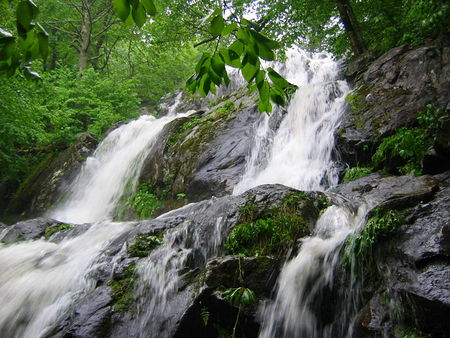
Would a rule change allowing greater mountain bike access in national parks lead to more of these scenes? NPS photo.
Mountain bike accessibility in national parks could expand exponentially under a rule change proposed by the Bush administration, according to the National Parks Conservation Association.
While the current regulation largely restricts mountain bike use to designated trails in developed areas, NPCA officials said the pending regulation would, if approved, allow superintendents to "designate bicycle routes on:
1. existing trails within developed areas;
2. existing trails within undeveloped areas; and
3. new trails within developed areas."
"Under the proposal, if any trail designations within these three areas were considered controversial or would significantly alter public use patterns, then the superintendent would be expected to issue a special regulation," the parks advocacy group said in comments on the proposed rule change."
The comments came near the end of the public comment period on the proposed rule change. Also opposing it was Public Employees for Environmental Responsibility, the Association of National Park Rangers, the Tamalpais Conservation Club, the Bay Area Trails Preservation Council, Wilderness Watch, Wild Wilderness, the New Mexico Wilderness Alliance, and Grand Canyon Wildlands Council.
In its comments, the NPCA said the proposed changes would increase "the risk for local stakeholder groups to unfairly influence local park decision making" because a park superintendent in many cases would have the final say on opening trails. The current rule-making process requires National Park Service officials at the regional and national levels to review any proposed changes.
Additionally, NPCA said that while "a special regulation issued in the Federal Register would still be necessary for uses of, or activities of a, 'highly controversial nature' or that would result in 'a significant alteration in the public use pattern,' it is unclear what conditions would need to be met.
"Guidelines are needed to both assist the public in making this claim and assist superintendents in supporting their decision," the group continued. "We believe the Federal Register should not be used as a notification tool, as this proposal would do, but rather as a public involvement tool."
NPCA also believes any rule change should include language specifically prohibiting bicycles not only in officially designated wilderness areas but also in areas proposed for wilderness designation by the Park Service as well as areas currently managed as “potential Wilderness.”
NPCA officials also voiced their opinion that while national parks exist for the public's enjoyment, not all forms of recreation are appropriate for the national parks.
"We understand that some bicyclists, especially mountain bikers, would like to have increased access to the parks. However, the national parks do not have to sustain all recreation; that is why we have various other federal, state, local, and private recreation providers to share the demand, and to provide for those types of recreation that generally do not belong in the national parks, or that must be carefully limited," the group said.
"The 1916 NPS Organic Act, emphasizing conservation for future generations, is substantially different from the organic laws of the Bureau of Land Management, the US Forest Service, the US Fish and Wildlife Service, the Army Corps of Engineers, or any other federal agency. The NPS mission is also different from that of state park agencies, or of county or city park agencies. Together, these agencies provide for many forms of public recreation, including single-track mountain bike opportunities—but not all forms of recreation are appropriate in national parks."
Meanwhile, the other groups also urged Interior Secretary Ken Salazar to withdraw the proposed rule change, saying it was "a late lame-duck Bush administration plan to carve mountain bike trails across the backcountry of the national park system."
In announcing their opposition, the coalition pulled from an "action alert" the International Mountain Bicycling Association sent to its members, asking them to file comments in favor of the rule change. In that action alert, PEER officials said, IMBA described what is at stake this way: "…over 170 forests and grasslands administered by the NPS [National Park Service] and a potential 130,000 miles of trails, the move is a mouthwatering prospect for cyclists."
Among the concerns raised by the coalition are:
* Increased User Conflict. Introducing mountain bikes on backcountry trails will drive off hikers, horseback riders and other users, as fast moving bikers, sometimes in large groups, whiz down narrow paths;
* Introduction of Extreme (BMX) Mountain Biking Trails. The wording of the proposed rule appears to endorse, for the first time, construction of trails designed specifically for high-speed, bicycle motor-cross (BMX) racing, to the practical exclusion of other uses; and,
* Aggravation of Maintenance Backlog. High volume biking on backcountry trails will multiply the demand on the Park Service for erosion control to keep unpaved trails functional. The agency already reports a $9 billion backlog in maintenance projects.
"While we endorse the use of bicycles through the developed areas of park units like the C&O Canal in D.C., these proposed rule are designed to facilitate mountain bicycles in undeveloped park areas - the backcountry, far from paved park roads," commented PEER board member Frank Buono, a former NPS manager. "This rule could not only negatively change the backcountry experience for park visitors, but would allow a non-conforming use in proposed and recommended wilderness."
Jeff Ruch, PEER's executive director, added that, "This mountain bike rule is a classic example of special interest influence over management of our national parks. There is no shortage of other venues for mountain bikes that would justify opening up the last, best places within our national parks."

Story Categories:
A copy of National Parks Traveler's financial statements may be obtained by sending a stamped, self-addressed envelope to: National Parks Traveler, P.O. Box 980452, Park City, Utah 84098. National Parks Traveler was formed in the state of Utah for the purpose of informing and educating about national parks and protected areas.
Residents of the following states may obtain a copy of our financial and additional information as stated below:
- Florida: A COPY OF THE OFFICIAL REGISTRATION AND FINANCIAL INFORMATION FOR NATIONAL PARKS TRAVELER, (REGISTRATION NO. CH 51659), MAY BE OBTAINED FROM THE DIVISION OF CONSUMER SERVICES BY CALLING 800-435-7352 OR VISITING THEIR WEBSITE. REGISTRATION DOES NOT IMPLY ENDORSEMENT, APPROVAL, OR RECOMMENDATION BY THE STATE.
- Georgia: A full and fair description of the programs and financial statement summary of National Parks Traveler is available upon request at the office and phone number indicated above.
- Maryland: Documents and information submitted under the Maryland Solicitations Act are also available, for the cost of postage and copies, from the Secretary of State, State House, Annapolis, MD 21401 (410-974-5534).
- North Carolina: Financial information about this organization and a copy of its license are available from the State Solicitation Licensing Branch at 888-830-4989 or 919-807-2214. The license is not an endorsement by the State.
- Pennsylvania: The official registration and financial information of National Parks Traveler may be obtained from the Pennsylvania Department of State by calling 800-732-0999. Registration does not imply endorsement.
- Virginia: Financial statements are available from the Virginia Department of Agriculture and Consumer Services, 102 Governor Street, Richmond, Virginia 23219.
- Washington: National Parks Traveler is registered with Washington State’s Charities Program as required by law and additional information is available by calling 800-332-4483 or visiting www.sos.wa.gov/charities, or on file at Charities Division, Office of the Secretary of State, State of Washington, Olympia, WA 98504.


National parks and their natural resources belong to you. The National Parks Traveler works to ensure you know how these essential places are being cared for.
Sign Up For Our Weekly Newsletter
Unsubscribe at any time.
INN Member

The easiest way to explore RV-friendly National Park campgrounds.

Here’s the definitive guide to National Park System campgrounds where RVers can park their rigs.
Our app is packed with RVing- specific details on more than 250 campgrounds in more than 70 national parks.
You’ll also find stories about RVing in the parks, tips helpful if you’ve just recently become an RVer, and useful planning suggestions.


Comments
I think the opportunity for everyone exists on public lands. Mountain biking is not dangerous impact to the NPS or any other backcountry pursuit. Mountainn bikers invest large amounts of time and energy into trail construction and repair. Why are limiting the backcountry experience to a handful of hikers? Mountain Bikers have a less physical impact on the trail than a hiker or horseman for sure. Look at any given trail system. The initial 1-3 miles are usually wide enough to walk side by side, which is typical of a normal hiker starting off. If you follow a typical Mountain bike trail you will notice that the tread is for the most part 6-8 inches wide. Who's impact is worse? Open access for everyone.
-Team Trail Monster-
Trail Builder and Adopt-a-trail volunteer!
Backpacker/Hiker!
Mountain Biker!
PS...I want Wilderness Access as well for bikes! If it's good enough for a 1000lb animal packing a horseperson, then the trail is suffiently built to safely allow passage of 24lb bike with 150lb rider!
Jim,
If mountain bikes don't impact as much as hikers, why do mountain bikers invest large amounts of time and energy into trail repair?
Also, keep in mind that most trails in parks are designed for walking beasts. Thus they have waterbars and other trail structures that are inconsistent with the needs and expectation of bikers.
You mentioned the gradual narrowing of trails. That is often due to the large amount of use those trails receive. Another thing that causes that is multidirectional travel. A third thing that causes trails to widen is multi-use. People don't like to walk on horse manure so they move to the side (as would bikers), fast hikers have to move around slow hikers... and the list could go on. Each combination of users creates its own trail impacts but also their own social impacts and conflict.
Parks and Wilderness are not protected simply for our pleasures. They are there for much more important reasons.
In regards to your PS, please read the Wilderness act (you will see that Wilderness was created to secure a place for unmechanized travel) and while you are at it read the Organic Act (NPS) (and you may understand why open access for everyone is not an option).
I do what to say there is something you said I that agree with. Horses make one heck of a mess of trails. If they are not beating the trail to dust, they are filling it with manure and causing major erosion problems. BUT, the one benefit of the horse it that it allows some people who are not into bipedal motion to access some very inspiring places!
Jeff Ruch, PEER's executive director, added that, "This mountain bike rule is a classic example of special interest influence over management of our national parks. There is no shortage of other venues for mountain bikes that would justify opening up the last, best places within our national parks."
Essentially, the argument is that the "best places" in national parks should not be available for mountain biking because a different set of "special interest" groups got there first.
Not a good enough reason, in my book. The NPS has concluded that the impacts of bicycling are equivalent to hiking, and less than those caused by horse travel. Therefore, protecting the integrity of resource can not really be the issue.
Additionally, there are successful examples from around the world -- including national parks in cherished, pristine places like Canada and New Zealand -- that are almost too numerous to count. So much for the idea that people are incapable of enjoying shared-use trails
It's time to help our U.S. national parks find appropriate places to enjoy similar successes, and to provide channels to bring them online in a more efficient manner. That doesn't mean every backcountry trail should be opened to bicycles, but it's well worth improving the options for cycling where NPS staff identifies good opportunities to do so.
There are always a few in any group who choose to abuse or misuse trails. Mountain Bikers tend to groom the trails more, not repair them, because it helps prevent abuse by other users, even Hikers. If Equestrians, Hikers and Bikers will follow basic Leave No Trace rules, then the trails require minimal repair and the impact is minor. Most of the problems are caused by people using the trails when they are wet. I live in a State Park which has trails specifically for Hiking, Biking and Horse back riding and you can see 3 foot trenches on the horse trails because even after a heavy rain, the parking lot is full of trucks and trailers. Some people, i'm sure are just uneducated on trail etiquette, but others just don't care. The first step is to police each other, say something to your fellow trail users, but be nice about it and if that don't work then help the park officials enforce the rules. There's room for everyone out there.
To set the record straight, IMBA is well aware that the US Forest Service, not the NPS, manages forests and grasslands.
IMBA never issued an alert with the claim that mountain bikers are "salivating" about access to 130,000 miles of trails in national parks. We count about 12,000 miles of trails in the NPS system.
A simple web search reveals that this phrase was generated by a UK-based mountain bike site, which seems to have confused their US agencies. Like so much of the PEER assessment, their statement is factually wrong.
I have been following this rule change proposed by the Bush administration closely. I am an avid hiker that has had some bad experiences with mountain bikers. All rules state bikers are to YIELD to hikers and both to yield to horses. I am deaf and have had harrowing experiences with speeding bikers going side by side that I am unable to hear coming up behind me. I usually jump off of the trail to let these maniacs pass. I actually try to find hiker only trails if possible. The out of control bikers and dogs off leash really create major problems for those of us that just want to hike and enjoy the great outdoors. This can be a frightening experience for those of us that do not hear.
Why don't people just say it? We (hikers, equestrians, whatever) don't want to share the trails funded by the taxpaying public and would like to keep the trails to ourselves. Instead, they make up all kind of illogical arguments to support their claim. It's rather pathetic. I'm a mountain biker, proud of it and hate hiking (but certainly don't hate hikers). One day, we'll reclaim our birth right to pedal in wilderness. We just have to wait for the current generation of ecotrailnazis to die off. :)
Interesting.
Those who argue against mountain biking due to "trail damage" should be fighting tooth-and-nail to get horses off of the trail. In my neck of the woods, the horses leave the trail looking like it's been carpet bombed after they ride through. Our mountain bike club has to work continuously to undo the damage they cause to prevent serious erosion problems.
I've been involved in hundreds of hours of trail maintenance over the years, and I can count on one finger how many times we've had assistance from equestrians (or hikers for that matter). They contribute very little from what I have seen other than clipping overhead limbs and leaving them in the trail for others to pick up.
Nonetheless, I don't see any mountain bikers trying to kick them off of the trail.
Let's be honest, this is all about the fear of user conflict and nothing more. Most hikers and equestrians simply dislike mountain bikers.
We have the same problem here with the equestrians. We have done over 3000 hours of trail maintenance since 2000. Most of it is to clear brush, because we live in Florida where everything grows so fast, but also to repair the extensive damage caused by the equestrians. And like every where else, they don't pitch in to help maintain the trails they destroy on a weekly basis. If it wasn't for the local mountain bike group, our trails would be closed to all because we are the only ones who maintain the trails. We encounter hikers, cross country runners, equestrians and families using the trails and all but the equestrians thank us when they see us busting our tails on foot cutting back thorns, bushes, and smoothing out the trenches dug out by the equestrians. The equestrians have 2 major equestrian parks and other places to ride at so why they choose to ride on a trail that is not designed for them with tons of snakes to boot is beyond me.
To conclude we now have permission to build inside of a State park, sustainable single track where none currently exist. We are in there blazing miles of single track not just for mountain bikers to use but for everyone to use. this is going to create miles of trails for people to hike on and enjoy the state forest and they are happy because now they can advertise these new trails for potential hikers and campers and draw more people to the state park, equestrians included. But do you see any one else out there helping? no. Just us mean old mountain bikers who also tend to be hikers, campers, and equestrians (or in my case my daughter is an equestrian so I know, intimately, what goes on in their world).
so in the current economic conditions, I say it is in the best interest of the parks to open up access to mountain bikers to create revenue because we pay more than entry fees; mountain bikers tend to do a lot of road trips to places we can ride. Our group does a road trip every month to places other than where we live. so we bring money for fuel, hotels, restaurants and other things.
So please share the trails. we are not there to destroy but to use responsibly. I'm sure the majority of equestrians don't intend to do what they do but are truly ignorant of what they do (I hope-no one can be that mean could they?) and I think that is setting in because now the local equestrian group has contacted us and they want to help do trail maintenance so it's a start. we can coexist. so let's start and see where it goes.
I am an equestrian and I have to agree that the damage that horses do to trails is severe. The hooves just tear up trails. Though I do clear brush. I have ridden for years on private land and the only trails that are created are by esquestrians. Some hunters use the trails in the fall but no one else because most people do not know they exist. I have only ridden in Gettysburg NPS and not in any other park due to the drive considerations. I do not like towing a trailer up mountain roads as that wears out transmissions and brakes fast.
However I have ridden on trails that bikes and motor trail bikes use and the surface left by the bikes is great. It creates a level path that is very firm. Nice to walk or ride a horse on. I have found bikers to be courteous and we get off the trail for them and vice versa.
So I can only guess the animus toward mountain bikers is because hikers and esquestrians do not want to share the trails. I think that more recreational use of parks is better for Americans as it increases revenues. The enviros seem to want to prevent most recreational use of parks from snow mobile and mountain bikes and any new device that gets popular.
"Birth right to pedal in wilderness," Zebulon? And "ecotrailnazis"?
"Enviros", RAH?
Equestrians are "ignorant of what they do," Losdog?
"Most hikers and equestrians simply dislike mountain bikers," Scott G?
I sense a trend here...there's certainly a lot of animosity out there, whether it's spouted by pro-hiker or pro-biker or pro-equestrian. If this were California, there'd probably be a call for a support group;-)
All of this is terribly confusing, Kurt. Just when I got used to being called a "bunny-loving tree-hugger" or an "unresconstructed hippy-dippy ecofreak," now I have to know whether I am an "environmental wacko," an "econazi," or perhaps just a plain old "enviro."
I was active in the push to get Wilderness Areas in the early 1970's and considered myself a conservationist and enviromentalist. But since then the extreme positions of the enviromentalist have left me behind. So I still consider myself a conservationist but not an enviromenatlist. So yes " enviro" is short for the extreme anti human slant of "enviros" that want to eliminate the human part of parks and other activities.
So gulity as charged. But I blame my own preferred method of horseback riding for trail damage rather than bikes or human hikers.
I think a solution is a mix of multiuse trails and specific use trails to handle all the methods of travel on trails in parks and forests. Wilderness areas are restricted as to the use due to fragile conditions.
Maybe living in the west, where public lands that are open to hundreds of miles of rideable trails are open to all is gives me skewed viewpoint... but aren't there enough places where people can mountain bike?
Enough?
Well lets take Washington state, in fact lets narrow it down to the Wenatchee National Forest alone.
Here they will find 2,500 miles of trail to play on with their toy.
The Wilderness is closed to bikes not for any kind of logical reason, but simply because the ultra enviros managed to get the administration to close it. There is no inherent reason why bikes can't be used in wilderness other than the Sierra Club hates biking. Simple as that.
It's a matter of time, but hikers are aging and the kids are biking. Guess what will happen in the next 20-30 years when bikers are the majority? It'll be too late for me but not for my kids. In the meantime, there is always night riding. :)
On a separate note, I took my kids for a hike last week in Muir woods. I was quite amused to see that the vast majority of the visitors were sticking to the paved trails by the creek (nice, flat and covered with asphalt). So much for enjoying the great outdoors, I guess. :)
I would argue that is is closed to all sorts of mechanized use for very logical reasons. The wilderness designation was created to permanently set aside protected areas that could provide opportunities to completely get away from mechanized society. It has nothing to do with ultra environmental groups, and everything to do with preserving a place that helps provide contrast to how we live our lives.
I disagree that it is just going to be a matter of time before these rules change for wilderness. The more mechanized our society gets the more important it will become to protect wilderness (and there are some very strong groups who support that viewpoint).
Finally, biking may grow in popularity during the future... however I seriously doubt that will eclipse hiking (an activity that requires no special equipment and no monetary investment)
P.S. You are right when you say that there are no inherent qualities in the wildlands that makeup Wilderness that prevent any activity. The qualities (that prevent improper use of Wilderness) were in our society's ability to recognize the importance of pure, untrammeled, and unmechanized spaces and their growing importance to our society.
The NPS knows what it is doing at Muir Woods, Zebulon. Experience shows that if you let visitors wander around off-trail, they walk round and round and round those big redwoods. The result is dead trees. All of that tromping compacts the soil around the tree roots, eliminates vital air pockets in the upper root zone, and severely inhibits the downward movement of moisture. Fortunately, there are other plenty of other parks where you can go off-trail without endangering redwoods.
Keep Wilderness and National parks backcountry trails for animals ie. human; horses; and of course wild animals!!!
@ Zebulon-
I would bet that the NPS managed lands are such a minuscule percentage of the overall public lands that I don't think you lose out by not being able to mountain bike in National Parks.
I am a mountain biker, I live in an area with tons of mountain biking opportunities but little equestrian and the trails (wilderness) that don't allow bikes are not as shredded as the ones that allow biking (non-wilderness.) Let me say this again, I mountain bike and love it. I'm all for trail development but feel there is a time and place for everything.
Having run trail rehab programs via a nonprofit and put in a lot of hours rehabilitating trails myself (read: sore back, blisters and sweat...), I feel that I can comfortably say three things:
1) Mountain bikers don't show up to work on the trails, even when heavily recruited (at least around here)
2) Trails that allow mountain biking need more maintenance than those that don't.
3) Trails built or maintained to IMBA standards need TONS more work than those employing USFS standards.
4) The new generation (which I'm part of) of mountain bikers doesn't really slow down or tolerate walkers/runners/hikers/families on trails (around here) and gets upset when they have to slow down or pull an earbud from their ipod out to have a quick exchange with those not on a bike. I think hikers don't enjoy mountain bike trails because they are always having to jump out of the way. Say what you want, but you must not be riding fast enough to see where the conflict and disrespect comes from. I get mad when I have to slow down and then rebuild my cadence...
As such, I also don't see where the money to pay for these trails is going to come from other than sucking away funding towards rehabilitating/maintaining what is already there.
@ Zebulon- One more thing- If you take a look at the stats (take yer pick - typically generated from user surveys) you'll see that in heavily used public lands, hiking is the #1 activity.
I read the National Park Conservation Association and Wilderness advocacy group attachments. NPCA's position boils down to an argument that bicycles are fine for parking lots and for battling Winnebagos on NPS's paved roads. Despite NPCA's perfunctory statement that bikes may be OK on some trails somewhere, I've never heard of a trail that NPCA would find suitable for cycling. I wonder how many people under 40 would be excited to belong to an organization like this.
The people and organizations, like NPCA, who/that oppose giving individual park superintendents authority to decide on trail usage and want Washington to decide everything, would be the first to support the idea that some states, like California, should be allowed to set their own more stringent air-pollution control rules and not have to follow dictates from Washington.
So hypocrisy abounds. Nonetheless, one can dismiss the "concerns" (complaints) of hidebound groups and still acknowledge that mountain biking has an impact. All uses have impacts, some intrinsic, some extrinsic. Here's how I assess various traditional user groups' impact on wildlands:
1. Mountain bikers: low environmental impact, moderate intrinsic social impact (i.e., on the trails; see my following post), low extrinsic social impact (willing to share with others, do lots of volunteer trailwork, not hostile to other users).
2. Equestrians: moderate environmental impact, low intrinsic social impact (on the trails), moderate extrinsic social impact (hostility to mountain bikers and some other user groups; don't do much trail maintenance).
3. Hikers: low environmental impact, low instrinsic social impact (on the trails), moderate to high extrinsic social impact (insistence on keeping parks off limits to almost all nonmotorized users but themselves; don't do as much trail maintenance as mountain bikers do).
So no one can make a claim to social or environmental purity, notwithstanding the posturing of people and organizations who/that assert in substance that they possess a monopoly on both.
I am always reassessing the nature of trail-use conflicts. I no longer toe the party line of some of my fellow mountain bikers that nonmotorized user groups can all get along on every trail. And as I stated in my prior post, I acknowledge that the social impact of mountain biking can be, in certain senses, in certain places, and at certain times, higher than that of hiking. The environmental impact is usually the same, or even less, but the social impact on the trails is sometimes greater because we move faster (enabling us to scare people) and are more able to range farther into remote wildland interiors (enabling us to disrupt others' sense of solitude, which a number of people prize; I know I do). I believe we mountain bikers must acknowledge these issues and offer shared-use models that take them into account and neutralize (or minimize) any problems.
The question, though, is whether other user groups will work with mountain bikers in good faith. I doubt it. A number of Wilderness purists have been so fanatically devoted to their model of hikers-and-horses only that they have been willing to make the ultimate sacrifice: a virtual halt to Wilderness expansion for many years. This attitude shows that ideological purity prevails over the putatively fundamental goal of wildland protection. Given such a mindset, I fear that mountain bikers have little to offer that the purists will be willing to consider.
Anonymous of four posts above describes himself as a mountain biker but admits that he rides heedlessly ("I get mad when I have to slow down"). He wants to assign his misconduct to a whole generation of mountain bikers in his region. (Maybe it's midtown Manhattan.) It's fine that he admits to personal misbehavior, but I and thousands of mountain bikers don't want to be lumped in with him, because we ride politely and with sensitivity to others.
Regarding Anonymous's assertion that "the trails (wilderness) that don't allow bikes are not as shredded as the ones that allow biking (nonwilderness)," here's what one backpacker wrote of his Wilderness experiences with commercial horse pack trains in 2006:
"My trip to Stanley Hot Springs was full of surprises. This was my first trip into the Selway-Bitterroot Wilderness, which was the 1st Wilderness Area designated in Idaho and one of the first of the entire United States. It lies directly north of the massive Frank Church River of No Return Wilderness, and is separated from the Frank by only one road, the Magruder Road.
"We broke camp at Wilderness Gateway Campground at 4 a.m. in an effort to beat the heat. We were unfortunate to arrive during a week-long heat wave of mid-90s to 100+ temperatures. The last part of the hike down to Rock Creek was rough. There was little water, the trail was thrashed and loaded with horse poop due to extreme outfitter activity—in many places it was like hiking up jagged stairs. And, horse traffic on the trail proved cumbersome as the heat ratcheted up.
"Horses have the right-of-way here, so every time they are encountered backpackers and hikers have to get off the trail, approx. 5-6 feet below the horses and crush beautiful foliage as a result while the horses pass and kick rocks and dirt all over the party below. This makes for slow going, and if you have heavy backpacks on can really suck. We had to do it 4 times. Some of the outfitters were actually upset at having to deal with us backpackers, I think it was because our dogs spooked their horses and one of them spilled their beer. All in this particular party were drinking beer and smoking cigars while on the trail."
Source: http://www.idahohotsprings.com/destinations/stanley/index.htm
No one I know of has offered, with similar convincing detail, a kindred personal account about being displaced or forced to hike radically damaged trails because of bicycles. Moreover, the available science runs counter to Anonymous's assertion that mountain biking damages trails more than hiking.
Bob,
Muir woods has plenty of dirt trails (hiking only of course :)) that start from the bottom and go up toward Mt Tamalpais. I heard that they are quite fun to ride as well. :) Anyway, the point is that Muir woods is a huge attraction to hikers of all stripes, but the vast majority of them sticks to the asphalt portion of the park, which I found to be quite ironic.
Lee: you're stuck on that nonsensical definition of mechanized. Somehow, bikes are mechanized while carbon fiber poles, snow shoes, and pedal equipped cayaks are not. That is irrational. Just be honest and come out and say that you don't want to share your public parks with others. BTW, the dimishing number of people visiting the parks does not seem to support your vision that a growing number of citizens want to escape mechanized society. The truth is that a growing number of people can't seem to escape their couch.
Anonymous: the vast majority of park users are not dedicated hikers, they're casual strollers. They come in, walk around for a couple miles and go home. Equestrians are by far the smallest user group, and diminishing. Out here in CA, they're somewhere below 1% of all park users. The last statistic I read said that there were 30ish mountain bikers for every equestrian.
Trail impact of bicycles: if trail impact was the real reason for not allowing bikes, horses would have kicked out a long time ago based on how badly they trample everything they ride on.
Bottom line: this is all politics and established user group selfishness and nothing else.
Zebulon
That statement is frightening but true. And I believe that those who care about parks need to fight that trend. If people loose interest in parks, it could eventually translate into into additional funding problems, continued drops in visitation... and perhaps drastic changes in what a park is.
OK, OK... I admit that my definition of mechanized is idealistic (but so is the concept of Wilderness). Further, I am also confused at times by the difference between the use of technology and mechanization. And I have gotten into some very heated arguments about things like hang-gliding. No wheels, no power, and designed by Leonardo da Vinci in the 1500's hang gliders predate some of the earliest description of protecting wilderness... and I have no intention of ever hang gliding anywhere.
However, I completely disagree with your assessment that I don't want others to visit "my parks". I do want people to visits. The more people the better (to a point). However, I want them to come knowing that these places are special and have different rules than the rest of society. I wish that people could acknowledge that different rules for different places it ok (and good).
It seems that in our personal lives we have are comfortable with that statement. We often set rules about what can be done in our own yards (not just for impact reasons, but also for reasons related to the appropriateness of certain behaviors).
When the term public lands is used to describe parks I feel like people make the claim "it is part mine and I should be able to do what I like to do on it." That naturally leads to "tragedy of the commons" situations. If every special interest group is given the right to carryout their activities in parks and wilderness we loose some of the things that make them special.
And I sure someone will fire back at me a saying "you may believe that now, but just wait until the park service makes something you like to do illegal!" Maybe you're right. But right now I am happy that the parks are fighting to maintain an identity of their own instead of mutating into whatever the current special interest group wants.
Finally, to your bottom line. Specifically when you comment that it is an established user group's selfishness that is restricting others from being able to enjoy National Parks. It is easy to oversimplify the problems in parks and their causes.
IMTN, re: "No one I know of has offered, with similar convincing detail, a kindred personal account about being displaced or forced to hike radically damaged trails because of bicycles. Moreover, the available science runs counter to Anonymous's assertion that mountain biking damages trails more than hiking."
I'm not sure what kind of "kindred personal account" you'd like or "available science" you read that shows biking is no more damaging than hiking, but I've been on some trails in the Stanley Basin of Idaho that very easily could be described as "thrashed" by bikers. Trails where rocks rise 6-8 inches and more above the trail bed because tires have eroded away the soil, trails that pass through riparian areas that have been shredded by bikers not wanting to follow their friends' tires so they swing a little wider each time, trails where the elbows of switchbacks have grown wider and wider and more and more concave from biking pressures.
As for the courtesy of some mountain bikers, I was riding a single track with my wife and a friend when two bikers came upon us so quickly and quietly that they were on our rear tires before we knew it and somehow managed to pass us.
Sadly, your belief that the majority of mountain bikers "ride politely and with sensitivity to others" runs counter to my personal experience and certainly would seem to run counter to IMBA's perception as to what mountain bikers want. Here's a snippet from a post I wrote three years ago (so perhaps IMBA's position has changed):
Also, for what it's worth, a mountain biker had his bike confiscated in a Midwestern national park unit last year for "poaching" an extreme ride in that park. And there was an instance at the Grand Canyon a year or so ago when two or three mountain bikers on a cross-country trip actually managed to ride rim to rim -- even though it's against the park regs. They were caught when they chronicled the ride on their website.
Do these instances/comments reflect the majority of mountain bikers? Maybe, maybe not. As we all know, it only takes one bad apple to spoil the bunch. But in the case of a speed sport like mountain biking, when compared to walking, it wouldn't take too many bad apples to create significant problems in a national park setting. I've never heard of one hiker running over another hiker, yet I've come very close while walking on a shared-use trail to being run over by a mountain biker a time or two. In fairness, I've also encountered some very considerate mountain bikers, and like to view myself as one.
And, to be sure, there are bad apples in the hiking community as well, those who trash backcountry campsites and fragment trails by going cross-country because they can't be bothered with negotiating the entire switchback.
Perceptions are tough to overcome. Just look at the bulk of the comments directed at equestrians. (For what it's worth, while horses are much larger and heavier than mountain bikes and do indeed exact a considerable toll on trails, I've never encountered a horse traveling as fast as a mountain bike on a trail and never had to dodge one to keep from being run over.)
I can't help but return to what I've pointed out many times before, and what others have also focused on: national park landscapes are managed with a much different intent than Forest Service and Bureau of Land Management landscapes. Those areas have an institutional multiple-use bent, whereas Park Service lands foremost are to be conserved for future generations to enjoy. Why that is so difficult for some to digest I don't know.
I think it would be an interesting experiment to follow the course of two landscapes -- one Forest Service or BLM, the other Park Service -- that share a common boundary, the first with mountain bike trails, the second with only hiking trails, and study the associated impacts over the course of ten or 20 years.
If anyone knows of such a present-day study, please forward it.
Here in Colorado, we have many real-world scenarios for observing the relative impacts of hiking and biking. Many trails that are popular with both groups have sections that are close to bikes because of Wilderness designations -- the Colorado trail is the best-known example. Get out in the woods and take a look -- you will see that the popular sections of the trail, where there are trailheads with with easy car access, are wide and eroded whether the trail is closed to bikes or not. The remote sections that are open to bikes (many of which are quite popular with mountain bikers) are generally in excellent shape. The real world scenarios clearly show that it's the total volume of traffic that determines the impacts on the trail, and the presence or absence of bicycles is usually not the determining factor for the condition of the trail.
As for the social interactions, here is a personal story that I think might still be instructive. My wife, a sometimes-mountain biker, was out for a mellow ride the other day. I work for IMBA, so she tries extra hard to be a shining example of courtesy on our local trails and often asks me for advice on how to avoid problems with other users. She returned from her recent ride nearly in tears. She had slowly approached two hikers from behind, and called out in her most polite tone for permission to pass. She received a verbal lashing from the foot travelers, who first jumped off the trail as if they were about to be assaulted. One of them called out in an angry and sarcastic tone -- as she rode slowly by -- "Sorry we got in your way!" She was at a loss on how she could have avoided the situation, short of aborting her ride or choosing a different trail. Had the hikers been buzzed by a irresponsible rider? Maybe (though doubtful because the encounter was quite close to the parking lot) but nonetheless it goes to show that it can be easy to group people and hard to treat individuals like individuals.
I've seen my share of trails destroyed by hiker bad behavior. Kurt, your basic argument is that preserving national parks for future generations and allowing mountain biking is somehow mutually exclusive but offer no good explanation for it, other than bringing the fact that some bikers don't know how to behave. BFD. It all comes down to a category of users not wanting to share with the newcomers.
Rational people could come with inventive solutions, odd/even trail usage, creating separate trail for the first couple miles from the trailhead when interactions are the most frequent. There are plenty of easy solutions to the perceived conflicts, but I have yet to see a non MTBer coming up with anything other than "let's keep them out of our playground". Sad.
I think this is an excellent dialogue. I wish we could all meet sometime and hash these issues out in a way that might bring about change in trail management in the national parks. There's a lot of wisdom in these posts.
I must say respectfully to Kurt, however, that I perceive from your most recent post that you won't give an inch on the issues we're discussing here. Am I incorrect about that? I was willing to acknowledge in an earlier post that mountain biking can have on-the-trail social impacts that hiking doesn't. But I don't feel any similar give-and-take coming from you, e.g., an acknowledgment that, as Zebulon points out, many concerns can be addressed by well-established management techniques like alternate-day usage, uphill-only, or segregated trails for the first couple of miles. Zebulon has accused you of basically wanting national park trails for yourself as a hiker and you haven't disagreed with him—a state of affairs that evidence law calls an "adoptive admission" (i.e., silence in the face of an accusation is the same as admitting it). What alteration of the national parks' trail rules, if any, would be acceptable to you? Or do you rest firmly on a desire to continue the status quo or restrict mountain biking even more in the national parks?
IMTN, I'm certainly willing to keep an open mind, and have readily pointed to many parks where there already are mountain bike opportunities, and even shared trail efforts (Mammoth Cave).
But I've yet to be convinced that we should just lump national parks along with other public lands and treat them as such.
Is there no place else to ride? Hardly. I've made this point many times over the past three-plus years: The national park landscape is roughly 84 million acres, that of the BLM and U.S. Forest Service hundreds of millions. There are countless miles of trails already open to mountain bikes on the public landscape. It's not that bikers are going without.
Are mountain bikers being denied access to national park lands? No.
Odd-even? Have you ever ridden the slick-rock trail near Moab? Think an odd-even program would work there? Doubtful.
If the Congress in 1916 didn't think national parks should be special places, why didn't they just place the lands under the Forest Service?
Bottom line: Come up with a compelling argument and perhaps I'll agree.
So, if I understand well, national parks are special and therefore bikes should be kept out (same argument for wilderness). There is obviously no logical link whatsoever. Lee, I admire your wishful thinking, but one has to be realistic. If we want the future generation to come back to the parks, we are going to have to adapt to them. Young kids aren't hiking, but they sure are biking. So, simply wishing that things go back to the way they were won't make them so. It'd be like me wishing to turn back the clock, grow some hairs again and lose 25#. It'd be nice but is very unlikely to happen. :)
As I said, we could come up with inventive ways to share the public land in a way that we can all enjoy it in our own responsible human powered manner. That would bring new users back to the park, so that they don't become irrelevant to future generations.
odd-even? are you kidding me? that's something that heavily used urban interface trails under take for things like dogs on leash or mountain bikes/no mountain bikes... how would this play out in the short visitation season in yellowstone?
sorry, but mountain bikes are a different kind of use. the pro side makes them seem like they are harmless and just another user group suffering the snowboarding syndrome, to become accepted and mildly dominant in the future... i don't see it. hiking is much different than mountain biking, the speed issue alone separates them.
i don't see mountain biking over taking hiking in general, the cost alone to get a good bike and all the needed gear far outstrips that of hiking, no questions. i do both, and love mountain biking, but come on.
A Denver Post article on the same topic has triggered an avalanche of comments there, so on the off-chance that people haven't had their fill of discussions of this issue, I'm providing a link to the debate:
http://neighbors.denverpost.com/viewtopic.php?t=11762899
I suggest that mt. biking can enhance their argument re: mt. bike travel in national parks by recommending reasonable regulations and limits that protect the park resources and character while also being sensitive to the wishes of others to have trails free of mechanical vehicles. This means placing some trails and areas off limits to bikes or timing trail openings to avoid disturbing sensitive wildlife activities (nesting, calving, etc.). Additionally, off-road bikers could accept the responsibility of maintaining trails open to mt. bike travel. Anyone who has done trail maintenance knows this is an important and often difficult chore. Bikers should also reach out to other park stakeholders in search of ways to work together in protecting the parks and respecting each others needs and desires.
Ray. Good points, however, let me suggest the following:
- we are already proposing everything you're suggesting: doing trailwork, proposing odd/even days, etc.
- if mtbers disturb wildlife, then the same should be true of any other user
The issue is that other users just don't want to share, as evidenced on this thread. Then again, why would they? They have their own private Idaho funded at taxpayer's expense.
what about the poop! oh my god - why does there have to be so much freaking poop all over the destroyed trails?
horses dont belong on trails and their ... riders should ride around the farm and stay off public land
the biggest issue for hikers being disturbed by mtn bikes is frequency of contact - which is caused by high-use cross country and downhill shuttle trails
high use cross country trails almost always have few to no hikers due to the flatness of land and lack of classic views
the main contention is trails heavily used by both hikers and the downhill shuttle crowd, and the shuttle crowd goes very fast /
there will have to be some compromises in that arena - that is why i say there needs to be some bike free trails for hikers and hikers will have to concede some trails to heavy bike use