
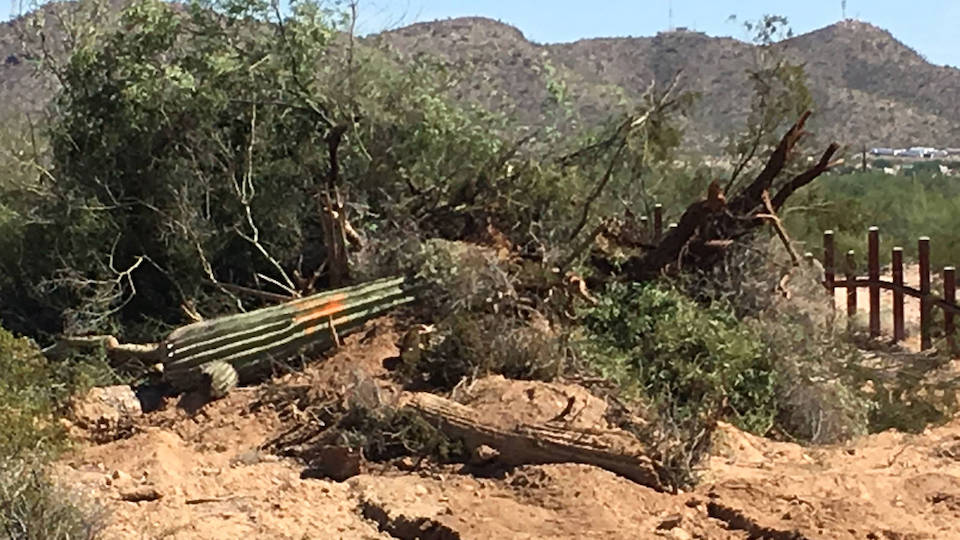
Groups are alleging that saguaro cactus knocked down for a border wall in Organ Pipe Cactus National Monument are being sold illegally/NPCA, Kevin Dahl file
Arizona's attorney general has been asked to investigate the possible theft and illegal sale of saguaro cactus that were removed from or knocked down in Organ Pipe Cactus National Monument to make way for a 30-foot-tall border wall.
"We wish to express our concern regarding attempted sales of saguaros in Ajo, Arizona, apparently done without tags or permits authorized by the Arizona Department of Agriculture," reads part of the letter sent Monday to Attorney General Mark Brnovich. "If verified, these alleged efforts to sell saguaros from border wall construction sites offer a tangible example of the failure of the Pentagon, Customs and Border Protection Agency, and Army Corps of Engineers to keep their contractors within the law."
Construction on the wall, intended to stem cross-border illegal activities, got under way in Organ Pipe last summer. The construction tore up the park's landscape along the US-Mexico border as the Trump administration has insisted a wall be erected to stem the flow of Central American immigrants to the United States. The work occupied a 60-foot wide swath of what's known as the "Roosevelt Reservation" in the monument. All told, the work could affect 218 acres within Organ Pipe, according to a National Park Service report.
While the wall has proven not to be impervious, its construction has been destructive to the national monument and could impede wildlife migrations, notably of rare Sonoran pronghorns. Too, a quick field survey by National Park Service archaeologists in June 2019 along 11 miles of the borderlands where the wall was to be built identified five archaeological sites. That survey left the archaeologists of the mind that "significant, presently-unrecorded surface-level and buried archaeological deposits persist across the project (are), and we must assume that all such unrecorded deposits will be destroyed over the course of ensuing border wall construction."
Construction crews have resorted to bulldozers and even explosives to level a path for the wall. According to the groups that wrote Brnovich, while some 2,000 cacti were transplanted to other areas in the eary days of the wall's construction, later Southwest Valley Constructors bulldozed "hundreds if not thousands of cacti it claimed could not be transplanted."
At the same time, "a significant numbers of saguaros were still removed, mutilated and placed in truck trailers and transported away on State Highway 85 toward Ajo. What is of legal concern is whether subcontractors had any state tags and permits to transport these uprooted or damaged saguaros on public highways as required by law, and whether they had authorization to sell or donate these saguaros as they attempted on October 17th in front of three witnesses."
The Arizona State Native Plant Law was first passed in 1929, and its current Arizona Revised Statute §3-906 spells out rules regarding the collection and salvage of protected plants; procedures, permits, tags and seals; duration; and means to request exceptions that have been in place since 2005.
Groups signing onto the letter included the Border Coalition, National Parks Conservation Association, Natural History Institute, Arizona-Sonora Desert Museum, Center for Biological Diversity, Desert Botanical Garden,Society for Conservation Biology, Boyce-Thompson Arboretum, Friends of Tucson's Birthplace, Wilderness Watch, and Borderlands Restoration.
The groups alleged that employees of Southwest Cactus, LLC, a business that transplants saguaros, last October approached Ajo businesses with offers of selling them "as many cacti as they want.” A call to Southwest Cactus on Tuesday was not immediately returned.
National Park Service officials in the agency's Intermountain Region office in Denver did not immediately respond to an email asking if they were aware of the allegations.
Stories about:
Story Categories:
A copy of National Parks Traveler's financial statements may be obtained by sending a stamped, self-addressed envelope to: National Parks Traveler, P.O. Box 980452, Park City, Utah 84098. National Parks Traveler was formed in the state of Utah for the purpose of informing and educating about national parks and protected areas.
Residents of the following states may obtain a copy of our financial and additional information as stated below:
- Florida: A COPY OF THE OFFICIAL REGISTRATION AND FINANCIAL INFORMATION FOR NATIONAL PARKS TRAVELER, (REGISTRATION NO. CH 51659), MAY BE OBTAINED FROM THE DIVISION OF CONSUMER SERVICES BY CALLING 800-435-7352 OR VISITING THEIR WEBSITE. REGISTRATION DOES NOT IMPLY ENDORSEMENT, APPROVAL, OR RECOMMENDATION BY THE STATE.
- Georgia: A full and fair description of the programs and financial statement summary of National Parks Traveler is available upon request at the office and phone number indicated above.
- Maryland: Documents and information submitted under the Maryland Solicitations Act are also available, for the cost of postage and copies, from the Secretary of State, State House, Annapolis, MD 21401 (410-974-5534).
- North Carolina: Financial information about this organization and a copy of its license are available from the State Solicitation Licensing Branch at 888-830-4989 or 919-807-2214. The license is not an endorsement by the State.
- Pennsylvania: The official registration and financial information of National Parks Traveler may be obtained from the Pennsylvania Department of State by calling 800-732-0999. Registration does not imply endorsement.
- Virginia: Financial statements are available from the Virginia Department of Agriculture and Consumer Services, 102 Governor Street, Richmond, Virginia 23219.
- Washington: National Parks Traveler is registered with Washington State’s Charities Program as required by law and additional information is available by calling 800-332-4483 or visiting www.sos.wa.gov/charities, or on file at Charities Division, Office of the Secretary of State, State of Washington, Olympia, WA 98504.


National parks and their natural resources belong to you. The National Parks Traveler works to ensure you know how these essential places are being cared for.
Sign Up For Our Weekly Newsletter
Unsubscribe at any time.
INN Member

The easiest way to explore RV-friendly National Park campgrounds.

Here’s the definitive guide to National Park System campgrounds where RVers can park their rigs.
Our app is packed with RVing- specific details on more than 250 campgrounds in more than 70 national parks.
You’ll also find stories about RVing in the parks, tips helpful if you’ve just recently become an RVer, and useful planning suggestions.


Comments
If the allegations of this article prove to be true, then it definitely sounds as though Southwest Cactus, LLC, is most likely NOT a signatory to this letter of concern. One would perhaps presume that a corporation which is known as "a business that transports saguaros" might well be aware ofthe various laws, regulations, and so forth regulating said cacti.
Rick, your other post would be hilarious if it were not so sad and uninformed. You have no clue what motivates me or what I have or have not chosen to do for others. I haven't said a single thing that expresses a lack of compassion or scorn for those in healthcare or any other field. You don't know these things because I don't talk about "me" nor am I constantly attaching others because they disagree with me. If anyone is "sour" here it is not me. The discussion was about the merits of opening the parks. I really don't understand why you cannot discuss the issues on their own merits without digressing into personal insults and attacks. Its is sad and I feel sorry for what appears to be a very unhappy life.
Wrong again throughout your post, but thanks for playing. All I know about you are the voluminous words you have typed onto this website for the decade or more I've shared these spaces with you. Don't worry - I"ve never expected insight, let along critical insight, in your posts. And my recounting of poignant real life events in my life was "hilarious... sad... and uninformed" I would guess so, if you can't relate to empathy.
And here i quote you: " I really don't understand why you cannot discuss the issues on their own merits without digressing into personal insults and attacks. Its is sad and I feel sorry for what appears to be a very unhappy life. "
I'm putting you back on "ignore" as I did preparatory to my neurosurgery, and recommend it to others. This is where you generally attempt to keep me engaged with picadore type barbed comments, but frankly I don't care. Sorry Kurt. I'll keep in touch, just not with our local McDuck.
Oh no, with all these comments going hither and yawn, I can't keep up and I'm so confused. I guess it's because I'm so sad and uninformed and have such a very unhappy life. I feel so lost and alone.
But, all joking aside, Eric, based on the opinions you pretty consistently express and Rick's experience, not to mention my own, with folks who voice your kind of opinions, you truly have left a pretty clear telltale trail about what "motivates" you and that trail certainly leads us to suspect that you're not exactly a generous, community-minded, guy when it comes to chosing what you want to to do for others and who you might be willing to do them for.
Why do I or maybe both Rick and I say that? You may not "think" you've "said a single thing that expresses a lack of compassion or scorn for those in healthcare or any other field" and, even if that were true, your silence would be deafening. However, the truth is even worse. In your last exchange with Rick, who being a healthcare professional himself is a bit sensitive about the death toll among his colleagues, your response was, "As to the healthcare worker deaths, they made the choice to work. Nobody forced them. We appreciate their sacrifice. (we also note that many (most?) died of COVID but not necessarily infected by their healthcare activites.)" Most fully formed, properly raised, decently educated adults might tend to see that comment as conveying a lack of compassion or even scorn for those in healthcare, especially at this time when so many of them are sacrificing themselves out of a genuine sense of duty that your postings, or should I say posings, pretty consistently reveal that you lack, although you seem to have a habit of confusing high school level political rhetoric for a genuine call of duty (it's not).
Okay, let's look at your lastest post right above here. You emphatically assert that you don't talk about yourself. While that's true considering word count, only because you aren't good beyond two or three sentences at a time, the real truth is that every single one of your bullying narcissistic comments is actually about you, what you want, framed around who you think you are. You literally ooze personally focused and self-centered. You go on to say you're not constantly attacking others because they disagree with you. Eric, do you not realize that, right this very minute in this very thread, you're chasing Rick around this website because he disagreed with you? Then, you scolded Rick that the "discussion was about the merits of opening the parks. I really don't understand why you cannot discuss the issues on their own merits without digressing into personal insults and attacks." Eric, you've chased Rick all the way over to an entirely different thread, a thread about the theft of some cacti, and are "digressing into personal insults and attacks" on a thread where you, yes, you, yourself, don't seem able to discuss the issue, the theft of some cacti, on its own merits without digressing into personal insults and attacks ...against Rick. You're not focused on the merits of any issue; you're seeking vengeance for Rick having the gall to disagree with you and find you disagreeable.
Honestly, your behavior here is giving me deja vu of one of the last scenes in the movie Gladiator. You know, the scene where the malicious, bullying, narcissistic emperor Comodus is screaming "Am I not merciful?"
"We appreciate their sacrifice" reflects scorn and a lack of compassion? What alternative universe do you live in? And no, I didn't chase Rick around because we disagree about whether we should open the parks, I "chased" him because he had a lengthy tirade that had nothing to do with the issues being discussed and were merely a personal attack on me. An attack that has no basis in fact. Kurt left me no avenue to respond other than moving to another thread. They only motives I have expressed is for obedience to the Constitution and respect for personal liberty and personal responsiblity. As to the theft of cacti, they should be prosecuted to the full extent of the law.
Thank you Rick and Rump for your commentary on our NPT resident, right-wing, narcissistic troll. Your comment, EC, about our healthcare workers who died in their dedication, service, and compassion for others by saying they had a "choice to work. Nobody forced them." You're not serious, are you EC? You and your PrivateBoneSpurs leader both exhibit many of the same narcissitic personality disorder traits: a mental condition where you have an inflated sense of your own importance, a deep need for excessive attention, and a LACK OF EMPATHY for others. But then to pile on even more, EC, by saying while they died of Covid-19 they may not have necessarily been infected by their healthcare activities! They died, EC...from Covid...during this Covid-19 pandemic...trying to save others from the virus.
No Brian, many of them did not die trying to save others. That was my point. Many of the people on Rick's list didn't die trying to save others - though that is what Rick was trying to imply. Some were retired, some were dentist or surgeons or were working in some other capacity that had nothing to do with fighting COVID. Does that make their death less tragic? Absolutely not. But it makes it no more tragic than the death of plumbers, ditch diggers, clerks or gasp, Realtors. I did and still express utmost gratitude to those willing to step forward and assist those in need. To point out it was their choice rather than the strong arm of government that had them do so demonstrates even greater appreciation for their sacrifice. But bottom line, this has nothing to do with the discussion re opening the parks. Rick's list of healthcare COVID victims and his personl life experiences are irrelevant. This has to do with the benefits of opening the economy, including the parks vs the risk that COVID posis to the general poulation and can those risks be mitgated.
Rump ---
Thanks for your kind words. You may certainly check with Kurt for how to contact me, so we can be in touch without bogging down NPT.
Let it go, BrianP. I'm certain that by delving into any version of the DSM you realize that insight is not to be expected. It indeed speaks to significant grandiosity and delusion to pomposely declare that a Real Estate huckster in Colorado divinely knows which of the deceased healthcare workers got COVID from working with COVID petients and which healthcare professionals got it at their local Safeway. I just want to see less of it ravaging the public who visit our National Parks. If you wish, please feel free to contact Kurt to be piut in touch with me, outside of NPT.
I have watched this site since the day it was launched - I had exremely high hopes for it and I do still enjoy much of the reporting. I worked with Kurt on many stories before retirement - some dating back to his days with the AP.
Now the comment section is always a favorite of mine for most sites that I follow - especially the ones where people explore their ideas or conclusions with others in a respectful manner - sadly we have lost that on NPT and yes - I put much of the blame at the feet and keyboard of ecbuck - he must be brilliant to be an expert at all things park-related and in his ability to irritate so many so much of the time.
I'm sure it's not a loss for anyone - but I find myself just moving right past NPT on a regular basis - especially when an article about possible cacti poaching leads to comments totally unrelated. I admire you RickB and Rump and the others who try to speak against the poison in the well but I fear it's a fool's errand.