
Editor's note: This updates that the public comment period was listed erroneously by Yellowstone National Park and that it will officially open Thursday.
A broadband company that claims people don't visit national parks for longer periods because of a lack of high-speed Internet service wants to blanket parts of Yellowstone National Park with such service.
In a proposal that was erroneously listed as open for public comment through November 12, AccessParks wants to install high-speed Internet service through more than 400 buildings in the park's developed areas that are managed by Xanterra Parks & Resorts. The request involves installation of "wireless radios, microwave point-to-point, point-to-multipoint, and indoor Wi-Fi installations."
Yellowstone spokesperson Morgan Warthin said Tuesday that the public comment on the right-of-way request was listed in error as running from October 28 through November 12. She said it will officially open this Thursday for a two-week period. If approved, the National Park Service anticipates "that the installation will be expanded in the future to offer the same service to the NPS and other concessioners."
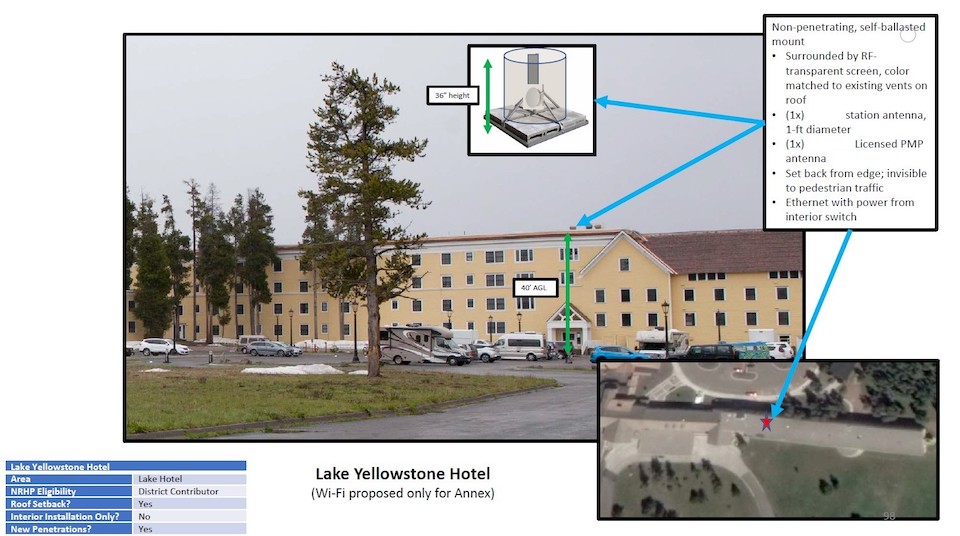
A broadband company wants to install high-speed Internet service in developed areas of Yellowstone National Park, including the historic Lake Hotel/NPS
Neither the proposal nor AccessParks' website lists the cost of using the service.
AccessParks has installed similar service at "hundreds of military bases worldwide, including the US Marine Corps, US Army and US Air Force, with no up-front cost to the facility. We were the first to offer HD-quality video streaming over Wi-Fi in hotels and lodges, even in the peak evening hours," according to its website.
Now taking aim at national parks, the company's team maintains that lack of quality Internet service turns people off from visiting parks.
"We couldn’t stay in national parks or most RV parks for more than a few days due to lack of quality Internet," the company states. "The solution we built for the most remote regions on earth for the military were a perfect fit for remote lodging and housing. Now, with AccessParks, we see a future where exploring the outdoors doesn’t have a time limit, and we can connect from anywhere, reliably."
Furthermore, says AccessParks, "(W)e believe that by addressing the need for predictable, quality internet in remote lodging, RV parks and campgrounds, we are helping more people experience the outdoors we love, for longer periods of time, and with the untethered freedom of exploring confidently. The outdoors should be a part of everyone’s life, especially younger generations. When parents can keep up with work for an hour in the evening, the kids benefit from longer stays."
The current proposal at Yellowstone calls for installation of "a large-scale wireless communication system covering Canyon Village, Grant Village, Lake, Mammoth Hot Springs, and Old Faithful. Equipment needs for this project include five microwave antenna locations, twelve wireless backhaul antennas ranging between three and six feet in diameter, three AccessParks remote solar repeater stations, and up to four hundred and eighty (480) transceivers of 11-inch diameter or less installed on receiving structures."
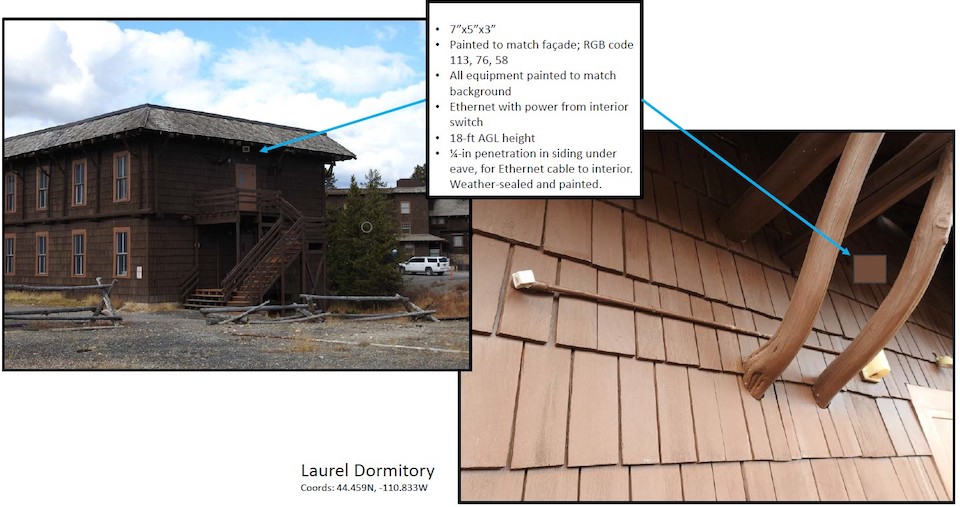
AccessParks maintains its service connections would be unobtrusive/NPS
Historic properties in the park that would be affected include Canyon Lodge, Lake Hotel, the Lake Hamilton Store, 78 Lake Hotel guest cabins, 64 Lake Lodge guest cabins, Seagull Dormitory, Mammoth Hotel, 97 Mammoth guest cabins, the Mammoth Dining Hall, Lodgepole dormitory, Juniper dormitory, Spruce dormitory, Old Faithful Inn, Old Faithful Lodge, 161 Old Faithful guest cabins, Laurel dormitory, and Columbine dormitory.
Yellowstone Superintendent Cam Sholly told Traveler in an email Monday that the proposal arrived at the park early in 2018, and that AccessParks has installed similar networks at Glacier National Park and Lake Mead National Recration Area and is seeking approval at Grand Canyon National Park.
"Personally, providing the connectivity to visitors is secondary to providing connectivity to the 3,000-4,000 NPS and concession employees, many of whom live/work in some of the most remote parts of the park," said Sholly. "Lack of connectivity is regularly cited as a major concern by employees and their families, and is unquestionably a major recruitment/retention issue. That said, we hear regularly from visitors that they wish we had better WiFi in visitor centers and hotels. Keep in mind that we already have WiFi (and associated infrastructure) in many areas; it's just very very slow. The upgrades and technology proposed here would make a major difference to employees and visitors.
"In regards to people who opine that connectivity upgrades within developed areas shouldn't occur, I invite them to come live at Grant Village or South Entrance, or Old Faithful for a season," the superintendent added. "They can see first-hand the enormous frustration much of our workforce has not being able to connect - whether that's kids doing homework, or other things we all use the internet for."
The superintendent also said there are no plans to provide similar service for backcountry areas of Yellowstone.
"Less than 1 percent of the visitation to this park stays overnight in the backcountry. There is no expectation by that visitor segment of increased connectivity that I have heard," said Sholly.
The superintendent also doubted that any visitors are cutting their vacations to Yellowstone short due to poor Internet service.
"The average length of stay has remained between 2-3 days and visitation is up dramatically over the past decade as you know," he said. "I have not heard anyone say they don't stay longer because of no WiFi. Obviously, I can't speak for everyone, so I'm sure you could find some who would say it, but it hasn't been something that I have heard."
Stories about:
Story Categories:
A copy of National Parks Traveler's financial statements may be obtained by sending a stamped, self-addressed envelope to: National Parks Traveler, P.O. Box 980452, Park City, Utah 84098. National Parks Traveler was formed in the state of Utah for the purpose of informing and educating about national parks and protected areas.
Residents of the following states may obtain a copy of our financial and additional information as stated below:
- Florida: A COPY OF THE OFFICIAL REGISTRATION AND FINANCIAL INFORMATION FOR NATIONAL PARKS TRAVELER, (REGISTRATION NO. CH 51659), MAY BE OBTAINED FROM THE DIVISION OF CONSUMER SERVICES BY CALLING 800-435-7352 OR VISITING THEIR WEBSITE. REGISTRATION DOES NOT IMPLY ENDORSEMENT, APPROVAL, OR RECOMMENDATION BY THE STATE.
- Georgia: A full and fair description of the programs and financial statement summary of National Parks Traveler is available upon request at the office and phone number indicated above.
- Maryland: Documents and information submitted under the Maryland Solicitations Act are also available, for the cost of postage and copies, from the Secretary of State, State House, Annapolis, MD 21401 (410-974-5534).
- North Carolina: Financial information about this organization and a copy of its license are available from the State Solicitation Licensing Branch at 888-830-4989 or 919-807-2214. The license is not an endorsement by the State.
- Pennsylvania: The official registration and financial information of National Parks Traveler may be obtained from the Pennsylvania Department of State by calling 800-732-0999. Registration does not imply endorsement.
- Virginia: Financial statements are available from the Virginia Department of Agriculture and Consumer Services, 102 Governor Street, Richmond, Virginia 23219.
- Washington: National Parks Traveler is registered with Washington State’s Charities Program as required by law and additional information is available by calling 800-332-4483 or visiting www.sos.wa.gov/charities, or on file at Charities Division, Office of the Secretary of State, State of Washington, Olympia, WA 98504.
INN Member

The easiest way to explore RV-friendly National Park campgrounds.

Here’s the definitive guide to National Park System campgrounds where RVers can park their rigs.
Our app is packed with RVing- specific details on more than 250 campgrounds in more than 70 national parks.
You’ll also find stories about RVing in the parks, tips helpful if you’ve just recently become an RVer, and useful planning suggestions.


Comments
I think it is wonderful to have spaces that are not connected, especially for kids. They need lots of encouragement to be part of the real world vs the electronic world. I say no to connectivity.
That's a fair opinion, Nancy, so you should not connect to the internet when you don't want to. But you shouldn't tell other people they should or should not do that.
Hmmm, it sounds like perhaps some adults are parents while other adults are children.
Parks, in particular Yellowstone, presently experience an excess of annual visitors according to reports they themselves have made; somehow, the attraction of additional visitors to already-overused facilities seems somewhat detrimental to the overall "experience" one is supposed to enjoy when visiting.
People don't visit because of lack of internet connection???? The last thing we need at Yellowstone is to invite more people. You can't get around as it is,
Yellowstone is one of the few places you can go to truly unplug. It would be a shame to change that. Yellowstone is one of the few places you can go and tell people you are going off the grid and really mean it.
Not really. NPS provides free Wi-Fi at the visitor center at Mammoth Hot Springs. There's already cellular data coverage at many of areas around the park. Many of the lodges provide Wi-Fi for their guests. Even campers at Xanterra-run campgrounds can get internet access.
https://www.nps.gov/yell/planyourvisit/goodsandservices.htm
https://www.yellowstonenationalparklodges.com/stay/plan/in-park-communic...
The issue in Yellowstone right now is that the internet infrastructure is slow.
George is spot on. If you want to be off the grid, don't plug in. Worry about how you enjoy the parks, not how others enjoy them.
While I agree with your matter of "choice", it doesn't address the inherent problems that the increase in traffic the plan is designed to promote overcrowing environments already stressed by the existing traffic.
"people don't visit national parks for longer periods because of a lack of high-speed Internet service". Bunk. I drove tour buses in national parks for four summers, and I've been bringing my own kids through the parks for 22 years. Not once have I heard the slightest support for this statement. I will tell you what I have heard, many times, for years, is profit-hungry corporations looking for ways to make a buck off of federal lands in ways that degrade the things that make "America's greatest idea" so great. And these initiatives are invariably launched with ridiculous and unsubstantiated statements exactly like the one above.
No blanket services. If the visitors or hired hands don't like it. Fine, it's overcrowded already, stay home.
True, WM, if you buy the line that is why they want to expand the coverage. I agree, Yellowstone needs nothing to increase visitation but it would seem there would be better ways to control that than limiting services.
Yellowstone National Park is a place that needs to be experienced to be appreciated. I know because I worked in the park for a whole season and still have very fond memories of my time there. I know how quiet the world can get sitting down beside a trail and listening to the birds, smelling the pine needles, and wind moving through the trees. For me it was a chance to connect to something we rarely have time to stop and notice. Distraction by being indundated by streaming the latest popular epasode of some TV, or internet program can be done at countless locations outside the park.
If your complaint is that you can not stand not being connected while visiting, perhaps you should consider booking accomodations outside of the park where you can get internet and whatever other modern convinced you are no longer able to live without. Try Jackson Hole, Cody, Red Lake Lodge, or other areas of intrest outside Yellowstone and Grand Teton where you have complete control of your social media. There are many interesting and available turest venues ( a.k.a. traps) to be distracted by.
Please keep the park as wild and natural as possible. The modern world is here when you get back.
"If your complaint is that you can not stand not being connected while visiting, perhaps you should consider booking accomodations outside of the park where you can get internet and whatever other modern convinced you are no longer able to live without."
If your complaint is how other people live their lives, then perhaps you should consider staying outside the park yourself, where you can work on your list of living requirements. With a pencil.
I say NO. Leave it alone. If people absolutely need internet, then don't go there. Let's keep as much of nature as we can. We were there in September, beautiful. Mary
Yellostone is my favorite place on earth. But let's get real. It has hundreds of miles of paved roads. It has luxury hotels. It has fine dining. While it has an abundance of wild and natural places, it also has plenty of places where modernity already intrudes. As intrusions go, Wi-Fi is far from the top of list of contributors to the Abbeyesque nightmare of industrial tourism. Roads, private vehicles, comfortable accommodations, gift shops all play a bigger role on that score. There is much to be said for the "if you don't want it, don't use" argument. But for those who reject that argument, I would ask, how can you justify easy vehicle access? Warm rooms heated with fossil fuels? Or any of the other accommodations to ease that Yellowstone and other parks have incorporated over the years? What the park "shouldn't have" always seems to stop one amenity short of what the speaker likes to use. Abbey would call us all soft and chase the lot of us out. I doubt that being able to quickly post that grizzly photo you just took is going to adversely affect the park experience for anyone, except maybe yourself, as you miss the next bear that comes along while looking down. But that's your business, not mine.
As the superintendent says, the primary reason for the upgrade is for the employes of the park and their families. This is a very good move by NPS to improve family life for their employees. BTW, I camped at Slough Creek CG this Fall and had 2 bars of Verizon! In no way does 21st century connectivity degrade or hamper the park experience.
It's not needed, end of discussion.
It's generally taken on a case by case basis. There are currently a few golf courses and swimming pools at full-fledged "National Park" units. Yet over the years some of these amenities have been removed/modified after being considered unnecessary to the mission of national parks. Even many horse riding providers have been reduced or eliminated in several national parks.
Certainly there are levels of amenities that I just can't see as suitable. The talk about campground amenities reminds me of the KOA style with hot tubs, go-karts, pool tables, and video games at/around the campground office.
For the most part it can be helpful in many ways. I remember being at Yellowstone seeing geyser watchers log eruption events. Sitting there with a laptop communicating with other enthusiasts would seem to be a reasonble use of computing resources and internet access.
Eventually we're going to be be seeking that happy medium between providing services that visitors might find useful and creating an environment where it detracts from the experience.
I have to admit that I actually agree with ec buck's first comment which paallells many others. If the expansion of signal can be done in an inobtrusive way and doesn't impact park resources then fine - and the employees and families will likely rejoice. For those of us that do not wish to have wired services in parks - and for the most part that is me - then just don't connect.
I really like that you can't get cell or Internet coverage everywhere in Yellowstone, and you don't see visitors that are constantly connected to their Iphones. There should be some places where Nature reigns, and it isn't that far to West Yellowstone, Gardiner or Cody! It is very sad if people can't live without their electronics for a few days (or a few hours, if they are staying in gateway communities) while they are in Nature's wonderland. And, I agree, if it keeps people away, more better, the Park is too crowded for longer and longer periods every year!
You really like that I can't get internet coverage in the park? Seriously? Do you have any idea how amazingly self centered that is? It's off the charts. If you don't want to access the internet there... then.... wait for it.... don't! YOU turn off YOUR phone. And if you don't want to see other people using THEIR phones, which they have every right to do, without interference from some self appointed phone policer, then YOU... turn YOUR head... and look the other way. At the wonderland. That YOU are supposed to be looking at. According to YOU. And YOU stop looking at other people on their phones. It just amazes me that anybody has the gall to tell other people whether or not they can use their phones.
It looks like you could use some time disconnecting with electronics. You seem extremely angry about this.
I'm enjoying reading all the comments and can see both sides of this issue....My husband and I have camped in many National Parks for years and have loved them all. 2 summers ago, we drove into Mt. Rainier N.P without a reservation hoping to find a site for 2 nights. We drove through the loops of Cougar Rock campground and found most of the sites were reserved. The yellow sign that was attached to the every campsite post says to call a certain number to reserve that site OR get on line to reserve - recreation.gov .....BUT there was NO cell service or internet service in this campground. We were fortunate to find a site for 2 nights but the irony was not lost on us. Whether we like it or not, this is our future.
Yellowstone is already too crowded. If people can not live without constantly being surrounded by cell service they are in the wrong place. Just another way for big business to come into our National Parks and make more money.
Is the NPS actually interested in making the visitor experience better?
Then why don't they start with banning Cigarettes?? Why am I subjected to breathing toxic fumes from selfish smokers every time I visit Yellowstone?
Have you ever tried camping next to a chain smoker in Yellowstone?
I can appreciate the needs of park staff and employees but would urge the NPS to put strict parameters on its own system that restricts additional WIFI to already developed areas and that forbids additional towers and dishes - take advantage of what infrastructure has already been installed. What is good for the contractor and what is good for the NPS and park visitors are likely two different things, and how it gets done, assuming that it does, matters. Yellowstone is a very special place for the natural elements that it preserves, and we should be sophisticated enough to ensure the preservation of nature while facilitating communication for NPS staff and millions of visitors.
Glad to see NPS doing this and support it 100%. This stuff matters to employees and visitors and this is another positive step being taken by current NPS leadership at the parks that demonstrates they do care about the front line employees. Housing is now a priority and that is a refreshing change.
No. Yellowstone is an amazing place to get away from it all and connect with the natural world. Please keep it wild.
Internet service in any National Park is a terrible idea. The point of going to the parks is to interact with nature, the rangers and whomever you traveled with. It is the perfect way to disconnect from electronics and reconnect with nature and people. There are already too many people mindlessly looking at their screens and getting in the way of others, or getting hurt. That is a hard no on internet in the Parks.
Proponents assure us that the equipment will not damage historic buildings. That's important, but even more important is how internet use changes people's behavior. Why do you go to Yellowstone or Glacier? Hopefully, it is to experience wild areas with unusual geothermal features, see wildlife and memorable scenery. Unplug. Personally, I would like to see YP advertised as Internet Free.
One commenter reminded us that we have the option of unplugging. Good idea, but tell that to the people on their phones as they wander by the Turn Off Your Phone signs at Old Faithful.
Many of the comments here seem to be from the perspective of visitors. In short, I don't particularly care if this service is available to that crowd. I am staying in Yellowstone for months as a work camping experience and would strongly urge for wifi for workers and family. I have an exam that I would quite like to be studying for, however the lack of readily available wifi puts a hamper on that. I'm glad some people seem very enthusiastic on seeing the park in it's most natural form or whatever the argument is there, however I urge them to think of people who are spending more than 2 or 3 days here as a little vacation. We live in a modern connected world and trying to force others to ignore that without knowing their circumstances is a bit rude and presumptuous.