
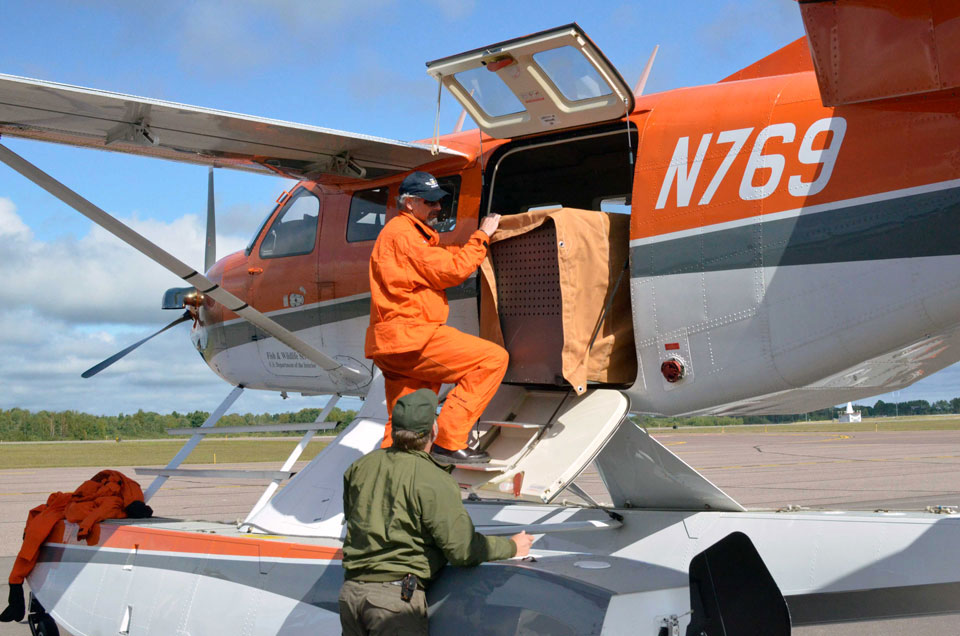
Another wolf has been transported to Isle Royale National Park to help balance the prey-predator ratio/NPS
One more wolf has been imported to Isle Royale National Park as part of the National Park Service's efforts to restore a prey-predator balance on the island park in Michigan's Lake Superior.
Last Friday park staff and partners successfully moved a wolf from Michigan’s mainland to Isle Royale. The 70-pound male, between 2 -3 years old, was captured in the Upper Peninsula and transported by amphibious aircraft to the island and released. This marks the beginning of the second year of a three- to five-year effort to establish a population of 20-30 wolves in the isolated park.
This fall’s efforts continue implementation of the June 2018 environmental impact statement decision to restore predation to Isle Royale's ecosystem. The Michigan wolf joins 14 other wolves on Isle Royale; 12 that were translocated last fall and winter and two resident wolves. The island population now includes eight males and seven females. One of the goals of the project is to source new wolves from diverse geographic areas to ensure genetic diversity. Since last September, wolves from Minnesota, from mainland Ontario, Michipicoten Island Provincial Park in Canada, and now Michigan have been brought to Isle Royale.
The goal for this fall’s operation is to translocate four to six wolves from Michigan’s Upper Peninsula to the park.

Biologists took measurements and assessed the health of the wolf before transporting it to Isle Royale/Michigan DNR
“We have relied on partners to access wolves for these translocation events,” Isle Royale Superintendent Phyllis Green said. “The Michigan DNR knowledge of wolf pack activity in the Upper Peninsula is extensive and we are relying on their expertise and support from trapping to veterinary services for this fall’s operations. We are hoping that the weather and conditions hold such that we are able to achieve the goal of bringing 4 – 6 wolves from the Michigan mainland to Isle Royale.”
The NPS and researchers from Michigan Technological University and State University of New York are tracking the movements of the wolves around the island. The primary goals of the project are to ensure that wolves form packs, reproduce, and act as predators on the park’s burgeoning moose population. Initial indications show that after just a few short months, the new wolves are starting to travel and hunt together. A female wolf from Minnesota and two males from Michipicoten Island Provincial Park have been doing just that since April.
The NPS, in collaboration with several state, federal, tribal, and university partners are studying the wolves and researching broad ecosystem change as the island adjusts to the return of predation, a key ecosystem community dynamic and a goal of the project.
Stories about:
Story Categories:
A copy of National Parks Traveler's financial statements may be obtained by sending a stamped, self-addressed envelope to: National Parks Traveler, P.O. Box 980452, Park City, Utah 84098. National Parks Traveler was formed in the state of Utah for the purpose of informing and educating about national parks and protected areas.
Residents of the following states may obtain a copy of our financial and additional information as stated below:
- Florida: A COPY OF THE OFFICIAL REGISTRATION AND FINANCIAL INFORMATION FOR NATIONAL PARKS TRAVELER, (REGISTRATION NO. CH 51659), MAY BE OBTAINED FROM THE DIVISION OF CONSUMER SERVICES BY CALLING 800-435-7352 OR VISITING THEIR WEBSITE. REGISTRATION DOES NOT IMPLY ENDORSEMENT, APPROVAL, OR RECOMMENDATION BY THE STATE.
- Georgia: A full and fair description of the programs and financial statement summary of National Parks Traveler is available upon request at the office and phone number indicated above.
- Maryland: Documents and information submitted under the Maryland Solicitations Act are also available, for the cost of postage and copies, from the Secretary of State, State House, Annapolis, MD 21401 (410-974-5534).
- North Carolina: Financial information about this organization and a copy of its license are available from the State Solicitation Licensing Branch at 888-830-4989 or 919-807-2214. The license is not an endorsement by the State.
- Pennsylvania: The official registration and financial information of National Parks Traveler may be obtained from the Pennsylvania Department of State by calling 800-732-0999. Registration does not imply endorsement.
- Virginia: Financial statements are available from the Virginia Department of Agriculture and Consumer Services, 102 Governor Street, Richmond, Virginia 23219.
- Washington: National Parks Traveler is registered with Washington State’s Charities Program as required by law and additional information is available by calling 800-332-4483 or visiting www.sos.wa.gov/charities, or on file at Charities Division, Office of the Secretary of State, State of Washington, Olympia, WA 98504.


National parks and their natural resources belong to you. The National Parks Traveler works to ensure you know how these essential places are being cared for.
Sign Up For Our Weekly Newsletter
Unsubscribe at any time.
INN Member

The easiest way to explore RV-friendly National Park campgrounds.

Here’s the definitive guide to National Park System campgrounds where RVers can park their rigs.
Our app is packed with RVing- specific details on more than 250 campgrounds in more than 70 national parks.
You’ll also find stories about RVing in the parks, tips helpful if you’ve just recently become an RVer, and useful planning suggestions.


Comments