
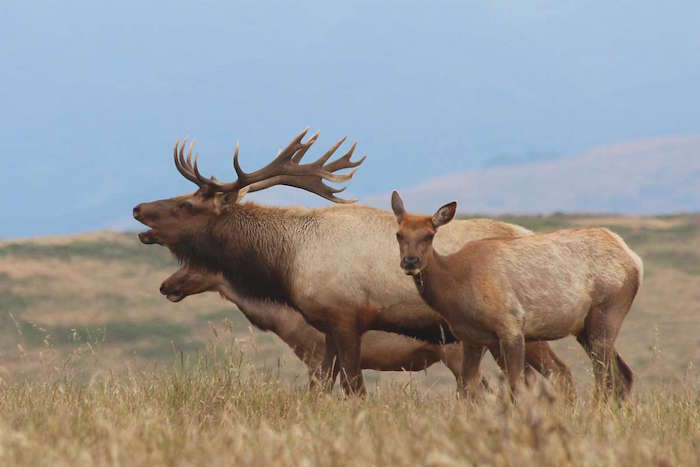
Point Reyes National Seashore staff next month are expected to release a draft management plan that addresses ranching inside the seashore/NPS file
Anticipation is building in advance of the release of a draft management plan for ranching and dairy operations at Point Reyes National Seashore, with opponents to the industries working to build support for the seashore's Tule elk herd.
At stake are not only the native elk that roam the landscape, but the generations-old livelihood of ranching families, as well as the health of native vegetation at the national seashore on the California coast that could be impacted. Up for consideration in the Draft General Management Plan Amendment and Environmental Impact Statement are options ranging from continued ranching unchanged to removing cattle from the seashore.
Once the draft is released next month, the public will have 45 days to comment on the way ranching and dairy operations and Tule elk at the national seashore should be managed going forward.
Ranching within the Point Reyes peninsula dates to the mid-1800s. Following the establishment of Point Reyes National Seashore and Golden Gate National Recreation Area, the National Park Service purchased the land from ranching families, who in many cases continued to ranch under time-limited reservations of use and occupancy. As the reservations expired, the Park Service continued to authorize ranching and dairying with agricultural lease/special use permits, as is allowed in the two parks’ legislation. Currently, 24 ranching operations are authorized for beef and dairy ranching under lease/permits, which include terms and conditions for the protection of natural and cultural resources.
In February 2016, litigation was brought against the Park Service related to an ongoing ranch planning process and the use of lands in the planning area for ranching and dairying. The plaintiffs and the Park Service, together with the ranchers and the County of Marin, entered into settlement negotiations. The court approved a multi-party Settlement Agreement on July 14, 2017. Per the agreement, the Park Service agreed that in lieu of a Ranch Comprehensive Management Plan, it would prepare a GMP Amendment and Environmental Impact Statement addressing the management of the lands currently leased for ranching in Point Reyes and the north district of Golden Gate.
According to Restore Point Reyes Seashore, a group that advocates for natural conditions at the seashore, cattle at the seashore outnumber Tule elk by nearly 10 to 1.
"The majority of Tule elk are confined to Tomales Point behind an 8-foot fence to prevent them from eating grass that’s leased to the ranchers. Half the confined elk herd—more than 200 animals—died during the recent drought for lack of water and nutritious forage," the group said. "But there's a free-roaming herd of Tule elk herd near Drake's Beach, adjacent to parklands grazed by cattle. Ranchers complain that these elk compete with their cows for grass. The NPS’s proposed remedies include killing, fencing, and removing the elk. Its current approach is daily hazing to run the elk off the leased range."
Some members of Congress want to legislate a permanent ranching industry at Point Reyes. Last year legislation sponsored by Rep. Jared Huffman, a California Democrat, called for "the Secretary of the Interior to manage the Point Reyes National Seashore in the State of California consistently with Congress’ long-standing intent to continue to authorize working dairies and ranches on agricultural property as part of the seashore’s unique historic, cultural, scenic and natural values..."
The bill would give cattle the edge over the native elk population at the national seashore.
"In areas of agricultural property where Tule elk present conflicts with working ranches or dairies, the Secretary shall manage the Tule elk for separation from the working ranches or dairies," it read. Further, the bill called for tribes to work with Interior to manage the elk population, either by relocating elk to tribal lands or hunting them "on a subsistence or ceremonial basis."
While the legislation didn't survive the last Congress, the congressman has indicated he will reintroduce the measure if needed to protect the ranching industry at the national seashore.
Stories about:
Story Categories:
A copy of National Parks Traveler's financial statements may be obtained by sending a stamped, self-addressed envelope to: National Parks Traveler, P.O. Box 980452, Park City, Utah 84098. National Parks Traveler was formed in the state of Utah for the purpose of informing and educating about national parks and protected areas.
Residents of the following states may obtain a copy of our financial and additional information as stated below:
- Florida: A COPY OF THE OFFICIAL REGISTRATION AND FINANCIAL INFORMATION FOR NATIONAL PARKS TRAVELER, (REGISTRATION NO. CH 51659), MAY BE OBTAINED FROM THE DIVISION OF CONSUMER SERVICES BY CALLING 800-435-7352 OR VISITING THEIR WEBSITE. REGISTRATION DOES NOT IMPLY ENDORSEMENT, APPROVAL, OR RECOMMENDATION BY THE STATE.
- Georgia: A full and fair description of the programs and financial statement summary of National Parks Traveler is available upon request at the office and phone number indicated above.
- Maryland: Documents and information submitted under the Maryland Solicitations Act are also available, for the cost of postage and copies, from the Secretary of State, State House, Annapolis, MD 21401 (410-974-5534).
- North Carolina: Financial information about this organization and a copy of its license are available from the State Solicitation Licensing Branch at 888-830-4989 or 919-807-2214. The license is not an endorsement by the State.
- Pennsylvania: The official registration and financial information of National Parks Traveler may be obtained from the Pennsylvania Department of State by calling 800-732-0999. Registration does not imply endorsement.
- Virginia: Financial statements are available from the Virginia Department of Agriculture and Consumer Services, 102 Governor Street, Richmond, Virginia 23219.
- Washington: National Parks Traveler is registered with Washington State’s Charities Program as required by law and additional information is available by calling 800-332-4483 or visiting www.sos.wa.gov/charities, or on file at Charities Division, Office of the Secretary of State, State of Washington, Olympia, WA 98504.
INN Member

The easiest way to explore RV-friendly National Park campgrounds.

Here’s the definitive guide to National Park System campgrounds where RVers can park their rigs.
Our app is packed with RVing- specific details on more than 250 campgrounds in more than 70 national parks.
You’ll also find stories about RVing in the parks, tips helpful if you’ve just recently become an RVer, and useful planning suggestions.


Comments
Permanent ranching industry? These are family businesses, not factory farms. The Seashore was founded in part to preserve them. That is why the Seashore includes a Pastoral Zone. These anti-ranch activists are fighting to change the nature of the Seashore, not to preserve it. They want to remake it as a wildlife park, kicking out the agricultural community. Agriculture is still an important part of the local economy, and these families are devoted to their way of life. The ranching heritage in Point Reyes is an integral part of this place. There would be no beautiful vistas here if ranching had not taken place for the last few centuries (first by the Spanish, then by the European settlers). That is what shaped the land everyone wants to protect.
At stake are the native elk? The elk are not native, and they are not at stake. This species was re-introduced here, and the elk are a marvelous tourist attraction, but they are not native wildlife. The Seashore has an obligation to manage the elk in a way that protects the ranches in the Pastoral Zone. There is plenty of room for both elk and ranches. The scare stories pitting the elk against the ranchers are nothing but propaganda. There is no chance the elk will be eliminated, the only question is whether they will be properly managed. There was a successful birth-control project here for the elk, but it was stopped for unknown reasons.
Restore Point Reyes Seashore is not an independent group that advocates for natural conditions at the Seashore, it is a propaganda project of the Resource Renewal Institute, one of the groups that sued the Seashore to change its ranch planning process. Yes, the ranchers "complain that these elk compete with their cows for grass" -- because the elk are illegally grazing on privately-managed agricultural land. When the elk were brought in, the Seashore's elk management plan said that "any depredations by elk on fences, crops or other property would require mitigation actions" and yet those actions have not been taken. It is not true that the elk are being hazed daily.
All the ranchers want is for the elk to be managed properly. The elk in the Pastoral Zone don't just graze there, they also damage fences and other property, gore the livestock, and impregnate cows -- when that happens the cow must be destroyed.
I hope you will interview some Point Reyes ranchers for your continuing coverage of this story, or at least reach out to some of the groups that are more objective than the anti-ranch activists. The University of California Cooperative Extension, the USDA Natural Resource Conservation Service, the Marin County Agriculture Commisioner's Office, and the Marin County Resource Conservation District all work with both the ranchers and the Sesahore and are knowledgeable about these issues.
Elk impegnating cows?
The detail about elk impregnating cows was told to me first-hand by a rancher I interviewed.
Maybe it was UFOs, hard to argue with such ignorance. Cattle on our public land is wrong.
Tule elk are native! There was once 870,000 Tule Elk in CA. This guy is spreading lies. I personally don't believe that ranching needs to be done on the beach. Native wildlife over ranchers!
They are a native species that was extirpated from the area, but there's a reasonably healthy population in California. And where is there ranching on the beach? Ranching is only done on grasslands that support (surprisingly enough) grasses.
A search on Google for the terms "tule elk impregnate cows point reyes" returns just one relelvant result: Ms. Rolph's comment above. And it's rich for Ms. Rolph to refer to Restore Point Reyes Seashoreas being "a propaganda project of the Resource Renewal Institute" considering her long time role in the various controversies at Point Reyes, especially the one concerning the oyster farm in potential wilderness. From her website: "As part of the Lunny support team, I provided pro bono communications services and created an advocacy website for the cause, www.savedrakesbay.com, which I continue to maintain."
I fully realize that there were elk in Point Reyes in the 1800s. I think there is a major distinction between a native species and a re-introduced species. If you don't see any difference between the two, I would be interested in your argument.
I stand by every word at the savedrakesbay.com advocacy site. If you can find something there that is not factual, please let me know and I will correct it. I make a point of calling it an advocacy site because that's what it is and I think it's important to be honest about where I am coming from. The About Us section makes it very clear that I am the author, my articles there often have links to sources, and in everything I publish about anything to do with Point Reyes I make a point of mentioning that I am writing a book about the Lunnys and what happened to them.
By contrast, the anti-ranch activists like to pretend they are something other than that. The Preserve Point Reyes site doesn't identify its authors, I had to drill way down to find out who it was. Based on this post, they seem to have represented themselves to Kurt as some new group (although it is possible that was an inference on his part). Similarly, George Wuerthner, a director of Western Watersheds, another of the sue-and-settle groups advocating against ranching in Point Reyes, publishes anti-ranch op-eds without reference to his affiliation. Both of these groups are spreading misinformation.
It seems to me that purposely spreading misinformation qualifies as propaganda, especially when the source is muddied. If someone thinks that's too strong a word for this particular set of misinformation, please go ahead and make the argument.
Attacking the messenger never strengthens one's case. I am a bit surprised at the lack of interest here in discussing the facts.
When I defended the Drakes Bay Oyster Farm, I remember being referred to as a PR shill paid by Kevin Lunny. I only wish I got paid for all that time I spent defending his business.
The reintroduction of a native species would not be necessary if man had not wiped them out in the first place. However, as wolves, once wiped out from the lower 48 have proven since their reintroduction, ALL native species are vital for a healthy and thriving ecosystem. The return of the wolves to Yellowstone is scientific proof of the symbiotic relationship all native species have, whether they had to be reintroduced or not.
The Bureau of Land Management and US Forest Service allow cattle grazing. Commercial grazing on federal land is clearly allowed.
Now grazing on NPS land is a fairly uncommon thing. Point Reyes has a very unique history where the ranchers basically agreed to NPS acquiring the land. Many were tenant farmers (RCA was one of the big Point Reyes landowners) who were concerned that their landlords would sell for housing development.The West Marin dairy industry was concerned that the loss of dairy ranches might lead to fewer dairy cows to make their processing facilities viable. Even the ranchers who owned their land outright agreed to it because they thought it would be for the greater good of the industry. There really is no similar setup. But the history of Point Reyes National Seashore was that it was created knowing there would be cattle grazing indefinitely.
It was never understood that ranches would be there indefinitely. I grew up very close by. We always, from the 60s on, expected that they would fade out as the owners died or deicided not to continue. The law establishing Pt. Reyes NS opens with:
"AN ACT To establish the Point Reyes National Seashore in the State of California, and for other purposes.
"Be it enacted hy the Senate and House of Representatives of the United States of America in Congress assembled, That in order to preserve, for purposes of public recreation, benefit, and inspiration, a portion of the diminishing seashore of the United States that remains undeveloped, …"
Dairy ranches do not fall into any of those 3 categories.
The law as it currently stands allows for indefinite renewals.
Now what this means has been up for fierce debate. I remember when it was 5 years at a time. Then Neubacher authorized 10 year renewals. When Salazar made the call on the oyster farm, he threw in his recommendation that they be 20 year terms. Now it's all up for grabs again.
I grew up on a sheep ranch a little inland from there. I had no idea that there were elk in the area, so suprised me big time.
Anyway, I think that, no I am positive that both ranching and wildlife would benefit greatly from management techniques that Allan Savory developed in Africa. He was not only able to greatly increase wildlife numbers and diversity, but was able greatly increase the livestock carrying capacity of the land at the same time while regenerating a very fertile soil. You can check out Allan's 22 minute TED Talk here: https://youtu.be/vpTHi7O66pI
For US application of Allan's techniques in dramatically differnt US environments,
see Will Harris' 15 minute video, "One Hundred Thousand Beating Hearts" here: https://youtu.be/UoQWLK8-CYE
and Gabe Brown's 65 minute presentation of his journey to regenerative agriculture here: https://youtu.be/ZTpYG0rAhBQ
I've been watching this comment string for a while now, reluctant to step in it for fear of tracking it into the house; however, I feel compelled at this point. I have no problems eating meat, oysters, cheese, ice cream, and so forth. And, I have substantial knowledge and long firsthand experience with cattle, selecting them, breeding them, ranching them, and even making them into meat. I am also all too familiar with ranchers and dairy operators and their problems. But, I'm also familiar with genetics and the problems that arise when gene pools get depleted. Much has been said, in the article and the subsequent comments. I think it’s time to step back and take a broader look.
A lot of numbers get used to describe the status of wildlife species, either currently or historically. I would never vouch for the exact accuracy of any such numbers; wild animals are just too hard to count precisely; but, in general, the numbers paint a clear and reliable picture. There were originally at least six, probably at least eight, elk species or subspecies in North America. All but four are now extinct; the others are wildlife varieties that have been lost forever. Of the remaining elk, Tule Elk are the smallest, have relatively complex antlers, are adapted to warmer coastal environments, are generally considered the most unique, and, unfortunately, are probably also the rarest. Out of a population estimated from between half and three quarters of a million prior to European colonization, no more than a few dozen survived by the end of the nineteenth century. In notional terms, that represents an evolutionarily recent reduction in their gene pool of up to twenty thousand to one. Yes, current estimates are that as many as five thousand Tule Elk exist today; however, today’s five thousand elk are the recent descendants of a gene pool of no more than a few dozen.
What does that mean? Let’s put it in perspective. Again in notional terms, imagine that the roughly three hundred million Americans in our nation gene pool today suffered a twenty thousand to one gene pool reduction like the one suffered by Tule Elk and only fifteen thousand Americans survived to reconstitute our population. Out of all of our vibrant and thriving cities, fifteen thousand is the population of only one very small town. Would they be our best or would they be among our worst? After such a horrific calamity, our future is much more likely to be dystopian than utopian. Now, go back and consider all the traits, capabilities, and survival skills Tule Elk may have lost. Remember also that the state of the science on predicting if, when, and where inbreeding effects are going to appear is nowhere near mature or reliable.
The article correctly points out that most of the elk at Point Reyes are fenced onto the Tomales Point area, trapped there so they can’t eat grass “leased” to ranchers; that more than two hundred of these rare elk recently died because they were trapped there, without water and forage; and that, as if the current situation is not disgusting enough already, the National Park Service is now proposing to kill more of these rare elk in other areas of the “parklands” because “ranchers complain” that these remnant specimens of Tule Elk are competing with their cattle for grass when "cattle at the seashore outnumber Tule elk by nearly 10 to 1" already. I ranched for decades; I know what ranching is all about; I also know the difference between marriage and rape; and it seems obvious that this is a case of pretentious ignorance, rampant greed, and spoiled selfishness run amok. At this point, we need these elk more than we need ranchers who are so unethical as to want to continue, much less escalate, this debacle and I would not disagree with a threatened listing for this species.
As far as the comments on this article, Savory was debunked long ago. The range looks good to people who don't know what they're looking at; but, the plant communities are all skewed toward faster regenerators and against the complete community that should be there. On this type of coastal range, those approaches would favor undesirable non-native vegetation that is already posing problems at the expense of native vegetation and probably make matters even worse. And, anyone who thinks elk are impregnating cattle has a truly ridiculous, sophomoric, and medieval understanding of biology; can’t reliably be given any credence on any topic beyond a grade school level; and certainly has no credibility on this topic, although I can believe some rancher told her that.
The law may now allow for indefinite renewals, but my reply was pointing out that PRNS was not "created knowing there would be cattle grazing indefinitely. "
If that had been the case, Rep. Huffman would not have felt the need last year to sneak into unrelated funding legislation a provision stating that is the intent of Congress for grazing to continue at PRNS. This was precisely the kind of measure that we justifiably criticize anti-environmental legislators for frequently doing.
I get that. I was incorrect that it was originally in the legislation, but there were a lot of things in the original legislation that were modified, including wilderness and potential wilderness status. I believe it was done as 50 year terms, but in 1980 that was modified to 25 year terms or a life estate. But this was in 1980, so it's not as if the indefinite renewals just snuck up on anyone in the past decade. The amendments became integral parts of the law. I don't recall there being anything controversial about it until recently when Neubacher started awarding 10 year terms and Salazar suggested that it should be 20 years.
It's true that I don't know much about elk. It sounds like I'm wrong about the impregnation detail. Thank you for pointing this out so that I can correct my knowledge. I'm working to trace the source of the error.
I do know quite a bit about Point Reyes.
I disagree with Dan Blake that ranching doesn't fit into the three categories mentioned in the overall purpose of the Seashore ("public recreation, benefit, and inspiration"). It fits under public benefit.
I also disagree with Blake's assertion that the Huffman legislation somehow proves that the Seashore wasn't created with the intent to retain grazing. Huffman's proposed legislation underlines the sad fact that Seashore officials have been unwilling to abide by the enabling legislation, or even by their own planning efforts. (The 1998 elk management plan, for example, which includes a formal Environmental Assessment, making it the rule of law, has not been followed; Seashore personnel have said it no longer applies. They are making up the rules as they go along.)
There is abundant evidence that the Seashore was indeed created with the understanding that ranching would remain indefinitely, starting with the mention in the enabling legislation of retained rights for heirs. It's very easy to get lost in the details; for those who want the full story I recommend Laura Watt's book about the management of Point Reyes National Seashore, The Paradox of Preservation.
In the documents from over the years that discuss ranching, it's quite clear that it has always been considered an important part of the Seashore. For example, the 1990 Range Management Guidelines document, which I read recently because it is referred to in the EIS and in some of the supporting documents, begins with the words:
"As illustrated below, the National Park Service within Point Reyes National Seashore and Golden Gate Recreational Area have been given an overall mandate to provide recreational opportunities, protect open space, preserve cultural and natural resources, and maintain agricultural activities in defined pastoral zones. It is the intent of the National Park Service to manage the pastoral zones of both Parks in a manner that will preserve park resources and recreational opportunities to the fullest extent, while honoring the legislative mandate or charge to also continue agricultural activities."
Then- Interior Secretary Salazar's November 29, 2012 decision memo on DBOC directing the Seashore to provide 20-year permits to the ranches says:
"Finally, the Department of the Interior and the NPS support the continued presence of dairy and beef ranching operations in Point Reyes' pastoral zone. I recognize that ranching has a long and important history on the Point Reyes peninsula, which began after centuries old Coast Miwok traditions were replaced by Spanish mission culture at the beginning of the 19th century. Long-term preservation of ranching was a central concern of local interests and members of Congress as they considered legislation to establish the Point Reyes National Seashore in the 1950s and early 1960s. In establishing the pastoral zone (Point Reyes enabling legislation PL 87-657, Section 4) Congress limited the Government's power of eminent domain and recognized "the value to the Government and the public of continuation of ranching activities, as presently practiced, in preserving the beauty of the area." (House Report No. 1628 at pages 2503-04.) Congress amended the Point Reyes enabling legislation to authorize the NPS to lease agricultural property that had been used for ranching or dairying purposes. (Section 318, Public Law 95-625, 92 Stat. 3487, 1978.) The House Report explained that "the use of agricultural lease-backs is encouraged to maintain this compatible activity, and the Secretary is encouraged to utilize this authority to the fullest extent possible. (House Report 95-1165, page 344.)
Accordingly, I direct that the Superintendent work with the operators of the dairy and cattle ranchers in the pastoral zone to reaffirm my intention that, consistent with applicable laws and planning practices, recognition of the role of ranching be maintained and to pursue extending permits to 20-year terms to the dairy and cattle ranches within that pastoral zone. In addition, the values of multi-generational ranching and farming at Point Reyes should be considered in future planning efforts. These working ranches are a vibrant and compatible part of Point Reyes National Seashore, and both now and in the future represent an important contribution to the Point Reyes' superlative natural and cultural resources."
That directive should have ended the matter. Then- Regional Director, Pacific West Region Jarvis issued the delegation of authority to that end on January 31, 2013. On that same day, the Seashore Superintendent forwarded the Jarvis memo to the ranchers with a letter saying NPS was committed to moving quickly on this and that they were currently working out the details. That was five and a half years ago and the Seashore has been stalling and obfuscating ever since then. Now they are trying to wriggle out of their obligations by rewriting the purpose of the Seashore with the current ranch EIS.
The elk at Point Reyes are being tragically mismanaged. The deaths of the elk in the Tomales Point elk reserve have nothing to do with the ranching or the fence, and everything to do with the lack of population control. When elk roamed in Point Reyes naturally, so did grizzly bears, black bears, and pronghorns. It's hard to understand why the Seashore imagined they could reintroduce a species that had been gone for over 150 years and just expect it to manage on its own as a wild animal. Without any predators, population control is necessary. A contraception project was reportedly piloted but abandoned.
Despite its failure to successfully manage the Tomales Point herd, the Seashore decided to introduce a free-ranging herd in 1998. To do so, it published an elk management plan that discusses the necessary population control and the necessity of keeping elk out of the pastoral zone, and of providing mitigation measures in the event of elk depredations on ranches. Those promises have not been kept. The ranchers have been told that the 1998 elk plan no longer applies. How they figure that, nobody knows; legally, it is still the controlling document.
That free-ranging herd that was created in the Limantour wilderness area has been allowed to overpopulate and is now grazing on ranches near there, and the Seashore refuses to take any meaningful action.
The free-ranging herd now has an offshoot in the pastoral zone that the Seashore is calling the Drakes Beach herd. (CA Fish & Wildlife considers it all one herd.) These elk are illegally being allowed to feast on privately managed agricultural resources. It is this herd that the Seashore is considering managing. The Seashore's preferred alternative in the current EIS would limit the population of this herd to 120 elk, out of a current estimate of 124 animals. This is a very minimal management effort, and under the preferred alternative, lethal removal would be used only for the Seashore's population control measures, not for eliminating elk depredations on ranches; for that, it proposes the current ineffectual hazing, along with elk-friendly fences.
The elk are being used as a political pawn rather than being managed properly. Those who care about this animal should demand that the Seashore take its wildlife management responsibilities seriously.