
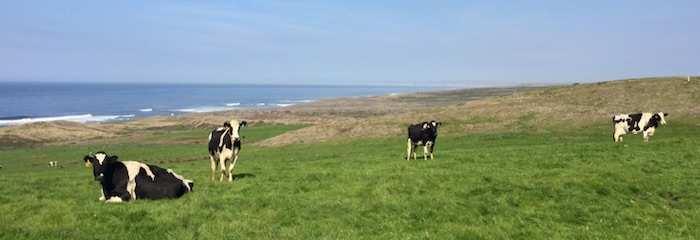
Should cattle gain an advantage over Tule elk at Point Reyes National Seashore?/NPS
The first time I drove to the Point Reyes Lighthouse, I was horrified to see large cattle ranching operations on National Park Service lands.
The adverse impacts of ranching on soils, water quality, vegetation, wildlife and visitor experience were undeniable: piles of manure, muddy trails, accelerated erosion, weed-infested pastures and gigantic heaps of rotting vegetation called silage (pasture plants are mowed and then fermented to feed livestock when there is no grass available). During the four years I worked at Point Reyes, I never drove past the ranches without shaking my head.
The ranched lands at Point Reyes are largely coastal prairie, which historically occurred from northern Los Angeles County into Oregon. More than 90 percent of this plant community has been disturbed or lost to development. In other words, the coastal prairie, as well as the plants and wildlife it supports, is rare and deserves full protection and restoration.
My co-workers understood that the ranches were “grandfathered” in under the national seashore’s enabling legislation. The government had purchased the ranches, and was to allow ranch operations to continue under leases for 25 years, or until the death of the ranch owner or his or her spouse.
I was not the only employee who believed the ranches had unacceptable environmental and social impacts, but for many years the Park Service could not, or simply chose not to, address the issue head-on — not until they were sued over those impacts.
In July 2017, the plaintiffs, ranchers, and the National Park Service reached a settlement — the Park Service could extend grazing leases for five years and was to complete a comprehensive environmental assessment of the ranches and subsequent general management plan within four years. This agreement was considered a win-win by all.
Then, suddenly, out of left (or, in this case, right) field, U.S. Reps. Jared Huffman, D-San Rafael, and Rob Bishop, R-Utah, quickly pushed a bill (HR6687) through the House of Representatives that attempted an end run around the settlement process, basically ordering the National Park Service to issue 20-year leases to the ranchers, and expressly putting the needs of ranches above the needs of natural resources and native wildlife (e.g., Tule elk).
Why did Huffman and Bishop try to force the Park Service to change the national seashore’s enabling legislation ahead of the environmental assessment of the impacts of the ranches? Perhaps because they knew at least some of the impacts of ranching on the environment at Point Reyes National Seashore would be, per the National Environmental Policy Act, “significant.”
Rather than allowing the National Park Service to conduct a thorough impact analysis and decide, with full public input, the fate of these private enterprises on public land, these politicians are trying to impose their will in favor of the ranchers. It appears that under an administration that clearly favors the economy over all else, and seems intent on privatizing as much of our public land as possible, Huffman and Bishop saw their chance to curry favor in Washington, at the expense of the integrity of Point Reyes National Seashore.
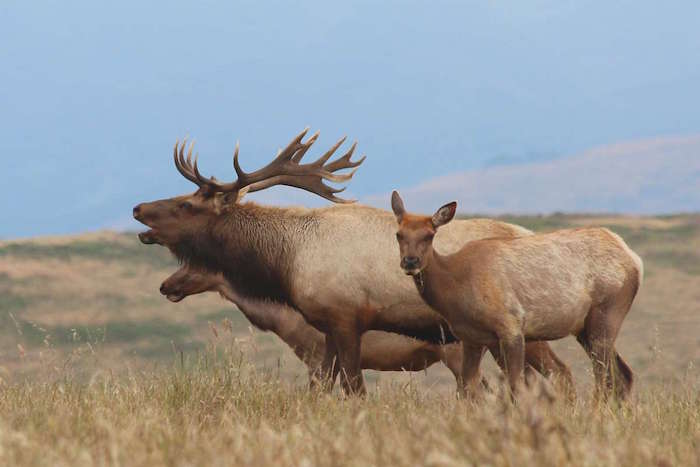
Tule elk could be managed under strict population caps if legislation to make ranching permanent at Point Reyes National Seashore passes/NPS
When considering HR6687, I urge our senators to do the right thing, to consider the needs and desires of all U.S. citizens — all of whom have a stake in Point Reyes National Seashore — as well as the needs of the land itself and the wildlife it supports. HR6687 should not be passed. Instead, allow the legal processes of environmental review and planning to go forward, and do not allow private interests to run roughshod over both the processes and the incomparable beauty and richness of Point Reyes National Seashore.
Let the National Park Service conduct its comprehensive analysis and, based on the data, (1) determine whether or not ranching can continue without harming the environment or the experience of the millions of people who visit the national seashore every year, and (2) if any of the ranches should be phased out or have their operations modified. To preempt this process in favor of private interests would be a breach of the public trust.
Barbara J. Moritsch worked as a plant ecologist for the National Park Service at Point Reyes National Seashore from 1998 to 2002. She is an occasional contributor to the Traveler.
Stories about:
Story Categories:
A copy of National Parks Traveler's financial statements may be obtained by sending a stamped, self-addressed envelope to: National Parks Traveler, P.O. Box 980452, Park City, Utah 84098. National Parks Traveler was formed in the state of Utah for the purpose of informing and educating about national parks and protected areas.
Residents of the following states may obtain a copy of our financial and additional information as stated below:
- Florida: A COPY OF THE OFFICIAL REGISTRATION AND FINANCIAL INFORMATION FOR NATIONAL PARKS TRAVELER, (REGISTRATION NO. CH 51659), MAY BE OBTAINED FROM THE DIVISION OF CONSUMER SERVICES BY CALLING 800-435-7352 OR VISITING THEIR WEBSITE. REGISTRATION DOES NOT IMPLY ENDORSEMENT, APPROVAL, OR RECOMMENDATION BY THE STATE.
- Georgia: A full and fair description of the programs and financial statement summary of National Parks Traveler is available upon request at the office and phone number indicated above.
- Maryland: Documents and information submitted under the Maryland Solicitations Act are also available, for the cost of postage and copies, from the Secretary of State, State House, Annapolis, MD 21401 (410-974-5534).
- North Carolina: Financial information about this organization and a copy of its license are available from the State Solicitation Licensing Branch at 888-830-4989 or 919-807-2214. The license is not an endorsement by the State.
- Pennsylvania: The official registration and financial information of National Parks Traveler may be obtained from the Pennsylvania Department of State by calling 800-732-0999. Registration does not imply endorsement.
- Virginia: Financial statements are available from the Virginia Department of Agriculture and Consumer Services, 102 Governor Street, Richmond, Virginia 23219.
- Washington: National Parks Traveler is registered with Washington State’s Charities Program as required by law and additional information is available by calling 800-332-4483 or visiting www.sos.wa.gov/charities, or on file at Charities Division, Office of the Secretary of State, State of Washington, Olympia, WA 98504.
INN Member

The easiest way to explore RV-friendly National Park campgrounds.

Here’s the definitive guide to National Park System campgrounds where RVers can park their rigs.
Our app is packed with RVing- specific details on more than 250 campgrounds in more than 70 national parks.
You’ll also find stories about RVing in the parks, tips helpful if you’ve just recently become an RVer, and useful planning suggestions.


Comments
The thing is, Rep. Huffman can hardly be called right field. He's one of the most consistently pro-environment and pro-science voices in the House and on the Natural Resources Committee. It's baffling, and he hasn't given a rational explanation for introducing the bill yet, given that there is a general management plan update in process. He insists the bill does nothing to change that, but its mere existence and terms put pressure on the Park Service.
I've asked this question about Huffman myself. Apparently, while being an "environmentalist", he has also always been a ranch/agriculture supporter. The more I dive into this the more I am learning about the heavy influence the ranching community has on many aspects of day to day life in Marin county leaving me to wonder if Huffman "benefitted" in other ways. $$$
The language of the bill changes the original wording of the purpose of the park, allowing the ranches to be considered part of the natural landscape despite there being nothing natural about them. News alert for everyone caught up in the declaration that the ranches are "historical", being around for a relatively long time is not the same as being natural.
National Parks should be for wildlife, natural-nature and low-impact visitors to enjoy not miles of barbed-wire, pollution, poo-pond and pee-creeks that for-profit cattle and dairy corporate industries offer the National Parks.
Scott - you do realize that Point Reyes was "barbed-wire, pollution, poo-pond and pee-creeks that for-profit cattle and dairy corporate industries" before being designated a NP. By the way, are you a vegetarian?
it well might have been, but at the time it was designated a national seashore, the area was under threat of massive housing development, and the landscape (despite the ranches) was felt worthy of protection, which is why the Seashore was established. The ranchers were given generous buyouts and lease backs in order to get their support for the seashore, But there was never any understanding orignally that the dairy farms would be permanent fixtures. It's not clear why the buy-back-leases haven't mostly run their course, though their term was for 25 years or the life of the rancher or their spouse, whichever was later, so maybe they are long-lived, hearty folk.
It seems the Park Service / Interior Department felt they could ignore that stipulation and rely on local supporters of dairying to carry the day ahould any political interference arise. That's the scenario that is playing out now. Prominent ag supporters have admitted that they want to change the intent of the park to preserving agriculture. And just a week or so ago, the Park Service announced that many of the ranches had been placed on the national Regiser of Historic Places—right up there with Independence Hall and Mt.Vernon ! </s>
The consistent theme in this article and the comments I have seen so far can be rendered simply as "We are environmentalists and we HATE ranchers, farmers, and anyone else who owns a business or a chainsaw or a rifle." In the veldbilt of such people is a sickening disconnect from the realities of life for most of mankind for the past several thousand years. Most people have had to wring a living from the soil. We are blessed to live in a nation where that is no longer true, but the codicil to that fact is the growing disconnect and disrespect for those who still do produce the nation's food and timber. It is for that very reason that I, despite an interest in environmental issues, no longer trust virtually any environmental NGO or spokesman to be anything else but an avowed and irreconcilable enemy of myself and any other farmer .
The article mentions the ranches were grandfathered in under the legislation designating the park. Are these leases permanent? Can their leases be bought out? I say either buy them out at fair market value or wait until the leases expire. It also mentioned 25 year leases when it was park was designated. If that's the case, then they should be coming up for expiration in a few years. Let them expire and/or buy them out.
Actually, they are well past their original expiration. However, rather than using their 25-year leases (and millions of dollars paid by the federal government) to prepare for a different future outside of ranching, the ranchers instead hired lobbyists and set about bullying and influencing the Parks Service staff. They should not still be there, but they are. So although your idea is a good one, the solution seems to be muddled in controversy and politics.
And 10s of thousands of far less significant places. Have you ever looked at what is actually on that list?
Yeah but the NRHP is just a listing of historical sites regardless of national significance. In fact, most of them have local significance and not even regional. It also provides zero protection. Many of them are privately owned. It's just a historical recognition list. Some places have even been demolished and torn down. So the NPS just removes them after that. It's a good list but shouldn't be confused with nationally historically signifigant places only. Only some are.
They weren't necessarily permanent. However, the legislation authorizes the land to be leased back. This was done as 5 and then 10 year leases. When Ken Salazar issued his memo denying the 10 year special use permit for Drakes Bay Oyster Company, he threw in a recommendation that the special use permits for the ranches should be increased to 20 year terms.
https://www.doi.gov/news/pressreleases/secretary-salazar-issues-decision...
Here's the relevant part of the legislation:
https://www.gpo.gov/fdsys/pkg/USCODE-2010-title16/html/USCODE-2010-title...
Preserving agriculture is in the legislation (15USC459c–5(a)) and has been since 1978. The original 1962 legislation wasn't so clear about how this would be done, but that was apparently clarified in 1978 via Public Law 95-625. The law currently in place set up the life estate or 25 years at the rancher's choice. It also allows for the land to be leased after those terms, with the original owners having first dibs.
The reason why the owners would agree to sell were complex. The entire dairy community was worried that this land being developed into housing would mean the loss of dairy cows and could make West Marin's dairy processing facilities less viable from loss of business. Many wanted to keep their way of life. Also - several of the ranches were not owned by the ranchers. They were tenant farmers who were worried that their landlords would sell out to housing developers. I've read somewhere that RCA was the biggest landowner in the area. I'd also think the landowners who sold got a sweet deal where they were no longer liable to pay property taxes and got a really good lease.
It seems that much of the current state of things comes as a result of lack of action by the Parks Service over the last several decades leading up to collision of issues and an opportunity to push a bill through the house and senate. So what the heck is going on with the Park Service?
thanks for all that info y_p_w!
Not a problem. I haven't necessarily even gotten all this straight. I took some interest in the laws regarding the cattle ranches as a tangential subject with the oyster farm, but never really got into it in depth. Apparently a lot of this was put in place piecemeal and it's very difficult to figure out what the law was in 1962, 1970, or 1978 as different pieces of legislation overrode previous law.
The NPS Point Reyes NS site is a good place to start, but it doesn't necessarily have the entire history. Their "establishing legislation" seems to put it all together as it existed in 2002, but doesn't go in depth into various new legislation that modified the law.
https://www.nps.gov/pore/learn/management/lawsandpolicies.htm
I researched it via the Cornell Law School's Legal Information Institute US Code database. It has a ton of detail on the history, including which public law sections resulted in changes.
https://www.law.cornell.edu/uscode/text/16/459c–5
Here's another version that's annontated:
This may have been done after the fact, since I heard the ranches were already purchased by the early 70s. Here's an example of one of the lease renewals:
https://home.nps.gov/pore/getinvolved/upload/planning_ranch_cmp_leases_p...
I know this is a lot to look at. However, I wanted to counter Dan Blake's claim that somehow there was an end-around against a definite term (i.e. "run their course") that was going to expire. As far back as 1978 there was already law that said that NPS could lease back the land to the ranchers, although that would have to be in a manner consistent with the rest of the enabling act. The law itself was open-ended. The intent of the park was in part to preserve agriculture. If you read the amendment to the enabling legislation (from 1978) it's pretty clear that it didn't mandate that agricultural uses ended with the expiration of the terms. The current renewals were done in accordance with the law.
Marion, I come from a documented ranching heritage that stretches back the better part of a thousand years and that's just the part we have proven documents on. I ranched for decades; I've bought and sold my share of ranches and land; I produced top quality grass-fed beef, high color hides, skull mounts, fence posts, and countless cords of firewood; I've legally taken and eaten my share of venison, elk, and bison; and, although I sold my business, I still own two working chainsaws, several partial spools of remaining unused barbed wire, my brand registration and iron, a very well cared for Callicrate Bander, and a good number of rifles, pistols, and shotguns. I do not hate ranchers in general, only the whiny ones who like to wear old west costumes, the ones who invariably turn out to be fake, shabby, sloppy, crooked, and/or codependent. You know, the ones you seem to like to defend and, my gosh, there's a lot of them like that out there nowadays.
Whenever I bought or buy a piece of property, like I did in my role as a taxpayer when the federal government originally bought out this Point Reyes trash, I want the conditions of the sale honored. As the article clearly states, when these so-called ranchers sold their holdings at Point Reyes, they took the money, millions of dollars worth, clearly understanding that ranch operations would only be allowed to continue for 25 years or until the death of the ranch owner or his or her spouse, whichever came later. They knew the deal; they signed the papers; they cashed the checks; they took the money; and they spent the money, in some cases actually making more money through questionable sublet-style transactions with RCA and other big outside corporations. Now, I've had some seller's remorse on occasion and I've sold ranches and land contingent on having a bit of extra time to get my stock moved and my operations closed. That's not uncommon. But, I guarantee that, if I had ever, ever, ever reneged on a deal the way this Point Reyes trash has done, the local sheriff's deputies and livestock inspectors would have been out there hauling all of it, including me, off the premises.
However, a previous commenter pointed out that, rather than using their 25-year leases and their share of the millions of dollars connived out of the federal government to invest in and build their future, they instead wasted the time, squandered the money, and then hired corrupt political lobbyists to bully the National Park Service into letting them continue to squat on park land. Boy, ain't that the truth. Ironically, they would have actually been better off had they used those 25 years to get some serious education and training, used that time to invest in and improve themselves, and used more of their share of that original federal largess to get a better start. If they had, they would be better off and we wouldn't be arguing over it now.
How do I know that? How can I say that? Well, I know because they started with more than I started with and they got even more in their share of the original deal, which is why they took the original deal in the first place. Had they shown even an ounce of initiative, they could have been sitting pretty by now; yet, I know where I got and I know they're still there arguing over a bunch of worthless, two-bit, trashy, Johne's disease infected dairy cows. They're an embarrassment to any real rancher.
After all this time and all their talk, they still don't even know how to run a clean dairy and now they want the NPS to let them raise sheep and chickens. Now that's going to end up being a lot of poultry feces.
Marion, these whiny codependent slackers are no ranchers. They're not even respectable farmers. They're just trashy squatters. Don't even get me started on Bob McClure. And, that Drakes Bay Oyster Farm bunch, one of their apparently self-appointed leaders once commented, on this very website, that the Tule Elk at Point Reyes needed to be eliminated because the elk keep breeding with the dairy cows and that, when that happens, the cows are "ruined" and have to be destroyed. She was and apparently still is sashaying around spouting her opinions about farms, ranches, national parks, and such; but, at least at that time, she actually knew so little about any of it that she thought elk went around fornicating with cattle and resulting in the need for some kind of "honor killing" at the dairy. Marion, I hope you at least know enough about farming and ranching to know that elk actually don't go around fornicating with cattle and that dairies don't then have to perform an "honor killing" on the "ruined" cows. If you do know that much, please inform that Drakes Bay Oyster Farm bunch; it's kind of embarrassing, not to mention just flat creepy, for those of us in the livestock business.