Senators Launch Another Effort To Pay For National Parks' Maintenance Backlog

June 29, 2018
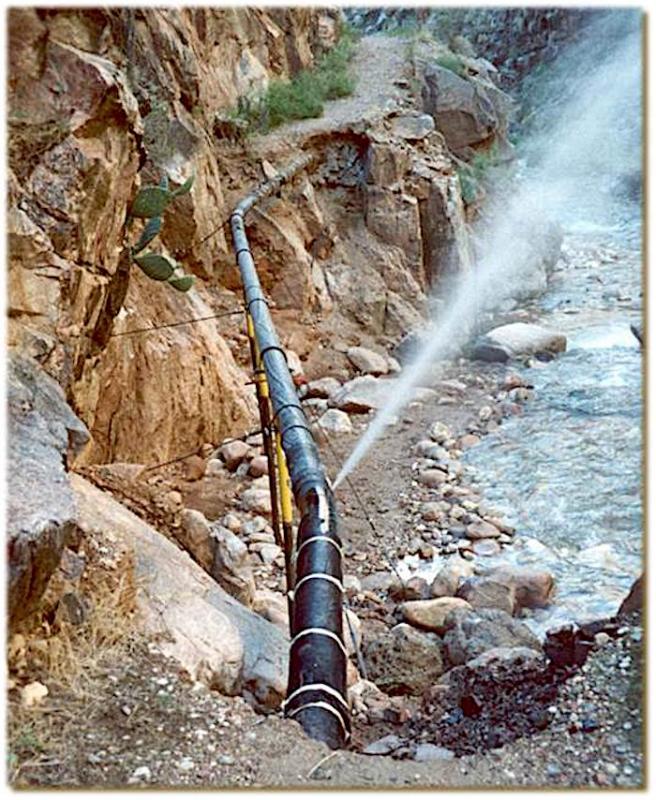
Pipeline leak, Grand Canyon National Park/NPS
Another measure to attack the $12 billion backlog of maintenance work in the National Park System has been introduced to Congress/NPS file

For the third time in a little more than a year, senators have introduced legislation aimed at addressing the staggering maintenance backlog across the National Park System. The latest bipartisan effort, which could cover more than half of the nearly $12 billion in backlogged work, pulls aspects from the previous two measures that have failed to gain traction.

In the wake of the National Park Service Legacy Act introduced in March 2017 by Senators Rob Portman (R) of Ohio and Mark Warner (D) of Virginia and the National Park Restoration Act introduced by Senator Lamar Alexander (R) and Congressman Mike Simpson (R) this past March, Sens. Portman, Warner, Alexander, and Angus King (I) on Friday introduced the Restore Our Parks Act. In addition to thse four senators, Senators Shelley Moore Capito (R) of West Virginia and Cory Gardner (R) of Colorado signed on as cosponsors.

The measure, which currently lacks a House companion, takes a more aggressive approach than the previous two to make progress on reducing the maintenance backlog. The Portman-Warner bill called for annual appropriations from Congress, over a three-decade period, to cut down the backlog. The Alexander-Simpson bill is the de facto Trump administration proposal to create a fund of up to $18 billion from revenues derived from on- and offshore energy development to pay for the work.

The Restore Our Parks Act would establish the “National Park Service Legacy Restoration Fund” to reduce the maintenance backlog by allocating existing revenues the government receives from on and offshore energy development. The $6.5 billion in funding envisioned by the legislation would come from 50 percent of all revenues that are not otherwise allocated and deposited into the General Treasury, not to exceed $1.3 billion each year for the next five years.

The difference between the Restore Our Parks Act funding stream and that called for in the Alexander-Simpson measure is the latest legislation would tap existing revenues coming in from energy development, and not rely on royalties from new energy development, something that drew criticism when the Alexander-Simpson bill first was introduced.

On Friday, the senators pointed to deferred maintenance needs in the park system, from nearly $75 million in the eight park units in Ohio to the more than a billion dollars in backlogged work in parks in Virginia, in promoting their legislation.

"Virginia now ranks third among all states in total deferred maintenance, trailing only California and the District of Columbia," said Sen. Warner. "The longer we wait to address the crumbling infrastructure in our national parks, the worse the problem gets. Today’s introduction marks a step forward in the process of finally fixing the $12 billion maintenance backlog at our national parks. I will continue to work with my colleagues to get this bill passed so that we can make much-needed investments in national treasures like Shenandoah National Park, which has nearly $80 million in overdue maintenance needs."

Sen. Alexander praised Sens. Portman and Warner for developing the latest measure, and predicted that it "should have near unanimous support."

"The end result is $6.5 billion toward eliminating the national park maintenance backlog, $215 million of which is in the Great Smoky Mountains National Park,” said Sen. Alexander.

At The Pew Charitable Trusts, which has been working to build support to erase the maintenance backlog, Marcia Argust pointed to the bipartisan backing of the latest legislation.

“Fixing our national parks is nonpartisan, as this compromise bill proves,” said Ms. Argust, who direct's Pew’s Restore America’s Parks Project. “Lawmakers are listening to the nearly 3,000 organizations that are calling on Congress to protect our parks and preserve local economies by enacting legislation to address the national park maintenance backlog, including repairs to historic buildings, trails, and campgrounds.”

At the National Parks Conservation Association, President and CEO Theresa Pierno commended the "leadership of these park champions for their bill that makes a strong investment in our parks that they desperately need and deserve. America’s national parks include our most treasured landscapes and historic and cultural sites that must be protected and maintained so that future generations have the opportunity to learn about the people and places that have shaped our nation’s legacy.”

Interior Secretary Ryan Zinke said the legislation could make significant inroads in improving the national park experience for visitors.

“Park infrastructure is about access for all Americans," he said. "In order for families, children, elderly grandparents, or persons with disabilities to enjoy the parks, we need to rebuild basic infrastructure like roads, trails, lodges, restrooms and visitor centers. This is not a Republican or Democrat issue, this is an American issue, and I think that the bipartisan body of lawmakers who put this bill forward is proof. I look forward to working with my colleagues in the administration and Congress to see this come to fruition.”

To learn more about the maintenance backlog, please read the following articles:

A copy of National Parks Traveler's financial statements may be obtained by sending a stamped, self-addressed envelope to: National Parks Traveler, P.O. Box 980452, Park City, Utah 84098. National Parks Traveler was formed in the state of Utah for the purpose of informing and educating about national parks and protected areas.

Residents of the following states may obtain a copy of our financial and additional information as stated below:

  • Florida: A COPY OF THE OFFICIAL REGISTRATION AND FINANCIAL INFORMATION FOR NATIONAL PARKS TRAVELER, (REGISTRATION NO. CH 51659), MAY BE OBTAINED FROM THE DIVISION OF CONSUMER SERVICES BY CALLING 800-435-7352 OR VISITING THEIR WEBSITE. REGISTRATION DOES NOT IMPLY ENDORSEMENT, APPROVAL, OR RECOMMENDATION BY THE STATE.
  • Georgia: A full and fair description of the programs and financial statement summary of National Parks Traveler is available upon request at the office and phone number indicated above.
  • Maryland: Documents and information submitted under the Maryland Solicitations Act are also available, for the cost of postage and copies, from the Secretary of State, State House, Annapolis, MD 21401 (410-974-5534).
  • North Carolina: Financial information about this organization and a copy of its license are available from the State Solicitation Licensing Branch at 888-830-4989 or 919-807-2214. The license is not an endorsement by the State.
  • Pennsylvania: The official registration and financial information of National Parks Traveler may be obtained from the Pennsylvania Department of State by calling 800-732-0999. Registration does not imply endorsement.
  • Virginia: Financial statements are available from the Virginia Department of Agriculture and Consumer Services, 102 Governor Street, Richmond, Virginia 23219.
  • Washington: National Parks Traveler is registered with Washington State’s Charities Program as required by law and additional information is available by calling 800-332-4483 or visiting www.sos.wa.gov/charities, or on file at Charities Division, Office of the Secretary of State, State of Washington, Olympia, WA 98504.

INN Member

The easiest way to explore RV-friendly National Park campgrounds.

The Essential RVing Guide to the National Parks 

Here’s the definitive guide to National Park System campgrounds where RVers can park their rigs.

Our app is packed with RVing- specific details on more than 250 campgrounds in more than 70 national parks. 

You’ll also find stories about RVing in the parks, tips helpful if you’ve just recently become an RVer, and useful planning suggestions.

The Essential RVing Guide to the National Parks 

FREE for iPhones and Android phones.