
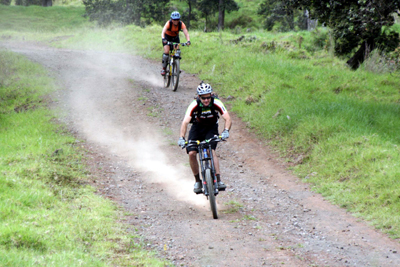
Interior Department officials reportedly are proposing a regulation that could make it easier for mountain bikers to gain access to backcountry trails in the National Park System. NPS photo of mountain bikers in Hawaii Volcanoes National Park.
Three years after the International Mountain Bicycling Association (IMBA) said it simply wanted mountain bike access to dirt roads in national parks, Interior Department officials reportedly are working to make it easier to expand mountain bike access to backcountry trails in the park system.
According to Public Employees for Environmental Ethics, Assistant Interior Secretary Lyle Laverty is preparing a regulation that would make it easier for park superintendents to allow mountain bikers into the backcountry of their parks.
"This is a lame duck gift for our Mountain-Biker-in-Chief," says PEER Executive Director Jeff Ruch. "With all the troubles facing the country, the White House should be concerned about more than where the president can ride his bike."
Of course, Mr. Ruch is using a little hyperbole with his statement, as the proposed regulation that's expected to be released in the coming weeks is aimed at all mountain bikers across the country, not simply the president.
But it should also be noted that IMBA has been lobbying hard, and not always forthrightly, in trying to expand mountain bike access in the national parks. (Oddly, the group also has indicated an interest in emulating the National Rifle Association to a certain degree to get what it wants.)
And let's not overlook that there already are hundreds of miles of mountain biking opportunities in the parks, ranging from the classic White Rim Trail in Canyonlands National Park to routes through the woods at Mammoth Cave National Park, the carriage paths in Acadia National Park, and even the rail trails in Cape Cod National Seashore. In all, more than 40 national park units off mountain biking opportunities in some form.
But what IMBA's leadership craves is single-track backcountry access, access even into proposed and designated wilderness areas. But that card wasn't revealed when the organization first began making inroads with the National Park Service back in 2005.
When IMBA signed a memorandum of understanding with the Park Service in 2005, the stated intent was that IMBA merely was interested in looking at riding opportunities on dirt roads. And while that original MOU called for pilot mountain bike projects in two parks, soon thereafter it was expanded to three -- Big Bend National Park, Fort Dupont Park in the District of Columbia, and Cuyahoga Valley National Park in Ohio.
And then, during the summer of 2006 an IMBA crew visited Hawaii Volcanoes National Park to offer trail-building advice and even ran a 15-mile test event. Here's what park officials had to say about that test event: The 15-mile route included a 6-mile, 1700' uphill and loop trails over loose gravel, slick grass, and steep rocky stretches To prevent the introduction of non-native plants and insects into the park, rangers helped riders clean their bikes, packs, and shoes before the ride.
In January 2006 IMBA's communications director, Mark Eller, told the Traveler his group did indeed have designs on seeing single-track trails cut in national parks. "We feel comfortable, the NPS feels comfortable, with looking at the potential for trails to be opened. Those all require the environmental assessments and rule-making procedures," Mr. Eller said at the time.
Also in January of 2006, Jenn Dice, IMBA's government relations director, told a member of the Coalition of National Park Service Retirees that IMBA's members want to see single-track trails in the parks because a majority of the membership finds dirt roads "boring and mind-numbing, and not the kind of fun they are looking for."
In fact, IMBA's official stance when it comes to developing mountain bike tourism is that "single track is essential." Here's what IMBA's web site has to say about single-track trails: "Mountain bikers crave single-track and designing interconnecting single-track trails will bring them in droves."
As for the organization's thoughts on wilderness, which is out-of-bounds for mechanized vehicles? While IMBA supports wilderness designations, it also believes "mountain biking, a low-impact, muscle-powered recreation, is an appropriate trail use on public lands and is consistent with the values of Wilderness land protection, which includes recreation in natural landscapes. When proposed Wilderness Areas include significant mountain biking opportunities, IMBA pursues boundary adjustments and alternative land designations that protect natural areas while preserving bicycle access. IMBA can support new Wilderness designations where they don't close singletrack bicycling opportunities. "
In its bid to gain more access to the parks, IMBA has been working behind the scenes to see about changing Park Service rule-making policies with hopes of cutting through the red-tape to open up more park terrain to cyclists. Drew Vankat, the group's policy analyst, told the Traveler last December that IMBA was mulling a run at changing the rules that must be negotiated for a park superintendent to open park terrain beyond developed areas to mountain bikes.
However, others within the Park Service said at the time that IMBA was "applying pressure" to have the existing rule-making procedures changed. Specifically, they said, IMBA wanted to remove the current requirement that superintendents promulgate a special regulation to create bike trails beyond developed areas.
Guess what? Apparently Mr. Laverty is proposing to do just that.
PEER officials say they fully endorse getting more people out of their cars to bike on the paved and dirt roads of national parks. However, the group also believes that mountain biking on narrow trails could damage resources and conflict with visitor enjoyment.
It was with those concerns that the National Park Service in 1987 adopted regulations for bicycles that allow mountain bikes on trails only after an individual park follows a stringent decision-making process that allows for closer scrutiny. The process requires notice of a proposed regulation in the Federal Register and publication of a special federal regulation. Several parks have adopted the necessary special regulations to allow bikes. Among the parks are Saguaro National Park in Arizona and Golden Gate National Recreation Area in California.
That said, according to PEER, the proposed regulation, if adopted, would allow each park manager to designate backcountry trails open to mountain bikes by making a simple notation in an internal document called a "compendium." Now, that management document is available to the public upon request, but receives no public notice or public comment prior to approval.
Remember Mr. Eller's comment above that IMBA realized that expanded mountain bike access required "environmental assessments and rule-making procedures"? Well, PEER believes that under this proposed regulation there would be no requirement for park managers to prepare any environmental compliance under the National Environmental Policy Act or other laws prior to adoption.
"The pending proposed bicycle rule is a step backward for park conservation. IMBA is correct to anticipate that such a lax and nearly invisible process will open many more trails to bikes," says PEER Board member Frank Buono, a long-time former NPS manager. "We think the current rule is a good one. PEER does not oppose mountain bikes on trails in backcountry areas that are outside of designated, proposed or recommended wilderness but each proposal to allow bikes on backcountry trails should be thoughtfully and publicly considered."
Story Categories:
A copy of National Parks Traveler's financial statements may be obtained by sending a stamped, self-addressed envelope to: National Parks Traveler, P.O. Box 980452, Park City, Utah 84098. National Parks Traveler was formed in the state of Utah for the purpose of informing and educating about national parks and protected areas.
Residents of the following states may obtain a copy of our financial and additional information as stated below:
- Florida: A COPY OF THE OFFICIAL REGISTRATION AND FINANCIAL INFORMATION FOR NATIONAL PARKS TRAVELER, (REGISTRATION NO. CH 51659), MAY BE OBTAINED FROM THE DIVISION OF CONSUMER SERVICES BY CALLING 800-435-7352 OR VISITING THEIR WEBSITE. REGISTRATION DOES NOT IMPLY ENDORSEMENT, APPROVAL, OR RECOMMENDATION BY THE STATE.
- Georgia: A full and fair description of the programs and financial statement summary of National Parks Traveler is available upon request at the office and phone number indicated above.
- Maryland: Documents and information submitted under the Maryland Solicitations Act are also available, for the cost of postage and copies, from the Secretary of State, State House, Annapolis, MD 21401 (410-974-5534).
- North Carolina: Financial information about this organization and a copy of its license are available from the State Solicitation Licensing Branch at 888-830-4989 or 919-807-2214. The license is not an endorsement by the State.
- Pennsylvania: The official registration and financial information of National Parks Traveler may be obtained from the Pennsylvania Department of State by calling 800-732-0999. Registration does not imply endorsement.
- Virginia: Financial statements are available from the Virginia Department of Agriculture and Consumer Services, 102 Governor Street, Richmond, Virginia 23219.
- Washington: National Parks Traveler is registered with Washington State’s Charities Program as required by law and additional information is available by calling 800-332-4483 or visiting www.sos.wa.gov/charities, or on file at Charities Division, Office of the Secretary of State, State of Washington, Olympia, WA 98504.
INN Member

The easiest way to explore RV-friendly National Park campgrounds.

Here’s the definitive guide to National Park System campgrounds where RVers can park their rigs.
Our app is packed with RVing- specific details on more than 250 campgrounds in more than 70 national parks.
You’ll also find stories about RVing in the parks, tips helpful if you’ve just recently become an RVer, and useful planning suggestions.


Comments
Great thats just one more thing for hikers to think about; when some fool racing down a trail on his or her mountain bike runs you over comming around a corner; or over a rise. So much for a peaceful hike in the woods.
While I do not support allowing bikes into the backcountry, I do think the current regulations are a little too strict. The current regulations prohibit bicycles on anything other than roads unless a special regulation is written as described in the story. In the middle are multi-use trails built specifically for bicycles and pedestrians. These are usually 8 feet wide and hard-surfaced. Even though these are built to handle bikes, parks must actually go through the long and expensive process of writing a regulation to allow bikes on these trails. As a result, most parks with these trails have never written a regulation - they just allow them. Since the trail planning process usually has public comment and NEPA compliance, it would be benefitial to have a regulation that allows bikes on trails designed and built for that purpose as long as the trail planning had the proper public comment and compliance.
Since I'm quoted in the Traveler's piece, I'm hoping to use this board to respond. No one at the Traveler has asked IMBA for comment on this matter of late.
In point of fact -- as Rangertoo points out -- the NPS rule change that IMBA has long requested changes nothing about NEPA requirements. The result we hope to see is simply a more straightforward process that parks will adhere to, rather then the daunting bureaucratic mess that currently exists.
A press release and a white paper on available IMBA's website explains the proposed rule change in detail. In short, we've been asking for a less convoluted process for establishing and documenting shared-use trails in NPS units since 1992.
Since Kurt brings up the use of hyperbole in his article, why does he say that trails open to bikes would "cut" into the back-country, while foot-travel trails are described as being "built"?
-- Mark Eller
I'm an avid hiker, fly fisherman and mountain biker. IMBA has taken an approach that is very considerate of other trail users. I support including mountain biking using the IMBA approach in appropriate locations within the national parks. This includes access on some good single track trails.
I think Rangertoo makes some really good points. As it stands, National Parks are pretty much known as "NO Go" zones for bicycles, and not just mountain bikes. You can be ticketed for riding your beach cruiser on a dirt service road that is open to NPS motorized vehicles. That frankly defies logic. The "trails" in the Marin Headlands that are open to bikes are all full width fire roads, historic routes that were established by the military prior to acquisition by the NPS.
I find Kurt's piece and it's overall slant a little disengenuous
Disingenuous?
IMBA's track record in dealing with the Park Service and in the importance of single-track opportunities as outlined above is accurate to the best of my knowledge. Even Mr. Eller didn't challenge it, though he did challenge PEER's contention that the proposed rule would shield superintendents from following NEPA. I've made calls to doublecheck that and am still awaiting a firm answer.
The NPS communications staff in Washington couldn't tell me unequivocally that an environmental assessment would be necessary, though they did say the public would be involved in any trail decisions. That said, there have been parks that have permitted mountain bike trails without doing EA's.
One case in point is Mammoth Cave, which in 1999 opened 13.7 miles of trail to mountain bikes after being approached by a local group of cyclists. Here's some history, provided by the park, on that endeavor:
The Traveler's point of view has been steadfast: There already are quite a few mountain bike options in the national park system -- roughly 40 parks, I believe, offer some opportunities. Plus, there are thousands more trails -- dirt roads, double tracks, single tracks -- on BLM and U.S. Forest Service lands.
As I've pointed out many times before, NPS has a much different management mandate than do those other two agencies. With all the existing opportunities, I just don't see the need to "cut" or "build" -- frankly, even in footpath vernacular the word most used in my experience is "cut" -- single-track biking trails in the national parks.
Are there dirt roads that could be opened to mountain bikers? Very possibly. The Traveler currently sees no problem with that option.
Yes Kurt your piece is indeed disingenuous. Comparing IMBA to the NRA is designed to be inflammatory. When checking the link one finds that IMBA was merely pointing out how to become an effective lobbying organization. By definition a lobbying organization tries to get rules passed, or voided, in order to benefit their constituency. Why is IMBA lobbying for trail use any different than the equestrian users in Mammoth caves lobbying for trail use. Unless you come out against all lobbying-including Sierra club and the Wilderness Society- you are indeed disingenuous. As to the single track issue: as a hiker would you prefer walking on a nice wooded track or a road? How about you lobby the NPS to rotate trail use: on odd days hikers can only use the roads and bikes the trails and on even days vice versa! (It's done on a popular trail system in Tennesee). You argue that 40 parks have some biking access and that's enough. How about the fact that hikers have hundreds of thousands of wilderness areas that bikes cannot access, but apparently that isn't enough for you. Why don't you just admit that you are prejudiced against a legitimate use of public land so instead of working to resolve conflict you create innuendo to enhance your position. Isn't that what you (inappropriately) chastise IMBA for doing?
The opponents to opening trails to mountain bikers never talk about their real motivation: selfishness. They just don't want to share the trails with other users. The arguments about safety, erosion, sense of belonging, and whatever else one comes up with is utter nonsense. The real motivation here is that established users just don't want to share their recreational areas with others. These national parks belong to all of us, and as such, should be shared with as many people as possible, as long the usage is appropriate. Mountain biking is a low impact environmentally friendly mode of recreation, just like hiking. Most of the backcountry is completely empty anyway, as few people ever venture more than a few miles from the trailhead. Let's open the backcountry to mountain bikers for all of us to enjoy our national parks.
Kurt,
I find it disappointing that you don't respond to any of the substantive criticisms from the posts above mine, nor the points I made, but chose to respond by going off on my use of the word disingenuous. I don't expect to change your point of view, but I hope you'll hear me out, and then maybe respond thoughtfully to my comments and those that preceded mine.
First, let me stipulate some things. I'm a backpacker, as well as a cyclist. I work in an environmental field that requires education and persuasion.
I don't want to see bicycles on the John Muir trail or riding through the Gettysburg Battlefield or the like, and I can't help but see this move from the White House as a somewhat self-serving gesture. I also understand the difference between the NPS mission and that of the other agencies.
That said, I do think that on a case by case basis, park managers could establish a very clear set of guidelines, then look at fire roads and yes, trails, using those guidelines, to see if some bicycle traffic could be compatible with that trail, it's surrounding, and the overall use of that trail. Criteria would include topography, degree of use, soil types, potential conflicts with other users, whatever was really relevant to the issue at hand. There are trail quotas and permits already required in some situations, and this could be a way to manage bikes, again, on very specific routes. With a careful process, you could pick trails that would still allow for quiet contemplation of nature.
When I used the word "disingenuous in regards to your opinion piece, I did it for some very specific reasons. It's not that you weren't clear where you stood. You are. But even with the opinion writer's option to cherry-pick your facts, you resorted to a series of emotionally loaded devices to get your point across. Here are a few:
- The use of the photo at the top, of speeding bikers kicking up dust on a dirt road, is visually loaded. Consider the different image that would be projected by a photo of cyclists climbing towards beautiful scenery or looking at a view.
- Your repeated use of the word "cut" when discussing whether a given existing route could be administratively opened to a new use;
- Your comparison of IMBA to the NRA; I don't know about you, but the two organizations couldn't be much more different in my mind, and Jenn Dice sure has a different style of communication from the NRA's Wayne LaPierre;
- Your singling out bike tire and gear cleaning in Hawaii, as if those same risks of non-native plants didn't exist from hiker's shoes and equipment;
I could go on, but I won't. You get paid for this and I don't. I'm a supporter of National Parks. I also believe in reasonable regulations based on transparent, objective criteria. I don't see a compatibility problem with those two sets of values.
--Dave
Dave, I don't think it is correct to say Kurt gets paid. My understanding is this is a webside serviced by volunteers. To be fair.
You are quite correct, d-2. Dave's remark is way out of line. Everyone who writes for Traveler is an unpaid volunteer. Kurt also has significant out-of-pocket expenses that aren't reimbursed.
Dave, unlike IMBA's track record on this issue, in which, once they got their feet in the door, they slowly expanded what they really seem to want from the National Park Service, I think the Traveler's position has been clear from the get-go, as I previously noted.
That said, as to your concerns:
* The photo was taken of IMBA riders at Hawaii Volcanoes National Park. It was an IMBA event and so I thought representative of the vision IMBA had of riding in the parks. It certainly seems to mesh with Jenn Dice's thoughts on what mountain bikers want.
* You're absolutely right, of course, about hikers being just as likely to bring invasive species into parks as cyclists.
* As I mentioned, "cut" is vernacular for trail building, whether for hikers, cyclists or equestrians.
* I'll let Jenn Dice's words speak for themselves. I think she made herself clear.
* I, too, have been known to ride mountain bikes. Got one in my garage, as a matter of fact. I've also been known to water ski. But I don't think all national parks should be open for water skiing and power boating. Ditto for snowmobiling.
Finally, watch for a piece Sunday on IMBA and their views on wilderness areas.
And, as D-2 and Bob have already pointed out, I don't get paid a dime for this website.
Let's be clear: wilderness should be open to bikes as Congress contemplated it when it passed the act over 40 years ago (look it up... it's in the notes). Bikes are no more mechanized than carbon fiber hiking poles and do less damage than horses. The number of visitors to the parks is dwindling every year. Opening wilderness to biking makes logical senses and would bring back people to their parks. The banning of bikes from wilderness is not based on objective science but rather some illogical reasoning. The pseudo environmentalists hang on to the ban as a way to appropriate to themselves a public good. Get used to it, at some point, reason will prevail and bikes will be allowed in wilderness once again.
Kurt,
Thanks for the response. I stand corrected on the compensation issue. I'm new to this site, and assumed from its apprearance you were a paid staffer. I note from the profile linked to your photo that you do have more than a little professional journalism experience, so my assumption based on website appearance and the quality of your writing doesn't seem like a great leap.
I might post later with some time to reflect and comment.
Regards,
Dave
Re the NRA mention, IMBA posted the article, The Fight for Trails -- What IMBA Can Learn from the NRA, on its website without disclaimer and without disowning it, after deliberately seeking permission to do so. What are folks supposed to think when they land on that page, that IMBA opposes the NRA's deft form of lobbying, or that it's intrigued by it?
There are indeed myriad lobbying and special interest groups out there. I would venture that all folks agree with some, disagree with some, and good care less about most. Would the world be better off without them? Probably yes, and probably no.
How do you decide which are the good lobbying groups, or the bad?
Why is someone castigated for opposing one or favoring another? Why is condemning NPS management decisions or styles OK, but questioning IMBA not?
Zebulon earlier commented that opponents to mountain bikes in the parks are "selfish." Well, couldn't that argument be flipped? Couldn't the mountain bike community, which already has access to Forest Service and BLM lands, along with many state parks, be accused of being "selfish" for wanting to now enlarge its footprint in the national parks?
As I've pointed out many times previously, the National Park Service has a decidedly different management mandate for its landscape than do the Forest Service or BLM. The national park experience is supposed to be different than those one has on forest or BLM lands.
It's hard to argue the selfishness of mountain bikers, when you figure out that we're the ones being kicked out of thousand of square miles of land for no rational reason. The whole "different experience" concept is a smoke screen. I don't see why our government should decide how, we, the taxpayers who fund such parks, should be enjoying the parks (obviously as long as that enjoyment does not impact the environment). The mental shortcut is that MTBers zoom along, frighten the poor hikers who are there for mental contemplation of the pristine landscape... Bikers enjoy the landscape (otherwise, we'd all be sticking to road biking) in their own way, and that should be good enough. At that point, the typical Sierra Club argument is that by riding along and having fun, this takes away from the hiker's desire for solitude and peaceful enjoyment of nature. Well, that might be true to some minor extent, but those are public lands. If one wants absolute solitude, one should buy his/her own private Idaho. On public trails, we all need to share.
This is not complicated.... Hikers, horses and bikers can get along IF, ...
1) The trails are designed properly on proper soils.
2) The overall density of visitors is meets visitor's expectations.
3) All visitors respect one another.
Given none of these simple rules are ever really meet to everyone's expectations,
some limits -and zoning- are required so that everyone can enjoy the outdoors.
I would like to bike on single track in the backcountry...but I realize I should not be allowed on all trails because other visitors are impacted by my riding. Likewise, I would expect that hikers and horse-riders not complain about bikers on mixed-use trails. The balance needs to be struck and can only be done at the local level using national fair guidelines.
@NC rider: They can not get along, and this is not just a matter of respect. It goes deeper.
Think of any single track encounter between a hiker and a biker or horses and mules. Who will step aside and let the other pass? It is always the hiker. 100%. While that is not really an issue while it happens, it has an impact on the self-esteem of the hiker. He feels inevitable second rate after a few encounters. It will make him angry and severely damage his outdoor experience.
I certainly felt so on Bright Angel Trail when I was passed by a mule train just below Indian Garden on the steep, narrow cut into the Tonto Plateau. It's a spectacular experience to immerse into the deep red sandstone, the desert environment of the Inner Gorge. We were very early, almost alone on that part of the trail. And there we encountered a train of around twelve mules with a guide who was polite, no question of that. He asked us to step aside and let them pass. Of course we did so. And stood for a few minutes in the dust and the smell of the mules. And in the chatter of gaudy, physically unfit tourists who I felt back then do not belong in a desert environment(*). It disturbed my experience. I still can see the dispersed dust in the air several minutes later on a photo I took of a singular yucca against the stone. Where there should be deep shadow and the column of yellow blossoms before it, there is noise of the dust in all the dark parts.
The same is true for encounters between hikers and bikers and here I can speak from both sides. I am not talking not so much about uphill (for the biker) sections, but it is certainly true for the downhill parts or long flat sections with hard surface, perfect for speed. There the landscape becomes just a backdrop, a playground for the biker. This is about fun, about speed, about going to the physical and technical limits. Any obstacle becomes a nuisance or even a danger. Hikers are perceived as obstacles. When you have really fun, you will shout ahead or ring your bell to make them aware of you in advance so they can jump aside. And this is not a matter of respect, because this is the core of the fun for bikers. they are out there with their bikes (and not on foot) because of the speed downhill, because of the fun to master a difficult section without setting a foot to the ground.
I see no way how bikers and horses/mules can coexist with hikers on the same trail, their relative speed and impact on each other is too different. And I can not see how new trails for them could be justified in a National Park. Is it acceptable to refer them to National Forests and BLM land for their playgrounds?
* This is the difficult and different issue: How to organize accessibility for all to the marvels of a Park without impairing the experience by the support infrastructure.