
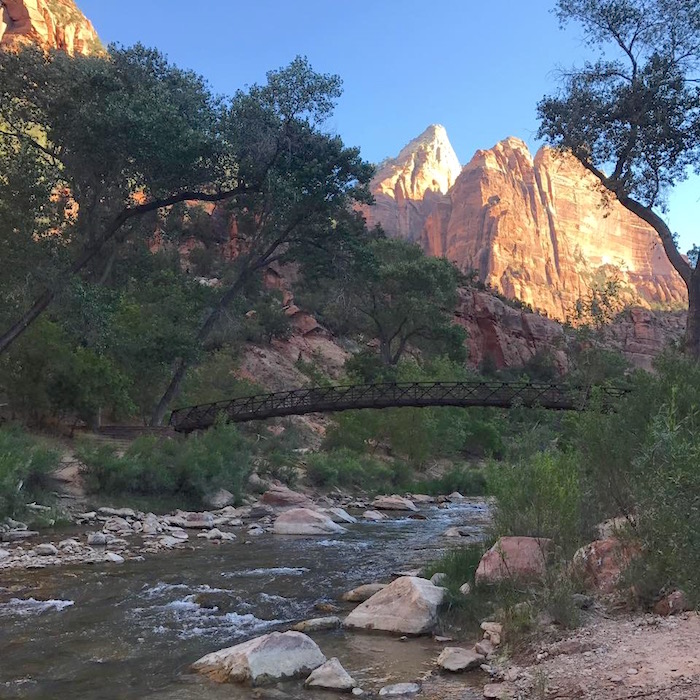
In a move that could signal the future of your national park vacation, Zion National Park officials are thinking of moving to a reservation system for entry into the iconic red rock cathedral to protect resources and ensure the enjoyment of visitors.
It's an idea being considered more and more in recent years by superintendents as record-breaking crowds strain places like Yellowstone, Yosemite, Glacier, Grand Canyon, Zion, and many other parks. There likely will be pushback to Zion's proposals. But park staff, budgets, the tight confines of 6-mile-long Zion Canyon, and today's growing crowds cast a reservation system as perhaps the best way to help superintendents meet the National Park Service Organic Act's overriding directive:
... to conserve the scenery and the natural and historic objects and the wild life therein and to provide for the enjoyment of the same in such manner and by such means as will leave them unimpaired for the enjoyment of future generations."
"On Memorial Day Sunday, we had 30,300 people in the park that day," John Marciano, the park's public affairs spokesman, said Saturday. "That's nuts. No one has a good time."
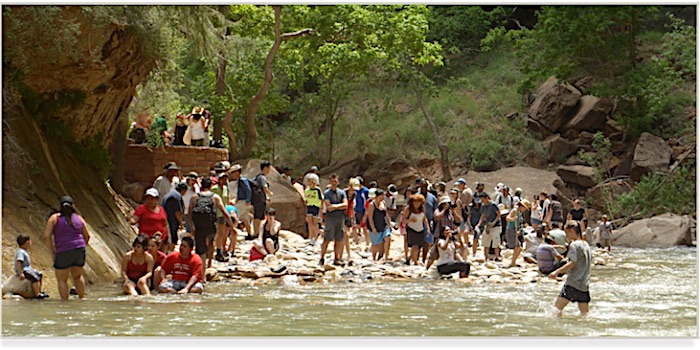
To provide visitors with a better experience in the park, and to better protect natural resources, Zion officials are seeking public comment through August 14 on three proposals:
- Alternative A: Make no changes from the current visitor management system.
- Alternative B: Require all visitors to obtain a reservation for their stay. With this reservation, they would be allowed to go to any of the park's frontcountry areas, places such as Zion Narrows, Angels Landing, and Observation Point.
- Alternative C: In addition to needing a reservation to enter the park, you'd need specific reservations if you wanted to enter Zion Narrows or hike to the top of Angels Landing. Day hikers heading into wilderness areas also would need to obtain permits.
A reservation system, if implemented, would apply to all areas of the park, from Zion Canyon and Checkerboard Mesa to the Kolob Canyon corner of the park.
Driving the process is overcrowding to the point where it can jeopordize safety and damage the park's natural resources. While there are roughly 13 miles of official trails in Zion Canyon, officials say there are more than 30 miles of visitor-created unofficial trails there.
"The longer we wait, the worse the condition of the resource gets," said Mr. Marciano.
Visitation to Zion has gone up 60 percent over the past decade, to more than 4.3 million a year. While the park years ago moved to requiring visitors to ride shuttle buses into the famous canyon unless they had lodging reservations, the shuttle system has bogged down with increasing demand.
"Visitors are experiencing long lines for basic services," said the park's newsletter that announced the reservation proposals. "The shuttles are routinely over capacity, with buses that have a capacity of 68 seated riders commonly being filled with between 95 and 100 people.
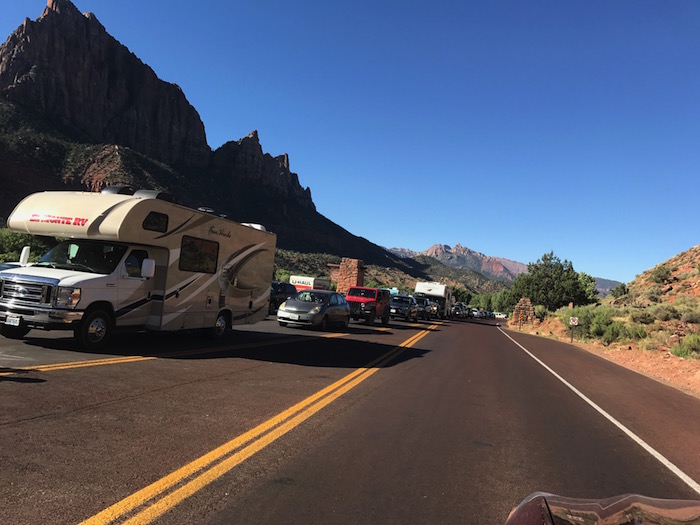
"Vehicular traffic is often backing up along roadways into Springdale, causing traffic congestion problems there," the newsletter went on. "Trails, campgrounds, and other infrastructure are seeing wear and tear more quickly and faster than funding allows for repairs."
Visitor safety also is at risk, as the number of emergency response calls for rangers "has increased exponentially, and emergency response can be delayed because of traffic congestion," said park officials.
Alternative C would also improve traffic flow from the South Entrance along the Zion-Mount Carmel Highway to the East Entrance by prohibiting oversized vehicles -- large RVs, tour buses, motor homes, and travel trailers -- from traveling that route. Alternative B would restrict those oversized vehicles to specific time windows in mornings and evenings.
Alternative B and C also would move the South Campground to a reservation system; it currently operates on a first-come, first-served basis.
Discarded from consideration in the effort to better manage crowds and protect resources was congestion pricing, also known as surge pricing.
"National park units are a public resource, and to the extent possible, should remain affordable to visitors across a range of financial status," the park newsletter said. "Congestion pricing could place unfair financial burdens on some visitors, as price points during peak vacation times would likely need to be very high to maintain visitor capacity by dissuading park visitors from entering during crowded times through paying a high rate."
In developing the proposals open for public consideration, park officials reviewed available data -- "We know how many people come into the canyon every day. We have a breakdown of big vehicles, small vehicles, people who walk in, drive through. We have that breakdown," said Mr. Marciano. "We also have (hiker) numbers for trails, Angels Landing, etc." -- and discussed the issue and possible solutions with Park Service staff in both the Intermountain Region Office in Denver and the agency headquarters in Washington, D.C.
If a final decision is made to go with a reservation system of some sort -- either Alternative B, Alternative C, or some sort of hybrid -- then Zion staff will have to settle on a daily visitor capacity.
Details of the proposal, and a page to comment, can be found at this site.
Stories about:
Story Categories:
A copy of National Parks Traveler's financial statements may be obtained by sending a stamped, self-addressed envelope to: National Parks Traveler, P.O. Box 980452, Park City, Utah 84098. National Parks Traveler was formed in the state of Utah for the purpose of informing and educating about national parks and protected areas.
Residents of the following states may obtain a copy of our financial and additional information as stated below:
- Florida: A COPY OF THE OFFICIAL REGISTRATION AND FINANCIAL INFORMATION FOR NATIONAL PARKS TRAVELER, (REGISTRATION NO. CH 51659), MAY BE OBTAINED FROM THE DIVISION OF CONSUMER SERVICES BY CALLING 800-435-7352 OR VISITING THEIR WEBSITE. REGISTRATION DOES NOT IMPLY ENDORSEMENT, APPROVAL, OR RECOMMENDATION BY THE STATE.
- Georgia: A full and fair description of the programs and financial statement summary of National Parks Traveler is available upon request at the office and phone number indicated above.
- Maryland: Documents and information submitted under the Maryland Solicitations Act are also available, for the cost of postage and copies, from the Secretary of State, State House, Annapolis, MD 21401 (410-974-5534).
- North Carolina: Financial information about this organization and a copy of its license are available from the State Solicitation Licensing Branch at 888-830-4989 or 919-807-2214. The license is not an endorsement by the State.
- Pennsylvania: The official registration and financial information of National Parks Traveler may be obtained from the Pennsylvania Department of State by calling 800-732-0999. Registration does not imply endorsement.
- Virginia: Financial statements are available from the Virginia Department of Agriculture and Consumer Services, 102 Governor Street, Richmond, Virginia 23219.
- Washington: National Parks Traveler is registered with Washington State’s Charities Program as required by law and additional information is available by calling 800-332-4483 or visiting www.sos.wa.gov/charities, or on file at Charities Division, Office of the Secretary of State, State of Washington, Olympia, WA 98504.


National parks and their natural resources belong to you. The National Parks Traveler works to ensure you know how these essential places are being cared for.
Sign Up For Our Weekly Newsletter
Unsubscribe at any time.
INN Member

The easiest way to explore RV-friendly National Park campgrounds.

Here’s the definitive guide to National Park System campgrounds where RVers can park their rigs.
Our app is packed with RVing- specific details on more than 250 campgrounds in more than 70 national parks.
You’ll also find stories about RVing in the parks, tips helpful if you’ve just recently become an RVer, and useful planning suggestions.


Comments
I absolutely HATE the idea, but what are the alternatives?
I'm waiting for the same thing to occur at Glacier and at Mount Rainier National Parks. I can't begin to tell you the crowds I saw in the Longmire and Paradise areas of Mount Rainier during my visit this past week. I had to get up pretty early in order to photograph spots like Narada Falls and Christine Falls before all the parking spaces were filled and people parked alongside the road at some good distance and then walked along the road where there are no shoulders. And Paradise was a madhouse. Sunrise, interestingly enough, was not quite as crowded and there always seemed to be parking spaces. Perhaps because there is no overnight lodging there or that you have to drive a good bit further to reach this area of the park? Dunno.
The National Parks are definitely getting crowded - too crowded for an unplanned quiet stroll through the parks. I too am a photographer - and the only way to get shots without lots of people are early morning shots. I am not a fan of reservations - but I don't see an alternative. Just too many people - and not all of them are too focused on taking care of the environment with regard to staying on trails, trash, noise, etc. I've even passed people hiking while listening to a stereo blarring off their back for all to hear. Seems contrary to me.
Don't require any more reservations. The National Park Service helped create this mess by promoting and advertising the parks, especially for the 2016 Centennial. Desist with all advertising and promotion of parks that are overused. If you require reservations to visit Zion for people of the West, then you should damn well require reservations to visit the National Mall for people of the East.
Times have changed - there are more people visiting the parks then there used to be... We have more and more people coming into the country every year... The NPS budget has been greatly reduced as the Federal Government funnels budget to other programs. Only a few parks actually pull in enough money to be self sufficient. I don't see a short-term solution to this issue other than to restrict the number of people who are visiting at a given time. And even that would be tough to manage on a day-to-day basis. Takes the spontenaity out of the process... but I would rather reserve the week I'm in the park than be bumper-to-bumper driving through the park - or in a long line of people hiking on one of the trails.
Yes! I never understood all this promoting. The NPS has brought this on themselves. Population growth is another big problem.
..." The National Park Service helped create this mess by promoting and advertising the parks...".
Perhaps instead a major dose of Congress not providing adequate funding to build and maintain appropriate infrastructure.
Rick B.
But the funding to our national parks was cut drastically 10yesrs ago. It recovered a bit during Obama's reign, but I see it being cut drastically again - in fact, I'm sure you've heard the talk of mining and drilling along or in the parks too.
Funding needs to increase for the parks to be maintained which includes everything from bathroom facilities (have seen some gross bathrooms in Yellowstone) to the trails to upkeep of visitor lodging And employment of park rangers.
Also, stop the travel/tourist companies from grabbing all the reservations for lodging in the parks. Reservations go crazy fast. It's a task to get our 3 tickets. Large tourist groups are more encouraged than the average family.
The advertising campaign is still affecting the number of visitors to the point that Angel's Landing and Heart Lake - sites a little off the beaten path - now get swarms of visitors.
I'm also glad that people want to see our national treasures, but when it gets so difficult for the average Joe and Jane to see them, maybe shuttles and reservations to enter are the answer.
For what it's worth, the state of Utah last year conducted a massive, national advertising campaign around its five national parks -- Arches, Bryce Canyon, Canyonlands, Capital Reef, and Zion.
I understand there is need for a change. We were recently at Yellowstone, and it was very busy. One thing we noticed was bus loads of foreign tourists. If there are limitations to who can enter the park I wonder how this issue will be handled. I felt proud that folks from other countries wanted to see our national treasures. If visitation is limited however, how do you tell taxpayers they can't come in? Tough problem with no easy answers!
Hi Jill! International travelers have been visiting Yellowstone since the Park was created in 1872. Many other countries followed our example and created their own national parks. The National Parks are for the enjoyment of all but there must be crowd and use management so that we can actually enjoy them. Keeping foreigners out is not the answer.
Rick, you say, "Perhaps instead a major dose of Congress not providing adequate funding to build and maintain appropriate infrastructure."
I'm gonna have to respectfully disagree with you on that one. Big time! (Or is it YUGE now?)
I completely agree that Congress needs to adequately fund our parks, but NOT for any more infrastructure.
If we continue adding to infrastructure but fail to somehow control the number of people, vehicles and other humanoid impacts upon our parks, Zion Canyon, Yosemite Valley, and all of Hayden Valley will have to be paved for parking.
And if it ever becomes necessary to have reservations to enter the National Mall or Great Smokey or Shenandoah or Gettysburg, then so be it.
Remember the mandate; ". . . to preserve unimpaired for the enjoyment of the future . . . "
How much will the future enjoy asphalt. (But then the way things are going, asphalt everything may be the future for our great grandkids.)
It's hard to be very optimistic right now.
I guess we're just fortunate we're not one of those park superintendents who will be blamed for anything that doesn't go right and never get any credit for things that do.
I have no problem with daily entry quotas, which are long-overdue at many parks, but reservation systems favor the well-off portion of society.and tour companies, who can afford to make reservations they may not use. Escalating fees, scalping, and the sort of corruption displayed at the USS Arizona Memorial tours will likely increasingly exclude the average American from the most popular NPS destinations. If quotas are required, reservation-only days should alternate with days having only first-come, first-served entry.
Great idea of alternating the days. We visited all three above mentioned parks in June, way to many tour buses. Especially at the Grand Canyon! What crushed my heart was most folks showed no respect for our great treasures.....crawling all over the rocks for a 'selfie' chasing after the animals at Yellowston, Glacier had so much traffic you couldnt enjoy it. We were guilty in that we pulled our 5th wheel. I think camping should be limited to small campers, no larger that 20ft. I felt guilty for all the room our rig took up at Coulter Bay. We were at Yellowstone back in '05, I was so surprised at all the conveniences everywhere . There were souvenir shops all over the parks. Taking away from the natural beauty.......
Entry quotas would work. Before Eisner and Eiger took over Disneyland, Disney had a strongly-enforced quota for daily visitation. It meant that the park was never suffocating with people. There was a legal reason, too, and this should have been obvious to the NPS decades ago - simple safety. There are clearly marked capacities in all public buildings; Disneyland worked with the local fire departments to set their capacity. Why can't the NPS do that? When the park is facing crisis - flood, fire, earthquake - and filled far beyond capacity, that is dangerous in the extreme. So I would suggest (in addition to other ideas here) that each park have a set capacity, based on safety concerns and laws.
As a lifelong resident who lives on the highway lead into zion national park I have mixed emotion. I have noticed the increase of tourist traffic leading into zion it has been years since I have been into the main canyon in Zion because of the crowding. If the park limits the tourism then I feel for all the business owners who depend on tourism. As a property owner who owns property inside zion national park backcountry I have seen first hand the ridiculousness of some of the park rangers who have harassed my family for decades and the wastefulness of the park they claim they are understaffed I think they are wasteful and refuse to do what needs to be done
The problem is not too many visitors. The problem is not enough national parks, and not enough funding for existing parks.
Though park attendance has skyrocketed, we have barely expanded our park system since the mid-1990s. Meanwhile, anti-park interests and their allies in government have deliberately suppressed park funding to bolster their efforts to privatize our parks and prevent any new ones from being created.
Instead of discouraging and limiting public access to our parks, we need to strengthen and expand our National Park System. If even a small percentage of the tens of millions of people who visit our national parks each year were informed, inspired, and activated, they could be the foundation of a powerful effort to make that happen.
We were in Zion early January. You can take your car in. No crowds. More beautiful with a bit of snow cover. Instead of doing summer promotions, recommended people visit in the winter. Just dress for it.
You wouldn't expect to have an empty camp site or hotel room waiting for you upon arrival in a national park. Permits have been required for camping in wilderness areas for years and years. It may be controversial as a new suggestion, but these kind of reservations will probably become more common in time.
I get the fact the park is over-crowded. At the same time, Utah is running a myriad of "visit the Mighty Five" commercials.
We live in Kanab and travel to Springdale for business a couple times per week through the tunnel. How about lobbying for an exemption for locals?
I can also see this could potentially hurt local business in some ways not yet revealed.
Reservations? Making more money for a corporation, and a foreign corporation at that? "National park units are a public resource, and to the extent possible, should remain affordable to visitors across a range of financial status," the park newsletter said. I'm retired, in the same financial poverty bracket as in early camping years. That reservation fee - which is another step toward privatizing public facilities that I helped pay for so some corporation from my investments - is a lot of money to young families and seniors. There is a problem - I've seen it in summers at Yosemite (and also seen the graffiti and heard the boomboxes). I also counted tour buses going INTO Grand Canyon when I was leaving - one or more per mile from Williams to the Park. These parks are not Disneyland, and not set up to make money for foreign corporations. Measures that would solve this problem?
Restrict tour buses and travel agencies from over-using the system.
Restrict advertising or require the advertisers to include crowding warnings in their ads.
Require all those who are day-tripping to use special public transit from Gateway communities, not cars. (Yosemite has great success with YARTS - it's a model for what can be done. And if YARTS brings folks in from Merced or Mammoth, sans vehicles, they will need reserved lodging or they'll need to leave that day.) EVERY ACCESS BUS SHOULD HAVE AN NPS - NOT COOP ASSOC - INTERPRETER ON BOARD TO EXPLAIN NPS HERITAGE, VALUES, HISTORY, AND COMMON SENSE RULES.
But do NOT make this another step towards privatization and use MY funded facilities to make swollen profits for a foreign reservation corporation
Looks like the problem is not limited to National Parks
http://denver.cbslocal.com/2017/07/18/mt-bierstadt-colorado-hiking-fee/
charge $15 like they do at Pike's Peak and regulate the numbers, issue solved! Was up at Zion at end of Feb, beautiful, uncrowded but cold. You make do. No one has the right to vist X park on Y date and not expect a crowd if they insist on visiting on the 4th of July
Glacier Bay limits the number of cruise ships that may enter the bay each day. Why not the same kind of restrictions on large tour buses in other parks?
Zion's not alone in this, as we all know. Here's an article from the Fresno CA Bee regarding Yosemite's crowding.
Perhaps articles like this one, that tell the truth about what's happening will have a dampening effect on visitation and may help a little.
http://www.fresnobee.com/opinion/opn-columns-blogs/article160640879.html
I am supportive of a reservation system. It is imperative so all can enjoy the park and protect resources. I think there needs to be a balance btw tour company and individuals. While you are at it, I think non US visitors shld be charged more than citizens.
In Zion National Park’s Visitor Use Management Concepts, WE SUPPORT:
• The park using a concessionaire to upgrade and operate the shuttle system which includes extending the shuttle to the east side of the park.
• We support limited online reservations for visitation to some busy front-country hikes during certain months only.
• We support online reservations for back-country hikes. Hikers should not have to drive into the park to obtain their back-country permits, thereby creating more traffic in the park.
• We support Zion NP developing more trail heads, parking pull-outs, and a bathroom facility on the east side of the park. This will spread out the crowds and help people have a better experience.
• We support limiting the use of the tunnel to oversize vehicles to night time and early morning times, and during the slow months of the year.
• We would support the total elimination of oversize vehicles in the tunnel during busy months if there was an east side shuttle so that these vehicles could park on the east side and still visit the park.
We DO NOT SUPPORT:
• Year-round requirement for reservations to visit ANY or ALL front-country hikes at this time.
• There is no need for this except for certain hikes that are very busy, during certain very busy months of the year.
• Keeping the shuttle the way it is with no access to the east side.
• Keeping the reservation and permit system the way it is, requiring back-country hikers to go into the park, creating more congestion, to obtain permits they should be able to get online.
Hey Collette----
Who is 'we'?
Zions National Park is so small it just can't handle more people and still provide a good experience. However, there are a lot more areas in Utah, and I'm sure in other states as well, that would also make great parks.
Instead of just limiting visitation at the existing parks let's expand the park system. Create more parks and let the crowds thin themselves.