
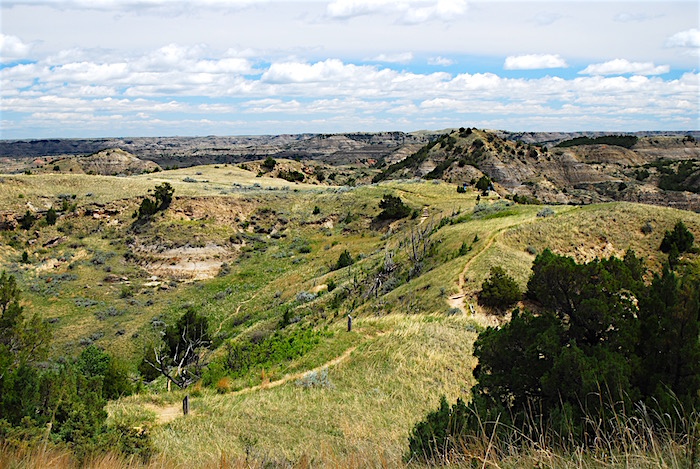
Editor's note: This updates with comment from park staff, former Theodore Roosevelt Superintendent Valerie Naylor, and Bart Melton, Northern Rockies regional director for the National Parks Conservation Association.
Plans to build an oil refinery, with supporting infrastructure that would include 1,000 residential units and a commercial development, just three miles from the entrance to Theodore Roosevelt National Park are moving forward, with the company filing its application for a permit to start construction on the proposed Davis Refinery.
As envisioned, this mix of industrial/residential/commercial development would dwarf most, if not all, towns in southwestern North Dakota, and potentially could impact the park's air quality, soundscape, and viewshed, according to opponents.
“The town of Fryburg, which is the nearest town, it’s not very large at all. Only a handful of houses. It's tiny," said Eileen Andes, chief of interpretation and public affairs for the national park, adding that most of the residents probably lived on ranches. "Medora, which is the town where our park headquarters is, has a year-round population of about 110. Medora is the county seat for Billings County, and the town itself isn’t much bigger than four blocks by four blocks."
The refinery proposal from Meridian Energy Group has in the past drawn criticism and opposition from the National Park Service, with past and present superintendents of Theodore Roosevelt voicing concern over the project that would be located near Belfield, North Dakota. That was before the company announced that it will "provide developed sites for over 1,000 residential units, ancillary commercial services such as restaurants and theaters, educational and acute care space, water and sewage treatment facilities, commercial, retail and industrial space as well as a new police and fire facility. The development will include two hotels that will house workers during refinery construction."
Valerie Naylor, a former superintendent of the park, was skeptical that Meridian Energy would be able to receive the necessary permits.
"I doubt that Meridian will be able to meet the strict requirements of the Clean Air Act that protect the air quality in Theodore Roosevelt National Park," she said in an email Tuesday evening. "I know the North Dakota State Health Department will carefully analyze the request for an air quality permit over the coming months and may very well deny it. Regardless, it is not appropriate to site an oil refinery at the gateway of our treasured national park. Air quality is one of the many serious aspects of this proposal that could be detrimental to the park and its visitors. It still shocks me that Meridian and others would choose this site for their proposed refinery without any other alternatives."
Meridian, which last week applied for the construction permit from the North Dakota Department of Health, Air Quality Division, maintains that it can build a refinery that will "exceed North Dakota’s most stringent air quality regulations." The company specifically is seeking a Minor Synthetic Source Permit, rather than a major-source permit, for a refinery capable of producing 55,000 barrels of fuel products per day. If the company's schedule is met, a refinery producing 27,500 barrels a day will be up and running in 2018. The difference in the two permits comes down to emissions; Meridian officials believe they can operate the cleanest refinery ever built.
Meridian also is proposing a gas-fired power plant to meet the refinery's energy needs.
“We are excited to take this next step in the process, as we continue to elevate and re-define the standards of a modern oil refinery. Our innovative design, equipment and the manner in which we have comprehensively integrated Best Available Control Technology will ensure that the Davis Refinery meets the strict air quality regulations put forth, and will remain compliant for years to come. Our state and our community should expect and accept nothing less," said Meridian CEO William C. Prentice in a release.
The excitement wasn't shared by the National Parks Conservation Association, which opposes the location of the operation so close to Theodore Roosevelt.
“Just as we shouldn’t allow an oil refinery to be built within view of Yellowstone or Yosemite national parks, and we will fight against the Meridian refinery, proposed within view of President Roosevelt’s namesake national park," Bart Melton, NPCA's Northern Rockies regional director, said Tuesday. "An oil refinery and associated industrial development would fundamentally threaten the pristine air and other conservation values that our nation committed to protect when we created Theodore Roosevelt National Park.”
Back at the park, Chief Andes said the Park Service would be closely monitoring the permitting process.
"We are definitely concerned about having a refinery close to the park boundary, and the National Park Service will be keeping a close eye on it," she said during a phone call.
Eddie Martinez, president and CEO of Zia Environmental Engineers & Consultants LLC., the company that will help design the plant, predicted that the operation would be "the most environmentally sustainable refinery ever built."
"This project will undoubtedly create a standard within the industry how companies will effectively control emissions," he said.
At NPCA, Mr. Melton shared Ms. Naylor's skepticism of the project.
“I would be surprised if they can achieve a 'Minor Source' permit," he said. "It’s a pretty large facility. But that’s really going to be determined at the end of the day by the North Dakota analysis of the proposal, which will take six months to a year.”
Targeted for a 620-acre swath of farmland between Belfield and Fryburg just east of Theodore Roosevelt, the refinery project is just the latest industrial development pressing in on the 70,447-acre national park. The U.S. Forest Service last year gave the OK for a 25-acre gravel pit across the Little Missouri River from Theodore Roosevelt's historic Elkhorn Ranch and roughly 25 miles from the core of the park's South Unit, while oil pumps dot the landscape in just about every direction. From Buck Hill in the park's South District, gas flares from fracking operations outside the park stand out at night.
The park, of course, was named after Theodore Roosevelt, who came to this landscape as a young man and discovered his conservation bent. The Elkhorn Ranch was where he recovered from the deaths of his wife, Alice, two days after giving birth to their daughter, and his mother on the same day, Valentine's Day 1884. The ranch setting remains bucolic today. While the ranch house is gone, there still stand some of the cottonwood trees that shaded the house and the porch from which the young Roosevelt would escape the heat with a book or simply to rock in his chair while taking in the Little Missouri and the badlands that it carved into the landscape.
Back in 2011, the National Trust for Historic Preservation, citing the gravel pit, named the ranch as one of its 11 most-endangered historic sites in the country. The pit is a byproduct of the oil boom, as it is a source for stone needed for the drill pads rising around northwestern North Dakota. Now, if plans to construct the oil refinery come to fruition, Theodore Roosevelt National Park might claim the distinction of being rimmed by more energy-related developments than any other park in the National Park System.
Stories about:
Story Categories:
A copy of National Parks Traveler's financial statements may be obtained by sending a stamped, self-addressed envelope to: National Parks Traveler, P.O. Box 980452, Park City, Utah 84098. National Parks Traveler was formed in the state of Utah for the purpose of informing and educating about national parks and protected areas.
Residents of the following states may obtain a copy of our financial and additional information as stated below:
- Florida: A COPY OF THE OFFICIAL REGISTRATION AND FINANCIAL INFORMATION FOR NATIONAL PARKS TRAVELER, (REGISTRATION NO. CH 51659), MAY BE OBTAINED FROM THE DIVISION OF CONSUMER SERVICES BY CALLING 800-435-7352 OR VISITING THEIR WEBSITE. REGISTRATION DOES NOT IMPLY ENDORSEMENT, APPROVAL, OR RECOMMENDATION BY THE STATE.
- Georgia: A full and fair description of the programs and financial statement summary of National Parks Traveler is available upon request at the office and phone number indicated above.
- Maryland: Documents and information submitted under the Maryland Solicitations Act are also available, for the cost of postage and copies, from the Secretary of State, State House, Annapolis, MD 21401 (410-974-5534).
- North Carolina: Financial information about this organization and a copy of its license are available from the State Solicitation Licensing Branch at 888-830-4989 or 919-807-2214. The license is not an endorsement by the State.
- Pennsylvania: The official registration and financial information of National Parks Traveler may be obtained from the Pennsylvania Department of State by calling 800-732-0999. Registration does not imply endorsement.
- Virginia: Financial statements are available from the Virginia Department of Agriculture and Consumer Services, 102 Governor Street, Richmond, Virginia 23219.
- Washington: National Parks Traveler is registered with Washington State’s Charities Program as required by law and additional information is available by calling 800-332-4483 or visiting www.sos.wa.gov/charities, or on file at Charities Division, Office of the Secretary of State, State of Washington, Olympia, WA 98504.


National parks and their natural resources belong to you. The National Parks Traveler works to ensure you know how these essential places are being cared for.
Sign Up For Our Weekly Newsletter
Unsubscribe at any time.
INN Member

The easiest way to explore RV-friendly National Park campgrounds.

Here’s the definitive guide to National Park System campgrounds where RVers can park their rigs.
Our app is packed with RVing- specific details on more than 250 campgrounds in more than 70 national parks.
You’ll also find stories about RVing in the parks, tips helpful if you’ve just recently become an RVer, and useful planning suggestions.


Comments
I drove past a refinery for years before I knew what it was. It was in Washington and had tall trees around it. My point would be that if you belong to the global warming religion nothing they do will be good enough. I'm just a regular guy without an agenda. I'd say just tell the truth.
"Normal guys without agendas" don't use charged language like "global warming religion". The scientific consensus is overwhelming.
Good to know, though, that if you're not perceptive enough to know what something is it won't affect the environment.
There's not many trees around this park. Not to mention the Little Missouri River runs through the park. Maybe they should build it somewhere it doesn't affect the air quality, water quality, and scenic beauty of a national park.
Overwelmingly corrupt. Tell us Todd, if the science is so strong, why have the predictions been so wrong?
Sorry dude, when the best and brightest scientists in the world say it's so, that's who I'm going with. Not ecbuck on the comment boards of the internet. I don't need to explain it, our best experts already have.
Don't fall for it, Todd. He will phrase things so that, if you answer or even debate his question, you will have accepted his premises. He has been pulling this fertilizer around here for years. Stand by for his baseless and predictatble outrage that I have pointed out his methods.
Rick - just because you run doesn't mean anyone else should - unless their position is as defenesless as yours.
Tell ya what, the day you get certified smarter than Neil deGrasse Tyson, let me know. You pull this horsefeathers in front of him or hundreds of other scholars. you'll be laughed out of the room. As you know, I don't run from you, I turn my back.
Todd - you were warned about the troll.
I vote no on this refinery proposal.
Rick, I don't have to be certified smarter to know the predictions have been horribly wrong. Perhaps Neil can explain why the predictions have been so wrong because you certainly can't. And its funny you claim you turn your back to me yet you try an attack post every time I make a comment (BTW that is the definition of a troll). You are turning your back but its not to ignore its to run when confronted with thefacts.
This is tragic
Doubt TR had this in mind. What a disaster.
For those who don't know the location well- The refinery could be moved 10-15 miles east, right along the BNSF rail line to near the city of Dickinson where it would be welcomed by nearly everybody. The proposed location is a deiberate stick in the eye to the natiional park and a notice to everybody that the oil industry can do whatever it wants wherever it wants in North Dakota. Few people outside of North Dakota realize the level of corruption in Bismarck. Despite the careful words of Valerie Naylor the ND Health Department operates as a wholy owned subsidiary of the oil industry with little to no expertise in this type of investigation. Meridian will get the air quality permits as fast as they can be produced but still look like the NDHD actually did something. Likewise the water permits. The problem with this proposal is the site. Why Meridian insists on the Fryburg site when they could put the refinery in Dickinson with little to no controversy is understandable only in the long range. It is the opening that will allow much more oil and industrial development in the oil rich area around and within the park. That is what this is all about.
Could you document that?
Can you document that it is not?
Ah the old prove a negative tactic. You made the accusation, it is up to you to substantiate it. I guess this establishes you as a proud member of Lee and Rick's Baseless Accusation Club.
Well,you can kiss this nice QUIET National Park good bye if this were to happen.
When I visited this park years ago you could smell the clean air and hear the wind on the prairies.
Now you will smell and hear something else in the air.
Sadly we live in a greed driven World
They haven't explained why they have been so terribly wrong. Perhaps you would like to try.
"Our best experts" is a term meaning what? That they are right because we call them experts? Would we ever call someone "our worst expert?" If not, we should simply stick with "experts," yes? In that case, what makes someone an expert? Is it enough simply to hold a Ph.D.?
All manner of Ph.D.'s I know are hardly experts. Certainly, the moment politics enters into the equation, they are far more comfortable going with the flow. They don't do the research; they let others do it. The very idea that science is itself riddled with anecdote eludes them because the word science protects their laziness.
The case for climate change is filled with laziness because that is what the big corporations want. Starting with General Electric, Vestas, Tesla, and Google, they want to sell us on the necessity of giving up our public lands. What is my "research?" That we are indeed giving them up. Simply, if you insist we worry about Theodore Roosevelt National Park, be consistent and worry about keeping any national park dependent on the public lands surrounding it. The project, i.e, the technology, has nothing to do with that.
Alfred, not sure I understand your post. You have in the past pointed out the issue of population growth and all the development needed to support that growth. I agree. I also agree it is not in the interest of the corporate oligarchy and those "experts" that support it, for political or other reasons, to protect our public lands. TRNP a good example, but there are many more, Soda Mountain comes to mind. In any case, there are some true experts in my view, it is hard to find them on the corporate media, but they are there.
I think that Alfred's point is that the supposed "protection" doesn't necessarily protect. And I would submit that the exploitation of resources doesn't necessarily defile.
It Seems these big oil companies can doo whaterver they want. Tjis is my land . This our Land. not corporation land. That is how the national parks are set up. not to go the the high bidder
I vote no on the refinery. But here's your global warming homework. Did a study that will show you actual numbers. Then try and get them to tell you where those numbers actually came from. Then see if they will share the spread sheet that the numbers were run through. Then try and find the assumptions. Usually you find that the science is not very good after all
This must be stopped! I grew up on the island of St Croix in the US Virginia Islands and in 1964 Hess Oil started building a refinery that would ultimately irrevocably destroy an important mangrove lagoon, take up hundreds of acres (as the largest refinery in the western hemisphere) build 3 areas of employee housing (when the agreement was that it was to provide jobs to locals)and change the demographics of the island community forever all on an island that is only 84 sq mi. In 2012 Hess Oil decided that the site was no longer profitable and dissolved the parnership with Venezuela, shut down the factory, removed 2000 workers and negatively affected hundreds of businesses. In the years that they were there the western town, downwind from the refinery, which also built a catalytic converter in 1992, suffered from a constant dust of fine particulate matter resulting in numerous cases of children and adults with respiratory problems, destroyed the sea life offshore and provided light pollution that destroyed the dark night skies.
A project like this has far reaching consequences beyond the obvious ones of destruction of views. The sib new thing"qualities" that may attract supporters will soon reveal themselves to be the awful and permanent side effects.
ease sign, share and help fight against this refinery!
https://www.change.org/p/protect-theodore-roosevelt-national-park-from-b...