
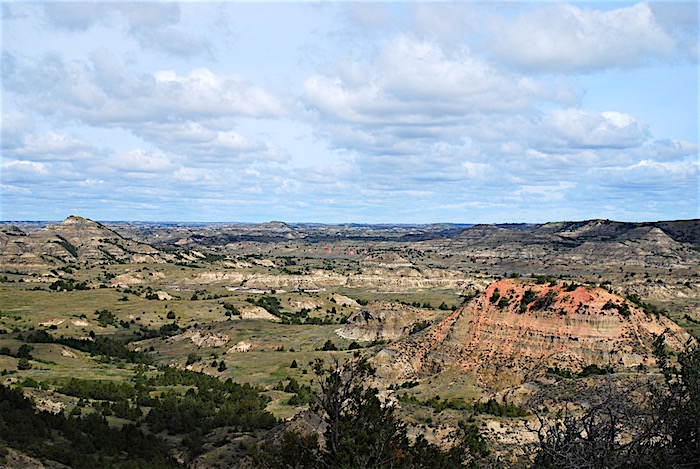
While falling oil prices have slowed production from North Dakota's oil and natural gas fields, a company sees that lull as the perfect opportunity to build a crude oil refinery in the state.
However, its proposed location just three miles from Theodore Roosevelt National Park has raised concerns from the National Park Service and conservation groups about how it will impact the park.
At Meridian Energy Group, Inc., the California company behind the $850 million refinery that could process 55,000 barrels of crude a day at full capacity, officials claim their proposed Davis Refinery would be "the cleanest plant ever built."
Others think it's a plant that should never be built in its proposed location.
“They shouldn’t be putting an industrial park next to a national park," Valerie Naylor, the park's former superintendent, said Friday during a phone call. "If this was being proposed within three miles of Yellowstone, Glacicer, Yosemite, or even Mount Rushmore, there would be a huge national outcry. I don’t know why there shouldn’t be a similar outcry about Theodore Roosevelt."
Targeted for a 620-acre swath of farmland between Belfield and Fryburg just east of Theodore Roosevelt, the refinery project is just the latest industrial development pressing in on the 70,447-acre national park. The U.S. Forest Service last year gave the OK for a 25-acre gravel pit across the Little Missouri River from Theodore Roosevelt's historic Elkhorn Ranch and roughly 25 miles from the core of the park's South Unit, while oil pumps dot the landscape in just about every direction. From Buck Hill in the park's South District, gas flares from fracking operations outside the park stand out at night.
The park, of course, was named after Theodore Roosevelt, who came to this landscape as a young man and discovered his conservation bent. The Elkhorn Ranch was where he recovered from the deaths of his wife, Alice, two days after giving birth to their daughter, and his mother on the same day, Valentine's Day 1884. The ranch setting remains bucolic today. While the ranch house is gone, there still stand some of the cottonwood trees that shaded the house and the porch from which the young Roosevelt would escape the heat with a book or simply to rock in his chair while taking in the Little Missouri and the badlands that it carved into the landscape.
Back in 2011, the National Trust for Historic Preservation, citing the gravel pit, named the ranch as one of its 11 most-endangered historic sites in the country. The pit is a byproduct of the oil boom, as it is a source for stone needed for the drill pads rising around northwestern North Dakota. Now, if plans to construct the oil refinery come to fruition, Theodore Roosevelt National Park might claim the distinction of being rimmed by more energy-related developments than any other park in the National Park System.
Oil refineries aren't often built in the United States. Currently, according to the U.S. Energy Information Administration, there are just 137 active refineries. Since the turn of the century, just three refineries have been built, and since 1985 just eight refineries came on line, the agency's records show. Just one of those eight, the Petro Star refinery in Valdez, Alaska, produces as much as 55,000 barrels per day, or as much as the Davis Refinery is designed to produce.
As proposed, the Davis Refinery would produce "(R)efined products include gasoline, diesel, jet fuel, heating oil, as well as lesser-known products such as lubricants, asphalt base, ethane for plastics, waxes and other specialty chemicals. The initial phase of the Refinery will focus on the production of jet fuel, diesel fuel and other distillate products, primarily for local markets."
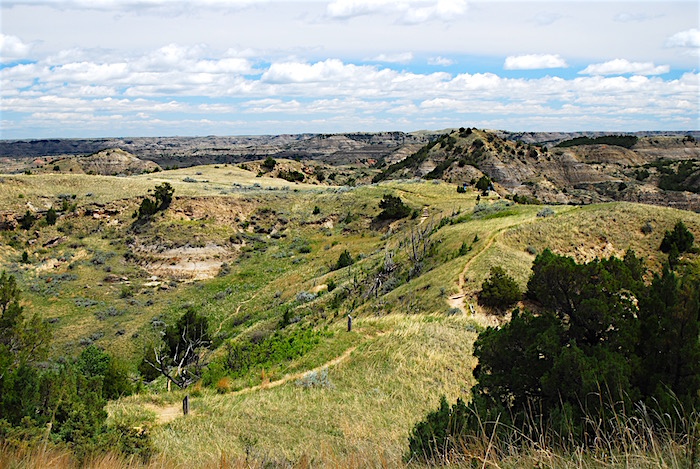
The proposed location is adjacent to a BNSF rail loading facility at Fryburg; the rail line actually runs through the refinery site. Oil and natural gas pipelines are close by, too, according to Meridian.
The property also is near the junction of Highway 85 and Interstate 94. Highway 85 is the main north-south arterial that tanker trucks can use to carry crude from the Bakken field to pipeline and rail terminals.
On their website company officials, noting that more than 95 percent of the daily production from the Bakken is taken out of state for processing, say building a refinery "in the heart of the Bakken will ensure a steady supply of below-market crude oil feedstock from production companies seeking transportation savings and a local market for refined fuels."
Beyond the proposed Davis Refinery, though, Meridian officials expect their plant would attract "compatible industrial process units," according to a zoning application they filed with Billings (North Dakota) County officials. "For example, Meridian has received inquiries from agricultural chemicals firms, brewing companies, and others interested in locating facilities nearby once the Project is in operation," the documents state.
The company produced a promotional video to explain its plans, but blocked public access after the Traveler story appeared.
Ms. Naylor shudders at the thought of such development so close to Theodore Roosevelt's South Unit.
“That industrial park will extend from Fryburg all the way to Belfield if that is the case," she said, referring to the company's expectations of additional buildout. "That would be a really big industrial area right next to the national park. That’s not acceptable.”
Not without irony, the industrial development, if it materializes, would welcome visitors to North Dakota's No. 1 tourist draw, the national park. This year the state's tourism campaign, starring actor Josh Duhamel, focuses heavily on Theodore Roosevelt National Park. And already this year visitation to the park is up more than a third, and related revenues are nearing $40 million annually.
Company officials were traveling Friday and not immediately available to discuss their project.
In their application to Billings County, they are seeking a zoning change to allow the refinery to be built on acreage currently zoned for agriculture. In addition, they want permission to begin site preparation this summer, before the requisite air quality permits for the entire project are issued, "so that the project does not lose this coming summer as part of the construction schedule for the project." According to Meridian, North Dakota officials said "grading and site construction" can begin before the permits are issued.
As planned, the refinery would be operational by 2018.
Beyond the physical siting of an industrial development so close to the park, opponents worry about its impact on air quality. Many national parks, Theodore Roosevelt included, carry a Class I airshed distinction, which requires the highest level of protection under the Clean Air Act. And according to the National Park Service, Theodore Roosevelt "has some of the best visibility and cleanest air measured among all national parks."
However, the agency has pointed out in the past that "(R)egional oil and gas development, as well as nearby mining operations, power generating facilities, and agriculture, contribute to the formation of ozone and haze, sulfur and nitrogen deposition, and deposition of toxic air contaminants (e.g. mercury) at Theodore Roosevelt NP."
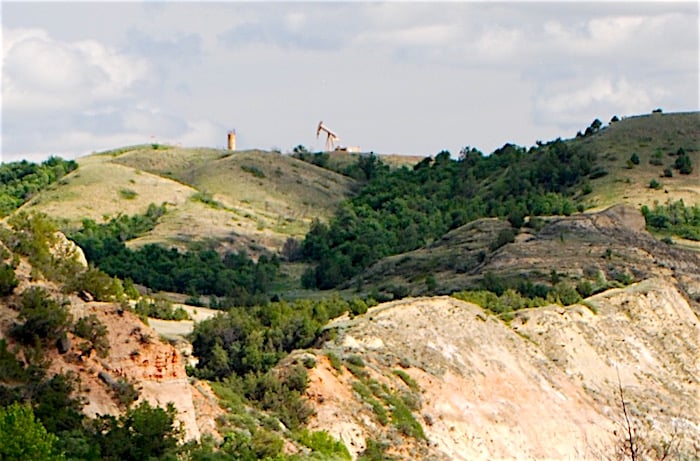
How the proposed refinery's contributions would affect that air quality is unknown at this stage. Park Service and state of North Dakota air quality officials say they'll conduct rigorous computer modeling to project what that impact might be. That process alone could take a year, they say.
"It’s a little soon to assert whether there will or will not be park impacts. But I can say with a facility of this size, this close to a national park, we’re really concerned," said Bart Melton, regional director of the National Park Conservation Association's Northern Rockies office. "There’s plenty of room in North Dakota for protecting the park and continuing to grow the economy in the Bakken, which, we’re not opposed to that growth. We just want to make sure that it occurs in a way that protects the park and builds the regional economy, too.”
Wendy Ross, Theodore Roosevelt's superintendent for less than a year, has been almost bowled over by the development ongoing around the park. And while the oil boom has slackened somewhat, she said Friday, that hasn't slowed everything down, citing the gravel pit, efforts to expand Highway 85 from a two-lane to four-lane stretch through the park's North Unit, and other infrastructure projects.
But the proposed refinery, she said, has moved to the top of list of projects that concern her.
“I don’t think anybody really realizes how big this is," said Superintendent Ross.
When the superintendent was asked, she couldn't point to another national park that has been faced by such developments closing in on so many sides.
"I really can’t. If you look down the list, I just haven’t seen anything like that," she said.
At the end of the day, said Ms. Naylor, siting a crude oil refinery next door to a national park is wrong.
“I think there are many, many issues, many questions that are unanswered," she said. "In reality, the biggest issue is this big industrial development shouldn’t be within three miles of one of our premier national parks.”
Stories about:
Story Categories:
A copy of National Parks Traveler's financial statements may be obtained by sending a stamped, self-addressed envelope to: National Parks Traveler, P.O. Box 980452, Park City, Utah 84098. National Parks Traveler was formed in the state of Utah for the purpose of informing and educating about national parks and protected areas.
Residents of the following states may obtain a copy of our financial and additional information as stated below:
- Florida: A COPY OF THE OFFICIAL REGISTRATION AND FINANCIAL INFORMATION FOR NATIONAL PARKS TRAVELER, (REGISTRATION NO. CH 51659), MAY BE OBTAINED FROM THE DIVISION OF CONSUMER SERVICES BY CALLING 800-435-7352 OR VISITING THEIR WEBSITE. REGISTRATION DOES NOT IMPLY ENDORSEMENT, APPROVAL, OR RECOMMENDATION BY THE STATE.
- Georgia: A full and fair description of the programs and financial statement summary of National Parks Traveler is available upon request at the office and phone number indicated above.
- Maryland: Documents and information submitted under the Maryland Solicitations Act are also available, for the cost of postage and copies, from the Secretary of State, State House, Annapolis, MD 21401 (410-974-5534).
- North Carolina: Financial information about this organization and a copy of its license are available from the State Solicitation Licensing Branch at 888-830-4989 or 919-807-2214. The license is not an endorsement by the State.
- Pennsylvania: The official registration and financial information of National Parks Traveler may be obtained from the Pennsylvania Department of State by calling 800-732-0999. Registration does not imply endorsement.
- Virginia: Financial statements are available from the Virginia Department of Agriculture and Consumer Services, 102 Governor Street, Richmond, Virginia 23219.
- Washington: National Parks Traveler is registered with Washington State’s Charities Program as required by law and additional information is available by calling 800-332-4483 or visiting www.sos.wa.gov/charities, or on file at Charities Division, Office of the Secretary of State, State of Washington, Olympia, WA 98504.


National parks and their natural resources belong to you. The National Parks Traveler works to ensure you know how these essential places are being cared for.
Sign Up For Our Weekly Newsletter
Unsubscribe at any time.
INN Member

The easiest way to explore RV-friendly National Park campgrounds.

Here’s the definitive guide to National Park System campgrounds where RVers can park their rigs.
Our app is packed with RVing- specific details on more than 250 campgrounds in more than 70 national parks.
You’ll also find stories about RVing in the parks, tips helpful if you’ve just recently become an RVer, and useful planning suggestions.


Comments
The parks have boundaries. Yet they want to control the land outside of their boundaries. I appreciate the environmental issues, but if that land needed protection then it should have been inside the boundaries.
I am a huge fan of the National parks, but this happens all the time. Walmart wants to build near a park, so people complain... but near a park is not in a park. Freedom has its costs, and one of those costs is that unprotected land is free to be built on.
It's not so black and white. There are "boundaries" and then there are right and wrong ways to think about the development of an area -- not just at the immediate boundary-driven level, but locally, regionally, state-wide, etc. North Dakota can still prosper from the oil without building a refinery right on top of one of this nation's natural and ecological gems. We don't have to live in a Homer Simpson world. http://1.bp.blogspot.com/-SjGQomaE3JQ/TvOguOjodyI/AAAAAAAAAUg/MQjy83Oe2F...
Um, that's not how property law actually works in this country. You have the right to do on your land what it has been zoned for (and this land is zoned agricultural). You have to get variances to do something different, which is not an unusual procedure but it does require analysis and possibly testing. You don't have the right to do something on your property that negatively affects mine. At least that's how it works with private citizens and small landholders. Big companies often do get away with ruining others' property (think mountaintop coal mininig in Kentucky, as an example) when they are able to muster political intervention.
Freedom certainly does have its costs, and that's why we've balanced the freedom of property owners with the safety net of processes like environmental reviews that ensure that large operations that use or produce toxic or otherwise harmful materials operate in some way that minimizes or eliminates the damage that can be done to neighboring property owners.
Theodore Roosevelt National Park is the property of all US citizens, and not only us but the property of our children and our children's children. No farmer looking to make a profit on a land sale, oil company looking to make some short-term profits on a dying oil boom, or state agencies looking to increase local employment should have the chance to harm it or diminish it.
In another feature in today's Traveler, we read about Soda Mountain.
Isn't this just Soda Mountain north?
Well since it isn't on government land and isn't subsidized (unless you can finaly explain how $57 billion of taxes and $16 billion of income is a subsidy), I would say they have nothing in common.
@Boufa - get real. our national parks are places we are trying to preserve for all time, for our children's children's great great grandchildren etc. who would want to go to them if they were surrounded by garbage, if the air was filled with chemicals, if the view from their mountains and rivers was of oil fields and fracking facilities and mining pits and shopping malls and thruways? NO ONE goes to the parks to see that crap - they go to get AWAY from all that crap. it's not a matter of legality - sure, it's legal to build whatever if it's not on park land - it's just not morally, ethically responsible to do so in such close proximity. unless we just don't care about our parks anymore - and don't care if many many generations from now - people can still go to them and find the peace and beauty that make them so special.
I drove through the Refinery Corridor along I-15 north of Salt Lake and was reminded by the odour de jour that oil refineries really are CRUDE. Anyone who made a similar odor in a public place would be shunned. Very impolite. You're supposed to save that for the restroom --- or at least step outside.
That's why the title of this article seems so appropriate :
Crude Oil Refinery Proposed Next To Theodore Roosevelt National Park Raises Concerns
Maybe it wouldn't be so bad if someone could come up with an oil refinery that wasn't crude.
I really liked this peice of info about the rosovelt national park
ND doesn't have a Highway 84, but it does have a Highway 85.
Many thanks, NoDak1. Thought I had caught that, but obviously not. It's fixed now.
I agree with Judy and Lee. The oil refinery emits odors and toxins into the air that will reach the park. Nothing that has that kind of destructive reach into our National Parks should be allowed. There really is no place that is appropriate for that. Money should be put invested into green sources of energy that preserve life and environment - not this toxic crap.
Unfortunately, Lissa, those "green" sources of energy aren't so green, either, and now threaten 40 million acres of "life and environment" across the public lands of the American Southwest. If it is wrong to place an industrial facility on private lands adjacent to a national park, how is it any less wrong to actually plan for them on our public lands adjacent to our national parks?
Read my article on Soda Mountain and the comments by Interior Secretary Sally Jewell. If our public officials claim to be making hard decisions, then what they ask of us should be hard. But they ask nothing--and do nothing--beyond another technological fix. Green energy is just a fix. The real fix is to live within our means, and no one is proposing that.
Aside from the obnoxiousnouss of this particular refinery, there is the big issue of cumulative impacts.
The U.S. Forest Service, which administers more than 1 million acres of public land surrounding Theodore Roosevelt National Park — Little Missouri National Grassland — has allowed unbridled drilling, livestock grazing, mining, predator and prairie dog killing, and other abusive resource extraction activities for years. These exploitative uses are already having a huge impact on the national park. So the refinery in question is just the most recent in a series of harmful activities adjacent to the park.
We need to expand Theodore Roosevelt National Park to encompass all of the national grassland and also to acquire key private lands, such as the tract proposed for this polluting refinery.
Putting oil exploration equipment & a oil refinery so close to park boudaries is reckless. The oil industry's record for land preservation is not good, "How can it be?" Their primary motive is to pull oil out of the ground in the most cost effecive manner. And that is n-e-v-e-r good for the environment. One accident and the landscape is ruined for a lifetime, if not more. This is a b-a-d idea.
Jeffery,
could you provide an example of an oil drilling/extraction accident that led to a lifetime of ruined landscape?
Well, EC, some would say the Deepwater Horizon spill in the Gulf of Mexico will live up to that. While it's only been six years, if you look at the aftermath of the Exxon Valdez spill of more than a quarter-century ago, it seems likely that the aftermath of Deepwater Horizon will linger for quite some time.
And the following is from a 2015 story on Jean-Michel Cousteau's Ocean Futures Society page:
Bottom line is that oil, and materials used to clean up spills, can be highly impactful to the environment.
Deep water has been six years, far from a lifetime and has minimal residual effects on the landscape, particularly relative to the predictions
The stink from the cracking plant can be filtered with scrubbers. However I don't want to see all sorts of other development popping up all around this park. Parks like this are supposed to be out in the wild, middle of no where. The developers need to design these buildings so we can't see them, put as much of the buildings underground or back up against a hill. Paint the stacks sky blue all with in reason financially. As technolodgy improves the plant should be designed with that in mind. I know I grew up near a cracking plant in the 50's in Texas. They do smell. Maybe they should hire Disney to come up with the outside design.
Ask the folks in Alaska affected by Exxon Valdez if the impacts have been"minimal." Can you cite any bonafide organization that says, and has the science to show, the impacts from Deepwater have been minimal?
From an NPR story:
http://www.npr.org/2015/04/20/400374744/5-years-after-bp-oil-spill-effec...
We are discussing oil drilling/extraction not shipping. I cant find any bona fide organization to say six years isnt a "lifetime" as that is self evident but i can find this:
https://www.tamucc.edu/news/2015/04/041315%20Spill%20Anniversary%20NR.html
Wasn't the BP well drilled? Thanks for the link to that article. Interesting, but they also note:
If there are any pluses to come out of Deepwater, it's the subsequent research into the impacts and how to mitigate them.
The Artful Dodger is dodging again.
Yes kurt, deepwater was drilled and as the article suggested it has largely recovered in 5 years, well short of a life time. The Valdez was not Drilled
And what exactly have i dodged lee? But before you answer that question, answer the half dozen you have dodged, or more accurately, run from. Explain how 57 bil of taxes with $16 bil of income is a subsidy. Tell us how the feds subsidize walmart. Show us where Republicans came unglued over bottle bills....... you are the master of dodge.
Dont know why i am getting the double posts. Must be the Italian internet.
Perhaps we should look at more recent articles, EC, which suggest the jury is still out on the damage to the Gulf:
http://www.wmnf.org/update-gulf-ecosystem-6-years-bp-oil-disaster/
http://www.theguardian.com/environment/2015/dec/11/bp-gulf-oil-spill-mex...
My take on these and other articles is that it's too soon to say Deepwater did only "minimal damage" to the Gulf. As for Exxon Valdez, no, it wasn't drilled, and I didn't say it was. Rather, I was pointing out the damage done by the oil released in that accident. That spill was measured at 257,000 barrels, while Deepwater was estimated at 9.5-10 times LARGER than that.
This is awfully tiresome -- I've answered all your questions many times over with documentation. So have Kurt and many others. You choose to ignore or dodge it.
Has DJT been taking lessons from you?
Give him a mirror, Lee, monogrammed with Q.E.D., for that unglued thingie.
the "jury" still out after 6 years is hardly an example of a lifetime of landscape alteration.
And no Lee you havent answered a single one of those. You provide links but because you dont apear to have any real understanding of the issues you are oblivious to the fact those links are totally irrelevant. Lets try this one again. Explain, in your own words, how is a company that pays $57 bil in taxes and nets $16 billion subsidies. Or looking at US operations alone, pays 6+ bil and nets a little over $100 Mill. Hint. LIFO accounting isnt a valid answer.
The problem is that what's on paper and what's actually happening are two different things. The oil companies (and many other industries) take advantage of a cave of tax loopholes larger than Mammoth and Carlsbad combined. Clever accounting allows them to hide the truth behind a smokescreen of gobblydegook.
One very significant subsidy is something called deferred taxes, which as this article explains, amounts to an eternal interest free loan from taxpayers to the industry.
http://www.usnews.com/opinion/economic-intelligence/2014/08/06/the-surpr...
Of course, one can find all sorts of other websites out there, such as the ultra-conservative CNS and others, that parrot industry propaganda for those who spend their time in the echo chamber seeking only the kind of "information" they want to find. It takes some effort to try to sort fact from fiction.
I know all of us who try to answer you are wasting our time. You'll sidestep, dodge and accuse until sunset tomorrow and then move on to another article here.
As for whether or not six years equals a "lifetime," that's just one more example of how you twist the words of others. Yes, it hasn't been a lifetime since Deepwater, but the effects of that spill (and Exxon Valdez) have not stopped. They continue and no one has any idea how long or far reaching their effects may actually extend. There are countless old well pads in the Uintah Basin where wells drilled 50 or even 60 years ago are still sterile patches of despoilation. That's a lifetime for a lot of people. Or we can move away from oil to coal and cite mountaintop removal or abandoned mining claims throughout the world that will be leaking poisonous substances for centuries yet to come.
But there's no point in continuing to try to respond. You'll just use some spilled oil to slip out of it and dodge around it by parsing words or distorting what others say.
Man, you'd make a great politician. Trouble is, the last thing the world needs is more of those.
Clean Refinery????? A big ugly plant that belches smoke and looks like what you see in Huston would not be a positive for the National Park. Oil and water do not mix. There must be more suitable locations in ND that are not 3 miles from the T. Roosevelt National Park. Refinery will not make gasoline and there is excess capacity for diesel in ND so it will not lowere fuel cost to residents of the state. May be a good deal for the investors and generate money to wine and dine politicians but in best interest of ND or it's residents. As of a few weeks ago Meridian had not been able to raise the initial funding to proceed so you are dealing with an under funded developer.
Lee, your ignorance knows no bounds. You should stick to topics you know something about, whatever that might be.
What is on paper is what is required by the SEC and offered by the IRS. There is nothing hidden except from those that have no clue how to read a financial statement. That is unless you are claiming that companies are lying to both. Deferred taxes is an accounting item used by virtually every company it reflects the fact the SEC and the IRS have different accounting methods. There is nothing unique to the oil companies and nothing that refects a subsidy. The only people that see see differed taxes as a loan are the people that believe that the purpose of business is to provide for their employees or that if someone keeps the money they make, its a subsidy.
Yes, and if we used the technology of 50 or 60 years ago it might be an issue. We don't and there isn't.
PS to my anon post above. Exxon's deferred taxes fell by $3billion in 2015 which means they actually paid $3 billion more than the $57 billion that hit their income statement. Once again Lee, rather than explaining in your own words why $57 billion in taxes on $16 billion of income is a subsididy you tried to link to some totally irrelevant article and came nowhere close to answering - because there is no valid answer.
Ach, ya. Just as I predicted. Another game of Dodge'em.
But you nailed it. There is no valid answer because so much is hidden from the public.
Ken Burns' America's Best Idea is on TV tonight. It's a story filled with examples of how powerful forces manage to keep secrets and use bullying tactics to avoid having to be accountable for their actions.
It's as true today as it was in the days of John Muir.
Lee, the only one playing dodge'em is you. You have been asked multiple times to explain how payng $57 billion ($60 bil) in taxes with $16 bil of after tax incomee is a subsidy and multiple times you have dodged the question responding with non-sequiturs and additional unsustantiated accusations. Just because you act blind doesn't mean things aren't clear to those that that know how to look.
Actually, the corporation both of you should be investigating is General Electric. They have paid absolutely no federal income taxes in umpteen years--all the while benefiting from green energy tax breaks. Nor does the story end there. Read on (below). I may have missed it, but has Senator Sanders mentioned GE? Or the president? Or Ms. Clinton? Of course not. Solar and wind are "in." Oil and coal are "out."
Who will pay the taxes? You will, and you always do. The price of the taxes is passed on in the product. What do the subsidies accomplish? They skew the market so that a questionable technology can still look "viable."
http://www.huffingtonpost.com/2014/04/01/ge-lobbying_n_5064783.html
Alfred - exactly. Now see if you can get Lee to understand that.
[addendum]. I looked at their financials back to 2010 and they in fact paid taxes every one of those years. Also, Al, why do you think they (their customers) should pay U S taxes on income they generate outside the US?
Holy Mackeral, Comrade --- of course I understand it. That's what I've been yowling about for years. Corruption and money and greed in all corners of American corporate and Congressional alleys.
We need to do away with ALL tax and legal (and illegal) loopholes for everyone. Level the playing field perhaps with a flat tax so that all of us share in equal percentages. All of these abuses have come about as a result of lobbying power, backroom deals and shady shenanigans between politicians and their special interest donors.
Solar and oil and coal and Walmart and GE and you and I and everyone else should be carrying our fair share of the burden to pay for the services and things we want.
But until the subsidies for oil and coal and other fossil fuels are turned off, and until environmental safeguards are enforced as they should be, those extractive industries should not be handed unfair advantage over alternative forms of energy production.
Unfair advantage? Paying $57 bil in taxes when you take home $16 bil Is an "unfair advantage". You have some strange concept of fairness. Can you explain that? Of couse not, all you have done is run from the question because you have nothing to support your accusations.
OK folks, this thread has run its life. We're closing comments.