
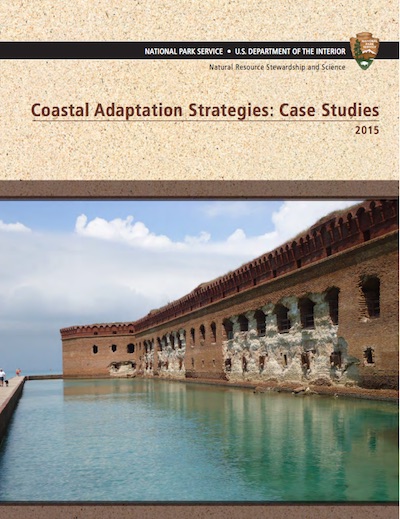
Examples of how climate change is impacting the National Park System from Everglades National Park in Florida to Bering Land Bridge National Preserve in Alaska were cited by Interior Secretary Sally Jewell this week to illustrate to a global audience the threats climate change poses.
The case studies pointed to Secretary Jewell during her appearance in Paris at the 21st Conference of Parties of the United Nations Framework Convention on Climate Change Conference on Monday were contained in a report published in September that details efforts in the park system to address climate change threats to infrastructure, recreation, and natural and cultural resources. The report follows a recent study that revealed sea-level rise caused by climate change could pose a risk to more than $40 billion worth of national park assets and resources.
“What’s happening in our national parks is a small window into the impacts of climate change on natural and cultural resources around the world,” Secretary Jewell told representatives from the UNESCO World Heritage Committee. “As negotiations kick off in Paris today, this report offers positive examples of what we can do, at a local level, to adapt and build resilience in the face of a changing climate – even as we work to curb carbon pollution around the world.”
Actions used by National Park Service managers to combat climate change in an already dynamic coastal zone are described through 24 case studies in the report. A few examples include: At Everglades National Park – a World Heritage Site – the new visitor’s facility in the Flamingo area was built with an elevated design to help reduce the risks from sea level rise and storm surges; the Gateway National Recreation Area in New York has restored salt marsh elevation in Jamaica Bay through the addition of sediment and vegetation; and in a lab in Ofu, part of the American Samoa islands, the National Park of American Samoa operates a facility that works on unique adaptations to Ofu coral and determining the cause of coral loss and damage.
“Sea level changes are subtle at some parks but already destructive at others where we are losing shoreline and infrastructure and where historical and cultural resources are also at risk,” Park Service Director Jonathan B. Jarvis said. “The upside is that we’re taking positive action as the result of adaptation planning we began in the National Park Service several years ago. This report illustrates actions we have underway to adapt to our changing climate, and as best we can, to preserve and protect the resources of our coastal parks.”
Dr. Rebecca Beavers, co-editor of the report, Coastal Adaptation Strategies: Case Studies, said it was compiled to inspire action, innovation, and dialogue among park managers and other coastal management agencies that are responsible for protecting natural and cultural resources.
Dr. Beavers, the NPS lead scientist on coastal adaptation to climate change, said the case studies will provide park managers with an array of coastal adaptation strategies.
“This report is one of a suite of tools with which the National Park Service is equipping their frontline managers – the park superintendents – to tackle diverse coastal challenges,” she said.
In addition to her meeting with representatives from the UNESCO World Heritage Committee today in Paris, Secretary Jewell also met with U.S. Ambassador to UNESCO Crystal Nix-Hines and UNESCO Director-General Irina Bokova to emphasize continued U.S. support for World Heritage and other UNESCO programs. Currently, there are 23 U.S. World Heritage sites.
Stories about:
Story Categories:
A copy of National Parks Traveler's financial statements may be obtained by sending a stamped, self-addressed envelope to: National Parks Traveler, P.O. Box 980452, Park City, Utah 84098. National Parks Traveler was formed in the state of Utah for the purpose of informing and educating about national parks and protected areas.
Residents of the following states may obtain a copy of our financial and additional information as stated below:
- Florida: A COPY OF THE OFFICIAL REGISTRATION AND FINANCIAL INFORMATION FOR NATIONAL PARKS TRAVELER, (REGISTRATION NO. CH 51659), MAY BE OBTAINED FROM THE DIVISION OF CONSUMER SERVICES BY CALLING 800-435-7352 OR VISITING THEIR WEBSITE. REGISTRATION DOES NOT IMPLY ENDORSEMENT, APPROVAL, OR RECOMMENDATION BY THE STATE.
- Georgia: A full and fair description of the programs and financial statement summary of National Parks Traveler is available upon request at the office and phone number indicated above.
- Maryland: Documents and information submitted under the Maryland Solicitations Act are also available, for the cost of postage and copies, from the Secretary of State, State House, Annapolis, MD 21401 (410-974-5534).
- North Carolina: Financial information about this organization and a copy of its license are available from the State Solicitation Licensing Branch at 888-830-4989 or 919-807-2214. The license is not an endorsement by the State.
- Pennsylvania: The official registration and financial information of National Parks Traveler may be obtained from the Pennsylvania Department of State by calling 800-732-0999. Registration does not imply endorsement.
- Virginia: Financial statements are available from the Virginia Department of Agriculture and Consumer Services, 102 Governor Street, Richmond, Virginia 23219.
- Washington: National Parks Traveler is registered with Washington State’s Charities Program as required by law and additional information is available by calling 800-332-4483 or visiting www.sos.wa.gov/charities, or on file at Charities Division, Office of the Secretary of State, State of Washington, Olympia, WA 98504.


National parks and their natural resources belong to you. The National Parks Traveler works to ensure you know how these essential places are being cared for.
Sign Up For Our Weekly Newsletter
Unsubscribe at any time.
INN Member

The easiest way to explore RV-friendly National Park campgrounds.

Here’s the definitive guide to National Park System campgrounds where RVers can park their rigs.
Our app is packed with RVing- specific details on more than 250 campgrounds in more than 70 national parks.
You’ll also find stories about RVing in the parks, tips helpful if you’ve just recently become an RVer, and useful planning suggestions.


Comments
Wish the money she spent preparing and flying there had been spent on the parks instead.
Washington State's governor is there, as well, rationalizing that some things can only be accomplished by meeting people face to face. But yes, 10,000 delegates makes for a lot of airplanes spewing out CO2, although again, the airplanes would probably be in the air with or without them. And so the rationalization grows.
If we really believe in climate change, we will have to stop every rationalization that "his" footprint is bigger than mine, or that my footprint is more "legitimate." Consequently, The Wall Street Journal reports (and I agree) that nothing will be accomplished other than broad statements allowing every country to insist it "tried." The delegates will then pronounce the summit a "success."
Our governor will come home insisting we have more wind farms, solar power plants, and carbon "caps." But no one will insist on capping population, and so the problem will go on and on.
Maybe Walmart needs to start selling vasectomies.
The climate scam is championed by the stupid. Every example she gave is the result of natural/cyclical climate. It's embarrassing to have this scam parroted by our government officials.
Anon- its not stupidity its intentional deceit to reach entirely different goals.