
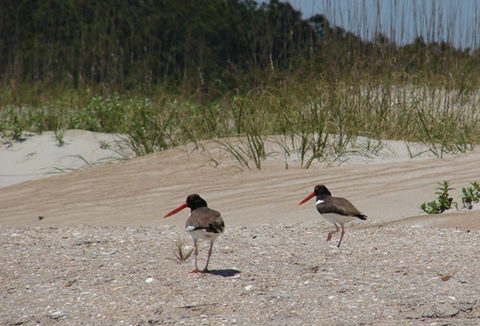
Has life on Cape Hatteras National Seashore gone to the birds?
How is life at Cape Hatteras National Seashore in the wake of travel restrictions aimed at protecting shorebirds and sea turtles that nest along the coast? As with many matters, it depends on whom you ask.
During a Senate subcommittee hearing last week, U.S. Senator Elizabeth Dole, a Republican from North Carolina, testified in support of legislation she sponsored that would overturn the management guidelines adopted earlier this year in a consent decree the National Park Service agreed to with Defenders of Wildlife and the National Audubon Society. She claimed her constituents are suffering undue economic hardships as a result of the consent decree.
A lawsuit filed by the conservation groups sought to limit access to South Ocracoke, Hatteras Spit, North Ocracoke, Cape Point, South Beach and Bodie Island Spit for up to three years because of the presence of piping plovers, which have been considered a "threatened" species under the Endangered Species Act since January 1986.
The lawsuit claimed the Park Service had run afoul of the National Park Organic Act, the National Environmental Policy Act, the Migratory Bird Treaty Act, the enabling legislation for the seashore, and the Park Service's own Management Policies by implementing an interim ORV management plan and failing to produce a long-term management plan.
Under that consent decree, the seashore's staff has greatly restricted off-road vehicle travel and limited pedestrian travel to protect nesting shorebirds and sea turtles. Opponents of the decree, though, have claimed it is over-reaching what reasonably is needed and that the economy that depends on Cape Hatteras is tanking.
But according to the Virginian-Pilot, that's not necessarily the case.
Even with the closures, ORV users and pedestrians have had broad access to the beach. On Thursday, Park Service figures showed 26.4 miles of the park's roughly 67 miles were open to ORVs and 58.5 miles were open to pedestrians. The majority of the prohibited area is due to normal seasonal or safety closures. About eight miles were closed because of wildlife.
It's too soon to gauge the economic impact of the closures, but the effect doesn't appear to be as dramatic as feared. Retail sales tax figures for May and June aren't yet available; bait and tackle shops and other businesses are reporting a sharp drop in sales. Other economic indicators are generally positive, however.
Carolyn McCormick, director of the Outer Banks Visitors Bureau, said in an interview that "the closures did not help us in any way, shape or form." But, she said, key tourism figures in Dare County were good in spite of closures, gas prices, a weak economy and wildfire smoke.
Comparisons of 2007 and 2008 figures show occupancy taxes on hotels and rental houses in Dare were up 6.3 percent in May and 2.85 percent in June. Year-over-year, gross revenues from the meals tax were up 5.12 percent in May but down 1.09 percent in June. (Numbers for July aren't ready yet.)
Story Categories:
A copy of National Parks Traveler's financial statements may be obtained by sending a stamped, self-addressed envelope to: National Parks Traveler, P.O. Box 980452, Park City, Utah 84098. National Parks Traveler was formed in the state of Utah for the purpose of informing and educating about national parks and protected areas.
Residents of the following states may obtain a copy of our financial and additional information as stated below:
- Florida: A COPY OF THE OFFICIAL REGISTRATION AND FINANCIAL INFORMATION FOR NATIONAL PARKS TRAVELER, (REGISTRATION NO. CH 51659), MAY BE OBTAINED FROM THE DIVISION OF CONSUMER SERVICES BY CALLING 800-435-7352 OR VISITING THEIR WEBSITE. REGISTRATION DOES NOT IMPLY ENDORSEMENT, APPROVAL, OR RECOMMENDATION BY THE STATE.
- Georgia: A full and fair description of the programs and financial statement summary of National Parks Traveler is available upon request at the office and phone number indicated above.
- Maryland: Documents and information submitted under the Maryland Solicitations Act are also available, for the cost of postage and copies, from the Secretary of State, State House, Annapolis, MD 21401 (410-974-5534).
- North Carolina: Financial information about this organization and a copy of its license are available from the State Solicitation Licensing Branch at 888-830-4989 or 919-807-2214. The license is not an endorsement by the State.
- Pennsylvania: The official registration and financial information of National Parks Traveler may be obtained from the Pennsylvania Department of State by calling 800-732-0999. Registration does not imply endorsement.
- Virginia: Financial statements are available from the Virginia Department of Agriculture and Consumer Services, 102 Governor Street, Richmond, Virginia 23219.
- Washington: National Parks Traveler is registered with Washington State’s Charities Program as required by law and additional information is available by calling 800-332-4483 or visiting www.sos.wa.gov/charities, or on file at Charities Division, Office of the Secretary of State, State of Washington, Olympia, WA 98504.


National parks and their natural resources belong to you. The National Parks Traveler works to ensure you know how these essential places are being cared for.
Sign Up For Our Weekly Newsletter
Unsubscribe at any time.
INN Member

The easiest way to explore RV-friendly National Park campgrounds.

Here’s the definitive guide to National Park System campgrounds where RVers can park their rigs.
Our app is packed with RVing- specific details on more than 250 campgrounds in more than 70 national parks.
You’ll also find stories about RVing in the parks, tips helpful if you’ve just recently become an RVer, and useful planning suggestions.


Comments
the negative response to the consent decree seems to be overstated and without sufficient basis. I have seen signs that indicate that the government is trying to "close Hatteras." I can only conclude that these signs are intended to misinform the public and to sway public opinion through a campaign of misinformation. I walked the beach along the cape shore this morning (8/5/08) and the ORV's clearly still have sufficient access to the beach and prime fishing areas. The restricted areas seem to be confined to what is reasonably necessary to protect wildlife and, at the same time, allow access for beach driving. The restrictions are limited in time and scope. The park service has clearly provided a throughway for vehicles to pass through the areas restricted for protection of wildlife so that people who want to fish in the surf in more remote areas can continue to do so. I am in Salvo for a 2 week vacation (spending limited personal income for this vacation) and the limited restrictions are in no way a disincentive for my visit. To the contrary, I am pleased that the park service is working towards protecting the valuable and pristine natural resources, including wildlife, on these outer banks, which resources are clearly a draw to tourism. I am not personally or professionally involved in this dispute or litigation but wanted to offer my observations and view of the situation based on my experience as a visitor and someone who enjoys both state and national parks.
Clearly, as you are in Salvo for vacation, you have no frame of reference for what is going on in Hatteras. Walking the beach...looking for birds and seashells no doubt. If that's what floats your boat, I'm sure Salvo is glad to have your money, since Nags Head and Myrtle Beach were out of the budget this year.
If you were there to fish, you may have a better grasp of the issue. Further south. In Hatteras. Home of the best surf fishing in the world.
Here we go with our beloved Congress again: they'll look at the economic downturn as an excuse to ramrod their own peeves through to legality. "Oh, the economy is bad, it must be because we aren't letting people tear up the beach with their ORVs." Forget that we have an oil crisis and food costs are going up. These things are keeping people home, not rules on beach usage.
But Congress, being Congress, will use this downturn to trod on the law to the benefit of their friends.
==================================================
My travels through the National Park System: americaincontext.com
I have recently volunteered for the US Fish and Wildlife Service at Pea Island NWR located within the national seashore. I have followed the recovery programs for piping plovers along the East Coast since they were listed in 1986. At that time I was located in Rhode Island where our population of plovers had decreased to only several pairs due to heavy pedestrian traffice on beaches and also to limited vehicle traffic. With similar recovery efforts that have finally been enacted on the National Seashore, Rhode Island population of plovers has recovered to somewhere around 70 pairs of plovers.
Senator Dole, the National Park Service and the US Fish and Wildlife Service in North Carolina should be ashamed of themselves for the lack of action over the past 22 years. While political groups and state and federal protection agencies have played games over the last 22 years - the population of piping plovers has declined by half. This is an outrage. There is no reason in this world why people cannot give up travel over a small portion of the coastline during nesting season for the birds. Not only the plovers are suffering but also other beach nesting birds. The damage that is done to the beach itself is also worth mentioning. The repeated travel over the sand destroys the beach habitat for invertebrates and other things living in the sand along the shoreline.
During my stay at Pea Island, we traveled down to Cape Point and I was appalled at the damage done to the beach front by vehicle traffic. People will still come to the beach. People will still come to fish. It has been proven in Northeastern states such as Rhode Island, on Cape Cod in Massachusetts that both people and birds can survive together on the beach. The problem in North Carolina is that certain groups of people are too selfish to compromise for the benefit of the wildlife.
[That's not true.] Plovers weren't observed in Cape Hatteras until the 80s. Cape Hatteras isn't part of their natural range. Storms and predators make it extremely hostile to plovers as they account for the lions share of plover deaths. There are also only 21 documented cases of a piping plover being run over by a vehicle. 20 were by government officials (AKA Park Services).
You guys are trying to play God and establish a migratory bird in a region outside it's natural range. Stop ruining our beaches.
yall are a bunch of ignorant people with more concerned about birds than humans and threatened not endangered at that...you will spin your tales and invent figures that dow/as/and selc seem to make appear out of thin air without
any shread of proof of those figures..
pardon my spelling but folks like you posting garbage like this and pawning it on an uninformed / unsupecting public
and using my tax money to sue is a criminal offense and i hope congress passes the law that dole and her foks want and outlaw suing the fed gov't over trivial matters such as this..
dow and as have no other purpose than to waste tax payer money of lawsuits
me out...
I can't wait until you people realize the true effect this consent decree has put on eastern NC. If this consent decree is not overturned, life as we know it on Hatteras Island and further south will be non-existent. People have already lost their jobs, business' are suffering and homeowners who rent their houses on the island are just begining to feel the effect.
I ask all you naysayers, how would you feel if some special intrest group decided that your favorite park or golf course had to be closed down because of an animal that is threatened but not indigeonous to that area was spotted and your livlihood was effected by this. I am sure you would fight tooth and nail to protect your income and the losses that would come along with it.
Before you make your these uneducated stetements like the ones above, learn the facts first.
This is happening all over this country, special intrest groups are taking over this country, stopping industry, preventing oil drilling and refineries ans keeping pepole from going and enjoying our great land that we pay taxes to support. Its rediculous and one day soon, our Government will stand up against these people and put and end this eco-terrorism!! GO FISH, it will make you a better person!!1
The below is one of many truthful articles you can find if you choose to determine facts as opposed to opinions. This is not about ORV access, this is not about birds, this is not about turtles. This is about a violation of rights and laws. This is about people losing their jobs, land and homes. I believe many of you that have the narrow view that the consent decree is a good thing would feel very different if your life was the one that was being ruined.
The below is copied from a letter in The Island Free Press by Dr. Mike Berry.
There is a clear difference between science-based, socially responsible and equitable environmental management and a growing political movement called "environmentalism."
Responsible environmental management uses sound science and professional judgment to balance the human needs and rights of people with the need to manage and sustain natural processes. As a public health professional, I will always place the health and well-being of humans first, and I will never accept a political philosophy that suggests people are less important than other species. Increasingly, "environmentalism" places species ahead of humans. Sadly, this new-age philosophy has crept deeply into our political process. Humans should never be completely shut out or deprived of their environment, so that other species should prevail or dominate. With a good understanding of science—knowledge of how the environment works—humans can make rational decisions and manage conditions so as to connect with their environment and at the same time provide for the existence of other species.
The environmental activist lawyer's comment to the court and to the media in U.S. District Judge Terrence Boyle’s court on April 30 that this consent decree and "settlement" represents a "win-win" management program is about as far away from the fact as one can get.
The park management formula laid out in the consent decree is a new public policy. This new park policy was put together on the fly in about 10 days behind closed doors, without any open discussion of scientific fact, explanation and justification of environmental management strategies, or consideration of the many needs and desires of the general public. In this court-approved settlement, the federal government agrees to respond to the dictates of three non-governmental special interest groups for the next three years. Citizens cannot even challenge the Park Service or these non-governmental groups about this management policy. Essentially, this consent decree takes the Cape Hatteras National Recreational Seashore and turns it into a national maternity ward and nursery for five bird species and turtles.
Every legitimate public policy in our democratic society is based upon the Constitution. Public policy is intended to provide for the public good and the rights of persons and that begins with the protection of citizens and promotes conditions that enhance social well-being. Citizens have a right to be a part of and have a say in the formulation of governmental policies that affect their lives. However, in this consent decree we have public policy created by dictum and without benefit of comment or review.
In addition, the consent decree appears to grant special rights to species, overlooking the fact that the Constitution grants rights only to persons. There is nothing in the Constitution that grants any right to a bird or turtle. That fact is seemingly not being taught in law schools these days.
Traditionally, federal courts interpret and render opinions on the law and protect citizen rights as spelled out in the Constitution or the federal statutes. It has been long recognized that Congress and the courts do not have the technical knowledge or resources to manage national parks. That is why Congress established the National Park Service. Park Service professionals are responsible for making technical judgments and management decisions with regards to the peoples' park. However, this consent decree is the product of a process called "judicial review." Increasingly, especially with regard to environmental issues, this judicial process is properly criticized as "legislating and managing from the bench."
In the April 30 court hearing, the judge acknowledged about five different times the need for public participation and review, but then, at exactly one hour into the hearing, he completely set aside any public concern or comment and signed off on the settlement. The Outer Banks community intervenors had no choice but to go along with the agreement or have the beach shut down completely. The court knew that and could have at least opened the settlement to include public hearings.
This consent decree is a classic example of how not to formulate environmental policy. It is good example of why good public policy must always be transparent and provide for public review and comment. The formulation of good policy takes thoughtful planning and organization, time for citizen interaction and review, including science review, much along the lines of what is currently being attempted with the negotiated rulemaking process.
The truth is that under the consent decree the closures at CHNS completely shut down human access to the premier surf fishing location on the east coast, Cape Point, for several weeks. Human access was completely denied, pedestrian as well as ORV. Additional prime fishing areas were also closed. Any reports of this issue that don't reflect that reality are misleading. Official NPS and media reports of the amount of beach open have consistently included areas that are technically open but to which there is no possible access due to adjacent closures. Reality doesn't "depend on who you talk to." This type of action orchestrated by protectionists whose main goal is to severely limit public access to public lands, only drives a wedge between groups who have a common interest in protecting habitat for future generations. Most sportsmen support protecting natural areas and the habitat they include and have historically accepted restrictions to protect the resource. However, actions driven only by the egos of self-appointed protectors will not be accepted without a fight. When few can have access to our wild areas, few will stand to protect them when they need protected.
Who you talk to is the real question. What isn't said in all this is the fact that the Consent Decree in words APPEARS to take all parties positions into account. What it doesn't say is that ALL PARTIES have equal ability to verify sightings of nesting birds. What it doesn't say is Last Year Nests were located at grid X Y, and oddly this year every nesting area was withing close proximity to the access ramps to the beach. The original set aside on some ramps did leave room for pedestrians and vehicles to pass, but with in a week, Incredably, some one violated those particular areas and by Decree, the are was expanded and now did include ramps and access paths. In effect limiting the ability to pass the closed off access to get to the areas that remained open. Blockage from both end kept miles of beach inaccesable for most of the summer. The fishing community was locked out. Oh there was beach available to fish from, but not in areas where fish are normally caught. If you are of the opinion that the poor little birdies are being pushed out, you need to read more. Read the Island Free Press, even read some of the information about these effect birds available on the internet. You will quickly learn that the Piping Plover (PPL) Spring and Summer nesting area is closer to Long Island (oh yea, they have money, their beachs aren't closed) and their wintering area is Fl, GA and the gulf. The PPL at CHNSRA are just lazy mooches. they decided not to migrate, took up residence in an area that is not condusive to their survival. The mooch food off the fisherman ( would that be a reason their nest are located in the BEST FISHING AREAS?) and now they have a few bird wacko's sueing the FED GOV. Remember folks when they win, they get all their cost reimbursed by YOUR TAX DOLLARS. One - it takes away from the money available to run our parks, two- You know a tax increase is in the works to make the agency budget for the following year. three- this is a vicious circle, sue, get money, raise taxes, sue because they have more money to sue for. We, property owners in Hatteras love the bird as much as the next person, but if they can't survive without the wholesale rip off system. This year there were 7 birds fledged. that's 3 more than last year, at what cost? It is multi-millions of dollars per bird... that's the cost. All we're saying is think before you spout off about the poor little birdies that you know very little about.
cape hatteras is not a park, national parks traveler. it is a national recreational area for human biengs.human biengs have been driving on the beach at H.I. for a long time, human biengs that have been driving on the beach for a long time have been long time stewards of the beach. they clean it up, love the enviornment and the wildlife. they dont go around chasing plovers, attempting to band them, killing and maming hundreds of them. oh yes its true. killing predators such as fox and coons. also true. shaking hands and pledging to negotiate in good faith, all the while spinning yarns and decieving honest americans. you really need to get the facts and stop pretending to be for something, when your true objective is totally different.
I keep seeing Hatteras Island refered to as a natural area. The "natural" part of the island was "destroyed" when we built the dunes as one of FDR's depression ending work projects(no there is nothing natural about the dunes they are manmade) in order to have a hard surface road. Why build a hard surface road on a barrier sandbar? For developement so tourists (humans) could be attracted to the beaches and money, jobs etc. could be created. These manmade dunes keep the natural process of ocean overwash from occuring, which causes the front of the island to be shaved off and keeps the backside of the island from building. As a matter of fact Hatteras has only been an island for aroung 150 years. We artificially keep Oregon Inlet open with manmade jetties and dredging. Before you side with the misinformed (or intentionally misleading) wildife groups. relearn your basic science on barrier islands. Hatteras is a manmade park. Check Webster for the definition of the word Park. As for the birds check out the science and history of the story; nesting pairs, chicks fledged per year where the nests are/were located it doesn't match what I see the "wildlife groups" claiming. notice effects of hurricanes.
Beach buggies do not harm the beaches, if anything the tracks attract and hold sand. The dunes are destroying the beaches. My children learned a respect for wildlife and geology by fishing and driving on those beaches. If my only access to wildlife is the nature channel what a shame that would be. The bridge and allowing the sale of alcohol on the island has done more to change and damage the experience of Hatteras than anything else. Drunks and punks drive thru turtle nest enclosures not fishermen and women or their families.
I had always considered the audobon society as good people. I have seen the light now though. They speak with a forked tongue and deal underhandedly.
When the park was formed and the land bought beach driving access was promised.
The NPS was doing a good job, find out the truth about how many birds this year successfully nested outside of the bird enclosures from the last 20 years. Manage wildlife with science and evidence, not opinion.
How can "they" sue the gov't with my tax dollars? Why can't I use their tax dollars to defend my rights?
I belive that at the highest level the "do-gooders" are being used. This is not about the birds, a real estate take over maybe? Own eight little spots and the gov't and our tax dollars will maintain and provide someone with 2 islands and a private national park.
as stated so well above: "When few can have access to our wild areas, few will stand to protect them when they need protecting."
Please learn the geology and history of Hatteras Island and the Cape Hatteras National Seashore. Learn the science of the issues. The evidence will lead you to membership in the OBPA and the NCBBA. Bring a fishing rod and your children!
Tight lines and sharp hooks
ORV's have NO BUSINESS on the beaches at all unless they're emergency vehicles!!!!!!!!! Why can't fishermen/women WALK down to the beaches with their gear??????? I say that no ORV's (except fro emergency vehicles) should be allowed in ANY wilderness areas.....They enable people to trash the beauty,hassle the animals with their noise,and pollute the air.
Carol has not even got a clue what CAPE HATTERAS NATION REACTIONAL SEASHORE is about. It is not a wilderness area!!!!! A group of special intrest groups, (Dow, Audbon and Sleg), have formed an alliance and threatened to sue and close six for the most fished spotes on the outer banks. Under this threat a conscent decrees was forced down the throats of those involved. Thses groups got more than their six spots shut down. When you close the ramps to the beach you shut down more than just that area. You shut down the entire beach because of lack of access to the space between enclosures because you can't get to there.
Aside from not being able to fish the economic empact of this will eventually kill the local economy. I spoke with the owners of some local bait and tackle shops and their bussiness is down anywhere from 30 to 50 per cent from last year. the local motels and campground are having similar problems. The reality agents are not hurting because of the time frame for rental houses, usually 6 month to a year in advance. Next year will be the telling story on their situation.
I spent a month starting May 12 thru June 10 2008. If this concent decree is not over turned beore next year I won't be spend any money going somewhere I can only ride the roads. People go there mainly to fish and enjoy Gods creation called the ocean.
Because the access is sooooo long. If you are unfamiliar with the area in question look at it on a map. the dunes you cannot walk on The access areas in general do not allow for very many people to park and access with beach chairs, coolers, and the like. People with handicaps and restrictions with the ability to drive is considerate and compassionate the closures have restricted this access and shown that no knowledge about the true nature of this situation has been propaganded to such a degree that people do not realize what is at stake here. Human beings lives, livlihoods, and their childrens rights. Allowing an organization to sue our government and then have the tax payer (you and me) pay for the suit, dictate how where and when you can access public lands is an affront to our forefathers. If you do not believe like they do or act the way they want you to they sue. essentially forcing their will onto a free people. The interim plan was in place before the suit came about and was being effective. they are sitting in on the regulation negociations and you have to ask if they will negociate in good faith considering the suit. I believe not. The access to the beaches from each ramp from the closures have left no room to even turn around when there are a lot of people. read the report from the nps and do the math. you will see a spin from these organizations that should make you pause and do more research.
One thing people need to keep in mind is that despite the "ORV" being attached to this story wherever you read it, the problem is not just access for vehicles. It is also access for pedestrians. The Consent Decree calls for huge closures for both people and vehicles. It is true the pedestrian closures are smaller than for ORVs, however, even with the pedestrian closures the best beaches are closed to everyone - including surfers, kite fliers, etc. It's not just ORVs that we are talking about.
Also, before you decry the mobile surf fishermen and their noise and pollution, you should realize that it is these folks who care more, and do more than anyone to preserve these beaches for everyone, including the wildlife. The NC Beach Buggy Association, for example, hosts regular "beach respect" outings where everyone pitches in and cleans up the beach. You also have to understand a bit about the area before you make statements about allowing evil ORVs. Cape Hatteras in large part is only a beach, it is not a resort community. In years past pre-dating the establishment of the park the only way to get around was to drive on that beach - there were no paved roads. Beach driving is a part of the history and heritage of the island. Hatteras Island is not like Myrtle Beach or Atlantic City - it is big and wild and natural. You can't take a boardwalk 200 yards to the surf. If you want to get to Cape Point for example - one of the most unique places in all the world - you need to travel about 1.5 miles one way from the nearest parking lot (which is going to hold very few cars.) Since May of this year sadly, you have not been able to do that - it was closed until recently. Now it is open for a short time before it will be closed again because of the magic September 15th date when turtle nest closures become full beach closures (no humans allowed). Someone who thinks this is about turtles or birds should try and explain why you can walk behind a turtle nest on the 14th just fine, but the 15th onward is not to be allowed. And no, it does not have to do with the possible hatch window - full beach closures are already setup around that starting at the 50 day mark for each nest.
Imagine you grew up on Hatteras Island, imagine it was your parents or grandparents whose land was taken away from them by the federal government to create this National Park Recreation Area (no, it is not a "wilderness area"). They did not receive anything in return except a promise that the public would never be denied access to this resourse - now that is exactly what is happening.
You have no clue. I for one have degenerative back disease. For me and my 9 year old daughter to fish, I would need to walk 4 miles, carrying fishing equipment, umbrellas, cooler (No alchohol), etc. I guess you have never been to Hatteras island to make such an asinine comment. Check your premise, you, like DOW, Audobon, SELC obviously have an ulterior motive. OR, are you one who would prefer mankind die off and leave earth to the Animals?
Editor: The closing end of this comment was deleted for its unneeded harshness. While the Traveler welcomes the debate over this issue, the hope is that that debate can be conducted without directly and needlessly attacking others.
For those who think they have a need to blame ORV's for the Bird population decline first need to take their uniformed little minds over to www.nps/caha and check for yourself on the piping plover reports and you will see they have not actually increased in population of nests this year at all. I would also like you to note that there are no documented deaths of a piping plover by ORV, but there are many from predetation and storms. Does this mean you will ban acts of god from the beache also. After gathering your fact maybe we will actually listen to you.
This is so typical of a ignorant comment to make an all inclusive statement like "ORV's should not be on the beach" and "if fisherman want to fish the point let them walk their gear out". Well in your fabulous well thought out plan lets consider the handicapped and small children. Should we just post a sign stating you are not welcome? These inclusive statements are exactly why we fight you so hard. You will exclude anybody out there to further your cause. I only wish people like you would learn to think before you speak!!
This thread needs a rebuttal to the Va.-Pilot article referenced in the original text.
I hearby submit said rebuttal, from the "Island Free Press", penned by Mrs. Irene Nolan, and island resident and long-time writer for several Island newspapers. It speaks for itself, and supports Dr. Mike Berry's article also include in this thread.
*******************************************************************************
Island Free Press
By Irene Nolan
*******************************************
Move ORV debate back to Hatteras
The Virginian-Pilot
© August 4, 2008
What they said
The controversial consent decree about beach driving that's caused so much turmoil on the Outer Banks includes a provision that allows the parties to renegotiate the details. That's exactly what off-road vehicle users, environmental groups and local officials should begin doing as summer nears an end.
Last week, a U.S. Senate subcommittee heard testimony on a bill, introduced by Sens. Elizabeth Dole and Richard Burr and Rep. Walter Jones, that would scrap wildlife protections at Cape Hatteras National Seashore, imposed by an April 30 federal court order. Under the bill, those protections would be replaced with less restrictive guidelines the National Park Service had been using.
Sen. Burr, a subcommittee member, said the change would let residents and visitors return to a tradition of protecting wildlife while enjoying the seashore "in a way that God meant it to be enjoyed."
But the bill's prospects dimmed when National Park Service Deputy Director Daniel N. Wenk said his agency opposes the bill. He said the consent decree is a more effective way of balancing wildlife protection and recreational uses than the agency's previous strategy.
According to Wenk, the decree's restrictions on beach access for off-road vehicles and pedestrians during nesting and breeding seasons have increased populations of vulnerable bird species and sea turtles. This year's figures for turtle nests are at a record high.
The Park Service's stance is remarkable, given the agency's years of foot-dragging on developing a plan regulating ORV use - delays that prompted environmental groups to file suit against the agency.
The consent decree, which ended that lawsuit, was the result of an agreement signed by conservationists, park officials, a coalition of ORV users and Dare County officials.
But business owners and ORV users are upset with how the new restrictions have played out. Several prime fishing spots have been closed in the past two months because birds were nesting nearby. The restrictions are easing now as the breeding season ends. Last week, ORV users regained partial access to Cape Point, a popular spot. (Nightly closures, designed to protect nesting turtles, remain.) More reopenings are expected soon.
Even with the closures, ORV users and pedestrians have had broad access to the beach. On Thursday, Park Service figures showed 26.4 miles of the park's roughly 67 miles were open to ORVs and 58.5 miles were open to pedestrians. The majority of the prohibited area is due to normal seasonal or safety closures. About eight miles were closed because of wildlife.
It's too soon to gauge the economic impact of the closures, but the effect doesn't appear to be as dramatic as feared. Retail sales tax figures for May and June aren't yet available; bait and tackle shops and other businesses are reporting a sharp drop in sales. Other economic indicators are generally positive, however.
Carolyn McCormick, director of the Outer Banks Visitors Bureau, said in an interview that "the closures did not help us in any way, shape or form." But, she said, key tourism figures in Dare County were good in spite of closures, gas prices, a weak economy and wildfire smoke.
Comparisons of 2007 and 2008 figures show occupancy taxes on hotels and rental houses in Dare were up 6.3 percent in May and 2.85 percent in June. Year-over-year, gross revenues from the meals tax were up 5.12 percent in May but down 1.09 percent in June. (Numbers for July aren't ready yet.)
Park Superintendent Mike Murray said it's too early to measure the effect of the consent decree on attendance, but an increase in May and decline in June generally fit trends reported by other parks.
In the meantime, passage of a federal bill overturning the decree looks doubtful. It's unlikely the full House and Senate would take up the measure before the year's end.
In any event, it's hard to envision Congress jumping into this contentious situation and generating a useful response. The consent decree left open the potential for tweaking the details. Islanders, conservationists and park officials should begin that work for next year rather than continue to spin their wheels in a time-consuming, unproductive debate on Capitol Hill.
WHAT WE SAY
It is true that the consent decree allows for modifications by the court at the request of the plaintiffs, the federal defendants, or the intervenor/defendants.
The decree instructs that the parties must submit to dispute resolution before seeking modifications.
And there is little reason to believe that the environmental groups, having gotten just about all of what they wanted, will give one inch on the expanded bird buffers, night driving, or complete closures for turtle nests after Sept. 15. (Before Sept. 15, the Park Service can provide ORV trails behind nest closures when possible.)
Furthermore, the plaintiffs are now participating in a negotiated rulemaking process, with other seashore stakeholders, to devise a long-term ORV regulation. They claim to be participating in “good faith,” but we and others question that assumption. Until there was a consent decree, everything was on the table. Now, the groups will be negotiating from a base of the terms of the consent decree. We do not think the environmental groups will give an inch from what they got under the decree.
Virginian-Pilot editorials continue to refer to the “less restrictive” interim plan.
And, by the way, we don’t like the inference in this and previous editorials that it was the Wild West down here on the beach before the consent decree. The locals and visitors have lived with closures for wildlife protection for decades – closures that increased in size and time span over the years.
Yes, the interim plan is less restrictive in some areas. The major differences are the size of the buffers, night driving restrictions, and the fact that the interim plan gave park management some discretion to make decisions when the closure calls were close ones. There is no discretion under the consent decree.
The Southern Environmental Law Center, and now the Park Service’s deputy director Daniel Wenk, have proclaimed the consent decree a success after just three months.
That anyone could declare a management policy a success in three months defies reason.
The Pilot editorial specifically refers to sea turtle nests at a “record high.” The implication in the editorial and in testimony at the Senate hearing by SELC attorney Derb Carter is that this record high is a result of the consent decree.
The facts do not support that the consent decree has caused this turtle nesting boom.
Sea turtle nesting on the Pea Island National Wildlife Refuge on northern Hatteras Island is also approaching a record high. As of Aug. 4, there were 23 sea turtle nests on Pea Island, compared with 14 last year, which was considered to be a good year. And there has not been any driving on the beaches there in decades. It is perfectly possible to assume that it could be a record year for sea turtles on the entire North Carolina coast – not just on the Cape Hatteras National Seashore under the consent decree.
Yes, there were seven piping plovers fledged on the seashore this year – and only four last year. But the percentage of fledged birds per breeding pair is slightly down this year.
This year 11 pairs of piping plovers fledged seven chicks for a success rate of .64 chicks per breeding pair. Last year the six pairs fledged four chicks for a slightly higher nesting success of .67 chicks per nesting pair. Furthermore, the four chicks fledged last summer under the interim plan was a large increase from previous years. From 1999 through 2006, there were either no chicks or only one or two fledged per year. The average rate of fledged chicks per breeding pair over the last 15 years on the seashore is .66.
One piping plover nest was lost in a storm this year. Another nest and the rest of the chicks were lost to predation, as has been the case in the past. There is no evidence the chicks were killed by ORVs. Environmental groups will argue that the consent decree with its increased buffers allowed more pairs to nest this year and more chicks to fledge, but there is no reason to believe that nesting and fledging would not have been up this year under the interim plan.
The interim management plan was devised by the National Park Service in consultation with the U.S. Fish and Wildlife Service and with public input. It went through a review process that resulted in a Finding of No Significant Environmental Impact (FONSI) and final rule publication in the Federal Register last July.
Now the leaders of both of these services in Washington, D.C., are throwing their local management and staff under the bus by basically saying that they didn’t get the job done with the interim plan and the consent decree is better.
Well, where has the Washington leadership been these past few years while the interim plan was being formulated?
We can agree with the Pilot editorial that the Park Service’s stance on the legislation is “remarkable,” given that local park management sent several ORV plans forward to their bosses, beginning in 1978 --only to have those bosses in Washington take no final action.
And the 35-year or so delay in having an ORV regulation is what has given the environmental groups the ammunition to get as far as they have – that and a sympathetic federal judge who was known to have a problem with ORVs on the seashore.
The economic figures that are being thrown out by both sides of the beach access issue are totally meaningless at this point – unless, of course, you are one of the tackle shops whose business is down by 30 percent.
First, most visitors don’t even know about the beach access issue when they get here.
Next, occupancy figures will not show any fallout from beach access until next year. Most of Dare County’s occupancy taxes come from rental houses, and everyone who has rented a house knows that you do not get out of your contract unless there is a hurricane on your doorstep and maybe not even then. My brother-in-law died three days before his scheduled vacation on Hatteras in June, 1998, and the rental company made his widow, my sister, honor the contract. No refund. So you think anyone would get a refund because a few beaches are closed?
The point is that even the folks who knew the Point was closed couldn’t change their plans this year.
The question will be whether those people will come back again next year. And no one can answer that now – not Derb Carter and not The Virginian-Pilot editorial board and not the beach access advocacy groups.
The question of how many miles of seashore beaches are open to ORVs can’t be pinned down exactly. It’s a moving target that changes every day as birds come and go and turtle nests reach their hatch window.
In its editorial, the Pilot said 26.4 miles of seashore was open to ORVs. Today, I figured about 17, including three miles of beach south of Ramp 30 that was closed to ORVs over the weekend because of a turtle nest. That three miles of the beach is open to pedestrians, who can walk behind the nest.
Finally, we can agree with the Pilot editorial that there is little or no chance that legislation to overturn the consent decree will pass this year – or maybe any year.
There are only two more summers until there must be a final ORV regulation, so what’s the point?
The point is that the process that environmental advocacy groups have pursued has ignored the work and input of the residents of and visitors to Hatteras and Ocracoke and the hard work of the local park staff.
If the interim plan was good enough for the Department of Interior last year when the final rule was published in the Federal Register, why is it not good enough now?
We still say that the National Park Service should go back to the interim plan until negotiated rulemaking is concluded.
In the meantime, maybe the intervenors should ask the environmental groups for some changes to the consent decree for next year and see what happens.
Can’t hurt to ask.
Don't pay any attention to the above comments. This story was linked to a fishing message board and now they are all dumping their trash here. Cape Hatteras is a lovely place, but you don't need an SUV to enjoy it. Go out there and you will see hundreds of people driving all over the place. The country is in an oil crisis and a war and all they are worried about is being able to waste hundreds of dollars in their gas guzzling vehicles to go fishing. They stake claim to it with all the indignity of a welfare queen waiting for their monthly check.
Yep Phil, I did it, and and I'll bet ya want to know why? Well I'll tell ya. I did it for my kid. With all the negative influences our children are exposed to these days like MTV poluting their minds, peer pressures at school and general madness of knowing their futures aint as bright as ours were promised to us. Spending quality time with our families is more important now than ever.
Using an ORV to access the beaches on the Cape Hatteras National Seashore Recreation Area is how I spend my quality time with my child two weeks a year, once in the spring and once in the fall every year since she was old enough to walk, she will start high school this year. ORV use, surf fishing and bird watching, in my opinion aint a bad way to raise a kid these days, teaching our children about nature, species and plant identification and a heathly respect for our enviroment is a heck of a lot better than planting them in front of a TV, or just giving them some money and letting them run loose in a mall somewhere.
I cant even count the times over the years that my daughter has had to educate pedestrians on the proper use of our seashore and areas where they are allowed and not allowed.
Proper use of an ORV on Cape Hatteras National Seashore Recreational Area is a benefit to wildlife, without it the place would look like a landfill.
The prevailing currents that made the Outer Banks bring trash and debris from cargo ships and dumping off the seashore to the area, With out volunteers with ORV's the wildlife would have no beach to nest on and thrive, because NPS, Autobum and DOW sure aint gonna do it, thats a fact.
Just because someone drives an ORV on the beach that does not make them an anti-enviro, or evil, far from it. You might just find that they care more than you.
BTW, we love to watch black skimmers on the north end of Orcacoke, their so cool!
Yeah well.....try walking the beach in 2 years when it IS CLOSED TO PEDESTRIAN ACCESS TOO!!
You are all being mislead into thinking you will still have pedestrian access. You will not! Furthermore, walk the beaches 3 months ago and tell me there was sufficient access. What you dont know is that a large portion of the beaches are open but the access ramps are closed so you cant get to those "open" sections....hence the warcry - "free and open access" Can't have free without the open! Open your eyes!!! You are being made a fool of!
The business and people should have know this was coming. just as we all know the Bonner Bridge will be gone over
the next 5 to 10 years and they wont replace it because of the enviros. After the next Isabel plows
thur the area and washes the road out for the 15 million times. the place is disolete its like a closer artic circle just not as cold.
I visit there about 20 times a year all thoughout the year. It's a beautiful place for sure. The fishing and surfing is outstanding but
at what cost to the tax payer. A new bridge will cost 100 of millions and millions of dollars at what cost is it prohibitive to have
access. Have a tax increase of the islanders???? I know Id be pi^%$off if I lived in chapel hill and had to pay taxes on a bridge that
I would never use or see, only for going on vacation .The cost per island resident would be about 300,000,per resident oh and for vacationers
tax the vacation home owners? The free lunch is over it you want it you write the check my checks are gone..... to pay the stimulus
to the poor. out
Tommy, I have back problems too and it's sever but I do walk and hike. It's part of the back therapy program. However, would you give up your ORV and take a convenient small tram system to your fishing destination at Hatteras, if such a system could be provided with good ecological planning and sound management?
Phil G:
Addressing your comments, sir, I say this:
-How does the "link to a fishing message board" effect the content of an editorial written by a local journailst? Mrs. Nolan clearly defines both sides of the issue for consideration. Find the original article for yourself.
-ORV access is written into the original charter of the CHNSRA. Read the above.
-The same people whom you deride for driving on the beach, wasting war-concerned oil will simply drive elsewhere than Hatteras, leaving local businesses in financial ruin, burning said fuel elsewhere. Again, see above. Do you not own a fossil fuel burning car/scooter/furnace/stove yourself for personal convenience? I would assume that you have a reason to travel, and/or accept goods and services through means of such travel as provided by fossil fuel burning devices. Do you attack them in the same manner? Doubtful.
-No one expects a handout, as you so wrongly suggest. Just adequate beach access ALONG WITH species proteciton, but not human species elimination.
Educate yourself before you choose sides.
dap
Just so you all know, the new bridge allready has funds allocated for it from ncdot pending ongoing lawsuites from DOW, SELC and Audobon for public lands they think they own.
Dr. Mike Berry speaks the truth here, unbiased! Go to Island Free Press also an unbiased editor and read the truth.
Now, my turn to say a few things.
Who are any of you to tell me what I can drive and how much gas I can burn. Why don't you walk to work and save the fuel for the farmers to grow your food? Yes, I farm. I burn hundreds of gallons of fuel to feed you and a few more thousand just like you! Want to know what burns me? Driving 200 miles one way and I can not get on the beach after working my rear off all week to feed you! Opps, someone forgot to tell most of you uninformed non-resident, non-hatteras supporting, eco-nazis that you can not even walk on the beach where there are closures. Let me say it again. You can not walk on the beach where there are closures. Got it! If you wanted to walk three miles down the beach to fish where the fish are biting or just to sight see you can not do it. Again most of you do get that it is not about a handful of birds and turtles. It is about driving on the beach. Get your PhD in science before passing judgement. Want to here the something sad? These eco-nazis have have forced the National Park Service to kill hundreds of other animals so less than a dozen birds can mate on the beach. Look and you will find the pictures all over the internet of uniformed NPS employees with shotguns in hand on our great Cape Hatteras National Recreational Park killing foxes, racoons, opposums and such. Your special interest groups are playing God and are killers not environmentalist! DOW SELC and Audobon are killers!
@Tommy Linday: It is sad to hear about your back and I wish you well. And I understand that you would like to go to remote places despite your condition and need an all terrain motorized vehicle for that. But please understand that your wish is unreasonable in a National Seashore. Please accept that with age and illnesses all of us have to say goodbye to some activities we could do in our youth and can't anymore. It is not acceptable to demand that the public has to allow us each and every action we wish to compensate for our individual limits. Motorized access to undeveloped parts of the shore line is not consistent with the dedication of a National Seashore and must be phased out.
And to all who complain about the hardship for business owners: Cape Hatteras National Seashore is a national park. It is the duty of its administration to run it to the benefit of the nation and the general public. Not for the local community. As business owners: Be happy to make business with visitors, give your input to the administration, but do not expect the park to be run according to your percieved needs. It is a national park, not your backyard.
ATTN PHIL G and the REST of the uniformed:
To all here who state their opinions the Pro Access people are the ones who do not use lies to get our stories told. We can and will show you scientific studies and real data that will and does refute any and all claims by the special interest suing groups. In fact I can point you to all the data you want using the NPS/CAHA website, But I am sure that you will hold your hands over your ears and start screaming so your brain will not be poisened by the truth. I am sure the you PHIL G live greener than any human alive, but to insure your comments are true why dont you post your address , occupation, and please include pictures of your bicycle you use to coomute to your job. I also would like for you to stop putting everyone in the same group I for one have no need for welfare, but unlike you I would like my kids to be able to see the world while not sitting in a sealed glass container. ... lets see you prove your side with scientific data.
The true impact of the consent decree will not be felt until next year. The agreement was reached May 1st, after many reservations were already made. The increase in occupancy tax revenues quoted in the article is inflated by Dare Counties increased efforts to collect the tax from private homeowners, which is where the majority of the increase comes from.
The impact of the Judicial Consent decree that limited beach access at Cape Hatteras National Seashore is having a major and direct impact on park usage and the local economy. According to National Park Service information total visits to the park were down by 144,548 visits in June 2008, or over 20%. Total visits to the park have declined by almost 15% for the total year. (1)
According to the NC Dept of Revenue, the state taxable revenue reported in Dare County in the May period declined by 16% ($11.8M) compared to May 2007. For the same period Hyde county Revenue was down 15%. During the same time period taxable revenue for the state of North Carolina did not decline (2)
Walking and ORV beach access are major attractions for visitors to the Cape Hatteras National Seashore. The unnecessary limits put in place by the consent decree are now having a dramatic impact on the park usage and the local economy.
· June Park visitor access downs 20.92%
· June Park Service campground usage down 24%
· Vehicles on Bodie Island down 27% in June
No other National Park in the area experienced such a significant decline.
Visits to Wright Brothers National Memorial are up 8.26% year to year. (3)
Visit to Blue Ridge Parkway National Park are only down 3.7% year to year. (4)
Sources
(1) Cape Hatteras National Seashore Monthly Public Use Report, http://www.nature.nps.gov/stats/viewReport.cfm
(2) NC Department of Revenue, Monthly Sales and Use Tax Statistics for the Fiscal Year
a. http://www.dor.state.nc.us/publications/monthlysales.html
b. Dare County Taxable Sales: May 2008 = $64.2M, May 2007 = $76.1M. ("May data reflects sales primarily in April.." which was the first month of ORV and Beach walker restrictions )
(3) Wright Brothers National Memorial Monthly Public Use Report
http://www.nature.nps.gov/stats/viewReport.cfm
(4) the Blue Ridge Parkway National Park Monthly Public Use Report
http://www.nature.nps.gov/stats/viewReport.cfm
Can someone give me one damn good reason why a well managed motorized tram system that fits well ecologically with the Cape wouldn't work? Instead of being wall to wall with ORV's, we could have good spacial geography between acquired fishing posts...and with better visibility. We could have connecting cabs (like say ten light connected cabs to a jeep) to a good transporter...like in Yosemite. Drop offs and pick ups could be at pre-designated locations which can discussed with the local citizens of Cape Hatteras (and with pro access groups) and the National Park Service. To prevent over crowding, set up a quota system to prevent massive crunch time during peak tourist season. Is possible to set up such a tram system that could be beneficial to wildlife with less human impact on the shoreline and yet still provide the visitor with a quality fishing experience...and with less intrusive motorized traffic on the shoreline. Basically, the theme is to think green! In regards to your comments Stephen C., this is not a "eco-nazi" plot to throw you out of your ORV, but a proposal that might instigate some kind of environmental change that could be beneficial to man and wildlife without all sharp provocative forces clashing who owns the Cape.
Will someone please provide one scientific reason, backed by real data, to support the extreme closures dictated by the consent decree? I'm not asking for answers such as pristine wilderness, protected seashore, lazy fishermen, loud ORVs, blah blah blah. Give me one real reason to destroy a tradition that has been in place at Cape Hatteras for many decades. Show me one piece of scientific data that proves any animal species is in danger of becoming extinct due to ORV access at Cape Hatteras. The Interim Plan provided more than adequate protection for shore birds and turtles while providing reasonable access to some of the best fishing locations on the east coast. A return to that plan would not be detrimental to the wildlife on the island. The vast majority of ORV users on the island care deeply about conservation. There can be a compromise. Should the wildlife be protected? Absolutely. The consent decree, however, attempts to proctect a handful of birds (some of which are neither endangered nor threatened) through restrictions that go far beyond what is reasonable. I would argue that it has not and will not help the birds at all.
As for the Anonymous that wants and answer to "Can someone give me one damn good reason why a well managed motorized tram system that fits well ecologically with the Cape wouldn't work?" HURRICANES, INSURANCE, LIABILITY, WHO SALL RUN THIS? Shall I continue. This again proves the point about the people who reject the idea tha man and beast can cohabitate. THEY CANNOT RESEARCH OR THINK FOR THEMSELVES!!!!!!! TUNNEL VISION. Please people before you tear into someone who drives a vehicle on the beach put some thought into your comments and before you try to save the beaches from the horrible demise of the SUV please realize without us paying into the economy is the outerbanks there would be no outer banks National RECREATIONAL seashore.
Yes, the closing have had a detrimental affect! I love the birds, the deer, the fish, and all the other critters! I have done all I can do to drive with care, protect the animals and environment, leave with more trash that I brought, and reported violators. But while I am currently on the island for my family vacation I have made the hard decision not to return after vacationing years and years here, along with other weekends during the year. I find it interesting that I see no more wildlife than what I saw the first time I was here, even though the closures are now in place. I can't for the life of me understand why the bird fanatics can't accept Pea Island as the refuge it is, no driving there either...greed begats greed I suppose. In fact, we come here about the same week every year...I think I actually see less people, less cars. Has it hurt the economy? I bet it has...bad.
Please, somebody open the beaches back up!
sv
*Sigh...*
Here we go again. Many of you are making "armchair quarterback" decisions from 1000's of miles away, having never even set foot on Hatteras island. For shame, people! It's tantamount to me as an East Coaster telling someone how they should be running Yosemite, even though I've never been there.
I live in Virginia, and have had a summer residence on the Island for 15 years. My first trip to the island was ~1972. Let's just say that I'm pretty darn familiar with the area AND its flora and fauna. MUCH more so now that I have had environmentalist special interest groups shove an unfair lawsuit down my throat against my will. I have also learned that said eco's ignore hard scientific, peer-reviewed data, instead relying on "Spin" and half-truths to "speak for the poor animals".
MRC: Your comments make little sense to me, as in :
"And to all who complain about the hardship for business owners: Cape Hatteras National Seashore is a national park. It is the duty of its administration to run it to the benefit of the nation and the general public. Not for the local community."
This statement contradicts itself. The local community is BOTH the general public AND part of the nation. Not all of the CHNSRA is national park land, either. There are villages with privately owned land scattered along the lenght of the island. Do you dare suggest that these folks must just go away in the name of extreme environmentalism? Again, put yourself in their shoes, if that is possible fot you to do.
Again, with this statement:
"It is a national park, not your backyard."
For tens of thousands of people, it is both. Please educate yourself before you spout such rhetoric. You seem to very little knowledge of the area. I truly wonder if you could find it on a map.
To the Tram guy:
You also sound completely clueless as to the geography of the area. Disneyworld, it surely is not. A tram system with cute little trailers attached would go about 10 feet in the deep sand before becoming hopelessly stuck. Study the Google Earth map of this area. It's basically the Sahara desert with a coastline. Your idea, while well meaning to be sure, is simply not feasible.
The crux of the argument is: Millions of taxpayer dollars are being wasted to implement the Consent Decree. Thousands of visitors and locals alike have had their way of life severely affect, with no scientificly proven benefit to the several "poster children" species in question. The human species is being forced out of its god-given place alongside our animal brethren.
Dapster: They clean miles of beaches with heavy equipment in California and on the east coast beaches. I don't think it's a deep sand traction problem if we had tram system that was designed with special treaded tires and hooked up to a dune tractor. Just food for thought! Besides, I thought the National Parks belonged to all of us for in put...regardless of the issues. Isn't that why we have Kurt's very informative blog: National Parks Traveler!? Incidentally Dapster, if we could prove that the tram system could work (and it's economically feasible) would you give up your OVR to use it?
Anon,
Thanks for responding. The parks do indeed belong to us all for input. No argument from me there.
However, I'm a bit puzzled by your questions. Many folks believe that an ORV/SUV simply moving abouton the sand is detrimental. How would heavy equipment effect an area that many deem too sensitive for light vehicles? Diesel exhaust vs. gasoline? Tank treads vs. tires?
While this system would probably work, it would destroy the "Ramps", or dune crossovers that lead from the hard surface road to the beaches, allowing for storm surge overwash and dune destruction. The area is also laid out such that ramps are usually many miles apart, and the logistics of having to pick up every single family group at random spots along the beach would be nearly impossible. It would require an immense fleet of said vehicles. Imagine being stranded with a sunburnt child, waiting for hours to leave the beach, when you could leave immediately in you own vehicle. What then, of a serious medical emergency? Family emergency back at home? The logistical requirements for such a large area would be astounding, and impossible to manage.
Please, do go to this NPS website, which has all the ramps in question marked and shows just how desolate this area is:
http://www.nps.gov/caha/planyourvisit/googleearthmap.htm
It will also show you how the bird and turtle closures are laid out. Good info all around!
Last item: If said system was indeed feasible, and proved BOTH useful and practical, sure I'd ditch my ORV. But again, knowing the area as well as I do, and also being a Mechanical Engineer with 20+ years of practical experience, I just cannot make myself believe it to be possible.
Just my $.02 worth....
Regardless of the issue with birds and turtles, there needs to be some sort of ORV permitting system. There are simply too many people out there sometimes, and if you make any public resource completely free, it will be abused until it is destroyed. A good, LIMITED beach driving system is probably acceptable but nobody wants to give an inch. Negotiated rulemaking committees don't work because given the choice, tackle shops and real estate representatives would rather have nothing get passed than agree to any reasonable restriction in the name of "economic development". A note to the fishing people who have posted on here: people who don't agree with you don't "need to be informed". They know the facts and still disagree with you. And those "Plovers Taste Like Chicken" stickers aren't helping your case any.
How would a tram be an improvement over simply allowing ORV access while still allowing for reasonable bird closures? ORVs are currently doing no harm so what would be the point in implementing a tram system? Here are just a few drawbacks to your idea:
Someone has to run and maintain the tram. The NPS is already understaffed.
This would necessarily create a bottleneck for beach access especially during peak times.
What happens when a bird or turtle nests in the path of the tram? No more tram and no flexibility to route around closures.
Where will people park to catch the tram? There is currently not enough parking to accomodate this at any of the access ramps.
A tram would, overall, be a major inconvenience. Would it really make enough of a "green" impact to make it worthwhile? I seriously doubt it. When I take time off work and spend my money to head to the beach for vacation, I would really prefer to access that beach on my on terms... not via a tram system.
I think a major point you are missing, Anonymous tram person, is ORVs aren't hurting birds or turtles. So, a tram would resolve nothing but it would have a significant negative impact on the human outer banks experience. It would really be pointless. So to answer your question, would I give up my ORV for a tram? Perhaps if it was my only option I would consider it but it is not a good idea so I most definitely do not support it.
ANON, TRAM PROPOSAL...
One good reason. The amount of "Wetlands" (you know those area the USEPA doesn't let anyone do anything on?) that would be required to be bulldozed over and paved to support the parking, tram turnarounds in various location along the shore area would do more damage than all the ORV have ever done. Logistically speaking the contracts to the Haliburtons of the world, the equipment the lot attendants, the notices let alone the waiting times just about put that idea out of reach. Would I ditch my SUV, which by the way is just as quite as you Prius, probably not. You see my Hatteras House is 140 miles Round Trip from the Home Depot, when you make that trip, you pretty much need something big to bring that shopping trip results back in one trip. You don't do it every week but when you do it's a major planning event. It also serves to haul the friends and neigbors around to the grocery store, resturants etc. Many of consider car pooling a necessity on the island. There are so many cars there during the peak summer months and limited parking you have no choice but to have 6-8 passenger vehicles. In the 20 plus years we've visited and owned property on the island, we've never witnessed ORV's with LOUD MUFFLERS, we have not seen anyone doing DONUTS, the Speeders and Dune walkers we have either spoken to directly or called the NPS to report these inconsiderate people. And you might want to know, none of these few incidents were commited by the FISHERMAN, they were young kids who would have done that on the beach, in the parking lot or anyplace else they thought they could show off to their friends.
PHIL G. (thank you for not being anonymous, I like people who will admit to their opinions)
The permitting system only sound good on paper. Let just look at the issuance of them to begin with. How many is an approrate limit? Do the homeowner get first choice? If the homeowners exceed the limit, do some homeowner get locked out? If the homeowners have the all the limited permits, how would a visitor on a weekly vacation, or weekend fishing trip get a permit. How long would that process take, where do you park all the applicants while the process is taking place. This isn't Cape Cod where there are no villages around the area that they issue permits. Everyone is a visitor to the beach there and the line up for days prior to the opening of the permit office. It's a one or two day deal, and you may well sit there and not get a permit. In NJ the IBSP permit used to be $50 a year, litterly from Jan 1 to Dec 31 you wouldn't have to leave the beach, now the permit is over $200 and your limited to certain hours and many other restrictions. Permits are just another money maker with no real conservation, wildlife protection or anything else. The only thing it does is create a bigger bureaocracy.
The National RECREATION Area has done just fine for more than 50 years, The few birds that people are trying to entice to learn how to reproduce are not native birds, and those same people are not telling you about the large numbers of birds that are reproducing just outside the boundries of the actual park land.
The only way to stop out of control protectionist is to pass S3113 and let the Professional Park Service staff regain control of their own park. That's what we pay them for. We shouldn't be paying the lawyers of special interest groups to run our parks.
I would be willing to pay for a permit but there should be no quota. To me, the quota is the sticking point. At the very least, an unlimited permit system would reduce the number of joy riders who show no respect for the resource. The income could be used for additional park staff and additional protection for wildlife.
If you look to the Virginian-Pilot for "facts" then you'd do well to look to China for religious freedom...Phil G.,you don't know bird doo-doo about "facts",otherwise you would side with the truth.Piping plovers DO taste like chicken.That's why we like 'em!
Some points that are illuding those that don't know about beach sand, trollys, and mother nature.
1. Just making a point with this analogy. The Air force could bomb that sand with 10,000 pound bombs and next week you would not see where the craters were. Army trucks could ride for a month on the same sand and overnight you would never know the army trucks were there. What I am trying to say is that heavy trucks are not a problem heavy trucks on the beach are no problem. In fact, heavy trucks with heavy duty transmissions usually pull the subarus, small SUV's, and crossovers out of the sand when they venture out on the beach. Those small vehicles that do make it off the beach usually stop by the transmission shop on the way home for a rebuild.
2. Trollys have been tried by the NPS on other seashore parks. It did not work. Already proven.
3. Mother Nature will prevail no matter what any group does to change her. She will take and she will give on her terms not ours.
More later,
Stephen C
Stephen C: Your comment that "trolleys have been tried by the NPS on other seashore parks and didn't work". Can you tell us what seashore parks the trolley's were tried and when. Like to know more of facts why the trolley system failed...was it the lack of money or not a feasible plan due to logistics?
The trollys were tried a few years ago on one of the NE beaches. I can not recall but a google search should find it. I have also seen where the same enviro-groups have played the same game on Assateague. They just changed the bird from plover to something else.
Here's what I see. The NPS has not improved CHNRP since the 70's as far as access for pedestrians and ORV's. The two groups trying to do what both thinks is right have proposed very different solutions. The pro-access group has proposed more parking lots/boardwalks/bathrooms to help with the beach traffic. This would eliminate most of the overcrowding during the summer months and give a great deal of the visitors somewhere to go. Pro-access has also proposed actively providing habitat for the birds and deterring the preditors.
Although claims of only a few miles of beach were closed this summer, miles upon miles of beaches were landlocked so to speak because of closures on both ends of the open areas. No way to get to the open beaches.
I would like to see more parking lots with bathrooms and boardwalks so people will a place to go. I would also like to see access sand roads behind the dunes to bypass the bird areas without disturbing them. They are already built just locked. I would also like to see areas made more hospitable for the birds and less hospitable for preditors. Along with this needs to be an unlimited permit system for ORV's with the proceeds used to keep the parking lots and public areas maintained and a written test to get a permit.
The park service needs to get in the 21st century! There are over 300 million people in the US and the park has not been significantly improved to provide sufficient service to the citizens of the US.
Finally, there is a place just inside the hatteras inlet that is not on the maps. It is a set of dredge islands created by dredging the inlets to keep them open. These islands are un-official NPS property and off limits during bird breeding season. That where 1000's of the birds are. They have there own island. The kicker here is that Audobon and the bird counters will not include these birds. That's right. The birds are here- don't be fooled. Look hard enough there are published pictures that they do not want you to know about so they can plead their case on the unknowing public.
Don't be fooled. Find out the truth. Put the park back in the hands of the NPS not a judge and a paid lawyer.