
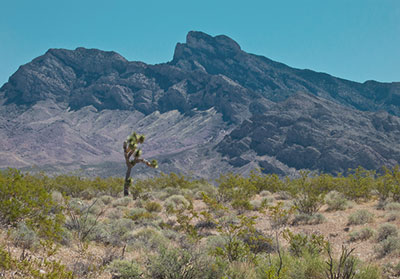
A view of the former Bunkerville Grazing Allotment in April 2012, with the Virgin Mountains in the background. Photo copyright Ralph Maughan.
In a situation that reads like a bad plot from an old western movie, officials with the Bureau of Land Management and Lake Mead National Recreation Area are hoping for a peaceful resolution of a cattle trespass dispute with a Nevada rancher that has lasted more than 20 years. It's a tense and tricky situation.
What's going on the desert northeast of Las Vegas?
The answer goes all the way back to the 1800s, when parts of the West were settled by ranchers who controlled vast areas of open range simply by securing relatively small tracts that included scarce and essential water sources'and then grazing their livestock on the adjoining land.
As more settlers looking for their own land arrived, open range was often overgrazed, disputes arose, and the resulting conflicts provided fodder for many a western novel and movie. Order was eventually secured by a combination of land surveys to define property lines, systems such as the Homestead Act to allow orderly transfer of public land to private ownership, and institutions such as courts and law enforcement to keep the peace.
Grazing Leases and the Bureau of Land Management
Public land which was not legally converted into private ownership remained in the public domain, and some ranchers continue to use public property to supplement their private range. Much of that public land is being managed today by the U. S. Bureau of Land Management (BLM), and that agency faces a challenging and often controversial task: "to manage and conserve the public lands for the use and enjoyment of present and future generations under our mandate of multiple-use and sustained yield."

The BLM manages grazing permits on public land all across the West. BLM photo.
One of those "multiple uses" is grazing, and a dispute between a rancher named Cliven Bundy and the BLM over the use of land in southern Nevada has lasted for more than 20 years. The former grazing lease, known as the Bunkerville allotment, includes public land managed by both the BLM and National Park Service at Lake Mead National Recreation Area, with the BLM handling grazing issues for the NPS.
"Multiple Use" Can Lead to Conflicts
A mandate to manage large areas of land for such diverse uses as grazing, wildlife, recreation, mining, timber and energy development often leads to conflicts, and that's the case on the Bunkerville allotment.
Beginning in 1993, the BLM informed Mr. Bundy about limits on the number of cattle he could graze on the allotment in order to meet regulations to protect wildlife, particularly a threatened species, the desert tortoise. Mr. Bundy refused to accept the limits and stopped paying the required fees for his grazing permit ... but continued to run his cattle on the property.
The BLM subsequently cancelled the grazing permit, and in 1997, Clarke County, Nevada, purchased all the active grazing permits in the area to conserve them for wildlife needs. A tentative proposal was made to Mr. Bundy to compensate him for any stock water rights or range improvements he might have in his former allotment. He rejected the offer...and continued to run his cattle.
Failed Negotiations Lead To Court Cases
After further attempts to negotiate with Mr. Bundy failed, a series of court cases that extended up to the Ninth Circuit Court of Appeals upheld an injunction which permanently enjoined Mr. Bundy from grazing cattle on the Bunkerville allotment, and ordered him to remove all trespass cattle. He refused, despite notices that the livestock would be subject to impoundment and removal if they remained.
While the legal wrangling continued, the number of cattle in the area continued to grow. In 1999, the BLM was able to document 51 head of Bundy cattle on federal range in the allotment; by 2011, over 900 cattle were counted by a helicopter survey of the rugged terrain.
Mr. Bundy apparently concedes that he has never owned any of the land in question, but disputes the BLM's jurisdiction; he contends he has the right to continue to use the property, since his family has been doing so since the 1880s.
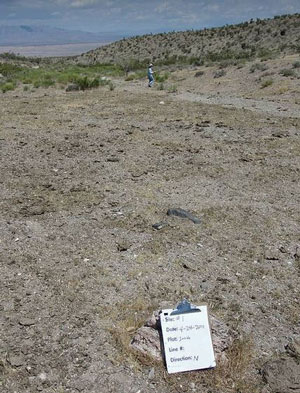
Damage to soil and vegetation from concentrated use by trespass cattle in the former Bunkerville Allotment. BLM photo.
The BLM Still Manages Lots of Grazing Permits
The BLM has taken pains to point out that it is not anti-grazing, noting that it "administers approximately 18,000 grazing permits and leases on 157 million acres of public lands..."Ranching continues throughout Southern Nevada on public and private lands," the agency notes. "BLM currently has three active grazing allotments on more than 100,000 acres of public lands in Southern Nevada."
Kirsten Cannon, spokeswoman for the Nevada BLM office in Reno, says, 'His cattle have been illegally trespassing on federal land for two decades and it's just unfair for those who ranch in compliance,' she said. 'We made repeated attempts to resolve this. The courts have ordered him to move his cattle. Now we've reached the last resort, which is impoundment.'
You can read a summary of the history of the dispute at this BLM link, and the agency, under increasing pressure from other local landowners and conservation groups, has decided it's time to remove the cattle and resolve the issue.
There's no doubt that Mr. Bundy has flouted the legal system for years, but you might wonder what else is at stake in this situation.
A Long List of Problems Caused by Trespass Livestock
The BLM cites a long list of problems caused by Mr. Bundy's cattle. Among the issues are damage by the cattle to springs and vegetation on public land and trampling of artifacts at cultural sites. Crops on adjacent private property have been damaged by foraging livestock, and residents of the communities of Bunkerville and Mesquite have complained about the impact of trespass cattle on city facilities, including the Mesquite Heritage Community Garden and the Mesquite golf course.
If you've even been around cattle which aren't accustomed to being "worked" regularly by humans, you'll understand the safety concerns for visitors and employees using the BLM and park lands in question. According to the BLM, "a State of Nevada employee at the Overton Wildlife Refuge has been attacked by a Bundy bull, and a feral cow was hit by an automobile within Lake Mead National Recreation Area. Cattle are frequently seen on public roads, including State Route 170, and pose a danger to vehicles and to members of the public traveling on public roads."
There have been other economic costs from the trespass livestock. The Nevada State Department of Wildlife has had to build extensive fences to protect state and federal lands in the Overton Wildlife Refuge from the cattle. The Walton Family Foundation had offered $400,000 for a matching grant to restore wildlife habitat in the area, but has withdrawn the funds until the trespass cattle have been removed. It's a reasonable decision; restoration efforts would be a waste of money as long as the cattle continue to roam and damage the area.
Two Decades of Waiting May Be Coming to an End
So, what's next?

These trespass cattle, removed off public land in northern Nevada, are being cared for until they are claimed and fines/impoundment fees are paid. BLM photo.
According to a statement from Lake Mead National Recreation Area, "The BLM and NPS have made repeated attempts to resolve this matter administratively and judicially. Impoundment of cattle illegally grazing on public lands is an option of last resort. The BLM and NPS are working closely with local, state and federal officials to ensure the gather of unauthorized cattle occurs in a safe and orderly manner."
During what will undoubtedly be a challenging roundup, the area involved will be closed to public use from March 27 through May 12. The park website notes, "Only a small portion of the northern and eastern part of the park will be temporarily closed, and Echo Bay, Stewarts Point, Redstone and the hot springs along Northshore Road remain open." You can view a map of the area within the park involved in the closure at this link.
Bundy's Response
So, what's Mr. Bundy's reaction to the latest developments? That's a cause for concern, and at least part of the reason for the closure of the area to the public during the impending roundup.
A previous roundup scheduled for 2012 was cancelled due to fears of a violent confrontation with Bundy, and the BLM opted for one more try at a solution in the courts. That cancellation in turn brought threats of a lawsuit against the BLM from an environmental group, for failure to enforce court orders to remove the livestock. In 2013, the BLM prevailed once again in court.
Bundy's response to the numerous court orders to remove his cattle has been succinct. "At first I said, 'No,'" he told The Los Angeles Times last year, "Then I said, 'Hell, no.'"
"I've got to protect my property," Bundy told the Times. "If people come to monkey with what's mine, I'll call the county sheriff. If that don't work, I'll gather my friends and kids and we'll try to stop it. I abide by all state laws. But I abide by almost zero federal laws."
The County Sheriff Urges A Peaceful Solution
It doesn't appear the county sheriff plans to intervene on the Bundys' behalf. According to Carol Bundy, the rancher's wife, 'We want him to step in and tell these federal characters that 'This is Clark County, Nevada, land and you have go through me to get these cattle.' But we have not heard a word.'
For his part, Clark County Sheriff Doug Gillespie understands the days of the 19th century range wars are long past. The Las Vegas Review-Journal quoted Gillespie as saying: 'I'm always concerned when there are situations like this where there is so much emotion. I hope calmer heads will prevail like they normally do. You're talking about rounding up cattle. You have to keep that in perspective. No drop of human blood is worth spilling over any cow, in my opinion.'
He absolutely right. Let's hope everyone else involved in this situation agrees.
Story Categories:
A copy of National Parks Traveler's financial statements may be obtained by sending a stamped, self-addressed envelope to: National Parks Traveler, P.O. Box 980452, Park City, Utah 84098. National Parks Traveler was formed in the state of Utah for the purpose of informing and educating about national parks and protected areas.
Residents of the following states may obtain a copy of our financial and additional information as stated below:
- Florida: A COPY OF THE OFFICIAL REGISTRATION AND FINANCIAL INFORMATION FOR NATIONAL PARKS TRAVELER, (REGISTRATION NO. CH 51659), MAY BE OBTAINED FROM THE DIVISION OF CONSUMER SERVICES BY CALLING 800-435-7352 OR VISITING THEIR WEBSITE. REGISTRATION DOES NOT IMPLY ENDORSEMENT, APPROVAL, OR RECOMMENDATION BY THE STATE.
- Georgia: A full and fair description of the programs and financial statement summary of National Parks Traveler is available upon request at the office and phone number indicated above.
- Maryland: Documents and information submitted under the Maryland Solicitations Act are also available, for the cost of postage and copies, from the Secretary of State, State House, Annapolis, MD 21401 (410-974-5534).
- North Carolina: Financial information about this organization and a copy of its license are available from the State Solicitation Licensing Branch at 888-830-4989 or 919-807-2214. The license is not an endorsement by the State.
- Pennsylvania: The official registration and financial information of National Parks Traveler may be obtained from the Pennsylvania Department of State by calling 800-732-0999. Registration does not imply endorsement.
- Virginia: Financial statements are available from the Virginia Department of Agriculture and Consumer Services, 102 Governor Street, Richmond, Virginia 23219.
- Washington: National Parks Traveler is registered with Washington State’s Charities Program as required by law and additional information is available by calling 800-332-4483 or visiting www.sos.wa.gov/charities, or on file at Charities Division, Office of the Secretary of State, State of Washington, Olympia, WA 98504.
INN Member

The easiest way to explore RV-friendly National Park campgrounds.

Here’s the definitive guide to National Park System campgrounds where RVers can park their rigs.
Our app is packed with RVing- specific details on more than 250 campgrounds in more than 70 national parks.
You’ll also find stories about RVing in the parks, tips helpful if you’ve just recently become an RVer, and useful planning suggestions.


Comments
"I don't know where you got that but I will again ask you to cite where in the Federalist papers (to which neither Franklin nor Washington contributed) is there a call for a stronger(vs states) central government.
Yes, Federalist wanted more power in the central government than non-federalist but even the most strident of Federalist that participated in the formation of the Constitution wanted a LIMITED federal government. Thus the enumerated powers and later the 10th Amendment."
Hi, ecbuck.
First, the Federalist Papers were good for expounding on the thoughts of Hamilton, Madison, and Jay, but they were not law.
As far as "enumerated powers" go, most Federalists in no way believed that the enumerated powers of the Constitution were the limits of the national government's powers. Please feel free to reference the debate about the First Bank of the United States, in which Hamilton expressed his belief in implied powers (http://avalon.law.yale.edu/18th_century/bank-ah.asp) -- essentially that the Constitution empowered the national government to take any steps necessary to carry out its duties, as broadly defined as they may be. Thomas Jefferson disagreed with this interpretation. George Washington sided with Hamilton and agreed with the implied powers idea.
Washington, you'll also recall, when faced with a situation similar to Cliven Bundy's -- some rural folks in the states not wanting to pay their fees to the federal government -- rode out at the head of the army to crush them.
Hamilton's idea of broad, implied powers was reaffirmed by another Founder, John Marshall, in the Supreme Court decision McCulloch v. Maryland, which reinforced both the idea of implied powers and also ruled that states had no authority to interfere with exercises of federal power.
My point is this: your claim ("Our Founding Fathers were well aware of the dangers of a Federal government and worked hard to place the power in the hands of the States. It is a basic principle of the founding of this nation.") is not true. Hamilton did not see the Federal government as a danger and he did not work to place "the power" in the hands of the state. He saw a powerful Federal government as being necessary in order to create an industrial economy. Agrarian politicians like Jefferson disagreed; he went so far as to say that the states had the power to nullify any Federal law they disagreed with. Madison initially sided with Hamilton but shifted over to Jefferson over the issue of the national bank. Adams, if you'll look at the Alien & Sedition Acts he signed, certainly didn't shy away from Federal power.
It's been a source of continuous disagreement in this country, and vigorous debate (as I said) where power should reside. This manifested during the debates over the Constitution, it manifested over the debates on the First Bank, on the debates over the Second Bank, on Calhoun's desire to nullify Federal tariffs, and it manifested during the Civil War. But the end result of all of this is that the law in this country recognizes the supremacy of the Federal government over the states -- that is, in fact, the entire reason we created a Constitution in the first place, because the weak centralized government created by the Articles of Confederation wasn't doing its job.
Nevada isn't a "sovereign state." It doesn't get to impede Federal laws. Neither does some bass-ackwards rancher who claims not to recognize the power of the Federal government. You can complain about the amount of land that the Federal government owns, but it STILL OWNS THAT LAND, and more to the point, Nevada as a political creation never owned the land to begin with. It was conquered by the US's Federal army in the Mexican-American War, it was ceded to the US government, and the US government subsequently created a Federal territory which it then allowed to become a state -- and in so doing, that state accepted the authority of the Federal government (more explicitly than most, given its own Constitution in which it recognizes Federal supremacy and the Federal ownership of much of its land).
Cliven Bundy has no leg to stand on.
Ec says: "If that is indeed the case (damage caused by Bundy's cattle), they have recourse (that has nothing to do with BLM lands). Do you have evidence of this happening?"
That damage has been widely cited, and a brief search indicates those cites stem from a BLM document summarizing that damage. I've not seen any evidence that refutes that information, so I'll accept it until proven wrong. http://archive.today/nvlzr
Yes, those who feel their property and interests have been damaged by Bundy's roaming cattle "have recourse," which is the courts. As clearly explained in previous posts, the courts at multiple levels have ruled that Bundy must round up and remove his cattle. He's refused to do so, and has mounted an armed resistance to those court orders.
The recourse to damage by Bundy's cattle does in fact have plenty "to do" with BLM lands, since the cattle are roaming illegally on public land managed by the BLM and then trespassing from there onto adjoining private property. Under those circumstances, it's entirely proper for citizens to expect the BLM to follow directions of the courts and see that the cattle are removed.
Given the above, and years of efforts by the BLM to resolve this problem in the courts, I'd be interested in hearing how ec thinks this situation should be resolved.
Baloney. Madison was the primary author of the Constitution. He also was the author of Federalist paper #41. In that paper he specifically addresses the issue and states that if the powers were to be broader, there would be no reason to provide a list. The list was the definitive set of powers.
But the incidents have nothing to do with the BLM
Those court decisions WERE regarding BLM land and had nothing to do with private property. If someone's private property was damaged they have recourse through the courts themselves.
Fines, judgements, jail. Not military force and killing cattle.
"Baloney. Madison was the primary author of the Constitution. He also was the author of Federalist paper #41. In that paper he specifically addresses the issue and states that if the powers were to be broader, there would be no reason to provide a list. The list was the definitive set of powers."
Hamilton disagreed, which is pretty obvious if you read his opinion on implied powers articulated in arguing for a national bank. Washington also disagreed, when he sided with Hamilton and agreed the bank would be constitutional even though the Constitution's enumerated powers conferred no such authority upon the federal government. John Marshall subsequently agreed as well.
And you're right, Madison did disagree with Hamilton, Washington, and Marshall when it came time to argue about a bank. That was my whole point. There were disagreements amongst the Founders. They weren't a monolithic bloc. They didn't unanimously fear federal power and want to vest all authority in the states, which was your original claim. Your attempted airbrushing of history is just false.
No that wasn't my claim. The Federalist didn't want to vest "all" power in the states. They recognized that some issues (primarily foreign policy) needed to be addressed at a national level. They did however, agree unanimously that the power of the national government be limited and as Madison wrote, both in the Constitution and the Federalist papers, the powers were limited to those enumerated. If not why not just have the Constitution say - "congress can make any law they want" I know some of you would like that, but that isn't what it says.
Boy this thread is a testament to sorry state of our education system. The fact that so many people are ignorant of the original intent of our founding fathers, ignorant of the fact that our nation was founded under the principles of limited government is appalling.
Thank you, ethelred, for two more intelligent and well informed essays on our history. I admit that I'm not an expert on our founders and their disagreements, but do know enough to recognize when the truth about our history is being distorted for whatever reason. It's frustrating to try to reason with or debate one whose "expertise" comes only from propaganda broadsides issued by very questionable sources.
"They did however, agree unanimously that the power of the national government be limited and as Madison wrote, both in the Constitution and the Federalist papers, the powers were limited to those enumerated. [...] Boy this thread is a testament to sorry state of our education system. The fact that so many people are ignorant of the original intent of our founding fathers"
You say I'm poorly educated, and you say I'm ignorant of the intent of the Founders. Okay. You also say that the Founders agreed unanimously that the powers of the federal government were limited to those enumerated in the Constitution.
So why can't you even respond to the evidence I've cited contradicting this? Here it is again, in case you missed it: http://avalon.law.yale.edu/18th_century/bank-ah.asp
If you're so much less ignorant and so much better educated than me, please explain how Hamilton's expressed opinions there are actually articulating a belief that the federal government has no implied powers, and has only its enumerated powers. I'm just an ignorant guy inadequately served by a terrible education system, so you explain to me how "It is not denied that there are implied well as express powers" actually means there are no implied powers.
Please explain to me what this actually means: "It is a common mode of expression to say, that it is necessary for a government or a person to do this or that thing, when nothing more is intended or understood, than that the interests of the government or person require, or will be promoted by, the doing of this or that thing. The imagination can be at no loss for exemplifications of the use of the word in this sense. And it is the true one in which it is to be understood as used in the Constitution. The whole turn of the clause containing it indicates, that it was the intent of the Convention, by that clause, to give a liberal latitude to the exercise of the specified powers. ... This restrictive interpretation of the word necessary is also contrary to this sound maxim of construction, namely, that the powers contained in a constitution of government, especially those which concern the general administration of the affairs of a country, its finances, trade, defense, etc., ought to be construed liberally in advancement of the public good. This rule does not depend on the particular form of a government, or on the particular demarcation of the boundaries of its powers, but on the nature and object of government itself. The means by which national exigencies are to be provided for, national inconveniences obviated, national prosperity promoted, are of such infinite variety, extent, and complexity, that there must of necessity be great latitude of discretion in the selection and application of those means."
I admit that my flawed reading of this sure makes it seem like Hamilton didn't agree that the power of the federal government should be limited to the specifics enumerated in the Constitution. But I'm sure you can enlighten me.
An April 20 editorial in a local newspaper, the Las Vegas Sun, sums up the situation very nicely, and touches on the above comments about our system of government. Here are some excerpts from this Nevada newspaper:
" This wasn’t a matter of a rancher pushing back against the government or a show of patriotism by Bundy and militia types; this was an open act of rebellion against the rule of law.... What he and his supporters are really doing is dismissing the American form of government..."
"Consider that Bundy hit a trifecta of sorts: He violated the laws Congress made, ignored the judicial branch’s orders, and defied the executive branch’s efforts to enforce those laws and orders..."
"It is deeply troubling that people, particularly some politicians, fail to see the seriousness of this and have tried to paint Bundy as a heroic figure. What they are saying is you can pick and choose which laws and court orders to follow, and with enough force, you can get away with it..."
"In the end, Bundy isn’t the victor; anarchy is. The rule of law, and society as a whole, lost."
http://www.lasvegassun.com/news/2014/apr/20/bundy-no-victor/
Jim Burnett, I have to admit that you present a well done piece on the Bundy affair. Thought came to mind what kind of piece you would come up with if you directed your efforts to clear up the enumerable scandals and direct assaults (or put them to rest) on the Constitution that have come from this administration and a few NPS Senior Executives that come to mind. I also have to think that effort could be career ending if the results were inconvenient to those in power. To direct your expertise at an individual who through his persistence at surviving in a very hostile natural environment seems like a waste of your talents. The Bundy affair has gained national exposure. The legalities of his difficulties are becoming clear but I must present a side offered by Dr. Ben Carson that may be at the crux of much of what people are feeling who our Senator Majority Leader from Nevada, Harry Reid, refers to as Domestic Terrorists.
http://www.washingtontimes.com/news/2014/apr/22/carson-when-
government-looks-more-like-foe-than-fr/
I really would appreciate seeing you delve into issues on up the food chain and to the heart of the increasing dissatisfaction with our bureaucrats and elected leaders. Maybe find out the wonders and satisfaction of self employment:).
A related issue with a Judge determining there was a criminal conspiracy by the BLM.
http://linkis.com/gopthedailydose.com/ftCEC
Thanks, Trailadvocate.
I certainly agree there's plenty of reason for "dissatisfaction with our bureaucrats and elected leaders" as well as with people like Mr. Bundy.
Fyi, I've been experiencing the "wonders and satisfaction of self employment" as a writer for nearly 13 years now, although my contributions to the Traveler are on a volunteer basis :-)
Well, there you go Jim! I look forward to more writings unencumbered (as much as possible) by bureaucratic threats by superiors or politicos. The Media used to be much more of a participant in that area. Kurt has done well managing the site, encouraging debate.
Thanks, ethelred. It's hard to see the Bundy circus as a serious statement in a conversation about state vs. fed. But at the very least, the story is a pretext to revisit and revel in the basics of early U.S. history, as you’ve demonstrated nicely.
trailadvocate...
It appears that you've pretty well drawn the lines of what box you are in and what box I'm in. All that remains beyond that is all the colors of opinion. I believe that what you are insinuating about President Obama and the others is snark. Is this a great country or what?
Yep, it is a great country. You being an ex-Psych Nurse, Rick B, you must know there is a reality that exists that is beyond personal boxes. I'll ask whether it's from your box or reality that you believe Potus is not a big fat liar (Alinsky Ideologue where lying is just good strategy). No proof? Had to ask.
There seem to be three different arguments going on here. The "Is Bundy right or wrong" argument...the "who owns the land" argument...and the "Government over-reach" argument.
So here's one rancher's perspective.
Most people I know don't care whether Bundy is "right". His legal problems are his business. Likewise as to the convoluted theories of land ownership.
We DO care about the BLM attempting to collect a debt through intimidation and massive over-reach of the power of the U.S. Government. The restriction of our First Amendment Rights, snipers posted in the hills, using tazers against protestors and pushing an old lady to the ground are not actions decent people can stand for.
We DO care about the complete ignorance of the BLM in choosing to "gather" cattle using helicopters and planes. That irrational decision was compounded by BLM's timing. It's calving season. Pregnant cows, mother cows and young calves suffered injury, death and separation of "pairs" (mother cows and their calves) which resulted in even more calves dying of starvation. Of the few cattle captured alive and without injury, more died when they were left in corrals, by the BLM, for days without water.
BLM .... not an agency to take pride in.
Roger that, McQue.
I thought it notable also that the BLM chose to shoot uncooperative livestock. Great stock handling skills. I'm grateful they chose to stop short of doing the same to the protesters. There are unresolved issues here, aside from Mr. Bundy.
It's beginning to sound like the halls of Congress around here.
Agreed, trailadvocate. Bundy is the least of the "issues" in this fiasco. When considering the actions of BLM, descriptive phrases such as "lack of integrity" and "reckless disregard" are the ones which come to mind.
All politicians lie. I support the ones who support more of the things I like than the other guy, and President Obama is so light years better than his predecessor the choice is clear to me. You apparently have different values from me and that is fine. Just don't expect me to buy into the value judgements you make.
McQue, how do you believe the BLM sould have handled the situation given the entirety of the past interaction between the BLM and Bundy? (And for those of you with a particular agenda/side, I am asking this innocently - I truly would like to know how someone closer to the issue than I would handle it).
I'm not a lawyer, dahkota, but basically.. If there was a valid Judgment against him, he should have been served by the County, just as anyone else would have been.
Then, if he didn't comply, a lien in the amount of the Judgment would be placed against his property. The Lien would be recorded to ensure any property sold would go toward payment of the lien.
If BLM's claims held up, a cattle gather could start in the fall. (Good cowhands know to work cattle slow and easy, it might take weeks.) If he, or anyone else, forcibly interfered with the cattle round-up, charges could be brought followed by arrest and incarceration by the County Sheriff.
No "special treatment" ... no hysterical over-reaction by the BLM ... just enforcement of the law toward both sides.
Jim, i normally agree with your comments, but I am not sure I buy into the fact that all political leaders, elected or appointed, are cut from the same cloth. I have a high regard for our current President, his cabinet, and congress persons and senators form both sides of the chamber, not all, but many. I do think the root of the problem is the amazing amounts of money being poured into the elections process. We are almost back in the Robber Barons era, or the Roaring twenties in that the political process is up for sale to the highest bidder. History takes interesting turns, Was it in 1856 that Chief Justice Taney declared a human being property, we now have a Supreme Court that has ruled property is a human being. And this includes properties (corporations) right to free speech in political campaigns, ie money, almost in unlimited amounts. I think it is a sad day that the Republican Party of Teddy Roosevelt and Howard Taft has backed away from the Sherman Anti Trust Act, the Tillman Act, the Glass/Stigall Act, well I could go on and on. The republican progressives at the turn of the 20th century gave us many National Parks, Forests, Monuments, direct election of senators, progressive income tax legislation, and culminating, with President Wilson, a Women's right to vote. But I can not just blame the Republican Party, President Clinton gave us the free trade agreements resulting in the loss of over 5 million good paying american manufacturing jobs. Made in america is hard to find right now.
In any case, it is interesting to study history and speaking about how things change I remember a history class on early american presidents and how some competent and educated women at the time, led by Abigail Adams, pleaded with our founding fathers to make sure the "Constitutional" language stating "all men are created equal" be changed to all men and women or all natural persons are created equal. Abigail wrote her husband stating," John, remember the ladies". John Adams replied, 'Depend on it", the future president wrote to his wife" that we know better than to repeal our Masculine systems".
Change is difficult, it took the women 145 years to get the vote, and here we are again, even with the voting rights act of 1965, still trying to disenfranchise voters with whom we may disagree with. Thank you Jim for your posts, they are always informative.
All well said, Mr. Mackie.
Thank you, McQue. I was curious as to why Bundy wasn't jailed and his property seized. I would have thought that was the natural progression 19 years ago rather than now. I think the BLM acted badly/over-reacted due to a fear of violence at the hands of the militia. It had occurred before and been promised to occur again. Unfortunately, they are all human; deadly threats have a way of shaking one up. But, that is no excuse for their stupidity in a spring roundup the way they did. Both sides acting badly. I'm guessing some saw Waco in it and didn't want that to happen.
Nope, never said that.
As to Hamilton and the National Bank - who cares what Hamilton thought? Hamilton proposed a plan, the "British Plan" at the Constitutional Convention. That plan gave the central government a broader role. It was flatly rejected. Hamilton had little to do with the writing of the Constitution thereafter. Madison, the primary author of the Constitution had a plan with limited and enumerated powers. When the anti-federalist criticized the language because it could be interpreted as you would like to do now, Madison, the guy that wrote the document, responded that no, there is a reason the powers are listed. Those are the powers the government has and they are the only powers. Madison's version was signed and ratified.
Just make sure you pay for and obey the value judgements Rick makes.
More wisdom from the father of western freedom, Cliven Bundy:
"I want to tell you one more thing I know about the Negro. [...]They didn’t have nothing for their kids to do. They didn’t have nothing for their young girls to do. And because they were basically on government subsidy, so now what do they do? They abort their young children, they put their young men in jail, because they never learned how to pick cotton. And I’ve often wondered, are they better off as slaves, picking cotton and having a family life and doing things, or are they better off under government subsidy? They didn’t get no more freedom. They got less freedom."
Classy guy. I can see why he's become a hero.
ecbuck,
Here is what you write now:
"As to Hamilton and the National Bank - who cares what Hamilton thought?"
Here is what you wrote previously:
"They did however, agree unanimously that the power of the national government be limited and as Madison wrote, both in the Constitution and the Federalist papers, the powers were limited to those enumerated."
Hamilton, whether you like it or not, was one of the Founding Fathers. So when you say they all unanimously thought X, you can't later say "Who cares what he thought?" Because what he thought was different from X, so they didn't all unanimously think X. Other founders agreed with him (Washington, Marshall, for two examples). It matters what they thought, too, if the argument being put forth is that the founders unanimously thought X, Y, or Z.
This is like Calvinball. You tell me I'm completely ignorant because I can't prove something, and when I prove it, you change the rules and say I didn't prove something I wasn't even asked to prove in the first place.
"Hamilton had little to do with the writing of the Constitution thereafter. Madison, the primary author of the Constitution had a plan with limited and enumerated powers. When the anti-federalist criticized the language because it could be interpreted as you would like to do now, Madison, the guy that wrote the document, responded that no, there is a reason the powers are listed. Those are the powers the government has and they are the only powers."
So originally we were told that all the Founders were on the same page about government power. Now we've shown that some of the Founders (including the country's first Secretary of the Treasury and the first President) weren't on the same page.
Yes, Madison was one of the primary authors of the Constitution (what he originally presented was modified significantly over the course of the debates, however; Madison wanted both chambers of the legislature apportioned based on population, and he was very disappointed that didn't happen, and he wanted a Council of Revision created, and that didn't happen -- the point is, it wasn't a work by one man, it was a work that was significantly altered through the process by the convention).
But Madison isn't the only person whose thoughts on the Constitution matter. Hamilton was a participant in the constitutional convention, too, as were plenty of other important figures. And many of them had differing interpretations about the text that they produced. Madison is not God, and we don't rigorously base all of our constitutional understanding upon what he thought about the text.
Hamilton left with a different interpretation. He made his case to Washington, and Washington agreed. And that interpretation was later taken to the Supreme Court in McCullough v. Maryland, and the Supreme Court agreed with Hamilton's interpretation as well. And that's the interpretation that is law today, and has been for over two hundred years. Your claim that modern society has "forgotten" what the Constitution is really about isn't true, you just want it to be about one thing and other people, back then as in today, don't agree. But you don't get to shut down debate by saying that all other modes of thought or interpretation are illegitimate because James Madison says so.
Yes, and that is not what you claimed I said. What I said was the was unanimity in the belief that the central government should be limited. If you have evidence that Hamilton believed it should be unlimited, please show us.
Also, if you have any evidence that the drafters of the Constitution didn't believe the enumerated powers were the limit at the time the Constitution was written, as Madison so proclaimed, please produce them. I certainly can't find anything in the Federalist papers that refute Madison's declaration in Federalist 41.
On that we must disagree. Hamilton's option of a more powerful central government was rejected. Madison's plan of limited government was accepted. The reality today is that most people either don't recognize or want to ignore that our original Constitution was written with the purpose of limiting the powers of the central government.
The fact that progressive courts have been among those that ignored that purpose may make it law but it doesn't change the original intent nor the fact that the further we have moved from that orginal intent, the lesser a nation we have become.
Seems like much of what many in the now crowd think is that the Constitution is whatever they think it should be. Not limited by what it actually states which has been the framework for, in reality, a very exceptional country. What's happening is people are really dumbing down, respectfully. Rick B, your statement about every President lies and just go with the one that does what you want really is chilling to me. Third world to my way of thinking. The Constitution is a framework to keep all parties inbounds. Something is going wildly wrong, by design. Keep believing the serial liar, don't think so. What does the end game look like in his world? Can he tell you/us, no.
"The fact that progressive courts have been among those that ignored that purpose may make it law but it doesn't change the original intent nor the fact that the further we have moved from that orginal intent, the lesser a nation we have become."
I'm not sure I'd classify John Marshall's court as a progressive one. In any event, different framers of the Constitution had different intents, and when the Constitution was ratified in each state, people there had different intents and interpretations as well. The Constitution was never the work of one man, and it was never given force of law by one man, which is why the whole idea of pointing to a singular original intent is flawed.
Regardless, "implied powers" was upheld by the Supreme Court, led by founder John Marshall, in 1816, so I guess we moved away from the original intent 198 years ago (along with moving away from the original intent of slavery and 3/5ths personhood 149 years ago), and frankly I think the country has become a much greater nation in the past two hundred years. Obviously others are entitled to disagree, and I welcome that disagreement, because it's part of what makes America great.
"Rick B, your statement about every President lies and just go with the one that does what you want really is chilling to me. Third world to my way of thinking."
Trailadvocate, I don't think that's emblematic of third world thinking, it's just a recognition that humans are flawed and our government is composed of humans who seek power, and in seeking power they're inevitably going to lie. Obama has lied, at times. So has Bush, so did Reagan, so did Roosevelt (both of them), so did Lincoln, so did Buchanan, so did Adams and even Washington. Rose-colored glasses pointed toward the past notwithstanding, I don't see a great degradation in the quality of our country (I think America is a pretty great country) or our leadership overall.
I don't agree with everything the current President has done or said, but I did vote for him because I think he was the better alternative and because his stances on various issues aligned more closely with my own than the alternative. I disagree with him on other stuff and am proud to oppose him in those instances, and I try to keep my mind open about such things. But I think you'll find not many people are going to be persuaded by you when you just seem filled with bottomless invective and don't make a nuanced and constructive case, instead just complaining that everything is lies and hatred and subverting the law.
Only to those that don't want to live by it. There was plenty of public discussion at the time. While there was lots of discussion of what those powers should be, nowhere does any Federalist refute Madison's declaration that the enumerated powers are the only powers.
elhelred, thank you for your measured and informative posts. I am certainly not an expert in any of this, historians spend a lifetime studying these issues. But what little I think I know mirrors your thoughts.
Thanks, too, ethelred, for pointing out what is (otherwise) widely acknowledged--that a hermeneutical reading of the Constitution is far from unproblematic.
ecbuck, you say "The reality today is that most people either don't recognize or want to ignore that our original Constitution was written with the purpose of limiting the powers of the central government."
James Madison, on the other hand, told Thomas Jefferson the opposite: "The evils suffered and feared from weakness in Government have turned the attention more toward the means of strengthening the government than of narrowing it."
You go on to say: "Also, if you have any evidence that the drafters of the Constitution didn't believe the enumerated powers were the limit at the time the Constitution was written, as Madison so proclaimed, please produce them. I certainly can't find anything in the Federalist papers that refute Madison's declaration in Federalist 41."
The Articles of Confederation stated that the federal government did not have any power "which is not by this Confederation expressly delegated to the United States." The Constitution changed that around by saying that Congress can "make all laws which shall be necessary and proper for carrying into execution" its powers. That is the clause which is cited for the understanding that the federal government has implied powers. If the drafters of the Constitution had wanted to limit Congress to only those powers which they had enumerated, surely they would have left in that same language that was used in the Articles.
Regretfully, I cannot offer you evidence, other than a logical reading of the changes between our two governmental texts, that the drafters at the time the Constitution was written recognized that the necessary and proper clause would give Congress implied powers above and beyond its enumerated powers, because the deliberations of the convention were bound by an oath of secrecy and no full accounting of their deliberations has ever been made available because of that. But some of the drafters of the Constitution did speak out against the clause (Edmund Randolph and Elbridge Gerry, for example).
I can tell you that even before the Constitution was ratified, plenty of founders recognized that Necessary and Proper would give Congress powers beyond those enumerated. Patrick Henry said during the Virginia Ratifying Convention that the clause would lead to limitless federal power. Virginia ratified anyway. If Anti-Federalists at the time recognized the meaning of those words and opposed the Constitution on those grounds, then surely the people drafting the Constitution recognized that the words could be interpreted in such a way as well.
James Wilson, who wrote the Necessary and Proper clause during the drafting of the Constitution and was later one of the original Supreme Court justices, stated during the Pennsylvania Ratifying Convention that Henry's interpretation was extreme in that the clause would not lead to limitless power, but that it DID give Congress powers beyond those specifically enumerated.
According to The Heritage Foundation, Wilson said the Clause "authorizes what is 'necessary to render effectual the particular powers that are granted.' Congress thus can make laws about something otherwise outside the enumerated powers, insofar as those laws are 'necessary and proper' to effectuate federal policy for something within an enumerated power. Although not independently valid under another enumerated power, such laws are supported by this clause to the extent that they constitute a means by which federal policy can be executed under an enumerated power."
This is the interpretation that Hamilton used when he argued that Congress can pass laws exercising powers that are not expressly enumerated within the Constitution, if Congress feels (and the courts agree) that these things can be in some way related to the powers that are enumerated. The Constitution didn't give Congress the power to create a National Bank, for example, but a National Bank could be interpreted as necessary for carrying out Congress's power to regulate trade or create currency, so the power to create a National Bank is therefore implied. The Supreme Court unamimously held this to be the correct view in 1816.
We also know that the drafters of the Constitution believed the federal government had more powers than those enumerated because in addition to enumerating specific powers, they also list specific things that Congress CANNOT do. But if the drafters believed that Congress had no powers other than what they expressly gave it (even though they removed the clause saying that Congress had no powers other than those expressly given it in the Articles), why say what Congress can't do? The enumerated powers don't say that Congress has the power to pass bills of attainder, but the Constitution still specifies that Congress can't pass bills of attainder. This was because the drafters recognized that Congress had the power to do things other than those expressly listed. And the Supreme Court (progressive or otherwise) has upheld this view, too.
This has been the structure of our country for 198 years since McCulloch v. Maryland. If America has been in decline for 200 years, so be it. If you want to claim we've lost our way and have been on the wrong track for 200 years, so be it. Me, I like the way America works, I like our system of government, and I think (though I can certainly point to some problems) that we're doing pretty well. I think America is a better place now than it was 200 years ago, and I think it's a better place than it was 100 years ago, and I think it is a better place than it was 50 years ago.
And I think part of what makes the country better is our evolving concept of protecting natural resources and public lands; I like that we've taken the idea of National Parks as first created under Ulysses Grant and later expanded under Teddy Roosevelt and have done even more with that, and have continued to look for new ways to preserve great parts of America for future generations. Part of that means not allowing rogue individuals to despoil public lands because they feel the laws do not apply to them.
rmackie - thanks for your comment in response to my remark that "there's plenty of reason for "dissatisfaction with our bureaucrats and elected leaders..."
You're absolutely correct that all of our leaders are not cut from the same cloth, and I didn't intend to suggest I was making a blanket indictment.
Thank you ethelred for sharing your knowledge with us. I've learned a lot and it's certainly amusing to see our slippery friend trying to play another round of Calvinball with someone who seems to have been able to put him into a dither.
That becomes very clear in such exchanges as: "They did however, agree unanimously that the power of the national government be limited . . "
And: "Nope, never said that."
Sounds a lot like a politician at work.
What's worse, a politician or an elitist?
Most multiple choice quizzes require four possible choices.
Used to be that way but now with Common Core...:).
BTW, Rick B, do all bureaucrats lie also or assumed to like the Lois Lerners and so many in this administration that are being protected by the AG (Held in Contempt)with the apparent blessing of the WH? As long as they're doing what you want? I believe that you don't go that far but that's what's going on.
That becomes very clear in such exchanges as: "They did however, agree unanimously that the power of the national government be limited . . "
And: "Nope, never said that."
Lee - please go back and reread. "Nope, never said that" refers to his claim I said the was unanimous agreement about enumerated powers".
I never said that. I did say there was unanimous agreement that the national government should be limited. Which is why, despite his long dissertation, ethel can't provide any evidence to show that isn't true.
For Ethel, Necessary and Proper cause gave the Congress the power to make laws necessary and proper to executing the enumerated powers. Not to let them do anything they wanted. If they could do anything they wanted why have enumerated powers (the point Madison made in Fed 41).
The reason there are things the government can't do is to ensure that those things aren't done pursuant to executing the enumerated powers. For example, the power was granted to "define and punish piracies" but the ex post facto prohibition prevented Congress from punishing those for piracy acts defined after the acts were committed.
ecbuck: "They did however, agree unanimously that the power of the national government be limited and as Madison wrote, both in the Constitution and the Federalist papers, the powers were limited to those enumerated."
me: "You also say that the Founders agreed unanimously that the powers of the federal government were limited to those enumerated in the Constitution."
ecbuck: "'Nope, never said that' refers to his claim I said the was unanimous agreement about enumerated powers". I never said that. I did say there was unanimous agreement that the national government should be limited."
I'm calling bs on this one. Had you simply said "They did, however, agree unanimously that the power of the government should be limited," I wouldn't have argued that point at all. Of course they all agreed that the power of the federal government should be limited. None of them were so extreme that they were advocating for a federal government that was literally limitless in its power.
But you threw that AND clause on at the end there. "And as Madison wrote, both in the Constitution and the Federalist papers, the powers were limited to those enumerated."
Now you're saying "I never said they were unanimous about enumerated powers." But you clearly did. You can try to evade that, but that's what you said, in plain English.
I wouldn't argue with "They did however, agree unanimously that the power of the national government be limited."
I wouldn't argue with "They did however, agree unanimously that the power of the national government be limited and some also thought that, as Madison wrote, both in the Constitution and the Federalist papers, the powers were limited to those enumerated."
But that's not what you said. So if you misspoke, fine, I'll accept that and that's fine. And I agree that absolutely, there are and should be limits on government power (in Hamilton's argument in favor of implied powers, he still didn't claim that the government was literally limitless in power). But some of the founders did very much believe that the Constitution allowed for implied powers beyond those enumerated, and the legal tradition in this country going back 200 years backs that up.
I hope you all saw Bundy's comments as quoted this morning in the New York Times:
“I want to tell you one more thing I know about the Negro,” he said. Mr. Bundy recalled driving past a public-housing project in North Las Vegas, “and in front of that government house the door was usually open and the older people and the kids — and there is always at least a half a dozen people sitting on the porch — they didn’t have nothing to do. They didn’t have nothing for their kids to do. They didn’t have nothing for their young girls to do.
“And because they were basically on government subsidy, so now what do they do?” he asked. “They abort their young children, they put their young men in jail, because they never learned how to pick cotton. And I’ve often wondered, are they better off as slaves, picking cotton and having a family life and doing things, or are they better off under government subsidy? They didn’t get no more freedom. They got less freedom."
He's not only a deadbeat, but also a racist. Even politicians like Rand Paul are distancing themselves from his remarks.
Rick
He's a piece of work, alright. His words have now become tools which might potentially be used, by association, against those who come to the defense of our freedom from government tyranny and the defense of our First Amendment Rights. Bundy's socially isolated, ignorant and with an ego so large that he actually thought people had shown up in Nevada to support "him". LOL He does have the right to speak his mind, just like you and me. I regret that he failed to consider and understand the consequences of his words.
The problem here isn't Bundy, it's the BLM/NPS/DOI/WH dangerous and decitful actions. Yes, I see the squirrel over there, but the uproar is not Bundy's failure to pay fees or the stupid things he says.
Those supporting this administration are a continually shrinking minority, many have realized the grave mistake they made. I didn't vote for him, but I was proud that he did get elected showing that racism is truely a problem of the past.
I'm glad to see some distance themselves from Mr. Bundy, who continues to educate the world about his true colors. And yes, it's true that the ideology of those who showed up to support him will be tainted by his remarks. According to news reports, some of those supporters wore name tags proclaiming themselves to be "domestic terrorists," a label which sure fits the individual shown in this photo, armed with a military-style assault rifle and occupying a bridge over I-15 while looking at the officers who were on public land, nowhere Bundy's small ranch. We should all be free to exercise our First Amendment rights, but this is not the appropriate way to do so.
Bundy's not the problem??? Perhaps you can explain that. He thumbed his nose at the federal government for 20 years, ignored court rulings against him, and now is trying to justify his actions in part by saying he's "standing up for the Constitution."
He's nothing more than a scofflaw inciting anarchy.
http://www.slate.com/articles/news_and_politics/jurisprudence/2014/04/bu...
You can try to evade that, but that's what you said, in plain English.
Nope I said it was unanimous that powers be limited and I claimed Madison said (I made no claim that anyone else said) the powers enumerated was the limit. But then, I have challenged you several times to show where anyone prior to the signing of the document contradicted Madison's claim in Fed 41. I am not aware of any such contradiction and you haven't provided any. So, even though I didn't say it, it might have been unanimously agreed upon as well.
Bundy is certainly "A" problem and in the wrong. But he certainly isn't the only problem in this scenario.
Pages