
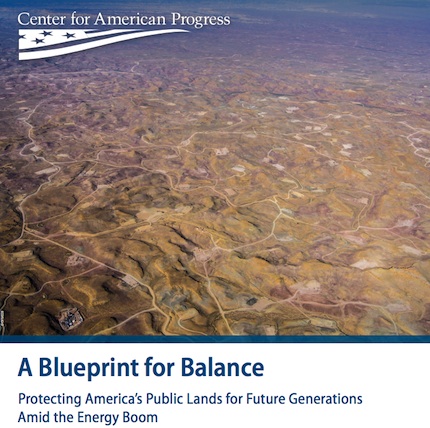
Is the country’s approach to public lands management balanced, or is it skewed toward resource development at the expense of the environment and recreation? A coalition of conservation groups believes it is skewed, and wants the Obama administration, and Congress, to provide that missing balance.
In a report issued Wednesday morning, the coalition -- The Wilderness Society, the Conservation Lands Foundation, the Center for Western Priorities, and the Western Energy Project -- call for a more concerted effort by the federal government to ensure that resource development is “economically sustainable, environmentally sound, and publicly supported.”
The question, of course, is whether the Obama administration, on which the report leans most heavily, and Congress agree that public opinion is for more balance and whether that desire can prevail against any Washington gridlock or industry lobbying.
"The last Congress was the first since World War II to not protect a single new acre of public land as a park, national monument or wilderness area. And the administration has been leasing lands for oil and gas development two-and-a-half times faster than it has been protecting lands for the American public,” Jamie Williams, president of The Wilderness Society, told a small group of reporters during a half-hour conference call Tuesday. “There is a Gold Rush mentality right now on our public lands, and that mentality not only puts the energy boom at risk of bust, but it also has real costs to America’s recreation, tourism, and outdoor economy.
“The bottom line is that we need to be as intentional about conservation as we are about energy development, putting conservation on equal ground with development.”
The 36-page report, A Blueprint For Balance, Protecting America’s Public Lands for Future Generations Amid the Energy Boom, is just the most recent call for the federal government to be more circumspect in its approach to public lands management, whether the focus is reaction to climate change or resource extraction.
Most recently a newly formed organization of retired National Park Service employees, Park Rangers For Our Lands, has called for better oversight of fracking, while the Natural Resources Defense Fund and the Rocky Mountain Climate Organization have warned of the impacts on the parks of climate change in a series of reports.
Cognizant of the gridlock in Congress, those groups behind the Blueprint For Balance outline a list of recommendations that, largely, can be taken by the administration without congressional action. Those recommendations range from having President Obama turn to the Antiquities Act to create national monuments if Congress doesn’t act to preserve lands, establishing additional wildlife refuges, and considering the economic value of recreation on public lands when making land-management decisions. There's also a request that the administration boost the royalty rates on oil and gas leasing to bring them more in line with what states levy, requiring companies to mitigate for drilling impacts, and giving priority to leasing proposals on “low-conflict areas or areas that conserve land.”
“The health of public lands and access to public lands are of particular importance to Latino communities,” said Maite Arce of the Hispanic Access Foundation. “Ninety-four percent of Latinos in the West see forests, national parks, and wildlife areas as an essential part of Western economies. And for middle-class families like my own, national parks and America’s conservation lands are our playgrounds.”
During the conference call, the coalition’s representatives stressed that public attitudes about federal lands were changing, and that it’s time that laws and regulations governing resource extraction change along with them.
“(The Blueprint) reflects the new reality that land in its natural state has economic value. Historically, making a living off the land often required resource extraction. But in the 21st century, many Western communities have proven that it’s also possible to make a living off our public lands in a sustainable way, through a vibrant recreational economy,” explained Ashley Kornenblat, who owns Western Spirit Cycling, a bike shop and tour company based in Moab, Utah.
“It’s also true that many businesses choose to locate near these protected public lands, because they know it will give them a competitive advantage to recruiting top talent to their business,” she added, citing the recent decision by Adobe Systems, Inc., and Goldman Sachs to open offices in the Salt Lake Valley.
"Unfortunately, because so many land-management policies were written for a different time and a different reality, we’re still seeing this incremental degradation of recreation assets upon which many communities now depend, and lots of businesses have invested, with the assumption that those recreation assets will be there.”
One section of the Blueprint calls for oil and gas companies that employ “fracking” processes to recover fuels to disclose what chemicals they use in their operations and to improve the “standards for managing wastewater discharge.”
From her base of operations in Moab, Ms. Korenblat is convinced public opinion will, in the end, sway those in the administration and those in Congress to provide the balance called for in the report.
“What a lot of members are starting to notice and learn more about is how powerful the recreation community is in their district. And that is starting to change the view that resource extraction should always have the upper hand, that should always come first,” she maintained.
“The jobs provided by recreation, and the recruiting that’s happening, where companies like Goldman Sachs and Adobe are moving to Salt Lake because of the recreation assets nearby, people are starting to recognize the revenue that’s coming from this source. That’s starting to make a difference in the way members of Congress are thinking about it, especially those from the West.”
Story Categories:
A copy of National Parks Traveler's financial statements may be obtained by sending a stamped, self-addressed envelope to: National Parks Traveler, P.O. Box 980452, Park City, Utah 84098. National Parks Traveler was formed in the state of Utah for the purpose of informing and educating about national parks and protected areas.
Residents of the following states may obtain a copy of our financial and additional information as stated below:
- Florida: A COPY OF THE OFFICIAL REGISTRATION AND FINANCIAL INFORMATION FOR NATIONAL PARKS TRAVELER, (REGISTRATION NO. CH 51659), MAY BE OBTAINED FROM THE DIVISION OF CONSUMER SERVICES BY CALLING 800-435-7352 OR VISITING THEIR WEBSITE. REGISTRATION DOES NOT IMPLY ENDORSEMENT, APPROVAL, OR RECOMMENDATION BY THE STATE.
- Georgia: A full and fair description of the programs and financial statement summary of National Parks Traveler is available upon request at the office and phone number indicated above.
- Maryland: Documents and information submitted under the Maryland Solicitations Act are also available, for the cost of postage and copies, from the Secretary of State, State House, Annapolis, MD 21401 (410-974-5534).
- North Carolina: Financial information about this organization and a copy of its license are available from the State Solicitation Licensing Branch at 888-830-4989 or 919-807-2214. The license is not an endorsement by the State.
- Pennsylvania: The official registration and financial information of National Parks Traveler may be obtained from the Pennsylvania Department of State by calling 800-732-0999. Registration does not imply endorsement.
- Virginia: Financial statements are available from the Virginia Department of Agriculture and Consumer Services, 102 Governor Street, Richmond, Virginia 23219.
- Washington: National Parks Traveler is registered with Washington State’s Charities Program as required by law and additional information is available by calling 800-332-4483 or visiting www.sos.wa.gov/charities, or on file at Charities Division, Office of the Secretary of State, State of Washington, Olympia, WA 98504.


National parks and their natural resources belong to you. The National Parks Traveler works to ensure you know how these essential places are being cared for.
Sign Up For Our Weekly Newsletter
Unsubscribe at any time.
INN Member

The easiest way to explore RV-friendly National Park campgrounds.

Here’s the definitive guide to National Park System campgrounds where RVers can park their rigs.
Our app is packed with RVing- specific details on more than 250 campgrounds in more than 70 national parks.
You’ll also find stories about RVing in the parks, tips helpful if you’ve just recently become an RVer, and useful planning suggestions.


Comments
The usual chicken little rants filled with falsehoods, misrepresentations and hyperbole.
As one example:
Yet this Federal report:
http://www.eia.gov/analysis/requests/federallands/pdf/eia-federallandsal...
shows that the % of US fossil fuel energy production on federal and indian lands has dropped from 36 percent of the total in 2003 to 27 percent in 2012. Not only has it dropped as a percent of the total, but the absolute level of production of oil, natural gas and coal are below 2003 levels and overall the production of fossil fuels is down more than 15% from a decade ago. Some "gold rush" .
ec...After looking at your Federal report acording to tables 2, 3, and 4 offshore production was greatly reduced but onshore production on Federal lands actually went up.
I don't trust anything that comes out of the Wilderness society loons anyway.
David,
Valid points although the natural gas has still declined each year since 2009 and the on-shore oil is a relatively small number to begin with. Combine that with the decline in coal (which isn't mined offshore) and I still think the "gold rush" characterization is invalid as is the suggestion that this activity could lead to a "bust".