
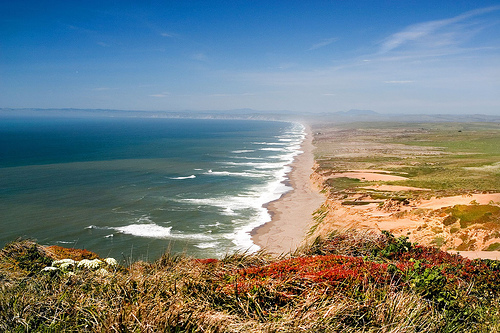
How we view and treat national parks today can have drastic effects on how they survive for tomorrow. Point Reyes National Seashore photo by Jack French via flickr.
Editor's Note: As the saying goes, they're not making wilderness any more. And they're not making the big, sweeping national parks and seashores that protect and conserve incredible landscapes and, within those landscapes, incredible biodiversity. William Tweed, who ended his National Park Service career as the chief of interpretation and cultural resources for Sequoia and Kings Canyon national parks and now writes on parks and nature from his Sierra Nevada home, touched on this fact in a recent op-ed.
We all love America's national park system, but we often have different expectations about local federal parks than about places farther away. Nowhere is this better illustrated than in arguments about Point Reyes National Seashore.
When Bay Area residents think about Yellowstone or Grand Canyon, attitudes are predictable. "These places are important, and they need to be protected without compromise," we say.
When we think about Point Reyes, the situation becomes more complex. We want it to remain unchanged but also to meet local needs. Longer-term concerns with which the Park Service must deal, things like climate change, demographic transformations and shifts in land use, seldom concern us.
The political movement that set out in the 1950s to protect Point Reyes feared that the area would be urbanized. To prevent that outcome they chose to add the area to the National Park System (1962) and set aside part of the resulting park as wilderness (1976). The legislation that defined these twin actions specified that the park would be administered to provide "maximum protection" for the natural environment.
The only exception was a clause that allowed ranch lands that were not in the wilderness portion of the seashore to remain in use. The intent, which remains valid, was to allow the region's historic dairy and beef ranches to continue to operate.
Now, with the seashore's golden anniversary four years away, this idealistic vision has come back to frustrate portions of the county that created it. Should Point Reyes National Seashore be a wild landscape set aside to preserve intact all its natural elements or instead be a scenic landscape managed primarily to support recreation and economic growth? We need both, you say, sensitively balanced, and if current law prevents this it's time to change the law.
Before we do so, however, a moment's reflection is in order
The political will that created Point Reyes National Seashore half a century ago got something profoundly right when it recognized that the region contained biological and cultural resources of exceptional value. What no one knew at the time was how much further the significance of those resources would grow over time. Now we know that no environment on this planet is beyond the reach of human impact.
Even the resources of national parks are not immune. Leading the charge is climate change, which threatens nearly everything biological. Following closely are a host of additional problems including alien species and habitat fragmentation.
Half a century ago, the Bay Area set out to protect the Point Reyes Peninsula and give its natural systems "maximum" protection. Since then much has changed. Population and recreational demand have soared. Economic expectations have grown. Studies document that our society is losing its connection to the natural world. These changes have brought us to a moment of decision regarding the future of the seashore. Many, without realizing it, are questioning the founding assumptions of this amazing park unit.
Those who focus narrowly on issues such as the future of commercial oyster farming within the seashore's wilderness or the perpetuation of exotic deer miss a critical point. Point Reyes National Seashore contains barely 100 square miles, yet this makes it by far the largest piece of preserved coastal land in our region. We have nothing else like it.
Half a century ago, Bay Area leaders created Point Reyes National Seashore and endowed it with a grand vision. Succeeding generations now must decide whether the time has come to abandon the founding purposes of Point Reyes or whether we should renew our commitment to doing the harder things that may be far more important.
The Bay Area prides itself on its world leadership in environmental affairs. But is that commitment strong enough to overcome the most basic of environmental conflicts - whether places like Point Reyes National Seashore belong to the future or just to us now?
William Tweed is a writer and historian who lives in the southern Sierra Nevada. He is working on a book about California's national parks and wilderness areas in the 21st century.
Story Categories:
A copy of National Parks Traveler's financial statements may be obtained by sending a stamped, self-addressed envelope to: National Parks Traveler, P.O. Box 980452, Park City, Utah 84098. National Parks Traveler was formed in the state of Utah for the purpose of informing and educating about national parks and protected areas.
Residents of the following states may obtain a copy of our financial and additional information as stated below:
- Florida: A COPY OF THE OFFICIAL REGISTRATION AND FINANCIAL INFORMATION FOR NATIONAL PARKS TRAVELER, (REGISTRATION NO. CH 51659), MAY BE OBTAINED FROM THE DIVISION OF CONSUMER SERVICES BY CALLING 800-435-7352 OR VISITING THEIR WEBSITE. REGISTRATION DOES NOT IMPLY ENDORSEMENT, APPROVAL, OR RECOMMENDATION BY THE STATE.
- Georgia: A full and fair description of the programs and financial statement summary of National Parks Traveler is available upon request at the office and phone number indicated above.
- Maryland: Documents and information submitted under the Maryland Solicitations Act are also available, for the cost of postage and copies, from the Secretary of State, State House, Annapolis, MD 21401 (410-974-5534).
- North Carolina: Financial information about this organization and a copy of its license are available from the State Solicitation Licensing Branch at 888-830-4989 or 919-807-2214. The license is not an endorsement by the State.
- Pennsylvania: The official registration and financial information of National Parks Traveler may be obtained from the Pennsylvania Department of State by calling 800-732-0999. Registration does not imply endorsement.
- Virginia: Financial statements are available from the Virginia Department of Agriculture and Consumer Services, 102 Governor Street, Richmond, Virginia 23219.
- Washington: National Parks Traveler is registered with Washington State’s Charities Program as required by law and additional information is available by calling 800-332-4483 or visiting www.sos.wa.gov/charities, or on file at Charities Division, Office of the Secretary of State, State of Washington, Olympia, WA 98504.
INN Member

The easiest way to explore RV-friendly National Park campgrounds.

Here’s the definitive guide to National Park System campgrounds where RVers can park their rigs.
Our app is packed with RVing- specific details on more than 250 campgrounds in more than 70 national parks.
You’ll also find stories about RVing in the parks, tips helpful if you’ve just recently become an RVer, and useful planning suggestions.


Comments
Point Reyes National Seashore is an amazing place. Unique geology, amazing nature, cultural heritage and superb recreation all comes together. I loved it, and even saw a gray whale and her young from the shore near the light house. But the problems to combine all those different assets and claims are hardly unique. It happens elsewhere and I think it's the most important issue for nature conservation these days.
There is even a National Park that is on the forefront of this very special balance: Cuyahoga Valley National Park in Ohio has been criticized for not being worthy the status of National Park. But I believe it can become a show case for integrating the natural landscape of the Cuyahoga river, the forests and open lands with the cultural landscape of the canal and the historic locks, the railway, the farms and farmland as well as the man made ponds. And to fulfill the recreational needs of Cleveland and Akron, There is a highly renown outdoor music arena (Blossom Music Center) in the south of the park. A ski area just outside.
I don't know if all those aspects can and will be integrated sustainably for the long term. But I think it is worth trying: in Cuyahoga Valley National Park and at Point Reyes National Seashore.
One of my favorite National Parks. It has all the amenities that blesses the human soul. You can gaze at the open sea all day and never tire. Once the coastal fog recedes and you can see the great expanse of open sea...your inner soul begins to feel renewed.
Bay Area leaders may have advocated for Point Reyes, but they did not create it. Congress did.
Also - I recommend you look at Indiana Dunes NL, an urban park older than Golden Gate or Gateway if you really want to see the face of urban/industrial/residential and park interface in a challenging area.
Skyrocketing fuel prices, budget tightening, and related factors are going to keep people closer to home. This should make our urban-oriented national parks (the ones within day-tripping distance, that is) much more appealing. It will be interesting to see whether highly accessible parks in metro regions -- Point Reyes National Seashore, Indiana Dunes National Lakeshore, and Cuyahoga Valley National Park all being good examples -- can implement higher levels of resource protection when they are under increasing pressure to accommodate the ordinary recreational wants and needs of day-trippers and weekenders. If these pressures persist, one might reasonably expect a tilt toward mass recreation facilities and programs like those of the National Recreation Areas.
???????????? Bob - Have you been to a National Recreation Area? I defy you to find any difference in protection of the resource at Santa Monica Mountains versus Mount Rainier or Deleware Water Gap versus Everglades. This idea that NRAs are some sort of lesser protected areas is nonsense. It is Yosemite that has a golf course, not Glen Canyon. Sequoia had a ski lift until recently. You really need to help your readers understand that the title designations of units in the National Park System DENOTE NOTHING. It is the individual legislation for each park that sets its management guidelines as well as the univeral NPS laws and policies.
Of course, Cuyahoga Valley was originally establised with the same National Recration Area designation as Gateway and Golden Gate, and was basically just "rebranded" for greater publicity. I think it would be hard to get too concerned if Cuyahoga Valley was managed in roughly similar ways to Gateway and Golden Gate.
On the other hand, should those "designation types" really matter? For example, what if Congress redesignated Indiana Dunes National Lakeshore as Indiana Dunes National Recreation Area?
With all due respect, Sabattis, you're asking the wrong question. It's a given that the designation types should matter. Classification is possibly the most fundamental concept in science or, if you will, scientific management. Each designation type should represent a group of parks having similar characteristics and similar managerial needs. In that sense, designation types most emphatically should matter. Since the National Park System has been designating units in an outrageously untrustworthy manner, often defying logic, the designations are becoming less and less useful for any practical purpose. There are two basic questions we should be posing: Why are many units of the National Park Service designated inappropriately?; and, How can this problem be corrected?
Two points:
1) I believe that Congress, rather than the National Park Service, designates most Unit Types (with the exception that the President can only designate a National Monument, regardless of the nature of the Unit). A large part of the problem seems to be ignorance... you often see bills proposed in Congress to designated "such-and-such National Heritage Area as a Unit of the National Park System", even though National Heritage Areas are not *Units* of the National Park System. (Of course, in fairness to Congress, National Heritage Areas are usually considered to be "part" of the National Park System, just not "Units" of the System - so no wonder its hard to keep straight! Also in fairness to Congress, its not clear who is responsible (Congress or the NPS) for the bizarre way of counting the 391 Units of the National Park System.))
2) I believe that there was either a Post or a Comment from Kurt a couple weeks back making the case that all National Park Units should have equal standards of protection, regardless of designation-type. I don't know that I really know what I think on that issue - I probably lean towards your position that designation types should matter, so differences are o.k., but it is hardly a self-evident or universally-accepted point.
The answer to your first question is simple Bob. Since the designation and "official" status are Congressional declarations, or movements, or processes, whatever..........it appears that as usual our government has its collective head up it's butt (or in the case of the Indiana Dunes, buried in the sand?) and no proper scientific classification has been awarded these locales. Political pandering, specifically designed to pacify some local nitwit of a congressman, who's had some nepotistic committee "look into the matter" came up with the name, put it on a piece of parchment, submitted it for approval, and viola, there you have it.
One BIG problem with reclassification of certain areas. National Lakeshores are generally, but not always, thought to have a greater degree of "protection", especially in the environmental sense, than is associated with the Recreation Areas. Now before all you boaters go off on me and cry about how you're limited in scope, when you can't just cruise where you want when you want, save it for another time. History has been literally washed from the face of the earth in many instances for your personal enjoyment, and the local environment has obviously been altered forever, both above and below the surface. In the case of the Indiana Dunes, the local environment was originally designated as a preservation area, based mostly on the fragile nature of the dunes themselves, and the drastic changes in the local environment which no longer support formation or replenishment of the "dunes". A switch in classification to a National Recreation Area would spell the end of the most guarded landscape of the park itself. You might as well bring in a giant fire hose and wash the dunes into Lake Michigan and create sandbars. Big Oil has done more than its share to forever alter the ecosystem in the southern lake and is currently lobbying to increase the levels of pollutants they can "legally" release into the southern tip of the lake, which happens to be the drinking water source for some 10MM residents. The sport fishing industry is all but gone. Air pollution and ozone levels have decreased air quality below that of the coal-fired electrical plant on the South Rim. Now, add in additional boating, ORV's mostly of the ATV and dirt bike nature, jet skis and other personal watercraft, and you might as well bulldoze the dunes and make the park into a perfectly level beach, destitute of native vegetation and wildlife.
Correcting the problem is actually quite simple. Get the damn political process out of the NPS business, of which their lack of knowledge is only surpassed by their lack of funding. Turn the responsibility over to the NSF, as an example, and encourage proper delineation of our national treasures from the perspective of those more qualified than graft-sucking politicians and their lobbyist friend cronies who function as clueless buffoons in this, and most other processes of environmental science.
Eek. Indiana Dunes sounds like a terrible place. "...additional boating, ORV's mostly of the ATV and dirt bike nature, jet skis and other personal watercraft, and you might as well bulldoze the dunes and make the park into a perfectly level beach, destitute of native vegetation and wildlife."
Let's be accurate here. jest skis are banned at Indiana Dunes. The primary boating in the lakeshore is kayaks. ATVs and ORVs are prohibited and rarely a problem. The park has the 7th highest diversity of plant life of any park in the system. It includes 4 national natural landmarks. It has 28 native species or orchids. The bogs, fens, and marshes are incredibly beautiful and the park canno keep up with the demand for places to go fishing from the lake shore or riversides.
Cuation! Weaselspeak alert! I'm quite aware that it is Congress, not "the National Park System" that designates units. Here is what happened. When I was drafting my comment, I wrote this sentence: .... Since the units of the National Park System have been designated in an outrageously untrustworthy manner, often defying logic, the designations are becoming less and less useful for any practical purpose. ..... Then I thought to myself; Hmmm, that sentence is passive; I need to write it in the active mode. So, I changed it to ....Since the National Park System has been designating units in an outrageously untrustworthy manner, often defying logic, the designations are becoming less and less useful for any practical purpose.... I thereby committed TWO mistakes (including failure to proofread) in one fell swoop. So, here's the bottom line: Yes, I'm an idiot, but not for the reason you think! :-)
Aha! Yes, the Internet is both virtue and vice - connections and discussions with like-minded people around the world, and all of our msitakes broadcast around the world as well.....
Just remember Bob.......
It's only those of us who freely admit that, in the grand scheme of things, we truly are neophytes in the intellect department, and are self-consciousless enough to admit that we don't know everything, that ever have a true chance to increase our knowledge base. After all, once you're omnipotent, what't left?
FYI- I was almost certain you were perfectly aware of the political processes involved, but my diatribe was more directed towards the masses who may not have been so familiar with the overall scheme of things.
I never mentioned anything about you and your idiocy. You should know by now that if I had thought so, you would have been made aware. Geez Prof, spit happens, even in the best of families!
Thank you for not making constant reference to my own level of ineptness, though I've provided ample opportunity for such critique. Keep up the good work, both here and in SC.
Any by the way, who bothers to proofread and spell-check?
We've got a Traveler article on park designation in preparation. I think you'll find it very interesting. Meanwhile, I stand by my statement that park designations should matter. It should be obvious that I'm not saying that we should apply different standards of protection. I'm only saying that the labels we give things should matter for grouping purposes. As far as the NRAs go, it's misleading to imply that NRAs don't have mass recreation facilities.
One of the concerns with extending the "national park" designation to any type of NPS unit is whether that will cause the public to shrug their shoulders when development or other threats to natural values are proposed in a old-school, big and wild national park because they've become accustomed to development in other places that are called national parks.
For instance, there is a push now to reclassify the Mississippi National River and Recreation Area (MNRRA) as a national park. Some folks are already calling MNRRA a national park in advertising for events taking place on the Mississippi River. MNRRA doesn't have land or legal authority to manage what happens on the Mississippi, but renaming it as a national park would give the people of Minneapolis/St. Paul a national park that really is in their back yards. (The Mississippi River flows right through Minneaplis/St. Paul.)
Whether associatiing "national park" with an urban area will change how Minnesotans respond to threats to other national parks that aren't urban remains to be seen. Or will it perhaps raise consciousness of national parks in general and make Twin Cities residents curious to see other their other national parks?
A National Park for the Upper Mississippi River was discussed as early as 1917. In 1932 the NPS sent the superintendend of Yellowstone NP, Roger Toll, on a five-day evaluation tour to southern Wisconsin and Iowa. He found the area not suited for a National Park, but recommended that the Effigy Mounds north of Marquette, Iowa should be protected in a National Monument. From then it took until 1949 until "Effigy Mounds National Monument" - http://www.nps.gov/efmo - was created.
Most probably Tolls conclusion still stands: If National Parks are supposed to be vast tracts of nature, unimpaired by men, then nowhere on the Mississippi River a National Park can be created. But if National Parks can be valuable nature, interspersed with remnants of historic use and modern day recreational needs of the Twin Cities, then the Upper Mississippi in the area that now is "Mississippi National River and Recreation Area" could become a National Park of that new kind.