
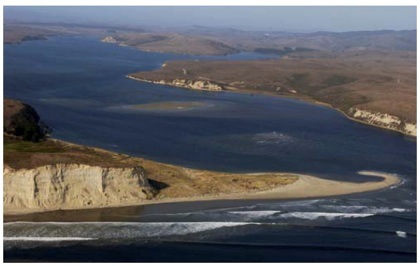
An oyster company's legal battle to continue operations in Drakes Estero in Point Reyes National Seashore will continue into the spring following an appellate court's ruling. NPS photo of Drakes Estero.
The 9th U.S. Circuit Court of Appeals has blocked the National Park Service from forcing an oyster farm out of Point Reyes National Seashore and scheduled a hearing on the dispute for May.
In a terse order filed Monday, the appellate court granted the request for an emergency injunction from the Drakes Bay Oyster Co., whose lease to operate in the national seashore's waters expired in November. The appellate court was asked to consider the motion after a lower court denied the same request.
"Appellants’ emergency motion for an injunction pending appeal is granted, because there are serious legal questions and the balance of hardships tips sharply in appellants’ favor," the order read.
On February 4, a U.S. District Court judge declined to issue a temporary restraining order that would have allowed the oyster farm to continue operations in Drakes Estero while its owner, Kevin Lunny, pursued a lawsuit against the federal government.
In seeking the TRO, the company's lawyers argued that Interior Secretary Ken Salazar broke the Administrative Procedures Act and violated the National Environmental Policy Act when he decided last November not to extend the lease for 10 years. In denying the lease extension, the Interior secretary cited the value of wilderness and congressional intent. On the very next day, Park Service Director Jon Jarvis declared the estero part of the Philip Burton Wilderness at the Seashore, effective December 4.
In her ruling, Judge Yvonne Gonzalez Rogers held that she had no jurisdiction to rule on whether the Interior secretary broke the APA, and even if she did, Mr. Lunny did not prove that Secretary Salazar acted arbitrary or capricious, or abused his discretion, in his decision.
Drakes Bay Oyster Co. also is facing a cease-and-desist order handed it by the California Coastal Commission last month. That order cited unpermitted operations in the seashore's waters by the oyster company, land alterations, debris from the farming operations, violations of previous cease-and-desist orders, and company boats operating in waters that were supposed to be closed to traffic due to harbor seal pupping.
Story Categories:
A copy of National Parks Traveler's financial statements may be obtained by sending a stamped, self-addressed envelope to: National Parks Traveler, P.O. Box 980452, Park City, Utah 84098. National Parks Traveler was formed in the state of Utah for the purpose of informing and educating about national parks and protected areas.
Residents of the following states may obtain a copy of our financial and additional information as stated below:
- Florida: A COPY OF THE OFFICIAL REGISTRATION AND FINANCIAL INFORMATION FOR NATIONAL PARKS TRAVELER, (REGISTRATION NO. CH 51659), MAY BE OBTAINED FROM THE DIVISION OF CONSUMER SERVICES BY CALLING 800-435-7352 OR VISITING THEIR WEBSITE. REGISTRATION DOES NOT IMPLY ENDORSEMENT, APPROVAL, OR RECOMMENDATION BY THE STATE.
- Georgia: A full and fair description of the programs and financial statement summary of National Parks Traveler is available upon request at the office and phone number indicated above.
- Maryland: Documents and information submitted under the Maryland Solicitations Act are also available, for the cost of postage and copies, from the Secretary of State, State House, Annapolis, MD 21401 (410-974-5534).
- North Carolina: Financial information about this organization and a copy of its license are available from the State Solicitation Licensing Branch at 888-830-4989 or 919-807-2214. The license is not an endorsement by the State.
- Pennsylvania: The official registration and financial information of National Parks Traveler may be obtained from the Pennsylvania Department of State by calling 800-732-0999. Registration does not imply endorsement.
- Virginia: Financial statements are available from the Virginia Department of Agriculture and Consumer Services, 102 Governor Street, Richmond, Virginia 23219.
- Washington: National Parks Traveler is registered with Washington State’s Charities Program as required by law and additional information is available by calling 800-332-4483 or visiting www.sos.wa.gov/charities, or on file at Charities Division, Office of the Secretary of State, State of Washington, Olympia, WA 98504.
INN Member

The easiest way to explore RV-friendly National Park campgrounds.

Here’s the definitive guide to National Park System campgrounds where RVers can park their rigs.
Our app is packed with RVing- specific details on more than 250 campgrounds in more than 70 national parks.
You’ll also find stories about RVing in the parks, tips helpful if you’ve just recently become an RVer, and useful planning suggestions.


Comments
I don't think the Second and Fourth Amendments are "under attack," Mike. In any case, I second you final paragraph.
Did not "skip" or rearrange anything. The words "the right of the people to keep and bear Arms, shall not be infringed" aren't contigent on your interpretation of "militia". In fact they aren't contingent on anything.
"the right of the people to keep and bear arms" is clearly not the subject of "shall not be infringed." Unless you skip over the comma.
But I think we're confirming Mike's sense that we're moving off topic.
We are moving off topic in a way but the underlying tones presented through this thread have everything to do with the Drakes Bay Oyster Issue and many others, I believe.
Been a good topic and I appreciate this forum and the posters. Don't believe the topic has ended.
Heading to the Backcountry now. Have a good day everyone:).
What????? Then what is the subject? of "shall not be infringed"?
Oh, and by the way, the text ratified by the states and authenticated by TJ as Secretary of State, has no comma.
Finally, tell us what enumerated power in the Constitution gives the fed government the right to regulate arms in the first place irrespective of the Second amendment?
And yes, I know it is off topic, (and I apologize Kurt) but you brought it up and I can't let it go unchallenged.
So let's get back on topic and stay away from discussing the 2nd or 4th amendments. They're not in play here.
With that said, when is a contract a contract, and when is it not?
To those who believe the NPS/DOI should reverse course and extend the oyster company's lease, what would you say if this involved private land that you owned, and which in good faith you had signed a contract with your lessee giving them X number of years to operate on your land, but after that, they had to move. But instead of your lessee honoring the terms that they agreed to, they went to court to fight the terms of the contract.
Or, if you were a businessman, would you purchase a company knowing that in seven years the lease to the land necessary for your operation to continue was going to expire? And even if there was an extremely remote possibility to renew that lease, would you invest in that remote possibility?
Speaking of backcountry. Am starting to investigate a backcountry trip in Dinosauer National Park. Would like to hike and camp with primay focus on fishing. Looks like most the river access camping is reserved for float trips. Not much info on the NPS site. Anyone familiar with this area that could provide tips.
"A well regulated Militia." "The right of the people to keep and bear arms" is an appositonal phrase. This is pretty basic, middle school grammar, ec.
But let's get back on topic.
Kurt, I understand your "contract" point. And generally, landlords have the right not to renew. Whether that was the right thing to do in this case is the primary disagreement as opposed to whether the government has the authority. As to suing, certainly not my preferred recourse. On the other hand, the government has established its own set rules for considering whether to lease. As I understand it, the suit is based on the claim the government didn't follow the rules. I don't know the answer to that question. I do know the government could have renewed the lease, kept a historic operation in place, kept people employed and avoided this whole controversy without detrimental effect to the area.
Before I go (you dragged me back, Kurt:), The contract back in the 70's (we are all part owners of Point Reyes) from what I've gathered did not include the verbage that Drakes will vacate. The culture, particularly the ultra environmentalists (I hate the way the term has been hijacked) have moved the goal posts to exclude ventures other than their own. In this case raising oysters for a grateful community. Hollistically raising them for the benefit of the environment raises questions as to their (the anti-Drakes Bay Oyster Co. folks) true motivations. Lets look at that aspect.We are all owners of Point Reyes NRA so the analogy to private property rights seems flawed to me.
ec -- in most places in Dinosaur, access to the river by anything other than some kind of floating device is going to be very difficult. But I think (although am not certain) that a limited number of non-commercial permits are available. So if you have a kayak or your own raft . . . . .
It also appears that at least along the Yampa, there are a number of large inholdings lining the river that may also limit access.
Check with the park and see if I'm correct.
The contract in the '70s put a 40-year length on the lease, and contained a "may renew" option. But the Congress through the Point Reyes National Seashore Wilderness Act also directed the Park Service to phase out non-conforming uses in the estero.
Lee & EC: Canoe/kayak access via the Yampa is best after July 1, I believe, when the river flows ebb and the rapids aren't as nasty. However, I understand the bugs become nastier after July 1;-) That said, perhaps the easiest access for fishing would be to go to the Jones Hole Fish Hatchery and hike down to the river from there. There are a number of campsites right along the Yampa at that point.
Thanks Lee and Kurt.
BTW Kurt, have you thought about sponsoring a park Q&A section on this blog where people could ask questions like mine and get answers?
Yep, it's on the drawing board. Tried it once years ago and was inundated by spam. Believe we've found a way around that; now it's just a matter of manpower and affording it;-)
That would be a great idea. I had a question about SEKI the other day and couldn't quite find the right place for it.
Regarding the contract Kurt... i sure don't know the answer. The NPS may very well be entirely within the rights of the contract. I think the question is a little larger than just the contract. If this were a private transaction, I think the answer might be different than acquisition of private property or a private lease for public purposes.
While I don't know the percentage of the property impacted by the oyster farm, the farm provides jobs and quality oysters, a rare product. I don't see that the benefits from removal outweigh those considerations.
While wilderness is important to many does it have to be here? Can't the wilderness accomodate the use ala Frank Church or Grand Teton? What does the public (the ones paying for all this) lose if the farm is continued within the park or wilderness?
Congress can do whatever it likes here. I'd like to see legislation introduced and passed that would permit the farm to exist within to the park.
Interestingly enough, I listened to an interview of Kevin Lunny today on KGO. Besides sounding like a normal human being, he also debunked the claims seen here. Apparently, when he bought the business, the understanding was that the lease was renewable. During the first couple years, he cleaned up some of the issues he inherited from the prior owner, and then the NPS started talking about not renewing the lease.
It'd be nice to see the NPT reach out to the DBOC and get a different point of view for readers to ponder. That'd be interesting.
The bottom line of all this is that it reinforced my belief that the wildernuts are just another bunch of fanatics.
Chiming in here briefly. I apologize that I haven't been following the latest twists and turns in this ongoing saga.
I think the farm will lose in the 9th Circuit Court of Appeals (the appellate court considering the case). The interior secretary would seem to have the law on his side. However, maybe the new interior secretary (Sally Jewell) will undo the decision before the farm closes.
Is it true that if the farm closes tons of oysters will simply be discarded? If so, there should be a protest in which hungry people demand to eat the oysters. Maybe soup kitchens in S.F. should stage a protest saying send them to us. There are plenty of hungry people in California. Our state now has one of the nation's highest poverty rates, I've read recently.
I've noted residential rental agreements in the cities of Berkeley or San Francisco. The rent control ordinances in those cities make it near impossible for a landlord to end a rental agreement unless there is "just cause" such as missing a rent payment.
However, this is the federal government we're taking about and not a private landlord. Federal leases with the BLM and Forest Service end up in court all the time. There are leases (40 years terms I believe) for vacation homes on Forest Service land. If the Forest Service were to deny a lease and order a vacation home owner to vacate and demolish a house, I'm almost sure the owner is going to sue the feds.
In addition to that, the State of California (through the California Fish and Game Commission) still asserts that it is the landlord for the water bottom allocations. The text of the reservation of use recognizes the authority of California to issue the water bottom leases. Yet NPS and Interior have issued orders evicting the oyster farm from the waters.
Zeb, re your "echo chamber" comment (thanks for editing it out). And here I thought you were a long-time regular reader of the Traveler.
Almost two years ago I interviewed Mr. Lunny for his side of the story:
/2011/10/debate-over-oyster-farming-point-reyes-national-seashore-offers-differing-perspectives8858
I also interviewed one of the original sponsors of the Point Reyes Wilderness Act (who contacted me after the story to say what a great job I had done with it):
/2011/09/politicians-past-and-present-want-interior-secretary-permit-oyster-farm-point-reyes-national-seashor8758
There also was a story about the bad NPS science:
/2009/05/national-research-council-blasts-park-service-report-oyster-farming-point-reyes-national-sea
A story about the need for more science:
/2011/11/new-study-says-more-studies-are-needed-determine-impact-drakes-bay-oyster-co-point-reyes-national-se9076
Another story about a panel questioning the NPS science (a story that brought complaints from the NPCA to me):
/2012/09/independent-panel-raises-questions-over-national-park-service-science-concerning-oyster-farm10491
A story about Congress having little faith in the NPS science:
/2011/12/congress-wants-national-academy-sciences-review-oyster-farm-studies-point-reyes-national-seashore9218
A story about Sen. Feinstein accusing the NPS of falsifying the science to get a desired conclusion:
/2012/03/point-reyes-national-seashore-staff-accused-more-wrongdoing-measuring-impacts-oyster-farm9691
And yes, there also have been stories about the California Coastal Commission's complaints about how the Drakes Bay Oyster Co. is operating.
Of course, it might be a while before Ms. Jewell is confirmed as the Secretary of Interor if Senator Murkowski follows through on her threat to put a "hold" on her nomination due to some unresolved dispute in Alaska.
Rick
Kurt, I missed that Lunny interview. I'll have to go back. I was still riled up by that interview last night.
As it stands, the oyster farm still exists, and I think under the law Drakes Estero is technically still potential wilderness. I know that they've had the memo issued (and published in the Federal Register) that "nonconforming uses" have ceased, but that's obviously not true. I recently saw DBOC products at my local market, so they're obviously still there and continuing the use with the court challenge holding up any actual conversion to full wilderness.
In addition to that, the overlapping jurisdictions are especially interesting. I haven't heard of California Dept of Fish and Game starting any action, but they have asserted that they have the authority to issue the water bottom leases until such time as they decide to end the leases. I know DBOC is in a precarious position, but as long as California contends that they still have that authority, the oyster farm has some hope. And the issues with the California Coastal Commission are odd, since their cease and desist order to DBOC seemed to claim authority over the oyster farm operations that were the authority of CDFG and the California Fish and Game Commission. DBOC's attorney attended the meeting and posed a comment in their public forum since it was too late to add it as an agenda item. He protested the California Coastal Commissions "incursion" into the Fish and Game Commission's authority over issues of the oyster farm. This is from the last commission meeting in February:
I've contended for a while that NPS has allowed for nonconforming uses in potential wilderness at the discretion of management - namely the High Sierra Camps in Yosemite and Bearpaw HSC in Sequoia. Perhaps those uses fall more in line with what NPS imagines from land that they manage
Pages