
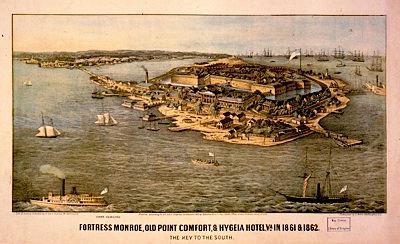
Fort Monroe has been added to the National Park System, as President Obama used the Antiquities Act to designate it as a national monument. Library of Congress sketch.
The National Park System grew by one unit Tuesday as President Obama used his powers under the Antiquities Act of 1906 to create Fort Monroe National Monument in Virginia. With that declaration the president preserved a site integral to the history of slavery, the Civil War, and the U.S. military.
The president crafted the announcement as part of a series of executive actions "to put Americans back to work and strengthen the economy."
“Fort Monroe has played a part in some of the darkest and some of the most heroic moments in American history. But today isn’t just about preserving a national landmark- it’s about helping to create jobs and grow the local economy," the Democrat said in a prepared statement. "Steps like these won’t replace the bold action we need from Congress to get our economy moving and strengthen middle-class families, but they will make a difference."
Fort Monroe is the 396th unit of the park system, and the 22nd national park unit in the state of Virginia. The president's action marked the first time he has used the Antiquities Act to preserve a landscape, cultural, or historic site in the country.
First exercised by President Theodore Roosevelt in 1906 to designate Devil's Tower in Wyoming as the first national monument, the Antiquities Act has been used by 14 presidents since 1906 to protect some of the most unique natural and historic features in America, such as the Grand Canyon, the Statue of Liberty and Ellis Island.
According to an economic analysis commissioned by the Fort Monroe Authority in 2009, the implementation of the Fort Monroe Reuse Plan - the centerpiece of which envisions the preservation of the majority of buildings located within the 570-acre National Historic Landmark District as well as significant landscapes and viewsheds – will help create nearly 3,000 jobs in Virginia.
Fort Monroe, a historic fort in Virginia’s Tidewater region, played a pivotal role in the history of slavery in the United States. Built between 1819 and 1834, Fort Monroe has occupied a strategic coastal defensive position since the earliest days of the Virginia Colony. It was the place where Dutch traders first brought enslaved Africans in 1619.
During the Civil War, the fort remained in Union possession and became a place for escaped slaves to find refuge. Fort Monroe was the site of General Benjamin Butler’s “Contraband Decision” in 1861, which provided a pathway to freedom for thousands of enslaved people during the Civil War and served as a forerunner of President Abraham Lincoln’s Emancipation Proclamation of 1863.
Story Categories:
A copy of National Parks Traveler's financial statements may be obtained by sending a stamped, self-addressed envelope to: National Parks Traveler, P.O. Box 980452, Park City, Utah 84098. National Parks Traveler was formed in the state of Utah for the purpose of informing and educating about national parks and protected areas.
Residents of the following states may obtain a copy of our financial and additional information as stated below:
- Florida: A COPY OF THE OFFICIAL REGISTRATION AND FINANCIAL INFORMATION FOR NATIONAL PARKS TRAVELER, (REGISTRATION NO. CH 51659), MAY BE OBTAINED FROM THE DIVISION OF CONSUMER SERVICES BY CALLING 800-435-7352 OR VISITING THEIR WEBSITE. REGISTRATION DOES NOT IMPLY ENDORSEMENT, APPROVAL, OR RECOMMENDATION BY THE STATE.
- Georgia: A full and fair description of the programs and financial statement summary of National Parks Traveler is available upon request at the office and phone number indicated above.
- Maryland: Documents and information submitted under the Maryland Solicitations Act are also available, for the cost of postage and copies, from the Secretary of State, State House, Annapolis, MD 21401 (410-974-5534).
- North Carolina: Financial information about this organization and a copy of its license are available from the State Solicitation Licensing Branch at 888-830-4989 or 919-807-2214. The license is not an endorsement by the State.
- Pennsylvania: The official registration and financial information of National Parks Traveler may be obtained from the Pennsylvania Department of State by calling 800-732-0999. Registration does not imply endorsement.
- Virginia: Financial statements are available from the Virginia Department of Agriculture and Consumer Services, 102 Governor Street, Richmond, Virginia 23219.
- Washington: National Parks Traveler is registered with Washington State’s Charities Program as required by law and additional information is available by calling 800-332-4483 or visiting www.sos.wa.gov/charities, or on file at Charities Division, Office of the Secretary of State, State of Washington, Olympia, WA 98504.
INN Member

The easiest way to explore RV-friendly National Park campgrounds.

Here’s the definitive guide to National Park System campgrounds where RVers can park their rigs.
Our app is packed with RVing- specific details on more than 250 campgrounds in more than 70 national parks.
You’ll also find stories about RVing in the parks, tips helpful if you’ve just recently become an RVer, and useful planning suggestions.


Comments
Good news. I hope to visit it next year.
Is this really going to create 3,000 new jobs? Really?
More on Ft. Monroe from the Beltway:
http://www.realclearpolitics.com/video/2011/11/01/carney_obama_declaring...
There is so many people with the same name on this spot that you have to resort to identifying them by the time they posted. So, Anonymous 1:23, I read the political disclaimer. It is a cryin' shame the White House didn't check into that firgure and/or state up front that it was the Governor of Virginia making the 3,000 jobs claim. I think Ft Sumter / Fort Moutrie runs with a steady staff of less than 20. Now I know that doesn't take into account the parttimers, voluntary, concessions, etc., but 3,000? Come on! So what do you think this 570 acres is going to cost the US annually? I think we ought to hear from the Lee Dalton on this one, after being upset that they dropped the Federal Biological but added a waaaaay more important Fort.
Whether it's 3 or 3000 it's still a good thing. And if it's only one new job that's more than the previous occupant of the WH and his party have created in the past 10 years. Just IMO. I still plan to visit the fort next year (unless the tea party has succeeded by then in its attempt to destroy the economy completely). And, no, no links from me.
It appears (to many) what is happening is that the economy must be destroyed to then build the country into a vision that is not going to be good. It's been tried before and failed, everywhere it's been tried. Not going to work and the Parks will flounder. I'd like to think I'm wrong but I don't think so.
Respectfully
Anon 4:31, you just plain miss the point. They drop one entity and start another. What is the net loss or gain?
Even in a bad economy, it might be important to preserve pieces of American history.