
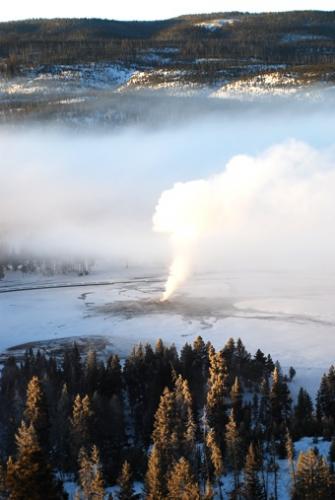
Wyoming officials want to see as many as 540 snowmobiles allowed into Yellowstone each day during the park's winter season, conditions allowing. Photo of the Upper Geyser Basin from Observation Point by Kurt Repanshek.
Wyoming's governor believes 540 snowmobiles a day could travel through Yellowstone National Park in winter without adversely impacting wildlife, air quality, or the park's soundscape.
Gov. Matt Mead made that point in the state's official comments to park officials, who are working on yet another environmental impact statement intended to come up with a feasible and legally defensible winter-use plan for Yellowstone.
"The daily limits listed in the proposed rule for snowmobile use is too low. The best available information for air quality, soundscape, and wildlife supports a level in the range of 540 snowmobiles per day," wrote the governor. "At that daily allocation level the impact to resources is recorded as minimal within the Draft Yellowstone Winter Use Plan and DEIS."
The park's currently preferred alternative, he said, would reduce by nearly 6,000 the number of snowmobiles entering the park over the course of the winter. Such a reduction would have a direct impact on the regional economy, Gov. Mead wrote.
"Yellowstone winter use is closely tied to businesses involved with recreation, hotels, restaurants, etc. Local communities are built around a seasonal economy, and the park is a large piece of that seasonal economy," he noted.
For more than a decade the debate over how winter in Yellowstone should be enjoyed has dragged on. The Park Service has gone back and forth with the political winds, calling back in 2000 for recreational snowmobile use to be phased out completely only to see the Bush administration drop that decision in favor of continued snowmobile use.
Legal battles waged by those who want continued snowmobile use and those who believe Yellowstone would be healthier without snowmobiles have prolonged the debate and led to a fistful of environmental studies -- environmental assessments as well as more complex and detailed environmental impact statements.
Under the park's currently preferred alternative, up to 330 snowmobiles and 80 snowcoaches would be allowed daily into the park for 45 days of the 90-day winter season. However, the Park Service's own science has pointed to 250 as the daily threshhold of snowmobiles over which the park's resources would be adversely impacted.
There are seven alternatives in the DEIS. In addition to the park's preferred option, which calls for a sliding scale of sorts that would determine daily snowmobile and snowcoach limits, one option calls for not allowing any motorized use, another calls for phasing out snowmobiles in favor of snowcoaches, and one proposes allowing up to 720 snowmobiles and 78 snowcoaches per day.
In his letter to the park, Gov. Mead believes the park's preferred alternative would prevent many visitors from enjoying Yellowstone in winter.
"Protection of resources does not have to come at the expense of access; we can have both -- healthy resources and open access," the governor stressed. "I reiterate what I wrote you in July -- we can balance protection of the park’s resources and snowmobile access, and I am committed to working with you and others to that end."
Gov. Mead also urged the park to allow non-commercial snowmobile trips in the park.
"The requirement that 100% of snowmobile entries into Yellowstone be commercially guided is extreme and unreasonable. Responsible non-commercial use of Yellowstone can be accomplished," he maintained. "It can be accomplished through a well-designed non-commercial guide system that includes an educational component with Yellowstone-specific elements to help visitors safely and responsibly visit the park. Non-commercial access to Yellowstone is important to the State of Wyoming, its communities, citizens, and visitors."
Story Categories:
A copy of National Parks Traveler's financial statements may be obtained by sending a stamped, self-addressed envelope to: National Parks Traveler, P.O. Box 980452, Park City, Utah 84098. National Parks Traveler was formed in the state of Utah for the purpose of informing and educating about national parks and protected areas.
Residents of the following states may obtain a copy of our financial and additional information as stated below:
- Florida: A COPY OF THE OFFICIAL REGISTRATION AND FINANCIAL INFORMATION FOR NATIONAL PARKS TRAVELER, (REGISTRATION NO. CH 51659), MAY BE OBTAINED FROM THE DIVISION OF CONSUMER SERVICES BY CALLING 800-435-7352 OR VISITING THEIR WEBSITE. REGISTRATION DOES NOT IMPLY ENDORSEMENT, APPROVAL, OR RECOMMENDATION BY THE STATE.
- Georgia: A full and fair description of the programs and financial statement summary of National Parks Traveler is available upon request at the office and phone number indicated above.
- Maryland: Documents and information submitted under the Maryland Solicitations Act are also available, for the cost of postage and copies, from the Secretary of State, State House, Annapolis, MD 21401 (410-974-5534).
- North Carolina: Financial information about this organization and a copy of its license are available from the State Solicitation Licensing Branch at 888-830-4989 or 919-807-2214. The license is not an endorsement by the State.
- Pennsylvania: The official registration and financial information of National Parks Traveler may be obtained from the Pennsylvania Department of State by calling 800-732-0999. Registration does not imply endorsement.
- Virginia: Financial statements are available from the Virginia Department of Agriculture and Consumer Services, 102 Governor Street, Richmond, Virginia 23219.
- Washington: National Parks Traveler is registered with Washington State’s Charities Program as required by law and additional information is available by calling 800-332-4483 or visiting www.sos.wa.gov/charities, or on file at Charities Division, Office of the Secretary of State, State of Washington, Olympia, WA 98504.
INN Member

The easiest way to explore RV-friendly National Park campgrounds.

Here’s the definitive guide to National Park System campgrounds where RVers can park their rigs.
Our app is packed with RVing- specific details on more than 250 campgrounds in more than 70 national parks.
You’ll also find stories about RVing in the parks, tips helpful if you’ve just recently become an RVer, and useful planning suggestions.


Comments
I decided i'm not coming to Yellowstone this winter because there is too much snowmobile exhaust so i will not be staying at any Yellowstone hotels or eating any food around there. Hope this doesn't hinder Yellowstone's economic recovery.
Two years ago my family and i did a snowmobile tour of Yellowstone and we really enjoyed it. We have been to YS 4 times in the past 3 years. It seems to me that for many of us the only way to see the park with only a few days in which to do it is on snowmobiles. We did not notice any adverse effects on the wildlife during our trip. The bison passing close enough to us to actually touch as they passed. The guides were very careful that we did not disturb the animals.I understand that many wish YS could revert to almost no human interaction and really understand that desire but everyone has an opinion.For my family to enjoy YS during the winter the supervised and careful snowmobile trip was perfect. I would be against non-commercial snowmobile use however. It needs to be carefully controlled like it is now. JMHO
You may not be able to SEE any adverse effects on the animals; however, animal stress levels increase during the winter due to scarce resources and cold weather as it is. Bison are creatures of habit and will travel the paths they know to get to the resources they know are there. Sure, if you don't try to interact with them, they'll just walk by you, but the noise that snowmobiles make causes an increased stress reaction the "fight or flight" portion of their brains are constantly active around you. If such reactions become common and sustained, they are more prone to disease (due to a lower immune system) and have fewer offspring which suffer just as human infants whose mothers were stressed during the gestation period suffer. They are restless, cholic and may suffer from similar immuno deficiencies.
This focus on snowmobiles and other loud, smelly vehicles as the sole driver of the winter economy around Yellowstone is short-sighted. There is much to be gained from promoting the area as a place to slow down, not a place to go fast. Try that for a few winters, and see what happens.
I think that there's plenty of places around Yellowstone without having to up the number of snowmobiles. If animals outside of the park can not be provided the same protections as animals within the boundaries, the park service should be able to best decide what is most beneficial for the park and the inhabitants. This is a national park and not a state park - it does not seem that it should be a decision for the governor as it belongs to all, not just any one locale nor the businesses that have benefitted from their association surrounding the boundaries.
The National Parks were not created to provide jobs or to create buisness oportunities.It is nice that people can make a living who live near parks but it is not the reason they are there.Also it is not the governments job to create jobs.The governor should know that.
Whats the average daily use over the last 5 yrs? I was at YS in the winter i dont think i saw more than 100 snowmobiles in a day, for the 5 days i was there. i have to say 540 seems a little high
The average number of snowmobiles per day during the 2008-09 winter season was 205. Wyoming officials say the numbers would have been higher in recent years if there hadn't been so much uncertainty over whether snowmobiles would be allowed in and under what circumstances.
If 205 is the average, then 250 to 300 is not unreasonable,Not sure why uncertainty would keep the numbers down.Look i get both side of this,but if demand is only 205 machines a day then why propose 540? Split the difference.Shake hands and enjoy the park
SUBLIME:
Bravo, folks. Well said, all around.
LUDICROUS:
No adverse effect of loud, smelly snowmobiles passing close enough to bison to touch them as you pass? Are you serious? What do you mean, that you are proud of not having actually collided with them? What guides were those who made sure you did not disturb the animals? "Folks, be careful not to run over any hooves out here, will you? It's OK to slap 'em on the rumps as you go by, but stay away from those horns on the other end, now!"
I'm disgusted. Especially after what I read and wrote on the aggressive mountain goat posting. Fools in paradise, ruining it.
I am assuming when [he] said. The bison passing close enough to us to actually touch as THEY passed, the snowmoblies were stoped but that may be LUDICROUS.
Public support for continued or increased funding of our national parks will decrease as the economy continues to worsen if regular folks are not allowed to actually use and enjoy the lands set aside for recreation. Telling citizens "we want your tax money to pay for the upkeep of this land, but you cannot touch it" will get old fast.
I don't understand why this issue is always inaccurately framed to make it look as if people are banned from Yellowstone in the winter. You can go wherever you want, whenever you want, as long as you're willing to use your legs.
I've been in Yellowstone in the winter on snow shoes and cross-country skies. More people should try it. Its good for you. Also, its pretty cheap. Even "regualr folks" can afford it.
What I find ludicrous is those still complaining about loud and smelly snowmobiles that haven't been allowed in the park since 2005 so it is obvious they haven't been in the park for a while. The current snowmobiles are all 4 stroke just like automobiles and don't burn oil. They are also quieter than the snowcoaches that you don't seem to have a problem with that still don't meet Best Available Technology requirements.
Another thing that I find ludicrous is those complaining about the close proximity that a snowmobile may get to bison on the groomed roads yet don't complain about the snowcoaches that must also go through those bison herds and the snowcoaches are a lot wider than a snowmobile taking up a lot more of the road pinching the bison into an even smaller area to get around them.
Finally to [Aaron], you might want to check and find out that you can't always go where you want when you want in the park when you use your own legs. It's great that people have the ability to use skis and snow shoes but I have not seen any families make the 60 mile round trip from West Yellowstone in one day on skis or snow shoes to see Old Faithful. If people have never used them I highly doubt they could do it no matter how great of shape they are in.
I say just go enjoy Yellowstone sometime in the winter and see how great it is. It is much quieter than the summer. Watch the clean and quiet snowmobiles tour the park at a controlled pace by an experienced guide. It has changed a lot since the 90's.
I just hope all can respectfully enjoy the park with reasonable options.
I'm curious as to whether there's much of an economic benefit for Wyoming since the majority of the snowmobiles enter through Montana. I suppose they receive sales and hotel taxes.
y_p_w,
Here's your answer from an article we ran back in July:
How might closing the East Entrance to over-snow traffic affect the tax coffers of Cody, Wyoming, and its surrounding Park County?
According to economic studies contained in the DEIS, "Recent lodging and tax data for Fremont (Idaho) Park (Wyoming) counties indicate that declines in snowmobile entries into Yellowstone in particular, and in winter visitation in the park in general, have not detectably impacted the overall winter tourist economy in the counties as measured by monthly lodging tax collections. This is despite the fact that the economies of these counties are relatively small."
Part of the reason Park County is not greatly impacted, the report notes, is that it draws 41
percent of its lodging tax revenues in winter from the Mammoth Hot Springs Hotel, which you can't snowmobile to.
I'm really conflicted over this issue. I have enjoyed snowcoach trips twice from Mammoth to Norris and Canyon. The snowcoaches are probably no more nor less noisy than snowmobiles.
It's true that the new class of four-stroke snowmobiles are much quieter and cleaner than the old ones. It's also true that the guides appear to keep riders under pretty strict control. All riders (and snowcoach drivers) I've seen have been careful not to run bison they may encounter along the way. Of course, I've seen only a very small sampling with my own eyes.
But I think I can safely testify to the fact that winter access to Yellowstone is much, much better than it was just a few years ago. To open that park to kinds of excesses and stupidity that is so rampant among snowmobilers (and ATV riders) outside the park would be simply disastrous.
Yet at the same time as I say this, I am very leery of opening Yellowstone to greater numbers of machines of any kind. I'm not privy to current statistics and research, but one of the great aspects of a winter visit is the quiet and feeling of wildness that still prevails amid the snowflakes.
I don't pretend to have the answers. But I think I can trust those who are seeking them to find the best available.
That sounds interesting. However, I was under the impression that the majority of snowmobile rentals/traffic would be coming in from West Yellowstone, MT. Wouldn't the additional lodging increase revenues at Old Faithful, which is in Teton County? Of course increased winter visitation to Yellowstone would only be a blip to Teton County, which has heavy winter visitation in the Jackson Hole area from ski tourism.
I guess I'm not sure of your question, y_p_w. Most snowmobile traffic does enter at West Yellowstone. Very little comes through the East Entrance. That would remain the case under the park's preferred alternative (which reportedly is being modified).
Teton County, Wyoming, would benefit from taxes generated at Old Faithful, Park County, Wyoming, from those generated at Mammoth Hot Springs.
I'm just wondering what the point is in describing the impacts of snowmobile traffic on counties that frankly aren't affected by such visitation.
If there's more snowmobile traffic, it's not going to affect revenues much in Park County. Revenues are going to be increased in Teton County. Perhaps it won't be that much in percentages due to the already high winter visitation in Teton County.
Politics....?;-)
The National Park system was not created to provide economic opportunities to surrounding states.Since Gov. Meade's State is the only state in the union to benefit from sales tax from a National Park , maybe he would give up that little perk to the park to mitigate the effects of 540 more snowmobiles polluting the park and disturbing wildlife?
Is there a process for comments from ordinary citizens? I figure my opinion should count just as much as Gov Meade's andd MY preference would be for NO snowmobiles. I suspect the animals would agree with me.
Bruce- Maybe before you proclaim what is or is not" ludicrous" you should do a little research so you don't look like an uninformed fool. The snowmobiles used in YS are specifically made to reduce emmissions and noise as much as possible. They are as quite as most cars which are allowed in the park the rest of the year. Perhaps we should ban cars/trucks as well. Especially the bikers on loud Harley's you see during the summer?? When I was there a few weeks ago several signs said 300 animals are run over by cars every year. I wonder how many are killed by snowmobiles Bruce?? Your description of "slapping" bison on the rear as they pass by proves you have no idea of what you are talking about. That description is assinine and juvenile to say the least. When our guides saw bison on the road ahead we all moved well over to the side-- all got off the snowmobiles on the side opposite the animals as they passed. They had no reaction to our presence. I understand people have different opinions to this situation but stick to the facts Bruce. And if you think I'm some kind of city boy who won't get out and hike your wrong as well. I've hiked most of the Nat. Parks in the west and have also hunted/camped and hiked throughout Canada and the Yukon.