
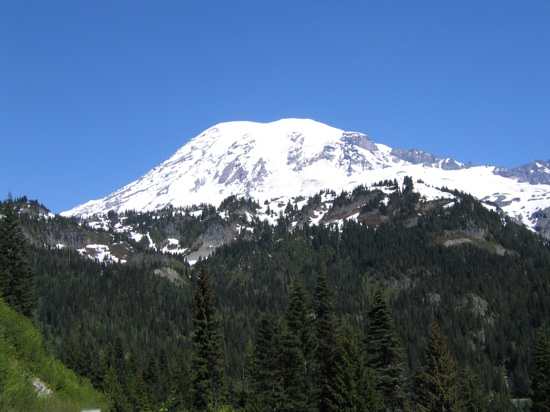
What do you think about sightseeing tours circling around Mount Rainier National Park? NPT file photo.
One of the increasingly thorny issues circling around the National Park System are sightseeing planes that circle national parks. Those tours have been debated at Grand Canyon, Crater Lake, and Grand Teton national parks, just to name three units of the system. Now you can add Mount Rainier National Park to the list.
Word came the other day that the Federal Aviation Administration, in cooperation with the National Park Service, has initiated development of an Air Tour Management Plan and associated Environmental Assessment for Mount Rainier pursuant to the National Parks Air Tour Management Act of 2000.
Five air tour operators currently provide commercial air tours over and within one-half mile of Mount Rainier. Most of these operators originate from the Puget Sound area, and one originates from Wenatchee, Washington. Since January of 2003, these five operators have had authority to conduct a maximum combined total of 114 air tours per year, though in recent years, operations have likely been below this level. While the air tour visitor experience varies depending on weather conditions and the desires of the air tour client, the primary attraction for air tour visitors is viewing the summit of Mount Rainier, according to park officials.
An Air Tour Management Plan is being developed for Mount Rainier to "provide measures to mitigate or prevent significant adverse impacts, if any, of commercial air tour operations ... including impacts on natural and cultural resources, visitor experiences, and tribal lands," a park release explained.
Back in October, the Park Service and FAA met for two days to discuss issues involving air tours. You can find the minutes from those meetings at this site. Materials presented at the meeting included information on: park resources; the acoustical environment at Mount Rainier; current and historical air tour operations; and representative air tour flight paths. In addition, Mount Rainier staff provided information regarding sensitive park resources, tribal concerns, and tourism patterns.
The FAA and NPS are now inviting the public, agencies, tribes, and other interested parties to provide comments, suggestions, and input regarding the Mount Rainier ATMP. Generally speaking, the agencies would like to know about any concerns or ideas the public has regarding commercial air tour operations at Mount Rainier and their management. Questions to consider when providing input include: Are there any significant issues the agencies need to consider during the planning process? How do you feel air tours will affect natural, cultural, and historic resources at MORA?
A Public Scoping Document that describes the project in greater detail is available at this site. You also can find hard copies in the park at the Longmire Museum, the Henry M Jackson Memorial Visitor Center at Paradise, the Ohanapecosh Visitor Center, and the Sunrise Visitor Center. Outside the park, copies can be found at the Eatonville Library, Puyallup Library, Enumclaw City Library, Buckley Library, Tacoma Public Library, and the Yakima Valley Regional Library. There's also a copy at the Environmental Center Resource Library in the Huxley College of Environmental Studies at Western Washington University.
And, of course, you can find the supporting documents and a place to comment on them at this site: http://parkplanning.nps.gov/projectHome.cfm?parkId=323&projectId=29122
Comments are being taken through May 3.
Comments may also be submitted to Keith Lusk (Air Tour Management Plan Program Manager, Special Programs Staff, AWP-1SP, FAA) via mail (P.O. Box 92007, Los Angeles, California 90009-2007) or email ([email protected]).
Story Categories:
A copy of National Parks Traveler's financial statements may be obtained by sending a stamped, self-addressed envelope to: National Parks Traveler, P.O. Box 980452, Park City, Utah 84098. National Parks Traveler was formed in the state of Utah for the purpose of informing and educating about national parks and protected areas.
Residents of the following states may obtain a copy of our financial and additional information as stated below:
- Florida: A COPY OF THE OFFICIAL REGISTRATION AND FINANCIAL INFORMATION FOR NATIONAL PARKS TRAVELER, (REGISTRATION NO. CH 51659), MAY BE OBTAINED FROM THE DIVISION OF CONSUMER SERVICES BY CALLING 800-435-7352 OR VISITING THEIR WEBSITE. REGISTRATION DOES NOT IMPLY ENDORSEMENT, APPROVAL, OR RECOMMENDATION BY THE STATE.
- Georgia: A full and fair description of the programs and financial statement summary of National Parks Traveler is available upon request at the office and phone number indicated above.
- Maryland: Documents and information submitted under the Maryland Solicitations Act are also available, for the cost of postage and copies, from the Secretary of State, State House, Annapolis, MD 21401 (410-974-5534).
- North Carolina: Financial information about this organization and a copy of its license are available from the State Solicitation Licensing Branch at 888-830-4989 or 919-807-2214. The license is not an endorsement by the State.
- Pennsylvania: The official registration and financial information of National Parks Traveler may be obtained from the Pennsylvania Department of State by calling 800-732-0999. Registration does not imply endorsement.
- Virginia: Financial statements are available from the Virginia Department of Agriculture and Consumer Services, 102 Governor Street, Richmond, Virginia 23219.
- Washington: National Parks Traveler is registered with Washington State’s Charities Program as required by law and additional information is available by calling 800-332-4483 or visiting www.sos.wa.gov/charities, or on file at Charities Division, Office of the Secretary of State, State of Washington, Olympia, WA 98504.


National parks and their natural resources belong to you. The National Parks Traveler works to ensure you know how these essential places are being cared for.
Sign Up For Our Weekly Newsletter
Unsubscribe at any time.
INN Member

The easiest way to explore RV-friendly National Park campgrounds.

Here’s the definitive guide to National Park System campgrounds where RVers can park their rigs.
Our app is packed with RVing- specific details on more than 250 campgrounds in more than 70 national parks.
You’ll also find stories about RVing in the parks, tips helpful if you’ve just recently become an RVer, and useful planning suggestions.


Comments
As an regular visitor and advocate of this country's national parks, it is with dismay that another short term idea is presented for revenue and profit for the NPS.
From a personal perspective, my family and I enjoyed a trip to Mount Rainier in July 2009 - We were fortunate to stay at the lodge and hike the trails. It is the peace and QUIET we seek in the national parks. It is to hear the waterfalls, observe the wildlife and escape from the commercialism of our everyday existence - not to hear the thrumming noise of engines in the air.
The powerful and connected individuals will not acknowledge the uniqueness of this park experience. It is to those that I must speak out and say that the park system is for ALL of the citizens of the world. Not for a few who are able to afford a trip in the sky or are too lazy to seek the peace and quiet most of us are seeking.
The impact studies concerning the environment should be clear enough evidence that this is not healthy for us or for the area.
Find another way to create revenue and don't make Mount Rainier another DisneyWorld.
When hiking in the back country in Glacier, I find the helicopter flights very intrusive. I would think the same would hold true to Mt. Rainier. You want to hike to find solitude. Hiking miles into the back country only to be buzzed by a helicopter would truly be a shame.
I feel the same about Harley-Davidson motorcycles - especially the ones that have been modified to be louder. The sound can carry for miles.
I do remember hiking to the top of Mount Tallac near Lake Tahoe (not necessarily out of sight from civilization but still miles from any road) and coming across the owner and employees of a local brewery. They brought a keg to the top and shared it with anyone. As a small plane flew over Fallen Leaf lake, we raised our glasses to the pilot, who proceeded to tip a wing in response. It wasn't too loud though.
"I feel the same about Harley-Davidson motorcycles - especially the ones that have been modified to be louder. The sound can carry for miles." - Y_p_w
I think Hot Springs NP must a mecca for this. Hiking the Ouachita Mountains, making coffee from the hot springs, going to the historic spas--an otherwise serene day constantly interrupted by the obtrusive noise.
Unlike the "DisneyWorld" atmosphere of Grand Canyon, Crater Lake or Grand Teton National Parks, 97% of Mount Rainier National Park is designated Wilderness.
Which also happens to border on the Glacier View, Clearwater, Norse Peak, William O Douglas and Tatoosh Wilderness's.
In my heart I agree with the views already presented, however, I don't agree with the characterizations of those who avail themselves of air-tour opportunities. The person who introduced me to the wonder and beauty of our national parks had to limit her visits to wheelchair accessible parks and views. One of her great joys was to see the Grand Canyon by helicopter, which took her to views and summits she could never have reached on her own.
As the population ages, a balance needs to be struck between the quiet and solitude desired by those lucky enough to be physically able to meet the challenge, and those whose love and appreciaton of these national treasures cannot be matched by their physical abilities. The more people who experience the parks, the more supporters of parks there will be.
Went to the Grand Canyon Skywalk on the Hualapai reservation shortly after it opened in '07. At any given time one could easily spot as many as seven helicopters flying nearby. I didn't find them annoying but with that much uncontrolled air traffic in a fairly restricted area, there's no way in h**l you could get me on one of those things.
Commercial sightseeing flights should be kept to a bare minimum or even none over a park as small as Mount Rainier. Aerial tourists from Pugetopolis could get excellent views along the west & north boundary on their way to & from St. Helens, for example. Because of the relative scarcity of clear days, 'The Mountain' is already a magnet for private pilots when the most visitors are present. Nearly all small planes seem to obey the two-thousand foot terrain clearance, but the skies already can seem pretty busy at times. Wouldn't any commercial quota be similarly crowded into the same periods of good weather? There is a busy flight corridor just south of the park used day & night by military helicopters traveling between Fort Lewis and the Yakima firing range. Additionally, the NPS uses contract helicopters fairly extensively for research, search & rescue, supplying & maintaining backcountry ranger stations, and removing human waste vaults.
What I remember was how clear and how many the stars at night were as I reached the top. The unique quite at night is something to listen for, and keeps me coming.
I live near Evans Creek near the Carbon River Glacier entrance to the park. We have chosen this spot to live in serentiy with nature and have no love for the flybys we already receive from the Military, Commercials planes or private planes. We are buzzed significantly already. The impact to those that live near the National forest is upsetting. We clean up tourist debris already to help the area stay beautiful, we do all we can to preserve the wildlife and preserve the park from a community and individual stand point for everyone that comes to enjoy this pristine area and wish not to have the park invade our space with this renevue generator. No one has ever asked us what we think of this.
The beginning of Yosemite? The wilderness experience does not include air tourism. It is the responsibility of the N.P.S. to protect the integrity of the Park. This does not include the noisy intrusion of airplanes and helicopters. The argument of aging baby boomers needing aerial views of the summit while depriving their children and grandchildren the solitude of the Wonderland Trail is an insult to all generations.
The "best" place in a national park to see and hear Harley-Davidsons is of course Devils Tower National Monument in the days around the Sturgis Motocycle Rally, an annual event each August. Several thousand Harley drivers each year pass Devils Tower on the last leg of their ride to the rally. Those days usually are the ones with the most visitors of the National Monument all year!
Wendy--
Just to clarify: the revenue & profits are to the commercial air tour operators, not NPS. To the best of my knowledge, NPS doesn't receive a dime from the air tours of Grand Canyon or elsewhere.
I think being buzzed at ~200' by an A-10 warthog in the Mojave Preserve tops the Harleys at Devil's Tower, although I don't feel a need to go to Devil's Tower to make sure.
In my mid 70's I still hike a bit on short trails and always love he quiet and separation from the city road life. Years ago I hiked continually above Mazana in the Twisp area. The Military flew jets very low to the ground for training. Talk about a jolt and ruining your experience. I have some sympathy for the comment about disabled and elderly needing the experience and would like to see that arranged, but the rest of us can hike in. A lot is being done to get elderly and handicapped into Mt Rainier and that should be increased and funded. I have also been in the Carbon River area and heard the noisy airplane or helicopter runs. Rescue helicoptors continually fly over my home in Bonney Lake to Mt Rainier and they shake the entire house, rattle the windows and you can feel it in your bones. Like to see all tour activity by airplanes and helicopters stopped, except for emergencies and now and then to help elderly or handicapped to get the experience.
While I agree that private individuals and corporations should not be making a buck from public lands, it would be a shame for less visitors to enjoy these sights each year!
That ship sailed a long, long time ago. Individuals and corporations have been making a buck from public lands since the founding of this country, whether it's registering a mining claim on BLM land or timber harvests on Forest Service land. Just visit Utah and check out all the mining activity on public lands. You might be surprised how much American oil production comes from public lands.
Even in our national parks, the concessions and permitted tour operators are rarely nonprofits. I frankly enjoy the service and amenities, and I realize that the profit motive is a key reason that these amenities exist.